
How to write a professional brief What is
How to write a professional brief
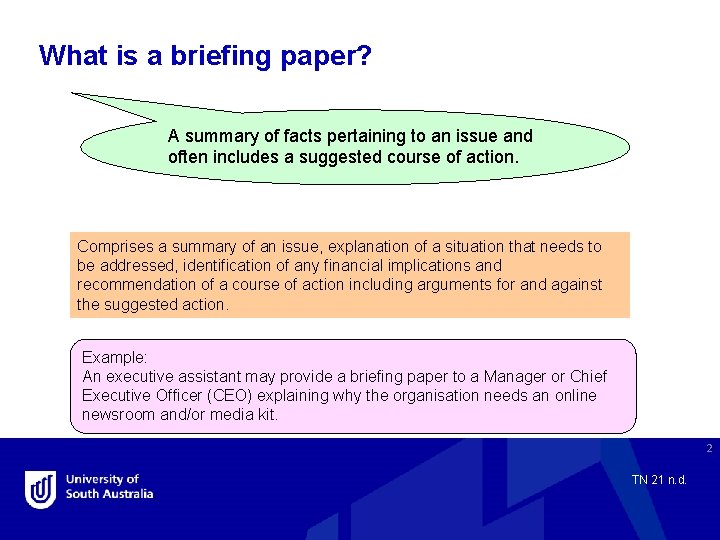
What is a briefing paper? A summary of facts pertaining to an issue and often includes a suggested course of action. Comprises a summary of an issue, explanation of a situation that needs to be addressed, identification of any financial implications and recommendation of a course of action including arguments for and against the suggested action. Example: An executive assistant may provide a briefing paper to a Manager or Chief Executive Officer (CEO) explaining why the organisation needs an online newsroom and/or media kit. 2 TN 21 n. d.
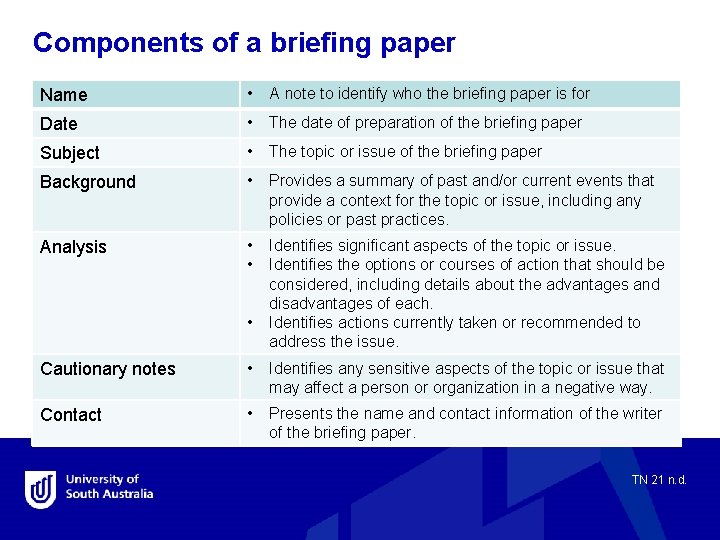
Components of a briefing paper Name • A note to identify who the briefing paper is for Date • The date of preparation of the briefing paper Subject • The topic or issue of the briefing paper Background • Provides a summary of past and/or current events that provide a context for the topic or issue, including any policies or past practices. Analysis • • Identifies significant aspects of the topic or issue. Identifies the options or courses of action that should be considered, including details about the advantages and disadvantages of each. Identifies actions currently taken or recommended to address the issue. • Cautionary notes • Identifies any sensitive aspects of the topic or issue that may affect a person or organization in a negative way. Contact • Presents the name and contact information of the writer of the briefing paper. TN 21 n. d.
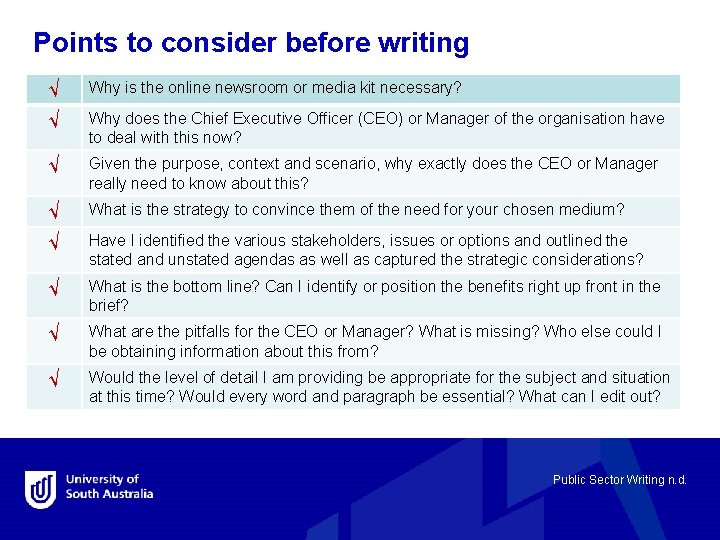
Points to consider before writing √ Why is the online newsroom or media kit necessary? √ Why does the Chief Executive Officer (CEO) or Manager of the organisation have to deal with this now? √ Given the purpose, context and scenario, why exactly does the CEO or Manager really need to know about this? √ What is the strategy to convince them of the need for your chosen medium? √ Have I identified the various stakeholders, issues or options and outlined the stated and unstated agendas as well as captured the strategic considerations? √ What is the bottom line? Can I identify or position the benefits right up front in the brief? √ What are the pitfalls for the CEO or Manager? What is missing? Who else could I be obtaining information about this from? √ Would the level of detail I am providing be appropriate for the subject and situation at this time? Would every word and paragraph be essential? What can I edit out? Public Sector Writing n. d.
Style and structure of a brief: The Opening The Purpose approach: Begin the brief with a clear statement identifying the purpose of the brief. Why is the CEO/Manager reading this? This is a preferred approach, particularly if you are presenting options and recommendation because you will be alerting the reader right up front that this is a ‘decision’ brief. or The Issues approach: You can just begin the brief with a clear and concise statement of the issue. This is a common format if, for example, the note will go into a briefing book along with other notes for a meeting or event where the purpose is defined somewhere else in the book. This format is not recommended if presenting options and recommendation. Public Sector Writing n. d.
Style and structure of a brief: The Body The Background section: Begins with the most recent developments (rather than a chronological ordering of events culminating in the issue of the day). The purpose is not so much to provide a chronology of events but to identify and frame issues and problems. The Current Situation section: Provides a snapshot of where we are right now (it is not a chronological story or a sequence of events). Key Considerations: Provides an outline of the variables to be taken into consideration regarding the issue. The various ‘advantages and disadvantages’ are presented. Conclusions or Next Steps (softer than recommendations): Presents the writer’s opinion or a conclusion that flows from the preceding sections, without necessarily offering a comprehensive or balanced case. Public Sector Writing n. d.
Style and structure of a brief: The Options and Recommendations Presents a more formal, balanced and objective presentation of the choices and preferred course of action. If the brief provides recommendations, they should be preceded by an options section outlining the pros and cons of each option with one or more of this becoming the recommendations. Public Sector Writing n. d.
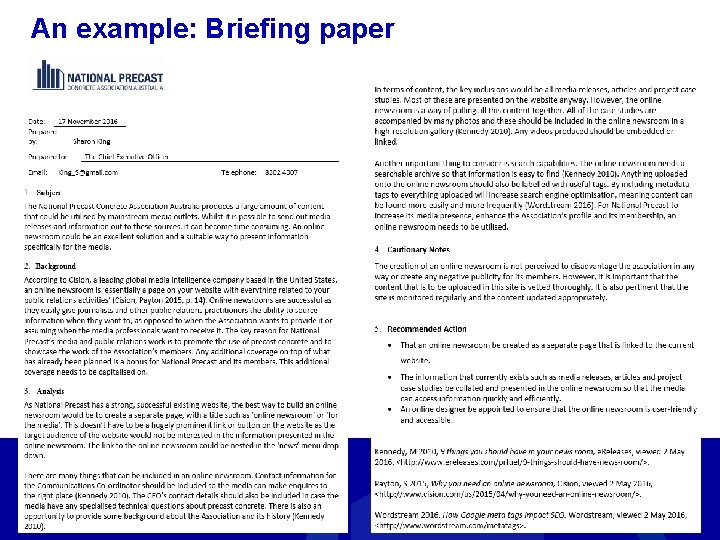
An example: Briefing paper
Reference Public sector writing n. d. , ‘How to write briefing notes’, viewed 17 November 2016, <http: //www. publicsectorwriting. com/? page_id=6>. TN 21 n. d. , ‘Developing a briefing paper’, viewed 17 November 2016, <www. edu. gov. mb. ca/k 12/cur/socstud/frame_found_sr 2/tns/tn-21. pdf>.
- Slides: 9