
How to Write A Primer on Effective Writing
- Slides: 26
How to Write A Primer on Effective Writing
General Approach Goals should be Clarity, Concision, and Coherence. We will work on these all year… Clarity: the quality of being clear Good grammar – complete, clear sentences, free from awkward phrasing or errors. Active Language – avoid linking verbs when possible, avoid passive sentences. Clear ideas – fuzzy, inexact, half-thought ideas result in fuzzy, inexact, throw-away sentences. Specific Language – take the time to find the EXACT word, not just close enough. Clean document – MLA format; no wrinkles, tears, smudges, etc. ; legible handwriting.
General Approach "Don't use any extra words. A sentence is like a machine; it has a job to do. An extra word in a sentence is like a sock in a machine. “ Annie Dillard, "Notes for Young Writers. " Concision: the quality of using the fewest words to say the most. Better writing is concise. It expresses complex ideas with fewer words. Concise writing does not use filler words and sentences to make it look longer, but makes an essay longer by adding more ideas, not repeating the same ideas again. Eliminate “warming up” phrases like “My opinion is…” or “The fact of the matter is that…” or “The point I wish to make is…” or “The reason is because…” Eliminate “very”, “really”, or other intensifiers and replace with better descriptor. For instance: “The fact of the matter is that the really stupid rabbit was also very hungry” should turn in to “The idiotic rabbit was also famished. ”
General Approach Coherence: the quality of “sticking together” or creating a unified whole. Stay on the main point (the thesis, in an essay) Paragraph topic sentences should relate directly to thesis. Examples and details should be connected directly to the topic sentences. Organize writing according to purpose. Have a plan.
MLA Format Use MLA Format for all written assignments (including homework and classwork) See Writing Guidelines handout for details regarding… Headings Font Margins Use of complete sentences (always, unless told otherwise)
Integrating Textual References 3 Ways: Summarize, Paraphrase, Quote Summary: explains the main idea of a long passage. Paraphrase: restates a short passage in other words. Quote: recounts the exact words from a passage. ALL uses of an outside text require attribution In MLA, this attribution is accomplished through parenthetical documentation.
Integrating Quotations Quoting selectively: after you have decided that you do want to use material in quoted form, quote only the portions of the text specifically relevant to your point. Think of the text in terms of units– words, phrases, sentences, and groups of sentences (paragraphs, stanzas)--and use only the units you need. If it is particular words or phrases that "prove" your point, you do not need to quote the sentences they appear in; rather, incorporate the words and phrases into sentences expressing your own ideas.
Integrating Quotations A. An introducing phrase or orienter plus the quotation: In this poem it is creation, not a hypothetical creator, that is supremely awesome. [argument sentence] The speaker asks, "What immortal hand or eye / Dare frame thy fearful symmetry? ” [orienter before quote] Gatsby is not to be regarded as a personal failure. [argument sentence] "Gatsby turned out all right at the end" (176), according to Nick. [orienter after quote] "I know you blame me, " Mrs. Compson tells Jason (47). [orienter after quote] Is she expressing her own sense of guilt? [argument sentence]
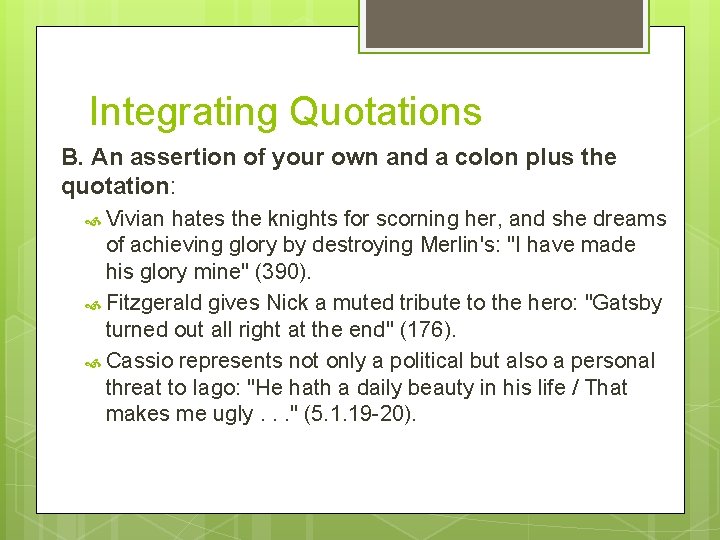
Integrating Quotations B. An assertion of your own and a colon plus the quotation: Vivian hates the knights for scorning her, and she dreams of achieving glory by destroying Merlin's: "I have made his glory mine" (390). Fitzgerald gives Nick a muted tribute to the hero: "Gatsby turned out all right at the end" (176). Cassio represents not only a political but also a personal threat to Iago: "He hath a daily beauty in his life / That makes me ugly. . . " (5. 1. 19 -20).
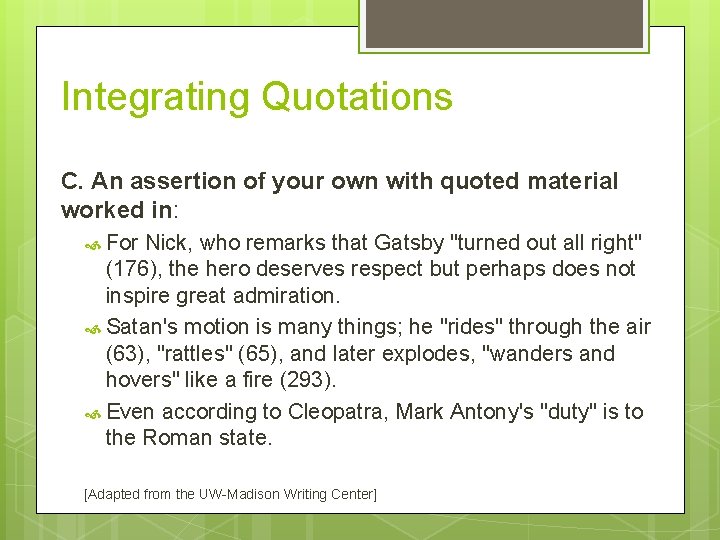
Integrating Quotations C. An assertion of your own with quoted material worked in: For Nick, who remarks that Gatsby "turned out all right" (176), the hero deserves respect but perhaps does not inspire great admiration. Satan's motion is many things; he "rides" through the air (63), "rattles" (65), and later explodes, "wanders and hovers" like a fire (293). Even according to Cleopatra, Mark Antony's "duty" is to the Roman state. [Adapted from the UW-Madison Writing Center]
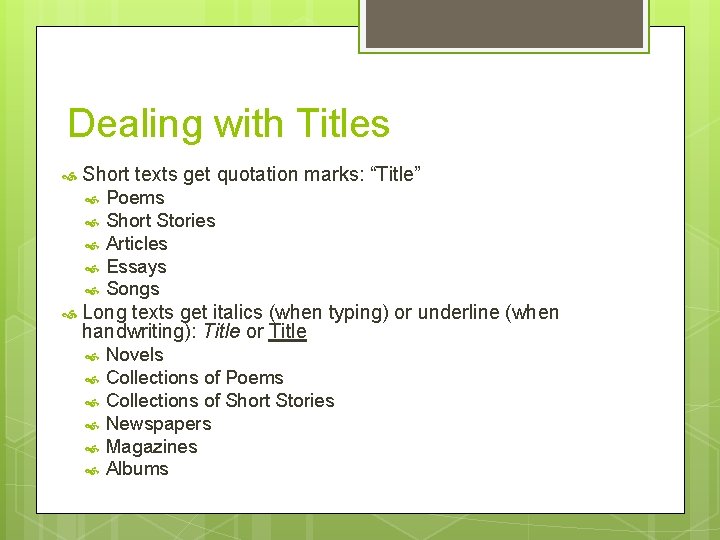
Dealing with Titles Short texts get quotation marks: “Title” Poems Short Stories Articles Essays Songs Long texts get italics (when typing) or underline (when handwriting): Title or Title Novels Collections of Poems Collections of Short Stories Newspapers Magazines Albums
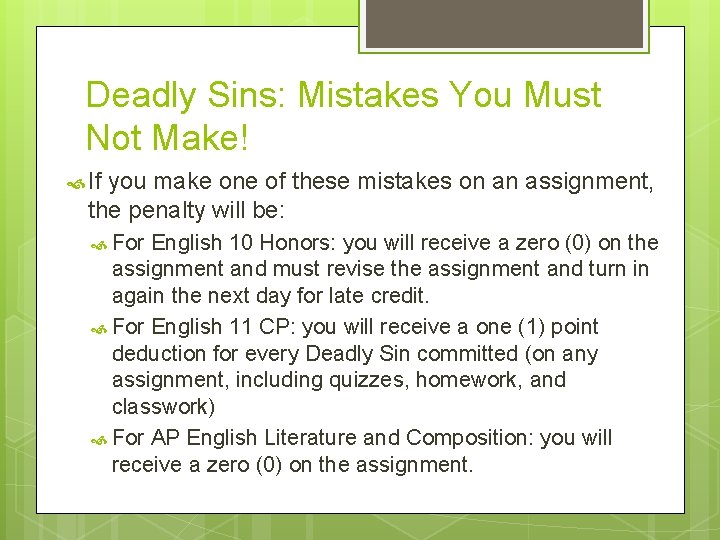
Deadly Sins: Mistakes You Must Not Make! If you make one of these mistakes on an assignment, the penalty will be: For English 10 Honors: you will receive a zero (0) on the assignment and must revise the assignment and turn in again the next day for late credit. For English 11 CP: you will receive a one (1) point deduction for every Deadly Sin committed (on any assignment, including quizzes, homework, and classwork) For AP English Literature and Composition: you will receive a zero (0) on the assignment.
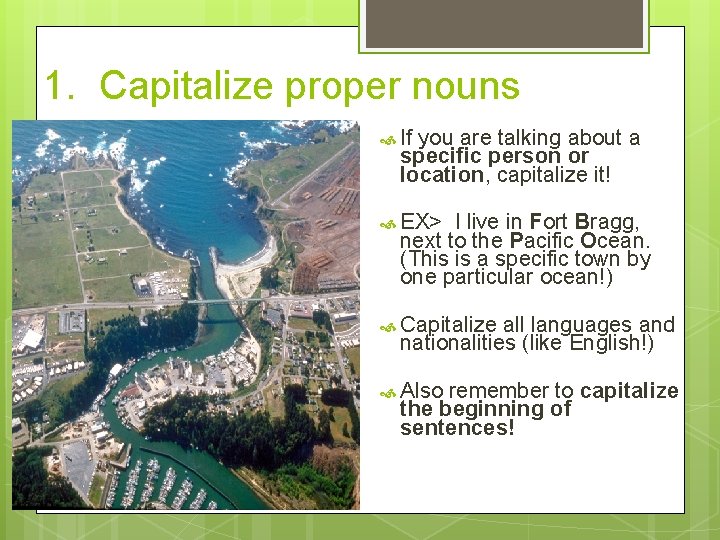
1. Capitalize proper nouns If you are talking about a specific person or location, capitalize it! EX> I live in Fort Bragg, next to the Pacific Ocean. (This is a specific town by one particular ocean!) Capitalize all languages and nationalities (like English!) Also remember to capitalize the beginning of sentences!
2. Use apostrophes with contractions Did not = didn’t The apostrophe MUST appear exactly where the letters are omitted O’clock = on the clock, so the apostrophe replaces n, t, h, AND e!
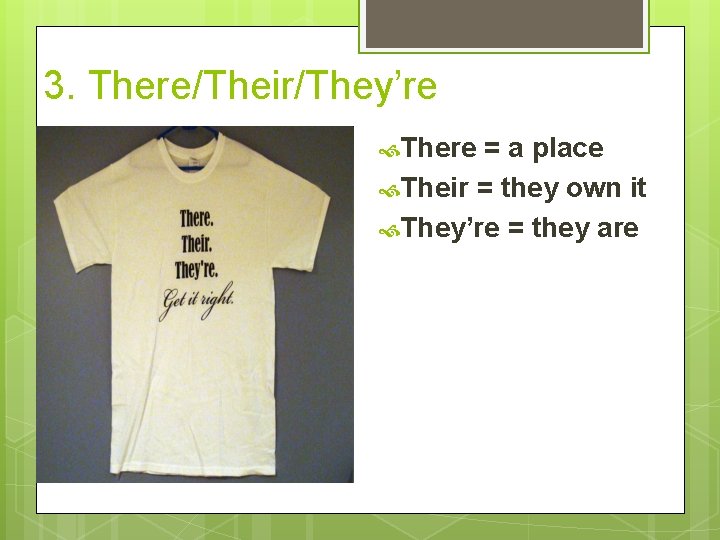
3. There/Their/They’re There = a place Their = they own it They’re = they are
4. Its, it’s It’s = contraction: it + is = it’s Its = possessive, showing ownership or belonging. Ex: It’s good to be alive. Ex: The bird built its nest. It’s not a very big one.
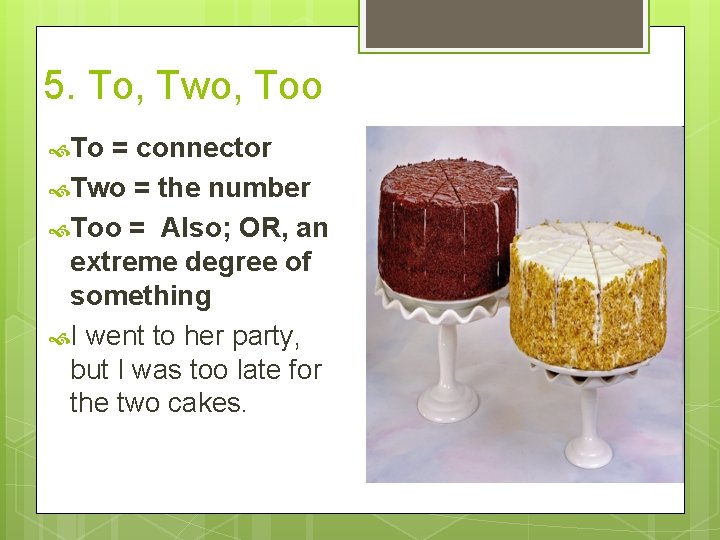
5. To, Two, Too To = connector Two = the number Too = Also; OR, an extreme degree of something I went to her party, but I was too late for the two cakes.
6. A LOT = 2 words! TWO WORDS, not ONE!! “There’s a lot of noise in the cafeteria. They’re testing their emergency system. ” However, you should probably never use it anyway – it’s a weak phrase.
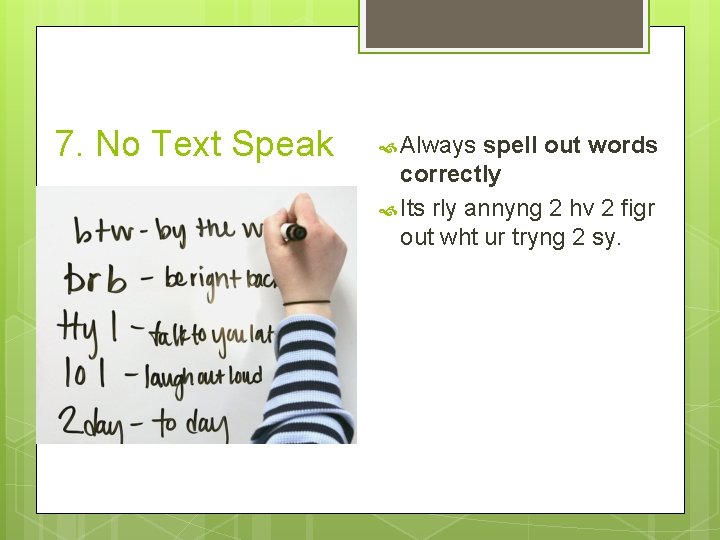
7. No Text Speak Always spell out words correctly Its rly annyng 2 hv 2 figr out wht ur tryng 2 sy.
8. More commonly confused words: (NEVER would of or woulda) double the consonant first) Could have / could’ve cause (means to make something happen) / (Never could of or coulda) ‘cause (short for Should have / should’ve “because”) (Never should of or Never “cuz” shoulda) college (there are no “a’s” in know / now college; NOT colledge) English (always capitalize all no one (is always two words) nationalities and languages) opinion (no ‘a’ in opinion) feel / fill / fell probably (NOT prolly, NOT probly) beginning (begin + ing, would have / would’ve
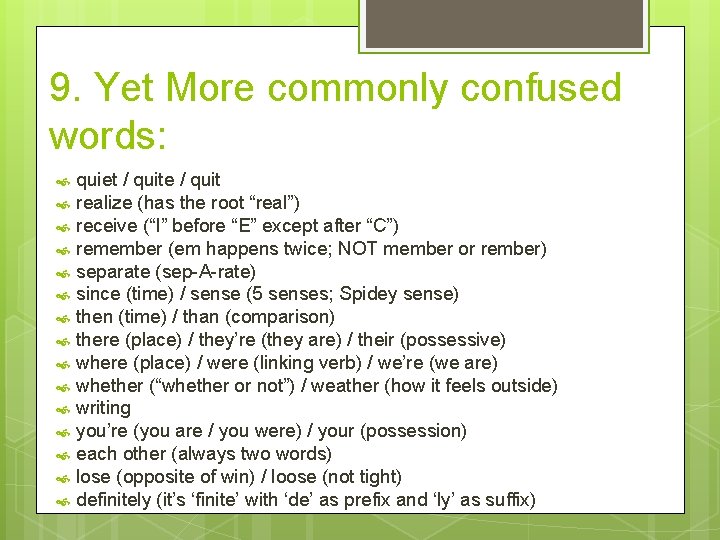
9. Yet More commonly confused words: quiet / quite / quit realize (has the root “real”) receive (“I” before “E” except after “C”) remember (em happens twice; NOT member or rember) separate (sep-A-rate) since (time) / sense (5 senses; Spidey sense) then (time) / than (comparison) there (place) / they’re (they are) / their (possessive) where (place) / were (linking verb) / we’re (we are) whether (“whether or not”) / weather (how it feels outside) writing you’re (you are / you were) / your (possession) each other (always two words) lose (opposite of win) / loose (not tight) definitely (it’s ‘finite’ with ‘de’ as prefix and ‘ly’ as suffix)
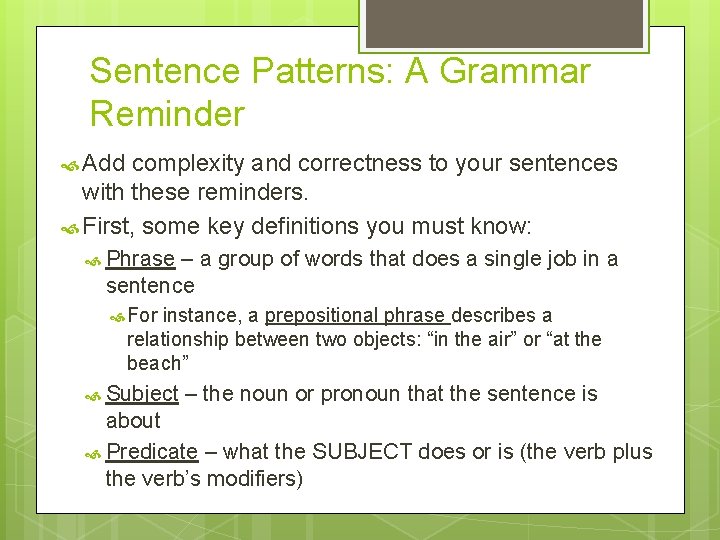
Sentence Patterns: A Grammar Reminder Add complexity and correctness to your sentences with these reminders. First, some key definitions you must know: Phrase – a group of words that does a single job in a sentence For instance, a prepositional phrase describes a relationship between two objects: “in the air” or “at the beach” Subject – the noun or pronoun that the sentence is about Predicate – what the SUBJECT does or is (the verb plus the verb’s modifiers)
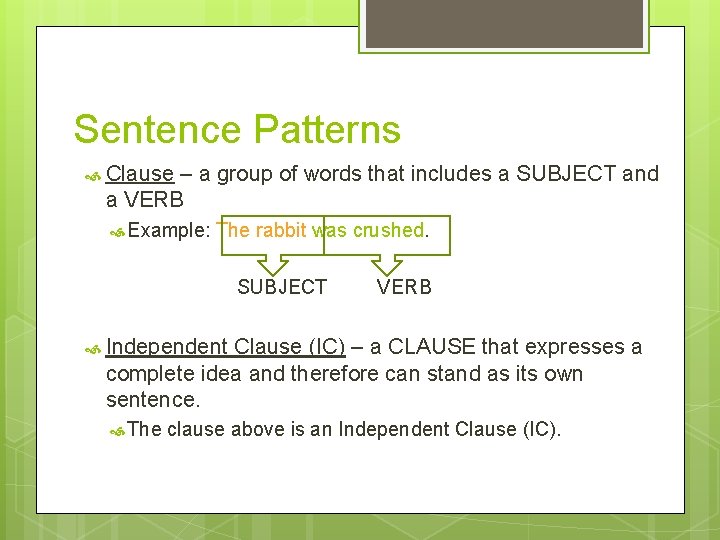
Sentence Patterns Clause – a group of words that includes a SUBJECT and a VERB Example: The rabbit was crushed. SUBJECT VERB Independent Clause (IC) – a CLAUSE that expresses a complete idea and therefore can stand as its own sentence. The clause above is an Independent Clause (IC).
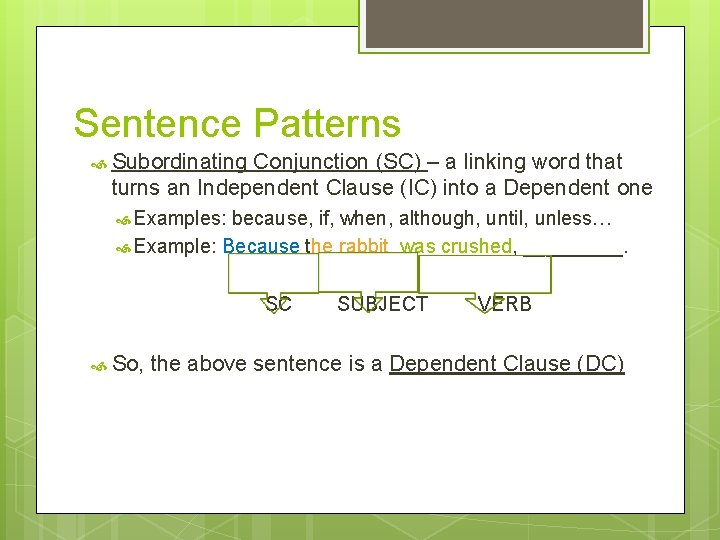
Sentence Patterns Subordinating Conjunction (SC) – a linking word that turns an Independent Clause (IC) into a Dependent one Examples: because, if, when, although, until, unless… Example: Because the rabbit was crushed, _____. SC SUBJECT VERB So, the above sentence is a Dependent Clause (DC)
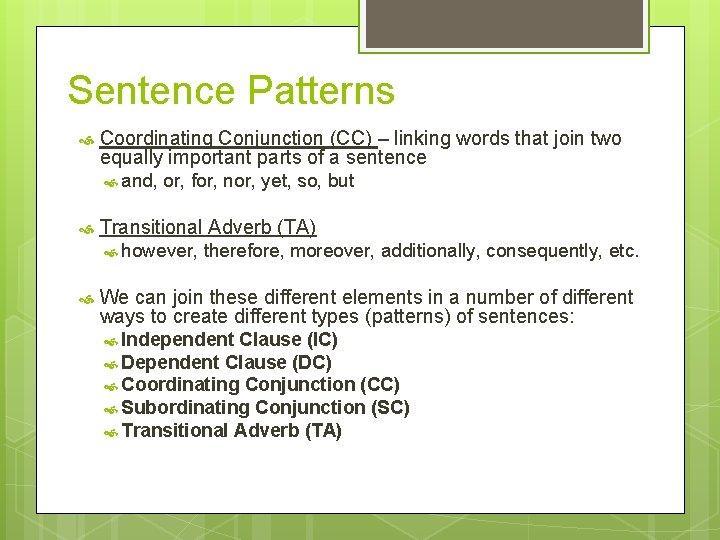
Sentence Patterns Coordinating Conjunction (CC) – linking words that join two equally important parts of a sentence and, or, for, nor, yet, so, but Transitional Adverb (TA) however, therefore, moreover, additionally, consequently, etc. We can join these different elements in a number of different ways to create different types (patterns) of sentences: Independent Clause (IC) Dependent Clause (DC) Coordinating Conjunction (CC) Subordinating Conjunction (SC) Transitional Adverb (TA)
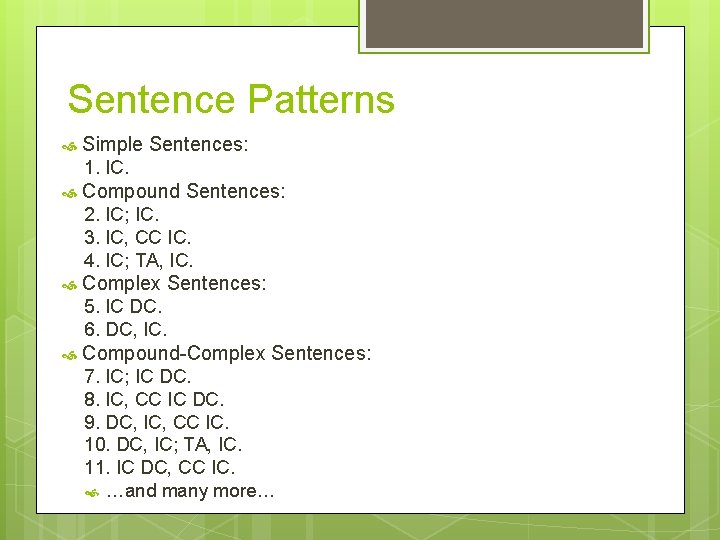
Sentence Patterns Simple Sentences: 1. IC. Compound Sentences: 2. IC; IC. 3. IC, CC IC. 4. IC; TA, IC. Complex Sentences: 5. IC DC. 6. DC, IC. Compound-Complex Sentences: 7. IC; IC DC. 8. IC, CC IC DC. 9. DC, IC, CC IC. 10. DC, IC; TA, IC. 11. IC DC, CC IC. …and many more…