
How to write a journal By Dr H
How to write a journal By Dr. H. Zainudin bin H. Hassan Faculty of Social Science and Humanity School of Education Universiti Teknologi Malaysia 81310 Johor Bahru,
Why publish? Publishing is one of the necessary steps embedded in the scientific research process. It is also necessary for graduation and career progression. What to publish: • New and original results or methods • Reviews or summaries of particular subject • Manuscripts that advance the knowledge and understanding in a certain scientific field What NOT to publish: • • Reports of no scientific interest Out of date work Duplications of previously published work Incorrect/unacceptable conclusions You need a STRONG manuscript to present your contributions to the scientific community
WHY? • Requirement for graduation • • Requirement for promotion • • To get reward/award • • To be recognized • • To disseminate knowledge
Always keep in mind that … …. your paper is your passport to your community !
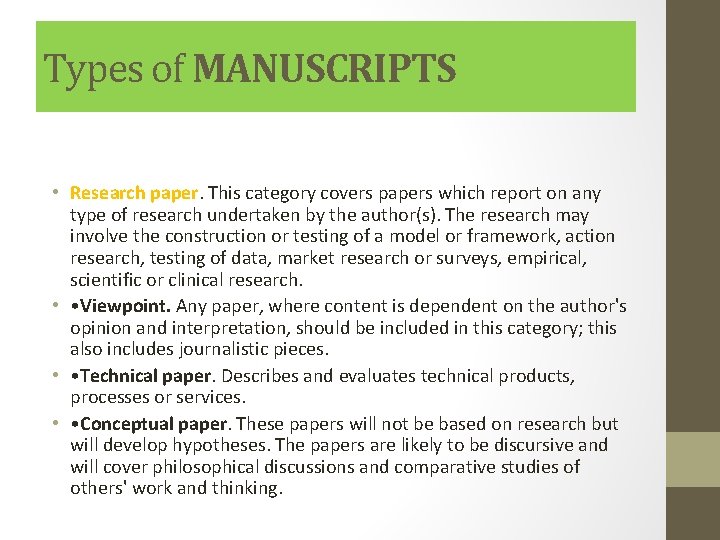
Types of MANUSCRIPTS • Research paper. This category covers papers which report on any type of research undertaken by the author(s). The research may involve the construction or testing of a model or framework, action research, testing of data, market research or surveys, empirical, scientific or clinical research. • • Viewpoint. Any paper, where content is dependent on the author's opinion and interpretation, should be included in this category; this also includes journalistic pieces. • • Technical paper. Describes and evaluates technical products, processes or services. • • Conceptual paper. These papers will not be based on research but will develop hypotheses. The papers are likely to be discursive and will cover philosophical discussions and comparative studies of others' work and thinking.
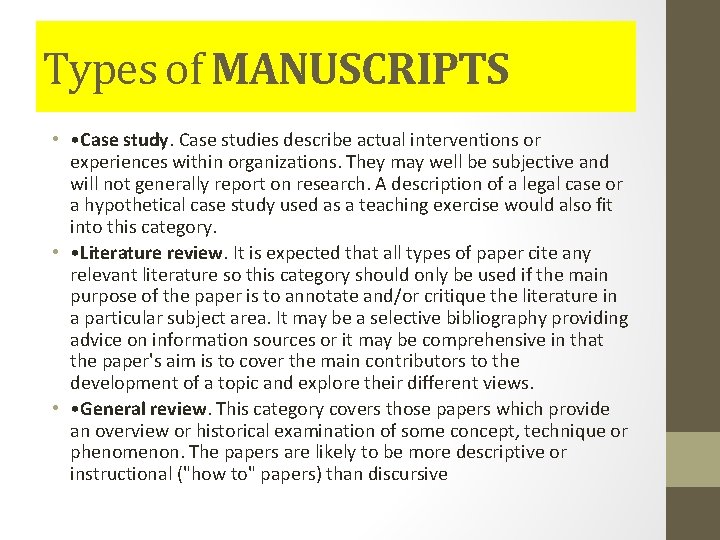
Types of MANUSCRIPTS • • Case study. Case studies describe actual interventions or experiences within organizations. They may well be subjective and will not generally report on research. A description of a legal case or a hypothetical case study used as a teaching exercise would also fit into this category. • • Literature review. It is expected that all types of paper cite any relevant literature so this category should only be used if the main purpose of the paper is to annotate and/or critique the literature in a particular subject area. It may be a selective bibliography providing advice on information sources or it may be comprehensive in that the paper's aim is to cover the main contributors to the development of a topic and explore their different views. • • General review. This category covers those papers which provide an overview or historical examination of some concept, technique or phenomenon. The papers are likely to be more descriptive or instructional ("how to" papers) than discursive
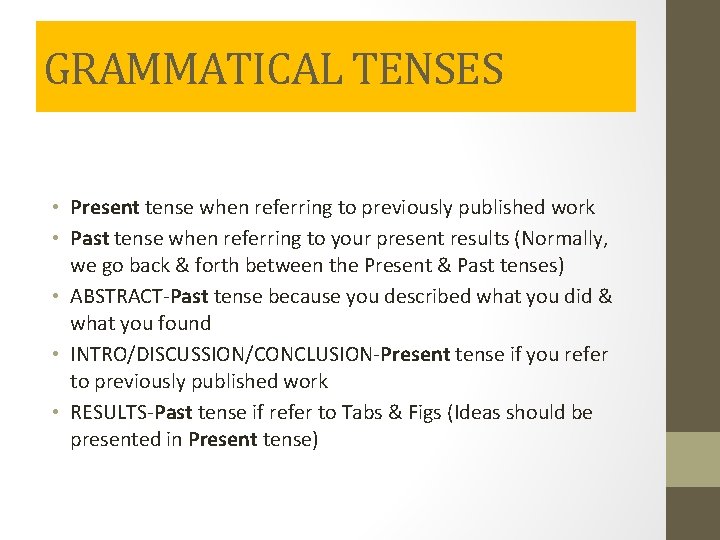
GRAMMATICAL TENSES • Present tense when referring to previously published work • Past tense when referring to your present results (Normally, we go back & forth between the Present & Past tenses) • ABSTRACT-Past tense because you described what you did & what you found • INTRO/DISCUSSION/CONCLUSION-Present tense if you refer to previously published work • RESULTS-Past tense if refer to Tabs & Figs (Ideas should be presented in Present tense)

Scientific Language – Overview • Write with clarity, objectivity, accuracy, and brevity. • Key to successful scientific writing is to be alert for common errors: • Sentence construction • Incorrect tenses • Inaccurate grammar • Not using English • Check the Guide for Authors of the target journal for language specifications
Scientific Language – Sentences • Write direct and short sentences • One idea or piece of information per sentence is sufficient • Avoid multiple statements in one sentence
TWO RULES APPLY • When a scientific paper has been validly published in a primary journal, it becomes knowledge • Therefore, whenever you cite previously established work, ethics requires you to treat the work with respect – you therefore use the present tense. • Your own present work is not presumed to be established knowledge until after it has been validly published. You therefore refer to it in the past tense.

Aktiviti Kumpulan Apa masalah ? Nggak ada waktu! Di mana mahu mula? Nggak punya bahan, Bingung mau nulis apa! Apa strategi? Sudah punya bahan, tapi gimana ‘ngomongnya’?
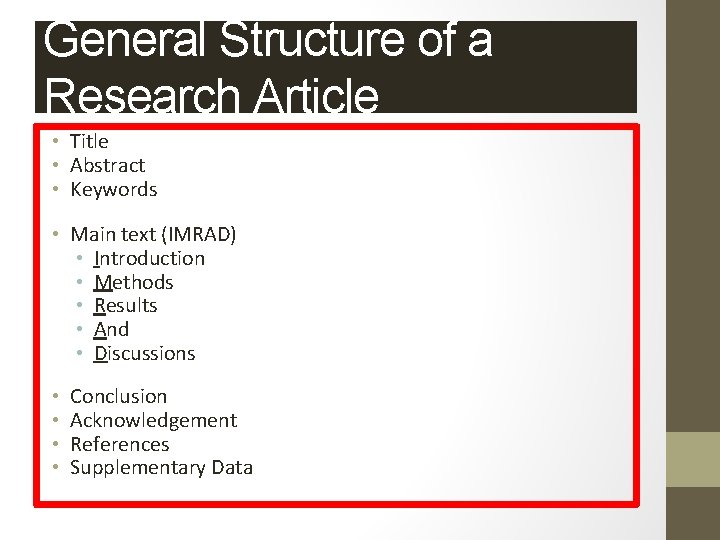
General Structure of a Research Article • Title • Abstract • Keywords • Main text (IMRAD) • Introduction • Methods • Results • And • Discussions • • Conclusion Acknowledgement References Supplementary Data
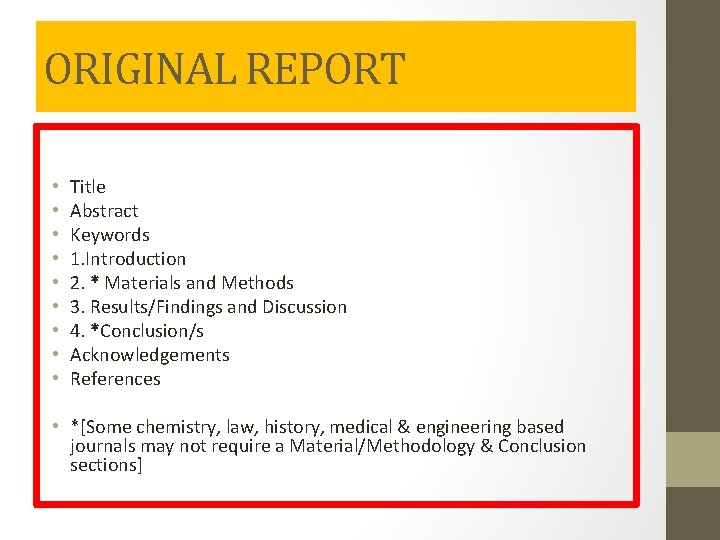
ORIGINAL REPORT • • • Title Abstract Keywords 1. Introduction 2. * Materials and Methods 3. Results/Findings and Discussion 4. *Conclusion/s Acknowledgements References • *[Some chemistry, law, history, medical & engineering based journals may not require a Material/Methodology & Conclusion sections]
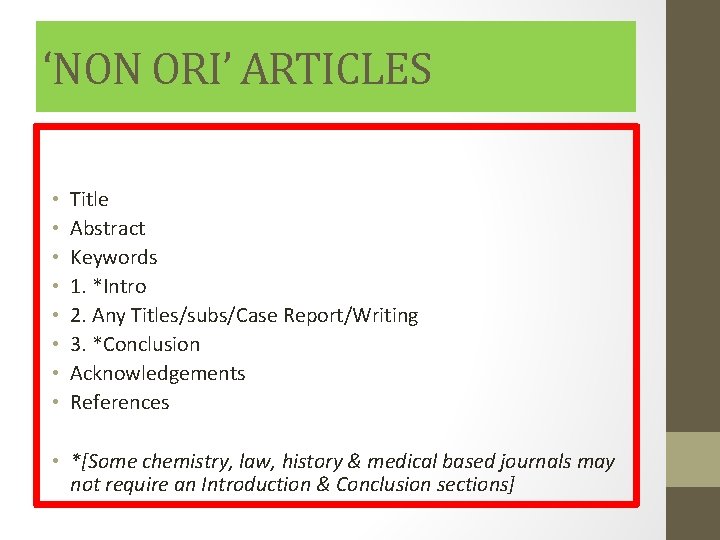
‘NON ORI’ ARTICLES • • Title Abstract Keywords 1. *Intro 2. Any Titles/subs/Case Report/Writing 3. *Conclusion Acknowledgements References • *[Some chemistry, law, history & medical based journals may not require an Introduction & Conclusion sections]
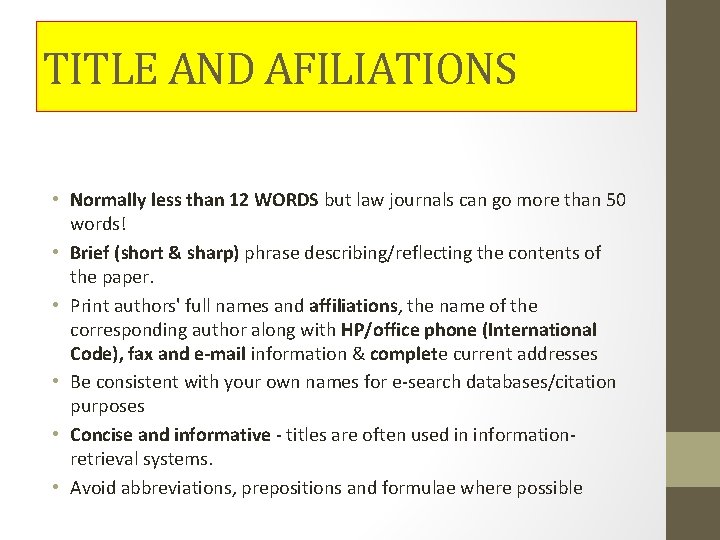
TITLE AND AFILIATIONS • Normally less than 12 WORDS but law journals can go more than 50 words! • Brief (short & sharp) phrase describing/reflecting the contents of the paper. • Print authors' full names and affiliations, the name of the corresponding author along with HP/office phone (International Code), fax and e-mail information & complete current addresses • Be consistent with your own names for e-search databases/citation purposes • Concise and informative - titles are often used in informationretrieval systems. • Avoid abbreviations, prepositions and formulae where possible
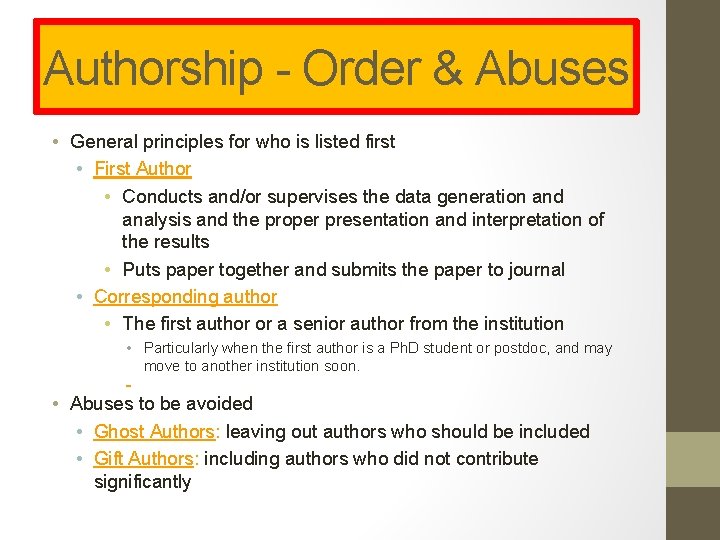
Authorship - Order & Abuses • General principles for who is listed first • First Author • Conducts and/or supervises the data generation and analysis and the proper presentation and interpretation of the results • Puts paper together and submits the paper to journal • Corresponding author • The first author or a senior author from the institution • Particularly when the first author is a Ph. D student or postdoc, and may move to another institution soon. • Abuses to be avoided • Ghost Authors: leaving out authors who should be included • Gift Authors: including authors who did not contribute significantly
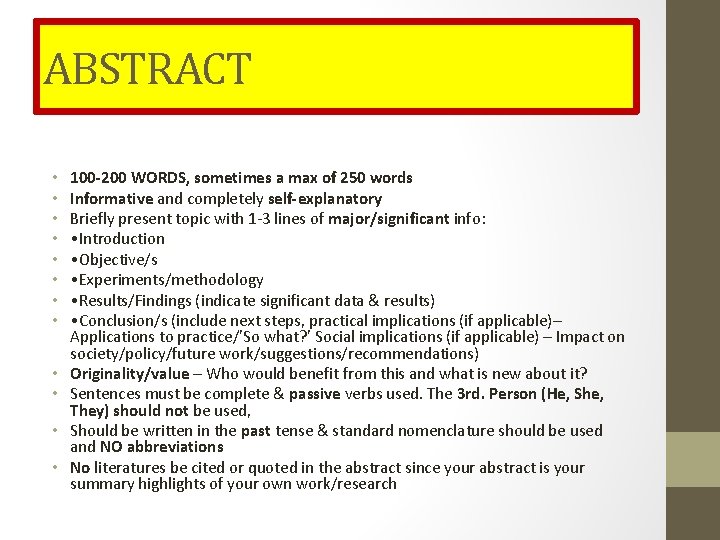
ABSTRACT • • • 100 -200 WORDS, sometimes a max of 250 words Informative and completely self-explanatory Briefly present topic with 1 -3 lines of major/significant info: • Introduction • Objective/s • Experiments/methodology • Results/Findings (indicate significant data & results) • Conclusion/s (include next steps, practical implications (if applicable)– Applications to practice/’So what? ’ Social implications (if applicable) – Impact on society/policy/future work/suggestions/recommendations) Originality/value – Who would benefit from this and what is new about it? Sentences must be complete & passive verbs used. The 3 rd. Person (He, She, They) should not be used, Should be written in the past tense & standard nomenclature should be used and NO abbreviations No literatures be cited or quoted in the abstract since your abstract is your summary highlights of your own work/research
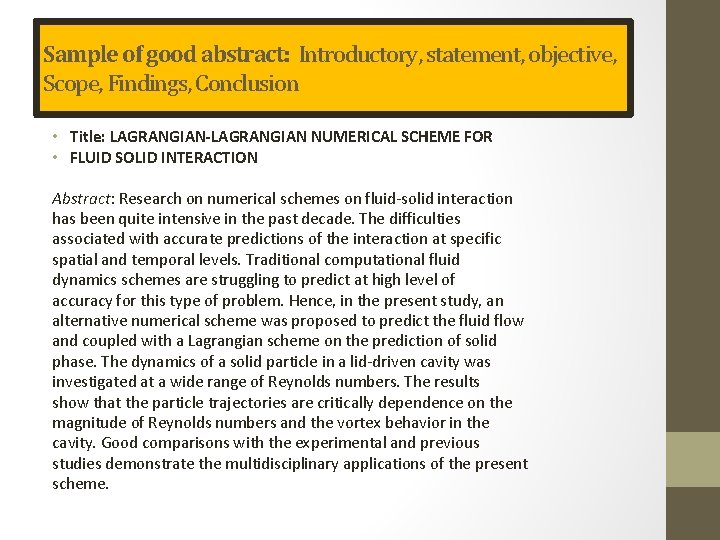
Sample of good abstract: Introductory, statement, objective, Scope, Findings, Conclusion • Title: LAGRANGIAN-LAGRANGIAN NUMERICAL SCHEME FOR • FLUID SOLID INTERACTION Abstract: Research on numerical schemes on fluid-solid interaction has been quite intensive in the past decade. The difficulties associated with accurate predictions of the interaction at specific spatial and temporal levels. Traditional computational fluid dynamics schemes are struggling to predict at high level of accuracy for this type of problem. Hence, in the present study, an alternative numerical scheme was proposed to predict the fluid flow and coupled with a Lagrangian scheme on the prediction of solid phase. The dynamics of a solid particle in a lid-driven cavity was investigated at a wide range of Reynolds numbers. The results show that the particle trajectories are critically dependence on the magnitude of Reynolds numbers and the vortex behavior in the cavity. Good comparisons with the experimental and previous studies demonstrate the multidisciplinary applications of the present scheme.
KEYWORDS • Usually 3 -8 WORDS (preferably five words) • For the purpose of indexing/references. i. e to enable searches in databases, include all the keywords of your research • NOT necessarily represent all the words in your title • Some journals, esp. submission through Scholar. One Manuscript Central already specified the keywords in a particular chosen field • Try to avoid abbreviations except standard ones
INTRODUCTION • Normally 1 -1. 5 PAGE but more with business/management papers • Should provide a clear statement of the problem, the relevant literature on the subject, and the proposed gap/approach or solution in present tense • Lays the overview/groundwork for why the paper that follows is important-often includes the definition of relevant terms, a literature review, any hypotheses, and how this paper differs from other studies or papers on this topic • Provides insights to the current or past problem • It should be understandable to colleagues from a broad range of scientific disciplines. • Should cite 10 -15 REFS with most current literatures of 1 -3 years back from the year of submission. Eg. 2011 submission must have 2010, 2009 & 2008 refs although your research has been conducted 5 years ago. • May include research questions & justifications of study • Outline how your work adds to knowledge/fills the gap • Objective must appear in the last paragraph
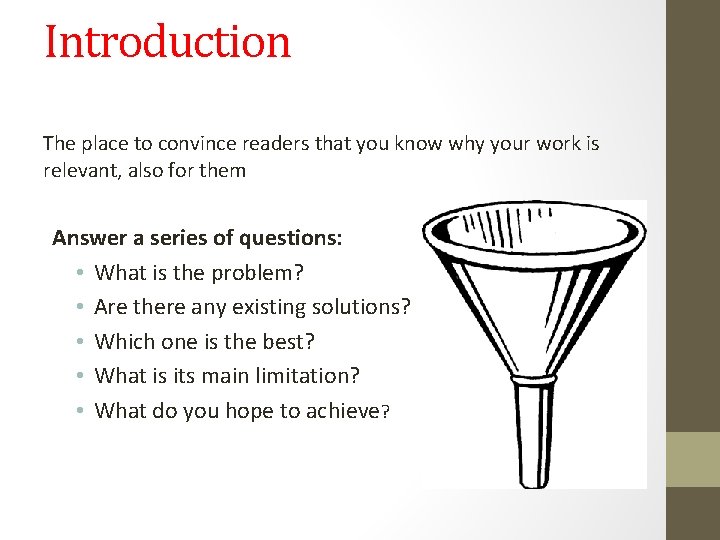
Introduction The place to convince readers that you know why your work is relevant, also for them Answer a series of questions: • What is the problem? • Are there any existing solutions? • Which one is the best? • What is its main limitation? • What do you hope to achieve?

Pay attention to the following • Before you present your new data, put them into perspective first • Be brief, it is not a history lesson • Do not mix introduction, results, discussion and conclusions. Keep them separate • Do not overuse expressions such as “novel”, “first time”, “first ever”, “paradigm shift”, etc. • Cite only relevant references • Otherwise the editor and the reviewer may think you don’t have a clue where you are writing about
METHODS AND MATERIALS • NO LIMITED PAGE • Should be complete enough to allow experiments to be replicated or reproduced. • Only truly new procedures should be described in detail • Previously published procedures should be cited, and important modifications of published procedures should be mentioned briefly • Capitalize trade names and include the manufacturer's name and address (if applicable) • Subheadings should be used & consistent with the order of methodology • Methods in general use need not be described in detail • Explain why you selected the sample & group you did/participants • Other previous relevant research must be presented adequately • Why did you use a particular questionnaire/instrumentation & why was it selected? What is its validity? Describe the measure you used • Why did you use a four or five scale Likert questionnaire?
Results – what have you found? • The following should be included • the main findings • Thus not all findings • Findings from experiments described in the Methods section • Highlight findings that differ from findings in previous publications, and unexpected findings • Results of the statistical analysis
RESULTS AND DISCUSSIONS • Clarity & Precision • In-line/in order with your Methodology (in past tense) • Explain & discuss why you get such results-may cite previous refs for comparisons. Be Crisp! • Better illustrated with Charts/Graphics/Tables (Charts/Graphs Preferable than Tables) • All Figures & Tables must be referred to as close as possible in Text (Past tense when describing findings in the authors' experiments; Previously published findings should be written in the present tense) • Be explained, but largely without referring to the literature, compared & discussed with previous literatures
Results – Figures and tables • Illustrations are critical, because • Figures and tables are the most efficient way to present results • Results are the driving force of the publication • “One Picture is Worth a Thousand Words" • Sue Hanauer (1968)
Results – Appearance counts! § Un-crowded plots Ø 3 or 4 data sets per figure; well-selected scales; appropriate axis label size; symbols clear to read; data sets easily distinguishable. § Each photograph must have a scale marker of professional quality in a corner. § Text in photos / figures in English Ø Not in French, German, Chinese, . . . § Use color ONLY when necessary. Ø If different line styles can clarify the meaning, then never use colors or other thrilling effects. § Color must be visible and distinguishable when printed in black & white. § Do not include long boring tables
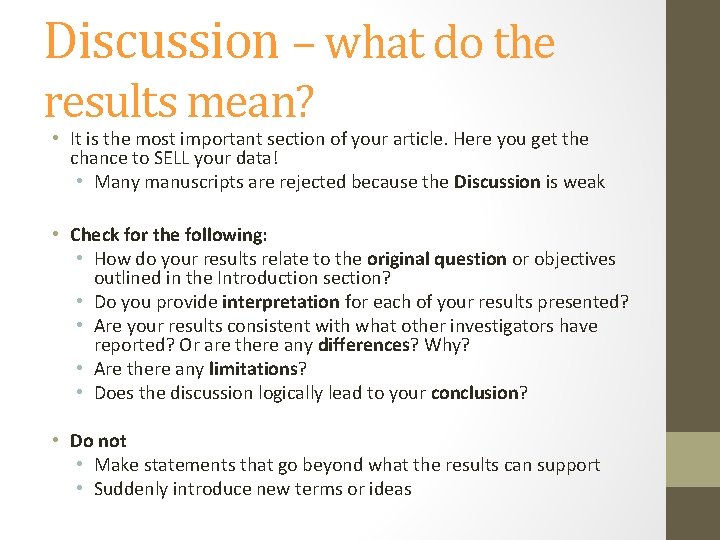
Discussion – what do the results mean? • It is the most important section of your article. Here you get the chance to SELL your data! • Many manuscripts are rejected because the Discussion is weak • Check for the following: • How do your results relate to the original question or objectives outlined in the Introduction section? • Do you provide interpretation for each of your results presented? • Are your results consistent with what other investigators have reported? Or are there any differences? Why? • Are there any limitations? • Does the discussion logically lead to your conclusion? • Do not • Make statements that go beyond what the results can support • Suddenly introduce new terms or ideas
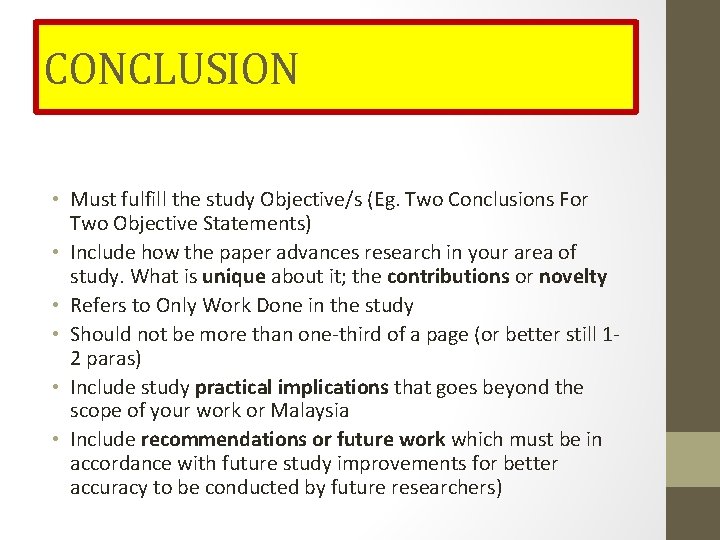
CONCLUSION • Must fulfill the study Objective/s (Eg. Two Conclusions For Two Objective Statements) • Include how the paper advances research in your area of study. What is unique about it; the contributions or novelty • Refers to Only Work Done in the study • Should not be more than one-third of a page (or better still 12 paras) • Include study practical implications that goes beyond the scope of your work or Malaysia • Include recommendations or future work which must be in accordance with future study improvements for better accuracy to be conducted by future researchers)
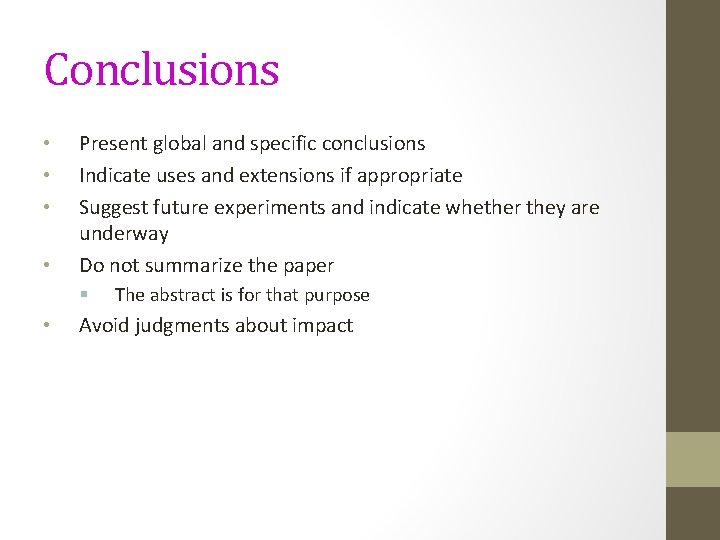
Conclusions • • Present global and specific conclusions Indicate uses and extensions if appropriate Suggest future experiments and indicate whether they are underway Do not summarize the paper § • The abstract is for that purpose Avoid judgments about impact
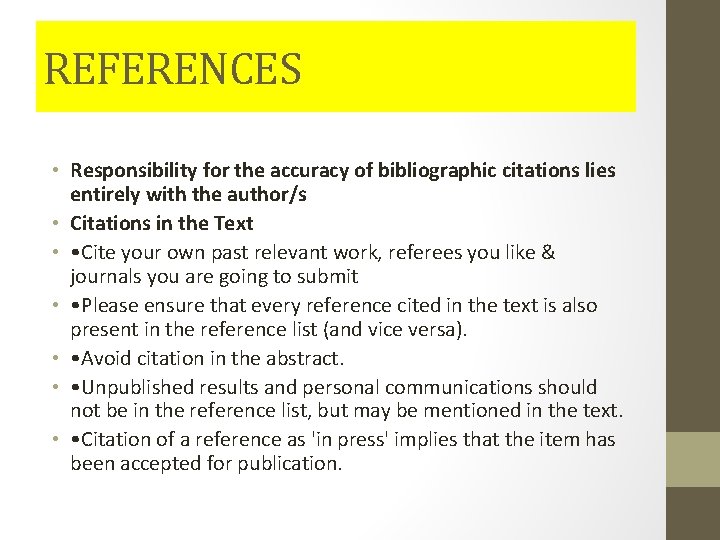
REFERENCES • Responsibility for the accuracy of bibliographic citations lies entirely with the author/s • Citations in the Text • • Cite your own past relevant work, referees you like & journals you are going to submit • • Please ensure that every reference cited in the text is also present in the reference list (and vice versa). • • Avoid citation in the abstract. • • Unpublished results and personal communications should not be in the reference list, but may be mentioned in the text. • • Citation of a reference as 'in press' implies that the item has been accepted for publication.
REFERENCES • Citing and Listing of Web References • • As a minimum, the full URL should be given. • • Any further information, if known (author names, dates, reference to a source publication, etc. ), should also be given. • • Web references can be listed separately (e. g. , after the reference list) under a different heading if desired, or can be included in the reference list, pending on journal’s instructions to authors/guidelines • • Don’t forget to print the access/retrieval date
REFERENCES • Text • • Citations in the text should follow the referencing style used by the American Psychological Association (APA). , Chicago or Harvard styles • • You can refer to the Publication Manual of the American Psychological Association, Fifth Edition, ISBN 1 -55798 -790 -4, copies of which may be ordered from http: //www. apa. org/books/4200061. html or APA Order Dept. , P. O. B. 2710, Hyattsville, MD 20784, USA or APA, 3 Henrietta Street, London, WC 3 E 8 LU, UK. • • Details concerning this referencing style can be found at http: //humanities. byu. edu/linguistics/Henrichsen/APA 01. html.
REFERENCES • Listing of Authors • • References should be arranged first alphabetically and then further sorted chronologically, if necessary or using numbers in order • • More than one reference from the same author(s) in the same year must be identified by the letters "a", "b", "c", etc. , placed after the year of publication. • • If >= to 3 authors, use et. al. & italicize in the text but full listing in the References list • • Jusoff, K or K. Jusoff or Kamaruzaman Jusoff?

References: get them right! • Please adhere to the Guide for Authors of the journal • It is your responsibility, not of the Editor’s, to format references correctly! • Check • Referencing style of the journal • The spelling of author names, the year of publication • Punctuation use • Use of “et al. ”: “et al. ” translates to “and others”, • Avoid citing the following if possible: • Personal communications, unpublished observations, manuscripts not yet accepted for publication • Editors may ask for such documents for evaluation of the manuscripts • Articles published only in the local language, which are difficult for international readers to find
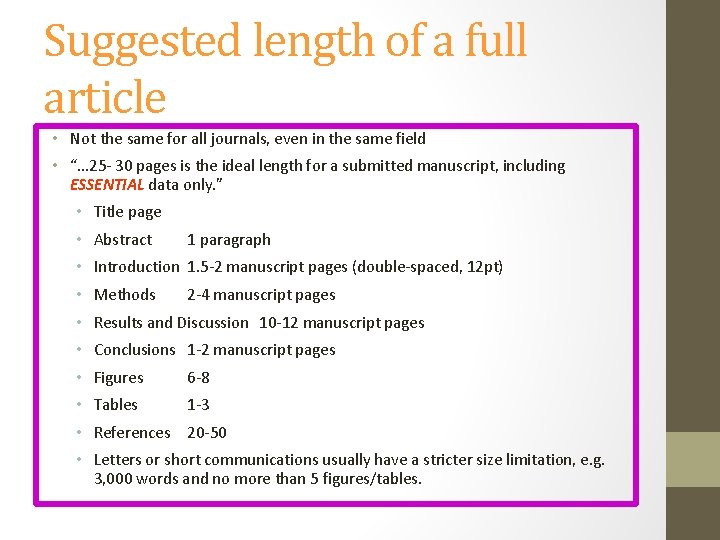
Suggested length of a full article • Not the same for all journals, even in the same field • “… 25 - 30 pages is the ideal length for a submitted manuscript, including ESSENTIAL data only. ” • Title page • Abstract 1 paragraph • Introduction 1. 5 -2 manuscript pages (double-spaced, 12 pt) • Methods 2 -4 manuscript pages • Results and Discussion 10 -12 manuscript pages • Conclusions 1 -2 manuscript pages • Figures 6 -8 • Tables 1 -3 • References 20 -50 • Letters or short communications usually have a stricter size limitation, e. g. 3, 000 words and no more than 5 figures/tables.
RIGHT TARGET • “Many papers are rejected simply because they don’t fulfil journal requirements. They don’t even go into the review process. ” • • Identify a few possible target journals but be realistic • • Follow the Author Guidelines –scope, type of paper, word length, references style, etc • • Find where to send your paper (editor, regional editor, subject area editor). Check a copy of the journal or the publisher’s web site • • Send an outline or abstract and ask if this looks suitable and interesting (or how it could be made so) • • Confirm how an editor would like a submission, e. g. e-mail; hard copy • • Read at least one issue of the journal – visit your e-library (UPM EZProxy) for access
SUBMISSION PROCEDURES • Very simple & straight forward • 2. Min of 7 & max of 15 papers per Special Issue volume • 3. Each paper should NOT exceed 6 -10 printed pages or 5, 000 words (extra page is chargeable) • 4. Source of papers: workshop/conference/seminars/ • 5. Request for special volume papers to managing/chief editor/s • 6. Appointment of guest editor/s upon approval • 7. At least 2 -3 bind reviewing process • 8. The reviewed papers and the corrections recommended must be done by the authors & sent to Guest Editor/s for approval • 9. Guest editor/s subsequently send for final approval to the Chief Editor • 10. Chief Editor send to Managing Editor further processing and file keeping, and follow up action such as Galley Proofs (GPs)

Cover Letter Your chance to speak to the editor directly • Submitted along with your manuscript • Mention what would make your manuscript special to the journal • Note special requirements (suggest reviewers, conflicts of interest)
Make every attempt to make your first submission a success • No one gets it right the first time! • Write, and re-write …. • Suggestions • After writing a first version, take several days of rest. Come back with a critical, fresh view • Ask colleagues and supervisor to review your manuscript. Ask them to be highly critical, and be open to their suggestions.

The Peer Review Process – not a black hole!
First Decision: “Accepted” or “Rejected” Accepted • Very rare, but it happens • Congratulations! • Cake for the department • Now wait for page proofs and then for your article to be online and in print

First Decision: “Accepted” or “Rejected” Rejected • Probability 40 -90%. . . • Do not despair • It happens to everybody • Try to understand WHY • Consider reviewers’ advice • Be self-critical • If you submit to another journal, begin as if it were a new manuscript • Take advantage of the reviewers’ comments • They may review your manuscript for the other journal too! • Read the Guide for Authors of the new journal, again and again.
First Decision: “Major” or “Minor” Revision • Minor revision • Basically, the manuscript is worth to be published • Some elements in the manuscript must be clarified, restructured, shortened (often) or expanded (rarely) • Textual adaptations • “Minor revision” does NOT guarantee acceptance after revision! • Major revision • The manuscript may be worth to be published • Significant deficiencies must be corrected before acceptance • Involves (significant) textual modifications and/or additional experiments
Rejection: not the end of the world • Everyone has papers rejected – do not take it personally. • Try to understand why the paper was rejected. • Note that you have received the benefit of the editors and reviewers’ time; take their advice serious! • Re-evaluate your work and decide whether it is appropriate to submit the paper elsewhere. • If so, begin as if you are going to write a new article. Read the Guide for Authors of the new journal, again and again.
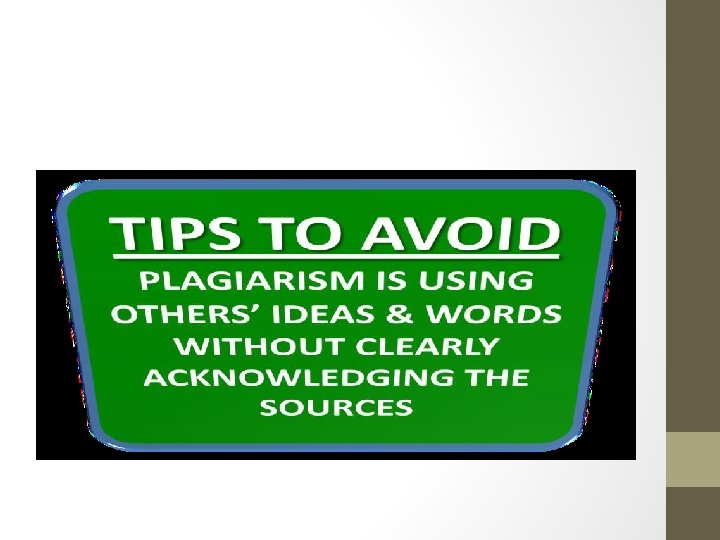
Plagiarism • A short-cut to long-term consequences! • Plagiarism is considered a serious offense by your institute, by journal editors, and by the scientific community. • Plagiarism may result in academic charges, but will certainly cause rejection of your paper. • Plagiarism will hurt your reputation in the scientific community.

Guidance For Authors (GFA)? • Panduan lengkap dan terstruktur yang diperuntukkan bagi penulis yang ingin mensubmit manuscript ke suatu jurnal atau jenis karya ilmiah lain (chapter book, research book) atau kegiatan seminar (prosiding). • GFA mutlak harus dibaca dan diikuti secara tertib oleh penulis untuk memastikan bahawa manuscript yang disusun dapat diterima oleh editor dan tidak menimbulkan masalah dikemudian hari • Ketidakpatuhan terhadap GFA dapat menyebabkan manuscript ditolak oleh editor sebelum masuk ke proses review

Apa Isi GFA? TATA CARA PENGIRIMAN MANUSCRIPT SISTEMATIKA DAN ATURAN PENULISAN MANUSCRIPT REVIEW POLICY ETIKA PUBLIKASI PUBLICATION POLICY COPYRIGHT DAN FUNDING BODY AGREEMENT • GFA setiap jurnal atau prosiding berbeda-beda • GFA dapat dibuat sangat umum atau detail
Yang Harus Diperhatikan! • Sebaiknya gunakan template penulisan paper yang disediakan jurnal atau penyelenggara seminar untuk menulis manuscript • Kenali bagaimana cara mensitasi. Tiap jurnal /prosiding memiliki cara mensitasi yang berbeda. • Kenali bagaimana cara menuliskan referensi. Tiap jurnal/prosiding memiliki cara yang berbeda. • Kenali cara mendefinisikan notasi, karana setiap jurnal punya style berbeda. • Tiap jurnal memiliki style yang berbeda dalam menampilkan tabel dan gambar
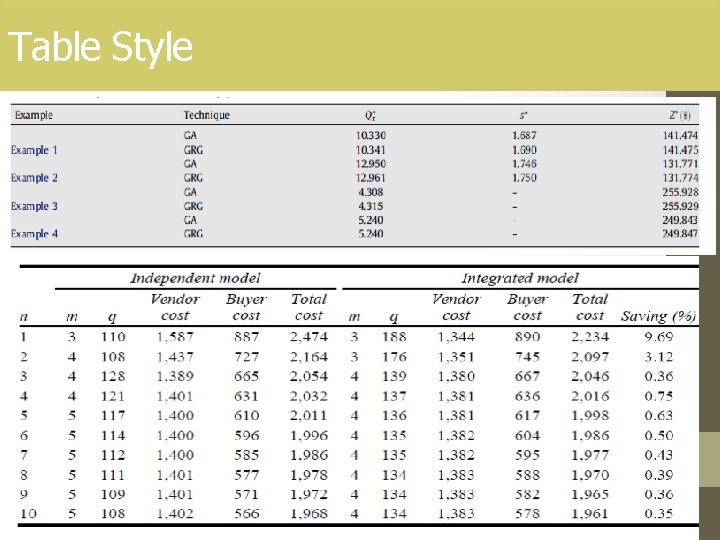
Table Style
WRITING FORMAT IN ICES • Format for Writing Full Paper • The full article must be formatted double-spaced, font size 12, page number 6 -12, Times new roman. The paper should be concise, clear and in readable style, and it must be accompanied by an abstract written within 250 or less words. Contributors are requested to type their official designations and personal addresses at the foot of the first page of the type -script. All papers will be reviewed and go though checking of plagiarism. • Article can be written concept base, theoretical, experimental and empirical. Please follow APA style of writing article.
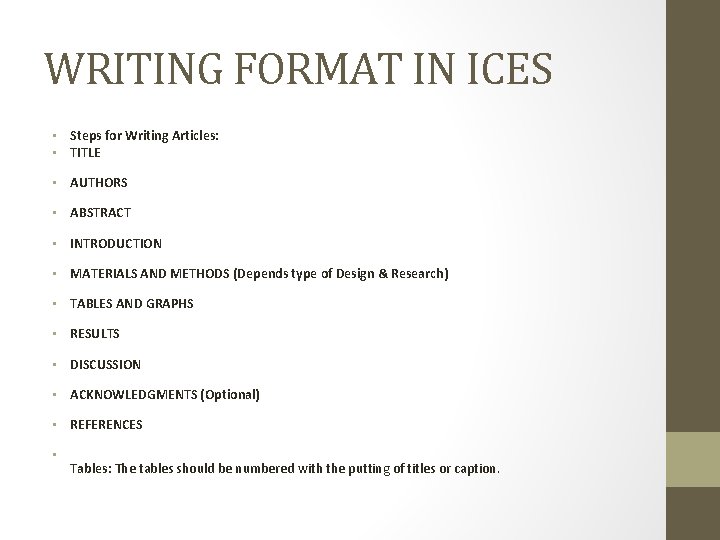
WRITING FORMAT IN ICES • Steps for Writing Articles: • TITLE • AUTHORS • ABSTRACT • INTRODUCTION • MATERIALS AND METHODS (Depends type of Design & Research) • TABLES AND GRAPHS • RESULTS • DISCUSSION • ACKNOWLEDGMENTS (Optional) • REFERENCES • Tables: The tables should be numbered with the putting of titles or caption.
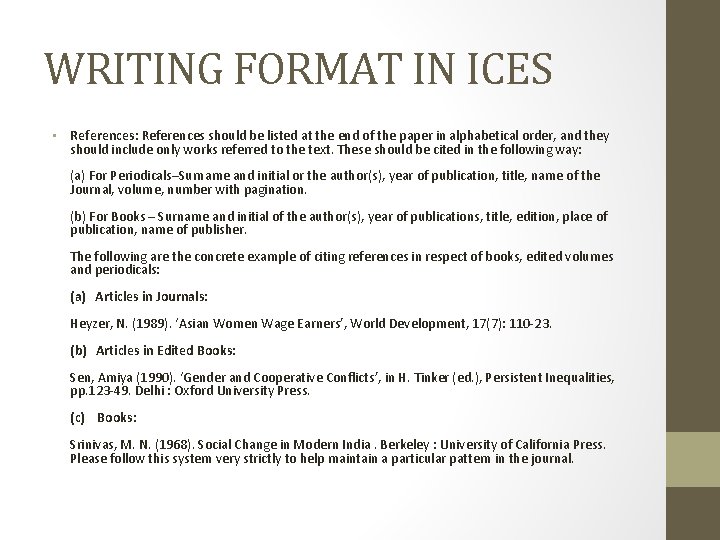
WRITING FORMAT IN ICES • References: References should be listed at the end of the paper in alphabetical order, and they should include only works referred to the text. These should be cited in the following way: (a) For Periodicals–Surname and initial or the author(s), year of publication, title, name of the Journal, volume, number with pagination. (b) For Books – Surname and initial of the author(s), year of publications, title, edition, place of publication, name of publisher. The following are the concrete example of citing references in respect of books, edited volumes and periodicals: (a) Articles in Journals: Heyzer, N. (1989). ‘Asian Women Wage Earners’, World Development, 17(7): 110 -23. (b) Articles in Edited Books: Sen, Amiya (1990). ‘Gender and Cooperative Conflicts’, in H. Tinker (ed. ), Persistent Inequalities, pp. 123 -49. Delhi : Oxford University Press. (c) Books: Srinivas, M. N. (1968). Social Change in Modern India. Berkeley : University of California Press. Please follow this system very strictly to help maintain a particular pattern in the journal.
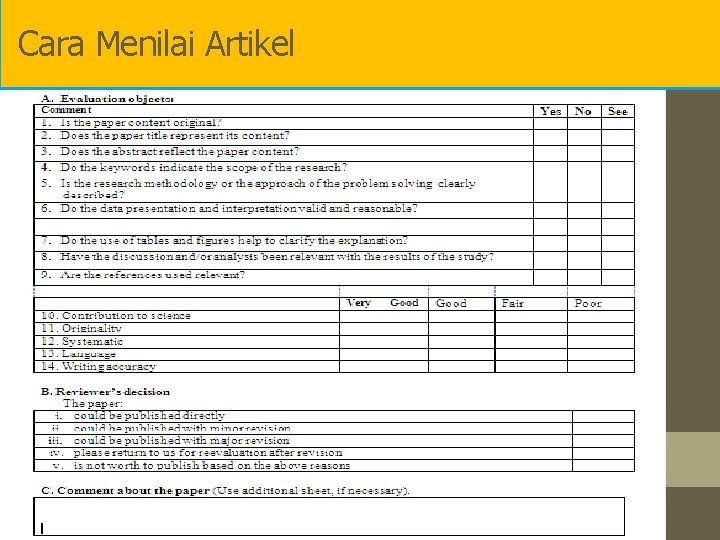
Cara Menilai Artikel
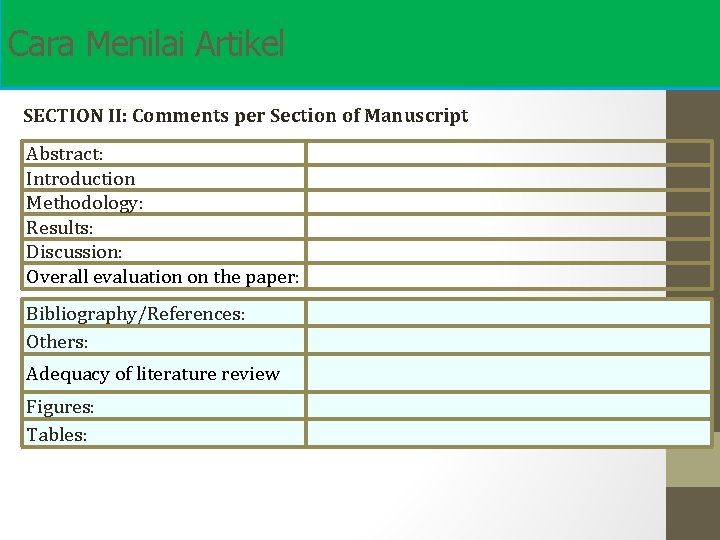
Cara Menilai Artikel SECTION II: Comments per Section of Manuscript Abstract: Introduction Methodology: Results: Discussion: Overall evaluation on the paper: Bibliography/References: Others: Adequacy of literature review Figures: Tables:
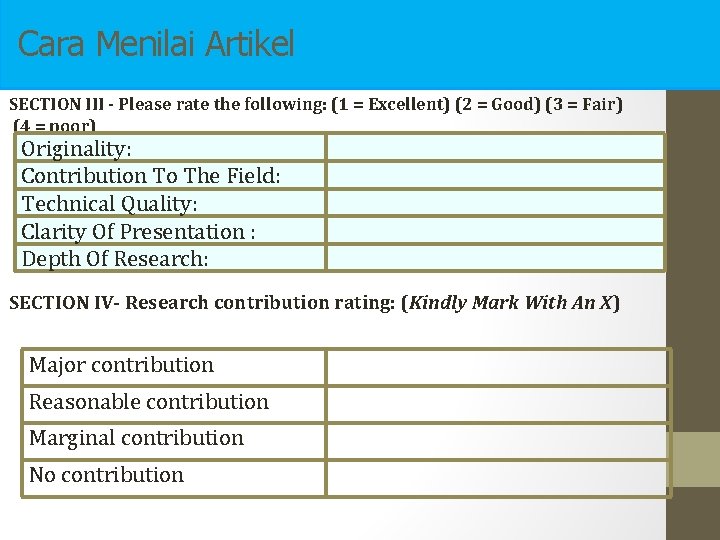
Cara Menilai Artikel SECTION III - Please rate the following: (1 = Excellent) (2 = Good) (3 = Fair) (4 = poor) Originality: Contribution To The Field: Technical Quality: Clarity Of Presentation : Depth Of Research: SECTION IV- Research contribution rating: (Kindly Mark With An X) Major contribution Reasonable contribution Marginal contribution No contribution
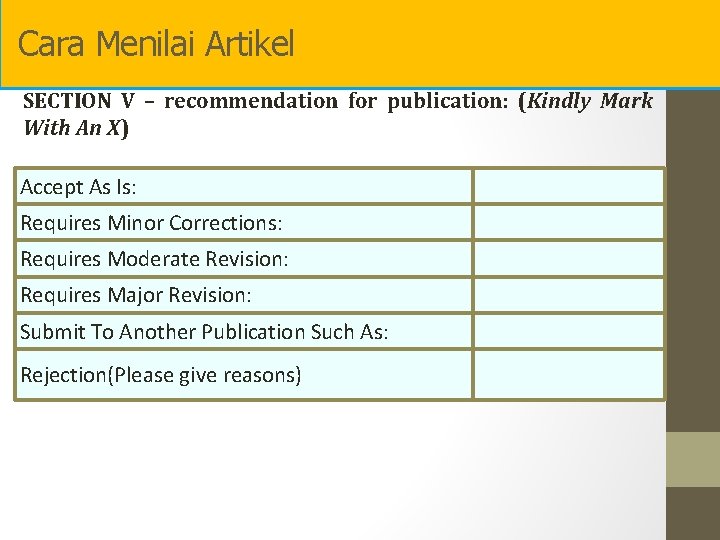
Cara Menilai Artikel SECTION V – recommendation for publication: (Kindly Mark With An X) Accept As Is: Requires Minor Corrections: Requires Moderate Revision: Requires Major Revision: Submit To Another Publication Such As: Rejection(Please give reasons)
2 Evaluasi Isi Manuscript (Bertindak sebagai Reviewer)

Bertindak sebagai Reviewer Judul a. Apakah judul artikel telah memuat kata-kata kunci dan tidak ada singkatan, rumus, jargon? b. Apakah judul artikel telah mewakili isinya? Abstrak: a. Apakah isi abstrak telah mencerminkan isi artikel? b. Cek jumlah “kata” dalam abstrak, hanya 150 - 200 kata? c. Pisahkan kalimat-kalimat dalam “abstrak” menjadi: Background; Methods; Results dan Conclusions, apakah sudah ada semua? . d. Apakah kata kunci telah menunjukkan ruang lingkup penelitian? e. Cek jumlahnya, umumnya hanya 4 -6 kata kunci? . f. Apakah Kosakata dalam “Kata Kunci” telah dipilih untuk katalogisasi / pengindeksan yang popular? g. Pertimbangkan kata kunci yang terdapat dalam “judul artikel” dan Cek apakah semua “key words” telah masuk dlm Abstrak ?
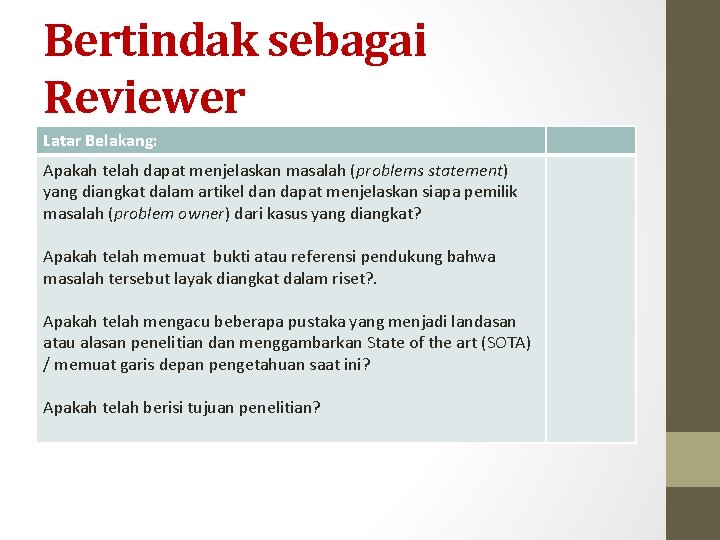
Bertindak sebagai Reviewer Latar Belakang: Apakah telah dapat menjelaskan masalah (problems statement) yang diangkat dalam artikel dan dapat menjelaskan siapa pemilik masalah (problem owner) dari kasus yang diangkat? Apakah telah memuat bukti atau referensi pendukung bahwa masalah tersebut layak diangkat dalam riset? . Apakah telah mengacu beberapa pustaka yang menjadi landasan atau alasan penelitian dan menggambarkan State of the art (SOTA) / memuat garis depan pengetahuan saat ini? Apakah telah berisi tujuan penelitian?

Bertindak sebagai Reviewer Approaches and/or Methodology : Apakah metodologi penelitian atau pendekatan pemecahan masalah telah dijelaskan dengan baik? Metodologi apakah sudah menjelaskan subjek dan objek penelitian secara terperinci? Apakah sudah menjelaskan bagaimana pengacakan (sampling) dilakukan atau menjelaskan urutan studi, waktu & tempat; populasi & sampel, metode sampling; dan sumber data? .
Bertindak sebagai Reviewer • Results and Discussion: • a. Apakah artikel ini telah memuat hanya data yang berhubungan dengan subyek artikel? sebagaimana didefinisikan dalam pendahuluan? • b. Apakah data dan interpretasi data disajikan dengan valid dan masuk akal? • c. Apakah hasil sudah disajikan secara bersistem sesuai dengan ‘tujuan penelitian’ atau hipotesis? • d. Apakah tabel dan gambar membantu untuk memberikan penjelasan hasil? • e. KESALAHAN YANG PALING UMUM: deskripsi berulang yang sudah jelas bagi pembaca dari pemeriksaan tabel dan gambar, tetapi ditulis; apakah ada dalam artikel ini? . • Conclusion and Future Research/Recommendation • Apakah kesimpulan telah dibuat dengan tidak mengulang hasil secara verbatim? . • Apakah kesimpulan telah dibuat menjadi generalisasi dengan memperhatikan keterbatasan hasil temuan? • Apakah telah menyajikan Implikasi temuan?
Bertindak sebagai Reviewer • Daftar Pustaka/Referensi: a) Apakah telah ditulis dengan mengacu pada aturan jurnal (sistem nomor atau nama-tahun) tertentu? b) Apakah seluruh kutipan dalam artikel telah ditulis referensinya dan seluruh daftar referensi yang ditulis telah dikutip dalam artikel? c) Cermati mutu pustaka acuan (keprimeran, kemutakhiran > 80%); apakah acuan primer (artikel dari jurnal/prosidings) telah berjumlah > 80% dari seluruh referensi? d) Apakah identitas acuan telah lengkap (volume, nomor halaman, kota terbit, nama penerbit)?

Aktiviti Kumpulan • Bagaimana memilih Jurnal yang sesuai ? • Apakah Kriteria anda ?
APA ITU OPEN ACCESS?
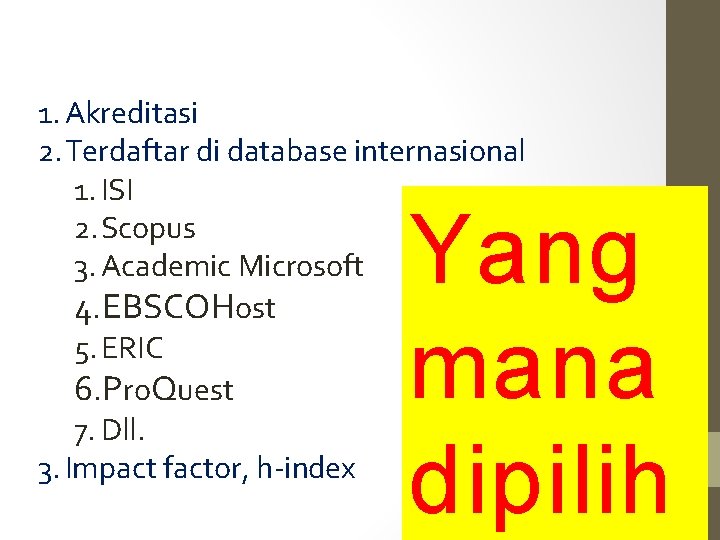
1. Akreditasi 2. Terdaftar di database internasional 1. ISI 2. Scopus 3. Academic Microsoft 4. EBSCOHost 5. ERIC 6. Pro. Quest 7. Dll. 3. Impact factor, h-index Yang mana dipilih

CEK DATABASE
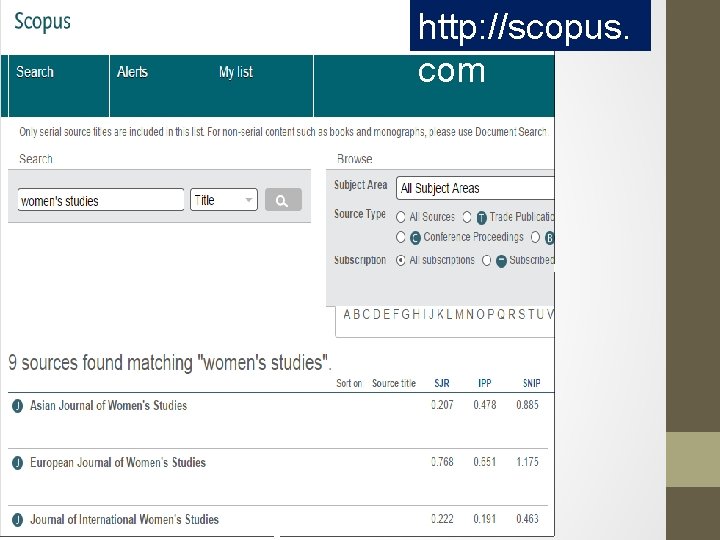
http: //scopus. com

SUBJECT AREA PUBLISHE R ISSN INDEKS

CEK WEBSITE JURNAL

BERHATI-HATI…!
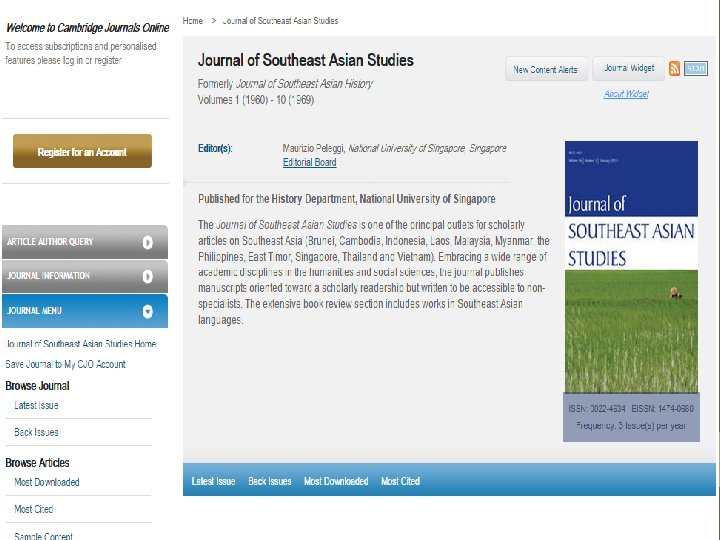
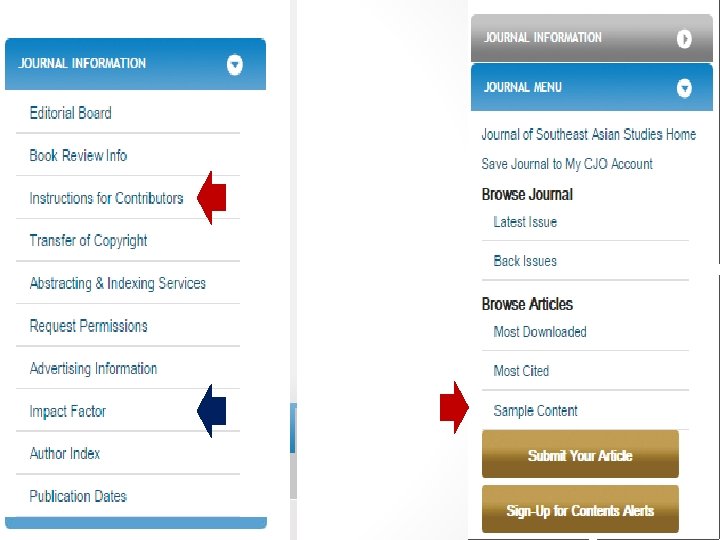
IMPORTANT. . . ! PENTING - AIMS & SCOPE - INSTRUCTIONS/GUIDELINES FOR AUTHORS/CONTRIBUTORS - SAMPLE ARTICLES

Bagaimana mahu Online Submission ?
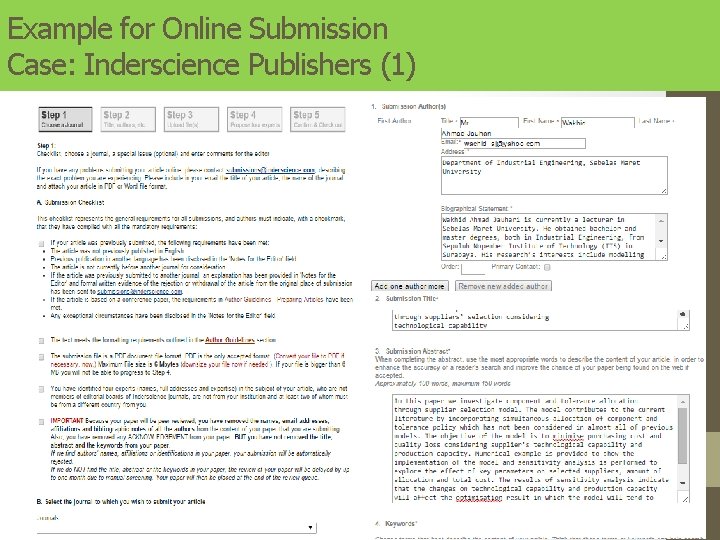
Example for Online Submission Case: Inderscience Publishers (1)
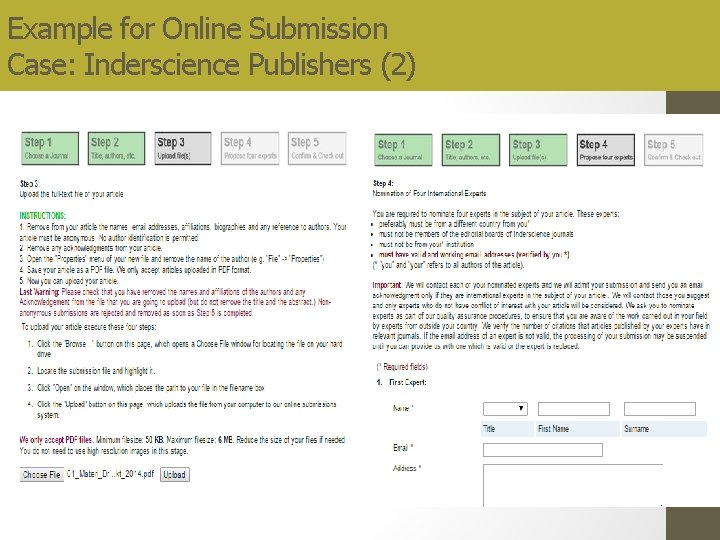
Example for Online Submission Case: Inderscience Publishers (2)
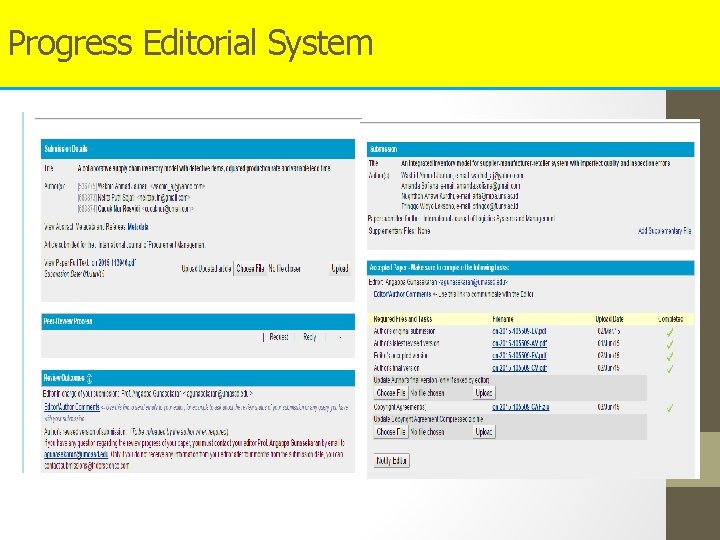
Progress Editorial System
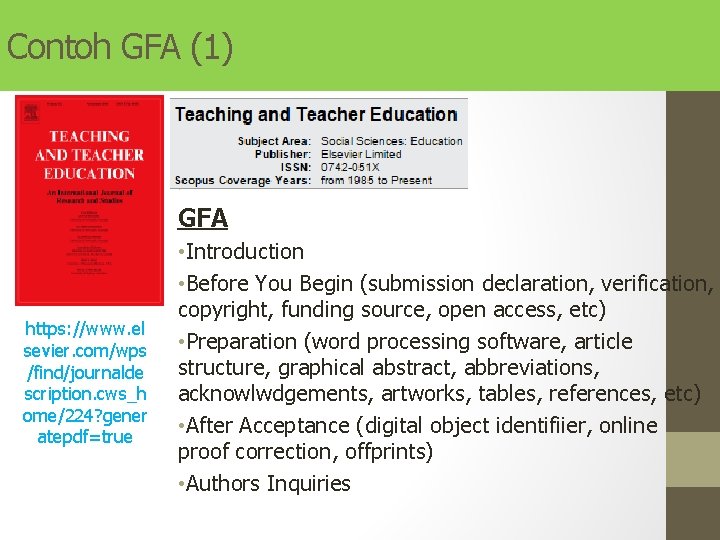
Contoh GFA (1) GFA https: //www. el sevier. com/wps /find/journalde scription. cws_h ome/224? gener atepdf=true • Introduction • Before You Begin (submission declaration, verification, copyright, funding source, open access, etc) • Preparation (word processing software, article structure, graphical abstract, abbreviations, acknowlwdgements, artworks, tables, references, etc) • After Acceptance (digital object identifiier, online proof correction, offprints) • Authors Inquiries
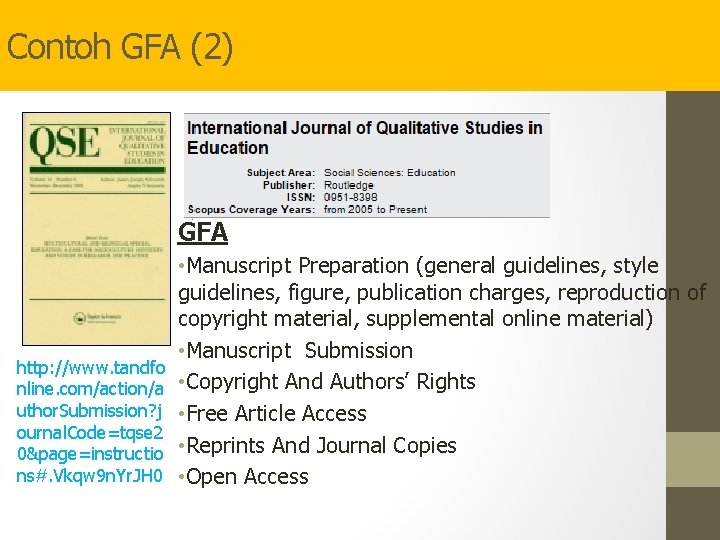
Contoh GFA (2) GFA http: //www. tandfo nline. com/action/a uthor. Submission? j ournal. Code=tqse 2 0&page=instructio ns#. Vkqw 9 n. Yr. JH 0 • Manuscript Preparation (general guidelines, style guidelines, figure, publication charges, reproduction of copyright material, supplemental online material) • Manuscript Submission • Copyright And Authors’ Rights • Free Article Access • Reprints And Journal Copies • Open Access
Thank You for Your Kind Attention Have A Nice Day Wish You For Every Success

Questions?
- Slides: 87