
How to Write a Good History Paper Have





- Slides: 19
How to Write a (Good) History Paper
Have a Strong Introductory Paragraph • A strong introductory paragraph tells the reader what the paper is about • Components: topic, (brief) historical context, thesis statement
End the Introduction with a Strong Thesis Statement • A strong thesis statement is one that makes an argument: a claim that can be either proven or disproven. The thesis is what you will defend in the paper. • Ex: “The American Revolution was inevitable because the British and colonists had incompatible notions regarding representation and Parliament’s authority to tax the colonies. ”
Make Sure That Each Body Paragraph Has a Good Topic Sentence • A good topic sentence lets the reader know exactly what will appear in the rest of the paragraph. • Ex: “Mercantilism defined how many British understood the relationship between the mother country and the colonies. ”
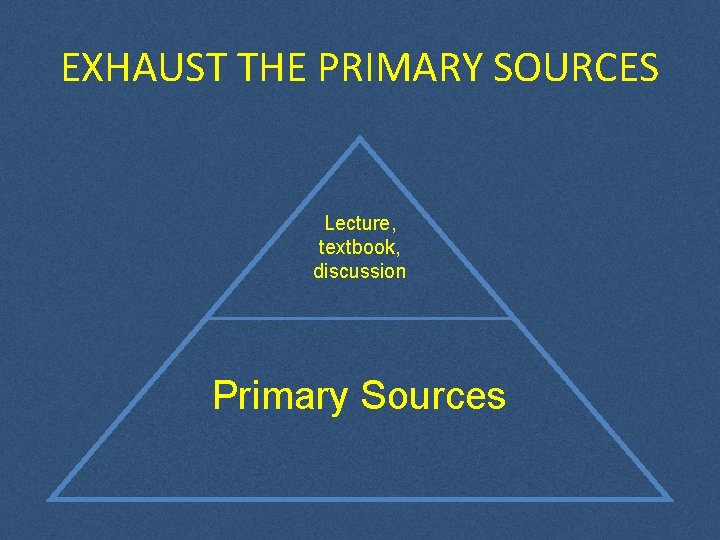
EXHAUST THE PRIMARY SOURCES Lecture, textbook, discussion Primary Sources
Make Sure To Have a Good Concluding Paragraph • A good concluding paragraph will review the main arguments offered in the paper • It will also contain some final “big picture” remarks • Do not make new arguments in the conclusion • Ex: Do not give another reason why the Revolution was (or wasn’t) inevitable.
Avoid Passive Voice When Active Voice Will Do • Passive voice: The argument that taxing the colonists without giving them representation violated their natural rights was made by James Otis. vs. • Active voice: James Otis argued that taxing the colonists without giving them representation violated their natural rights. • Passive voice obscures the doer of the action. Also, it’s really annoying to read.
Vary Word Choice • Avoid repeating words/phrases in the same sentence or group of sentences. It’s not fun to read. Also, forcing yourself to vary will expand your vocabulary and make you a better writer. • Solution: THESAURUS
Know the Meaning of the Words You Use • Is it • Revolutionary principles? Or • Revolutionary principals? • Solution: DICTIONARY
Citations • Use in-text citations (see assignment sheet format) • Cite both direct quotations and whenever you use information that isn’t your own, even if you’re just paraphrasing
Miscellany • Be precise – Ex: “The Stamp Act taxed some goods” vs. “The Stamp Act taxed college diplomas, newspapers, and playing cards” • Avoid slang – Ex: “Dickinson thought the Stamp Act sucked” vs. “Dickinson was upset that the Stamp Act imposed taxes solely for the purpose of raising revenue” • Avoid contractions – Ex: Can’t cannot • DO NOT: Write in the first person • DO: Write in the past tense
More Miscellany • Do not use outside sources – This is not a research paper, so draw only from primary source documents, lecture, textbook – Unassigned sources OK • Do not use block quotes – Aesthetically, they’re terrible to look at; additionally, using block quotes means that you’re not writing enough in your own voice – Direct quotes should be no longer than 2 -3 lines – DO NOT DIRECT QUOTE THE TEXTBOOK – Make sure to integrate quotes - don’t just drop them into the paragraph.
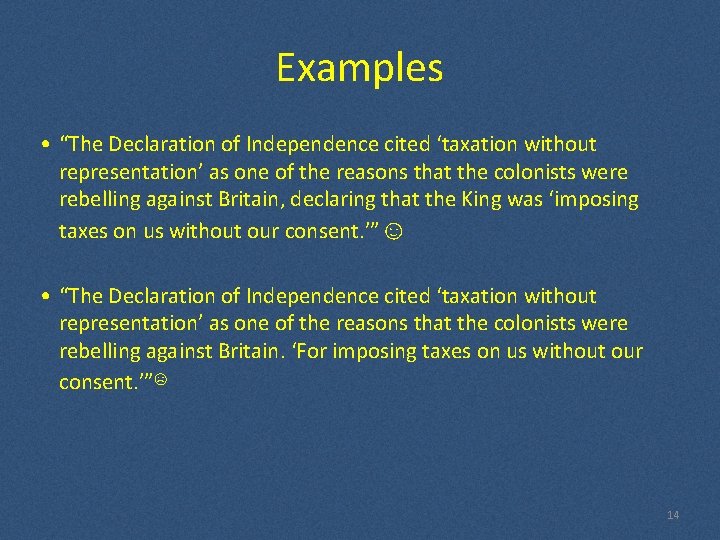
Examples • “The Declaration of Independence cited ‘taxation without representation’ as one of the reasons that the colonists were rebelling against Britain, declaring that the King was ‘imposing taxes on us without our consent. ’”☺ • “The Declaration of Independence cited ‘taxation without representation’ as one of the reasons that the colonists were rebelling against Britain. ‘For imposing taxes on us without our consent. ’”☹ 14
Proofread….
…. Out loud.
And of course…. .
DON’T PLAGIARIZE. EVER. UNDER ANY CIRCUMSTANCES. YOU WILL BE CAUGHT. AND YOU WILL FAIL. AND OTHER BAD STUFF WILL HAPPEN TO YOU.
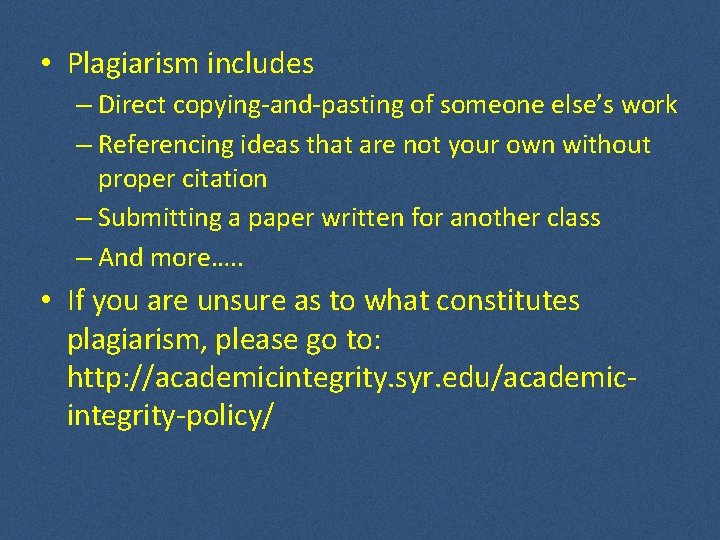
• Plagiarism includes – Direct copying-and-pasting of someone else’s work – Referencing ideas that are not your own without proper citation – Submitting a paper written for another class – And more…. . • If you are unsure as to what constitutes plagiarism, please go to: http: //academicintegrity. syr. edu/academicintegrity-policy/