
How to Write a Fictional Narrative 9 TH
- Slides: 11
How to Write a Fictional Narrative 9 TH GRADE LITERATURE
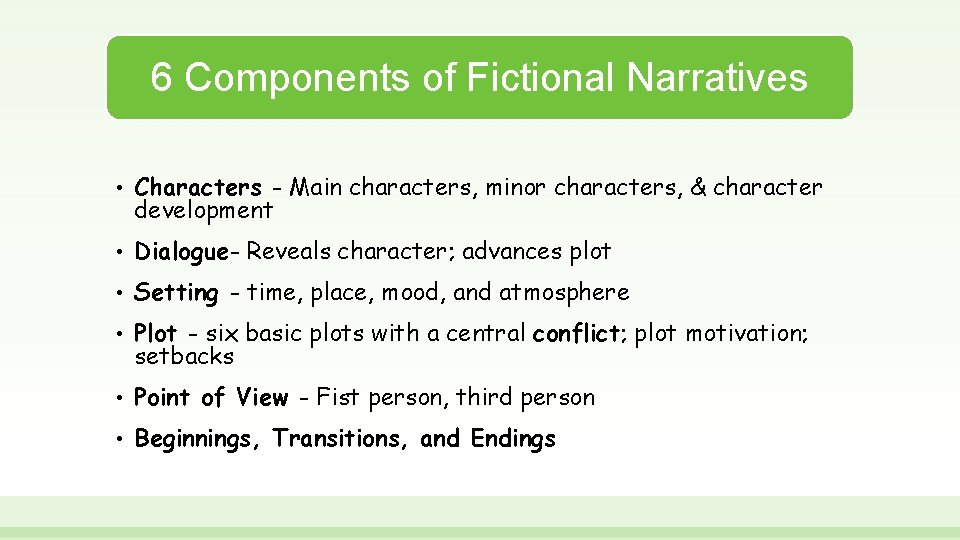
6 Components of Fictional Narratives • Characters - Main characters, minor characters, & character development • Dialogue- Reveals character; advances plot • Setting - time, place, mood, and atmosphere • Plot - six basic plots with a central conflict; plot motivation; setbacks • Point of View - Fist person, third person • Beginnings, Transitions, and Endings
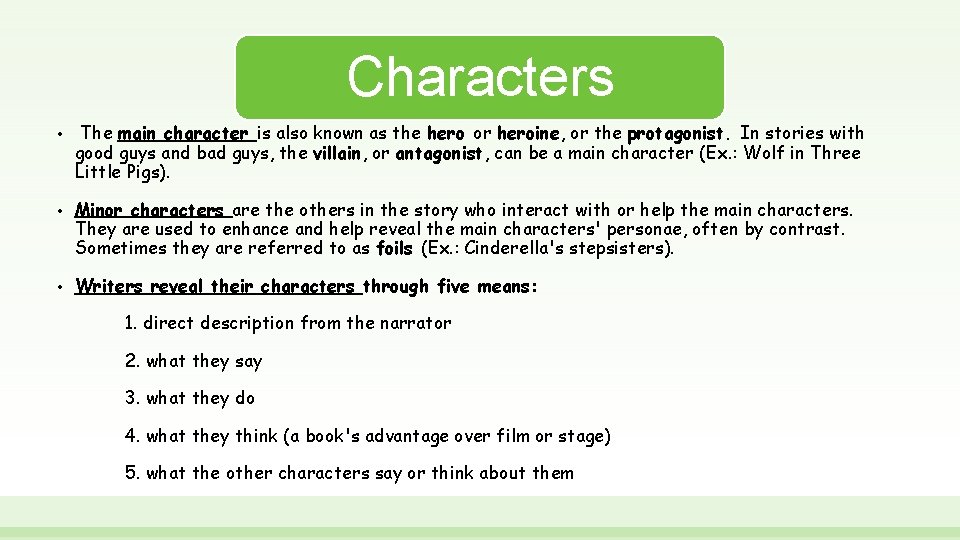
Characters • The main character is also known as the hero or heroine, or the protagonist. In stories with good guys and bad guys, the villain, or antagonist, can be a main character (Ex. : Wolf in Three Little Pigs). • Minor characters are the others in the story who interact with or help the main characters. They are used to enhance and help reveal the main characters' personae, often by contrast. Sometimes they are referred to as foils (Ex. : Cinderella's stepsisters). • Writers reveal their characters through five means: 1. direct description from the narrator 2. what they say 3. what they do 4. what they think (a book's advantage over film or stage) 5. what the other characters say or think about them
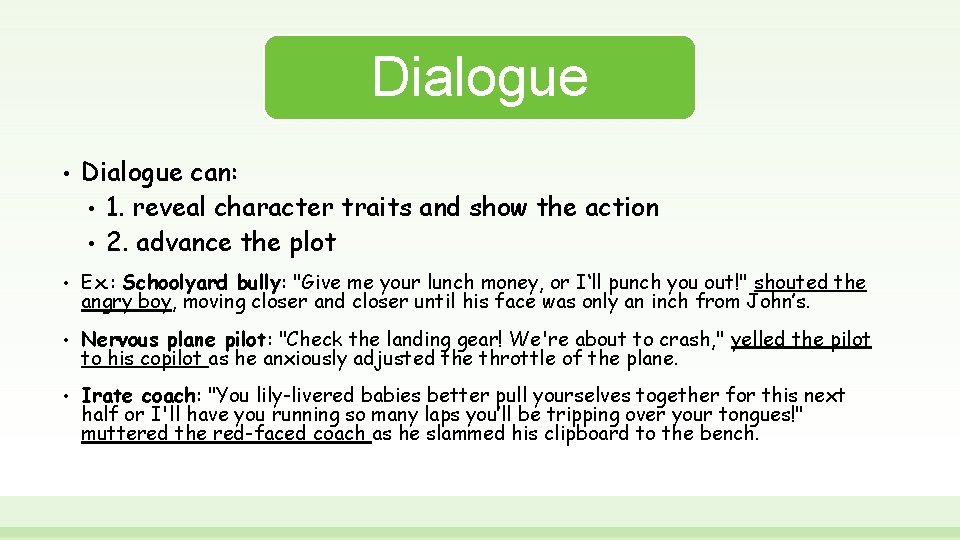
Dialogue • Dialogue can: • 1. reveal character traits and show the action • 2. advance the plot • Ex. : Schoolyard bully: "Give me your lunch money, or I‘ll punch you out!" shouted the angry boy, moving closer and closer until his face was only an inch from John’s. • Nervous plane pilot: "Check the landing gear! We're about to crash, " yelled the pilot to his copilot as he anxiously adjusted the throttle of the plane. • Irate coach: "You lily-livered babies better pull yourselves together for this next half or I'll have you running so many laps you’ll be tripping over your tongues!" muttered the red-faced coach as he slammed his clipboard to the bench.
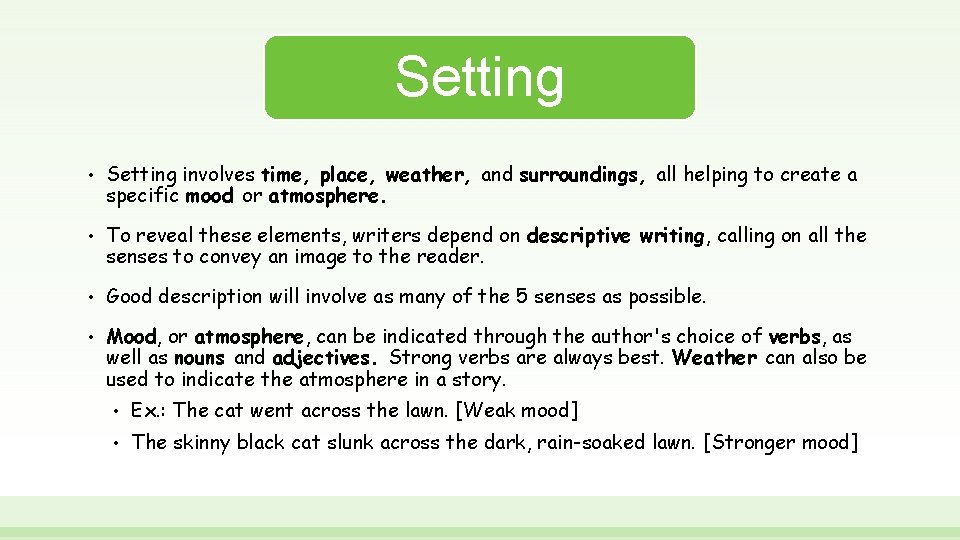
Setting • Setting involves time, place, weather, and surroundings, all helping to create a specific mood or atmosphere. • To reveal these elements, writers depend on descriptive writing, calling on all the senses to convey an image to the reader. • Good description will involve as many of the 5 senses as possible. • Mood, or atmosphere, can be indicated through the author's choice of verbs, as well as nouns and adjectives. Strong verbs are always best. Weather can also be used to indicate the atmosphere in a story. • Ex. : The cat went across the lawn. [Weak mood] • The skinny black cat slunk across the dark, rain-soaked lawn. [Stronger mood]
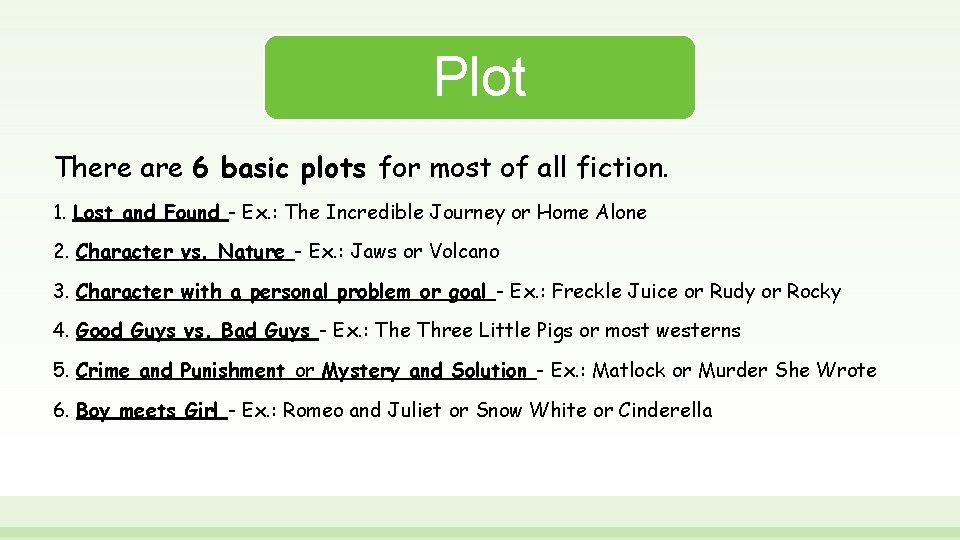
Plot There are 6 basic plots for most of all fiction. 1. Lost and Found - Ex. : The Incredible Journey or Home Alone 2. Character vs. Nature - Ex. : Jaws or Volcano 3. Character with a personal problem or goal - Ex. : Freckle Juice or Rudy or Rocky 4. Good Guys vs. Bad Guys - Ex. : The Three Little Pigs or most westerns 5. Crime and Punishment or Mystery and Solution - Ex. : Matlock or Murder She Wrote 6. Boy meets Girl - Ex. : Romeo and Juliet or Snow White or Cinderella
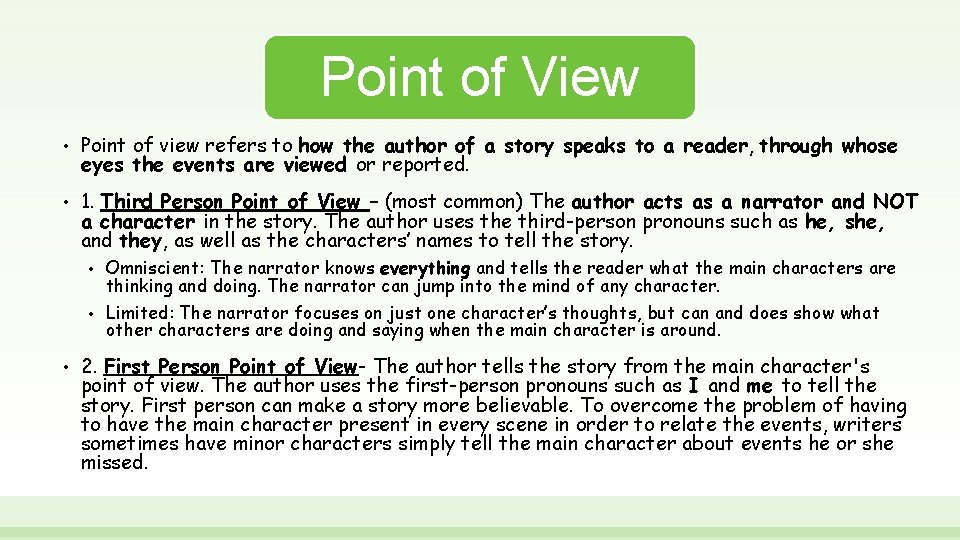
Point of View • Point of view refers to how the author of a story speaks to a reader, through whose eyes the events are viewed or reported. • 1. Third Person Point of View – (most common) The author acts as a narrator and NOT a character in the story. The author uses the third-person pronouns such as he, she, and they, as well as the characters’ names to tell the story. • • Omniscient: The narrator knows everything and tells the reader what the main characters are thinking and doing. The narrator can jump into the mind of any character. • Limited: The narrator focuses on just one character’s thoughts, but can and does show what other characters are doing and saying when the main character is around. 2. First Person Point of View- The author tells the story from the main character's point of view. The author uses the first-person pronouns such as I and me to tell the story. First person can make a story more believable. To overcome the problem of having to have the main character present in every scene in order to relate the events, writers sometimes have minor characters simply tell the main character about events he or she missed.
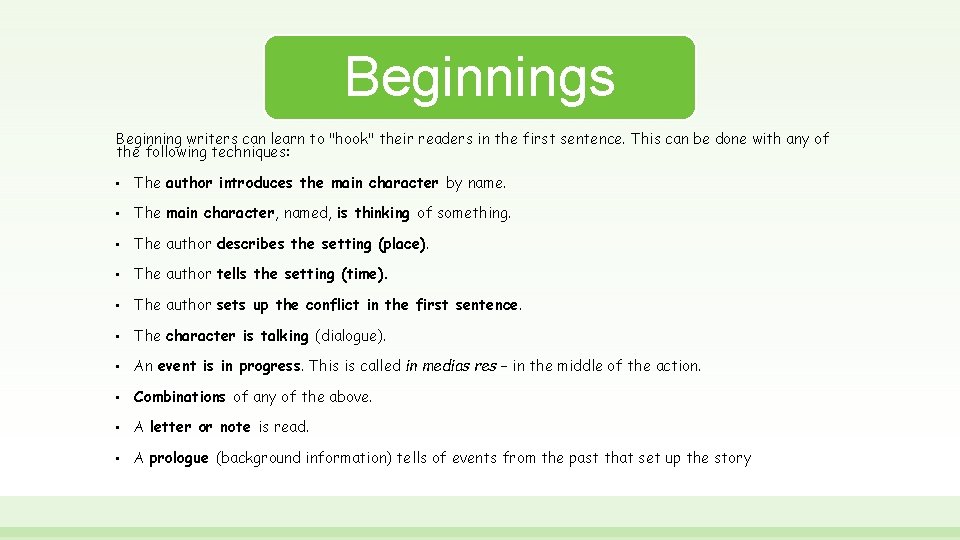
Beginnings Beginning writers can learn to "hook" their readers in the first sentence. This can be done with any of the following techniques: • The author introduces the main character by name. • The main character, named, is thinking of something. • The author describes the setting (place). • The author tells the setting (time). • The author sets up the conflict in the first sentence. • The character is talking (dialogue). • An event is in progress. This is called in medias res – in the middle of the action. • Combinations of any of the above. • A letter or note is read. • A prologue (background information) tells of events from the past that set up the story
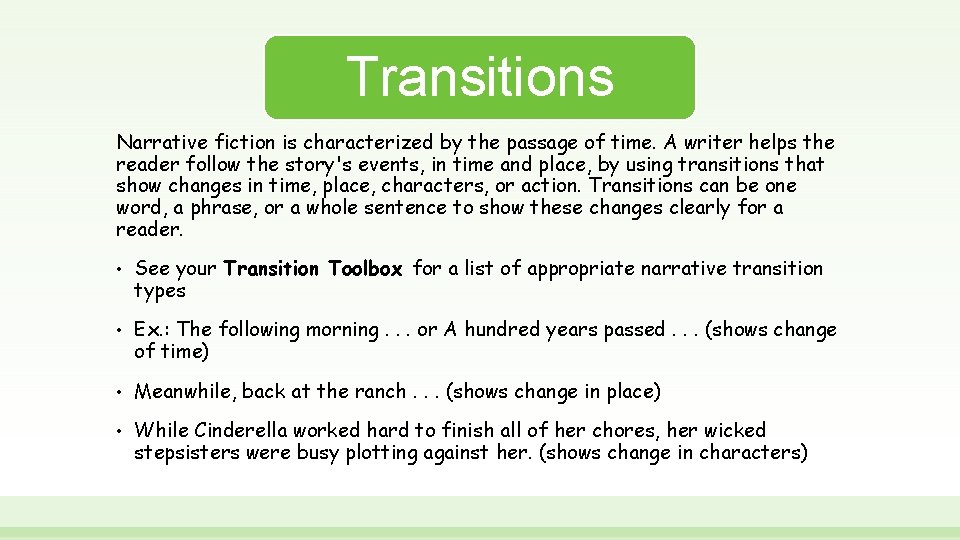
Transitions Narrative fiction is characterized by the passage of time. A writer helps the reader follow the story's events, in time and place, by using transitions that show changes in time, place, characters, or action. Transitions can be one word, a phrase, or a whole sentence to show these changes clearly for a reader. • See your Transition Toolbox for a list of appropriate narrative transition types • Ex. : The following morning. . . or A hundred years passed. . . (shows change of time) • Meanwhile, back at the ranch. . . (shows change in place) • While Cinderella worked hard to finish all of her chores, her wicked stepsisters were busy plotting against her. (shows change in characters)
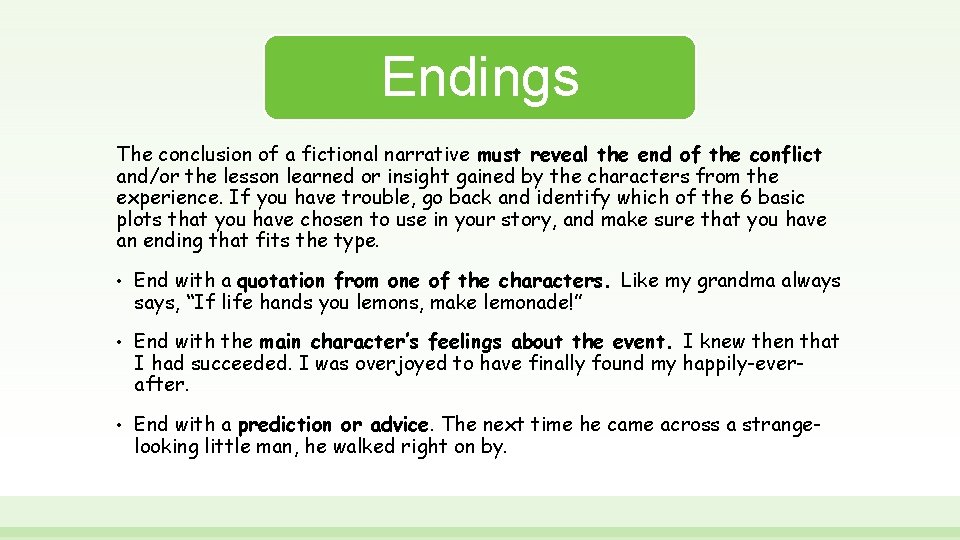
Endings The conclusion of a fictional narrative must reveal the end of the conflict and/or the lesson learned or insight gained by the characters from the experience. If you have trouble, go back and identify which of the 6 basic plots that you have chosen to use in your story, and make sure that you have an ending that fits the type. • End with a quotation from one of the characters. Like my grandma always says, “If life hands you lemons, make lemonade!” • End with the main character’s feelings about the event. I knew then that I had succeeded. I was overjoyed to have finally found my happily-everafter. • End with a prediction or advice. The next time he came across a strangelooking little man, he walked right on by.
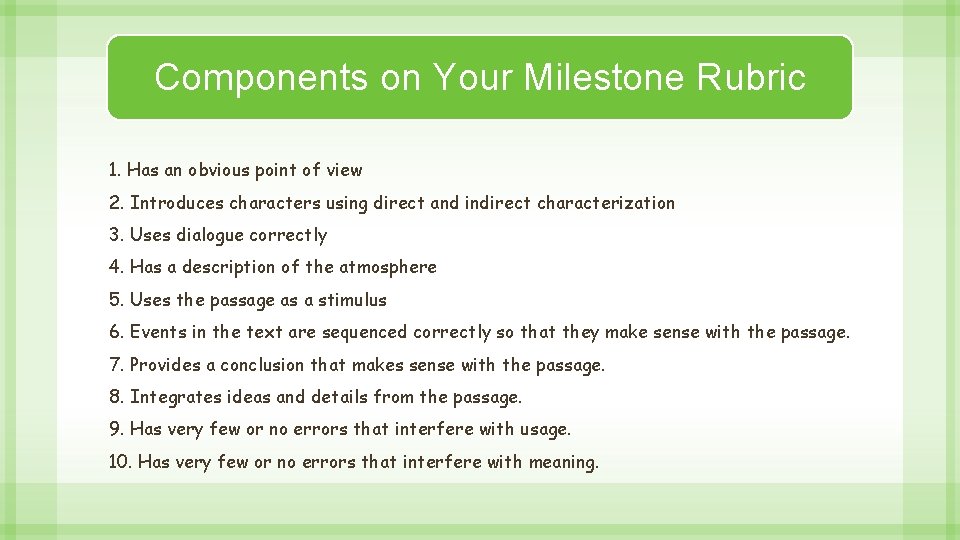
Components on Your Milestone Rubric 1. Has an obvious point of view 2. Introduces characters using direct and indirect characterization 3. Uses dialogue correctly 4. Has a description of the atmosphere 5. Uses the passage as a stimulus 6. Events in the text are sequenced correctly so that they make sense with the passage. 7. Provides a conclusion that makes sense with the passage. 8. Integrates ideas and details from the passage. 9. Has very few or no errors that interfere with usage. 10. Has very few or no errors that interfere with meaning.