
How to work with Olympus and Leica microscopes

- Slides: 20
How to work with Olympus and Leica microscopes
In the laboratory of medical microbiology you will work with: • Microscopes Olympus CX-31 that are quite expensive • Microscopes Leica that also expensive and also quite new • There are two microscopes on each working table. Do not work with demonstration microscopes (next to the whiteboard and at the working table) without being told by your teacher! • It is important not to damage any of them • In following slides, Olympus microscopes are described. The work with Leica microscopes is very similar, only some details may be different
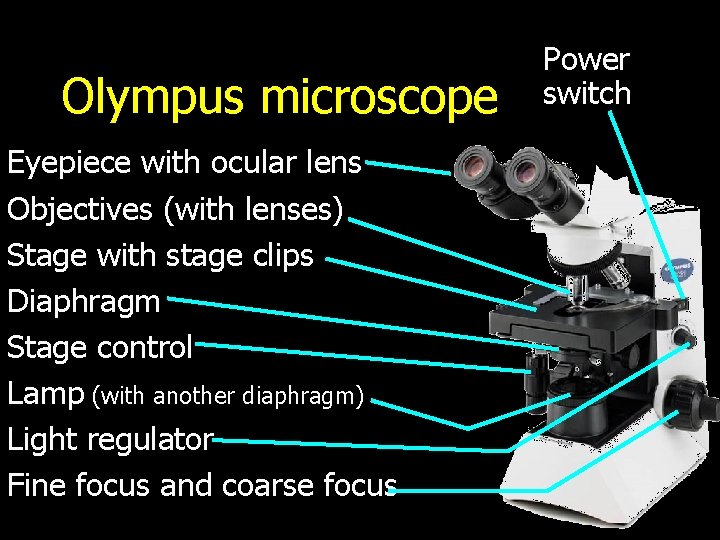
Olympus microscope Eyepiece with ocular lens Objectives (with lenses) Stage with stage clips Diaphragm Stage control Lamp (with another diaphragm) Light regulator Fine focus and coarse focus Power switch
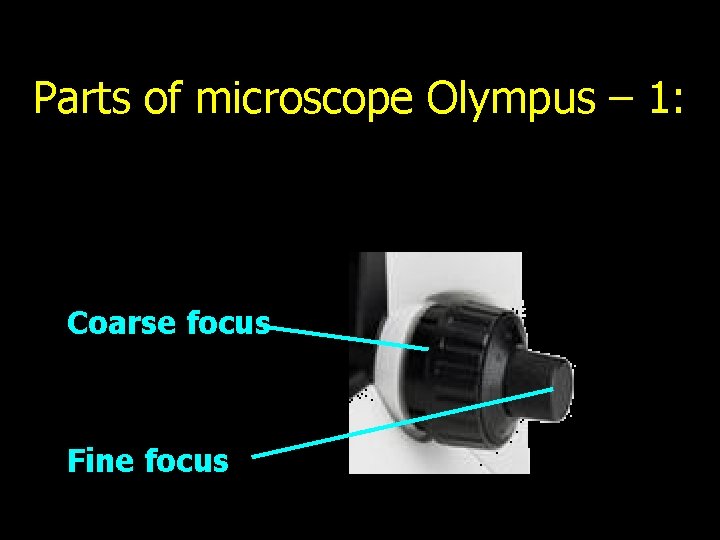
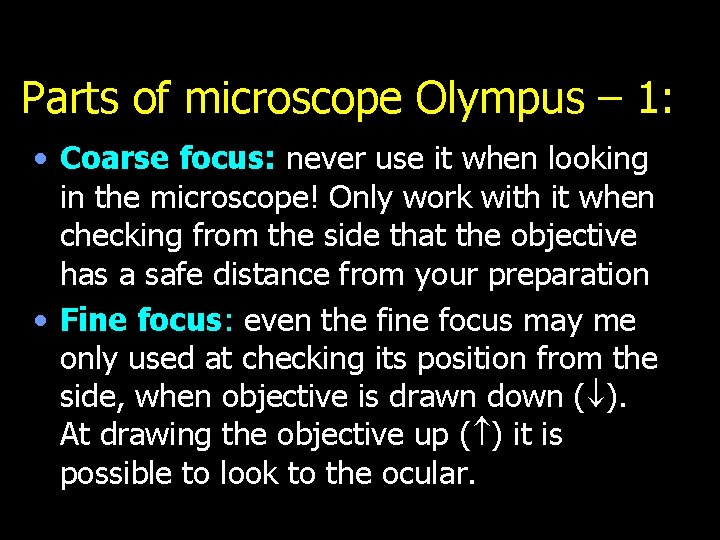
Parts of microscope Olympus – 1: Coarse focus Fine focus
Parts of microscope Olympus – 1: • Coarse focus: never use it when looking in the microscope! Only work with it when checking from the side that the objective has a safe distance from your preparation • Fine focus: even the fine focus may me only used at checking its position from the side, when objective is drawn down ( ). At drawing the objective up ( ) it is possible to look to the ocular.
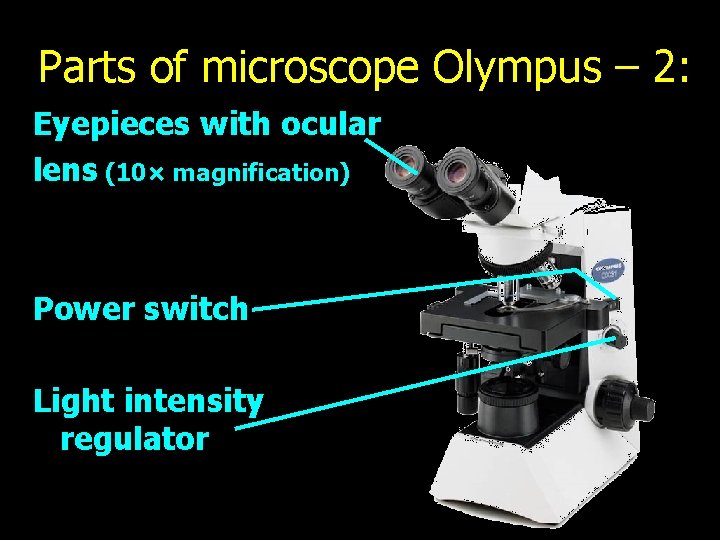
Parts of microscope Olympus – 2: Eyepieces with ocular lens (10× magnification) Power switch Light intensity regulator
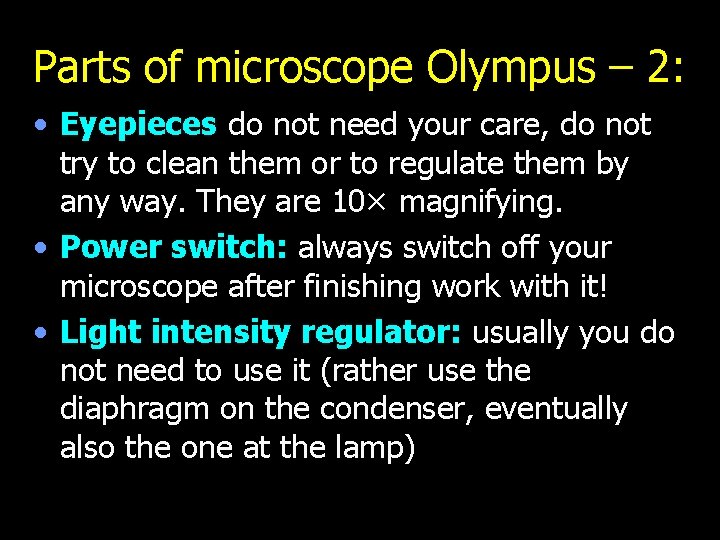
Parts of microscope Olympus – 2: • Eyepieces do not need your care, do not try to clean them or to regulate them by any way. They are 10× magnifying. • Power switch: always switch off your microscope after finishing work with it! • Light intensity regulator: usually you do not need to use it (rather use the diaphragm on the condenser, eventually also the one at the lamp)
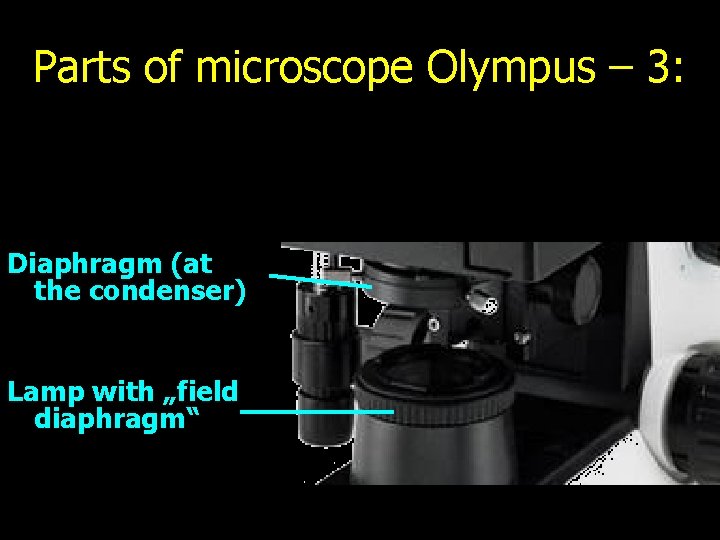
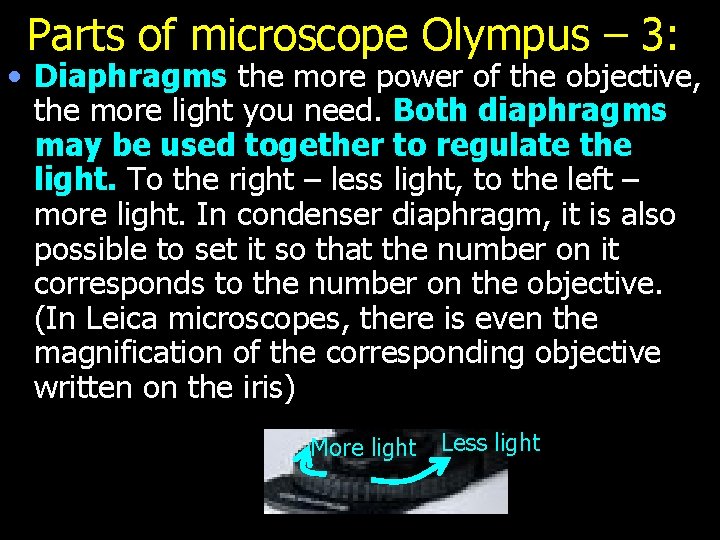
Parts of microscope Olympus – 3: Diaphragm (at the condenser) Lamp with „field diaphragm“
Parts of microscope Olympus – 3: • Diaphragms the more power of the objective, the more light you need. Both diaphragms may be used together to regulate the light. To the right – less light, to the left – more light. In condenser diaphragm, it is also possible to set it so that the number on it corresponds to the number on the objective. (In Leica microscopes, there is even the magnification of the corresponding objective written on the iris) More light Less light
Note: Köhler illumination • There exist also sofisticated approach leading to so called optimal or true Köhler illumination. Usually it is not necessary, if your microscope is well adjusted, it is sufficient to change the amount of the light coming to the preparation by means of the diaphragm. Nevertheless, if you are interested, you may find more data for example here: Köhler illumination (Wikipedia)
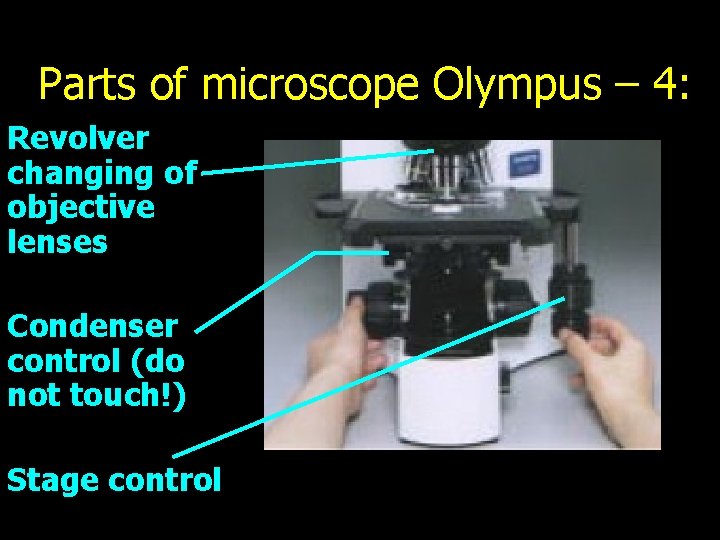
Parts of microscope Olympus – 4: Revolver changing of objective lenses Condenser control (do not touch!) Stage control
Parts of microscope Olympus – 4: • Condenser control: do not use it at any circumstances! • Stage control you should use it to find the appropriate place in the preparation • Revolver changing of objectives: – Use 100× magnifying immersion objective lens when observing stained preparations (Gram staining, Giemsa staining, Trichrom staining) and using immersion oil – Use 4×, 10× or 40× magnifying non-immersion objective lenses when observing wet mounts (including results of Faust and Kato method in parasitology. No immersion oil is used when using these objectives!
Immersion oil use • NEVER USE IMMERSION OIL WITH NON IMMERSION OBJECTIVE LENSES!!! • When using immersion oil with immersion objective, it is necessary to clean the objective after use
Cleaning the microscope • After use of microscope, non-immersion objectives should be only cleaned when dirty. Immersion objectives should be always cleaned by benzine („BENZÍN“) and soft gauze. Do not use filtration paper squares for cleaning objectives! It should be only used for cleaning of stage (= the flat part of the microscope, where your preparation is placed)
Discarding/cleaning the preparations • Preparations made by yourselves should be discarded after use to the disinfectant solution • Preparations already prepared at the start of the practical should be cleaned (see further) and placed back to the original Petri dish
How to clean a preparation without destroying it • Clean the preparation using benzine and filtration paper square from the underneath (bottom) side thoroughly • From upper side, do the same ONLY in areas where you see no visible preparation • Never try to clean the preparation part of your slide. It is only possible to blot out excess of immersion oil using filtration paper (without moving the paper against the slide!)
What to do after work with microscopes • Switch your microscope off • Clean the objective lens (lenses), if necessary • Clean the stage, if necessary • Cover the microscope by dust jacket • Discard/clean your preparation as described
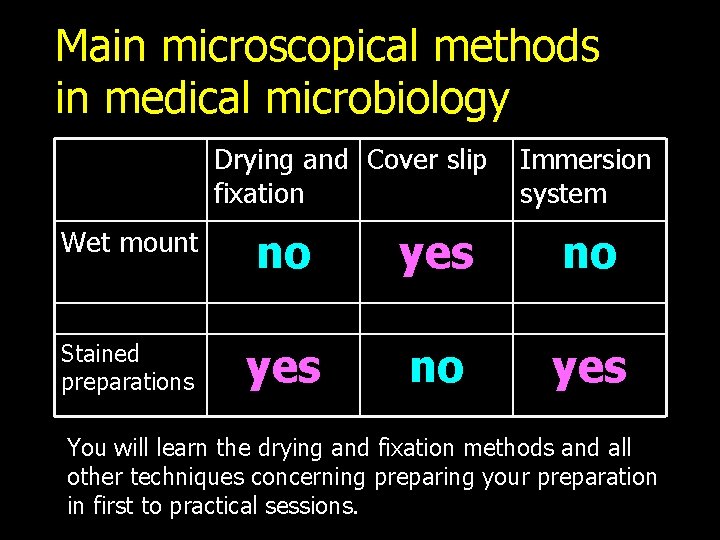
Main microscopical methods in medical microbiology Drying and Cover slip fixation Immersion system Wet mount no yes no Stained preparations yes no yes You will learn the drying and fixation methods and all other techniques concerning preparing your preparation in first to practical sessions.
Self-check that you understood properly • There is a e-questionaire on „ROPOT“ part of IS MUNI. Fill it, please. Successful filling it is a condition for your work in the first practical session.
We look forward to see you on the first practical sessions! Your teachers