
How to Use This Template 1 Take note

- Slides: 14
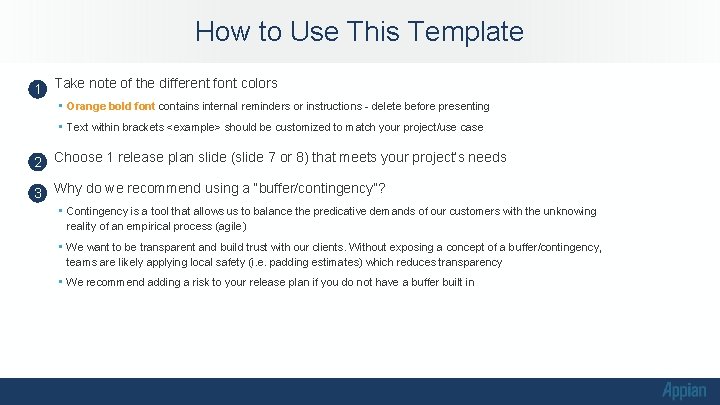
How to Use This Template 1 Take note of the different font colors • Orange bold font contains internal reminders or instructions - delete before presenting • Text within brackets <example> should be customized to match your project/use case 2 Choose 1 release plan slide (slide 7 or 8) that meets your project’s needs 3 Why do we recommend using a “buffer/contingency”? • Contingency is a tool that allows us to balance the predicative demands of our customers with the unknowing reality of an empirical process (agile) • We want to be transparent and build trust with our clients. Without exposing a concept of a buffer/contingency, teams are likely applying local safety (i. e. padding estimates) which reduces transparency • We recommend adding a risk to your release plan if you do not have a buffer built in
<Project Name> Release Plan Presenter | Title | Date
Agenda Executive Summary Release Plan Roadmap Assumptions Risks
Executive Summary Target velocity (<#> points per <2>-week sprint) is projected to deliver <list high-level functionality here> in <#> weeks Release Plan. The Release Plan includes several assumptions and risks items identified in this document. <Team Name> will work to ensure these items are mitigated to achieve target velocity.
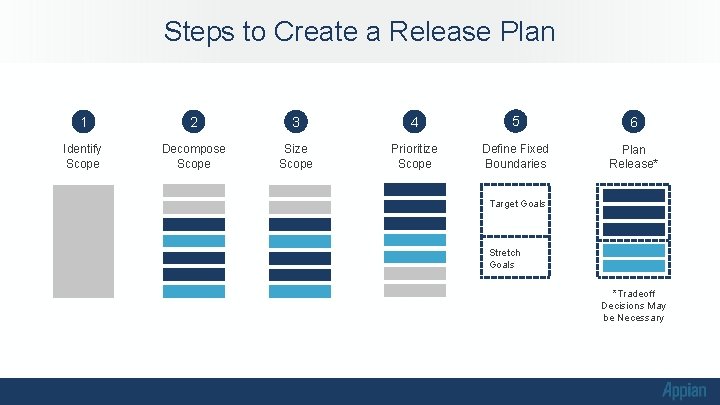
Steps to Create a Release Plan 1 2 3 4 5 6 Identify Scope Decompose Scope Size Scope Prioritize Scope Define Fixed Boundaries Plan Release* 8 21 3 2 13 8 13 13 8 3 2 13 8 21 Target Goals Stretch Goals *Tradeoff Decisions May be Necessary
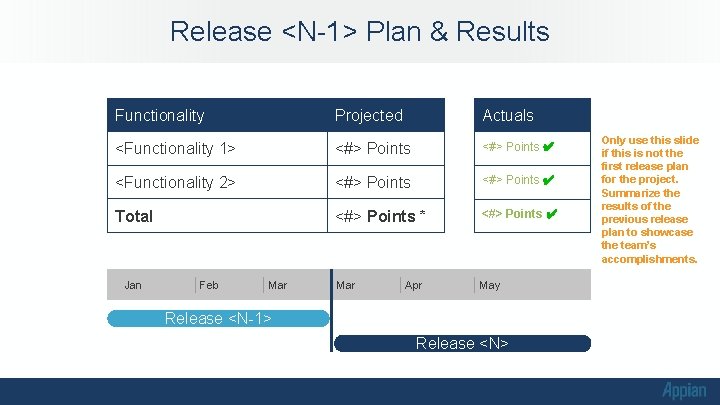
Release <N-1> Plan & Results Functionality Projected Actuals <Functionality 1> <#> Points ✔ <Functionality 2> <#> Points ✔ Total <#> Points * <#> Points ✔ Mar May Jan Feb Mar Apr Release <N-1> Release <N> Only use this slide if this is not the first release plan for the project. Summarize the results of the previous release plan to showcase the team’s accomplishments.
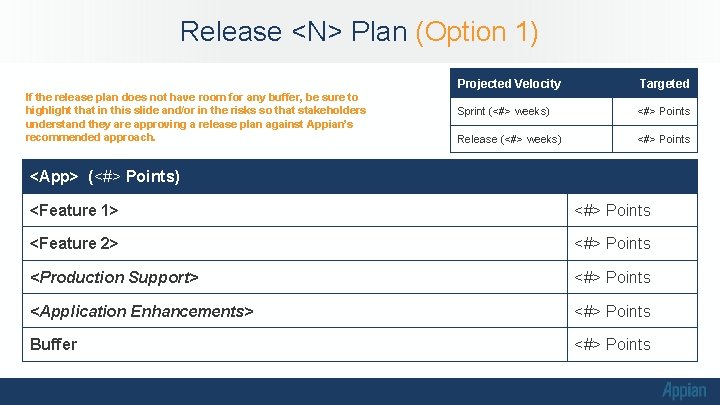
Release <N> Plan (Option 1) If the release plan does not have room for any buffer, be sure to highlight that in this slide and/or in the risks so that stakeholders understand they are approving a release plan against Appian’s recommended approach. Projected Velocity Targeted Sprint (<#> weeks) <#> Points Release (<#> weeks) <#> Points <App> (<#> Points) <Feature 1> <#> Points <Feature 2> <#> Points <Production Support> <#> Points <Application Enhancements> <#> Points Buffer <#> Points
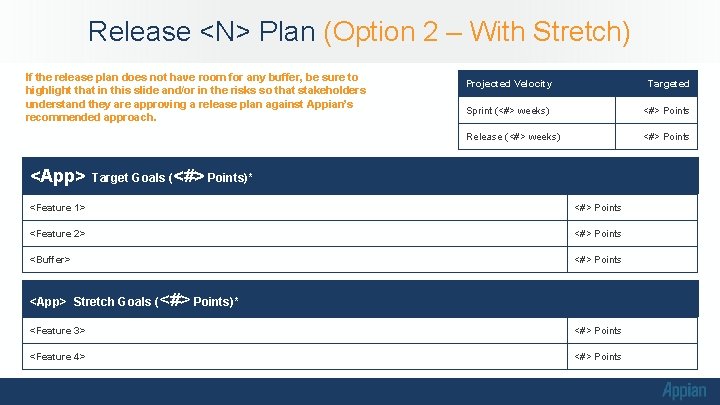
Release <N> Plan (Option 2 – With Stretch) If the release plan does not have room for any buffer, be sure to highlight that in this slide and/or in the risks so that stakeholders understand they are approving a release plan against Appian’s recommended approach. <App> Projected Velocity Targeted Sprint (<#> weeks) <#> Points Release (<#> weeks) <#> Points Target Goals (<#> Points)* <Feature 1> <#> Points <Feature 2> <#> Points <Buffer> <#> Points <App> Stretch Goals (<#> Points)* <Feature 3> <#> Points <Feature 4> <#> Points
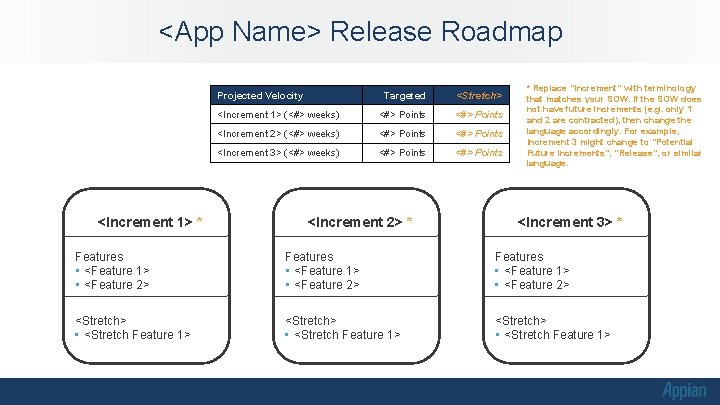
<App Name> Release Roadmap Projected Velocity <Increment 1> * Targeted <Stretch> <Increment 1> (<#> weeks) <#> Points <Increment 2> (<#> weeks) <#> Points <Increment 3> (<#> weeks) <#> Points <Increment 2> * * Replace “Increment” with terminology that matches your SOW. If the SOW does not have future increments (e. g. only 1 and 2 are contracted), then change the language accordingly. For example, Increment 3 might change to "Potential Future Increments", “Release”, or similar language. <Increment 3> * Features • <Feature 1> • <Feature 2> <Stretch> • <Stretch Feature 1>
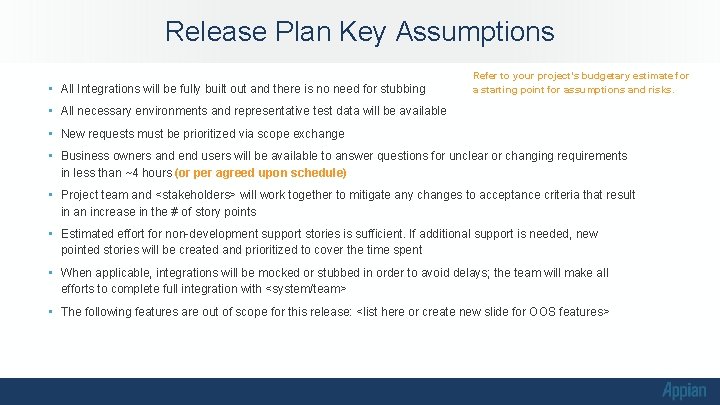
Release Plan Key Assumptions • All Integrations will be fully built out and there is no need for stubbing Refer to your project’s budgetary estimate for a starting point for assumptions and risks. • All necessary environments and representative test data will be available • New requests must be prioritized via scope exchange • Business owners and end users will be available to answer questions for unclear or changing requirements in less than ~4 hours (or per agreed upon schedule) • Project team and <stakeholders> will work together to mitigate any changes to acceptance criteria that result in an increase in the # of story points • Estimated effort for non-development support stories is sufficient. If additional support is needed, new pointed stories will be created and prioritized to cover the time spent • When applicable, integrations will be mocked or stubbed in order to avoid delays; the team will make all efforts to complete full integration with <system/team> • The following features are out of scope for this release: <list here or create new slide for OOS features>
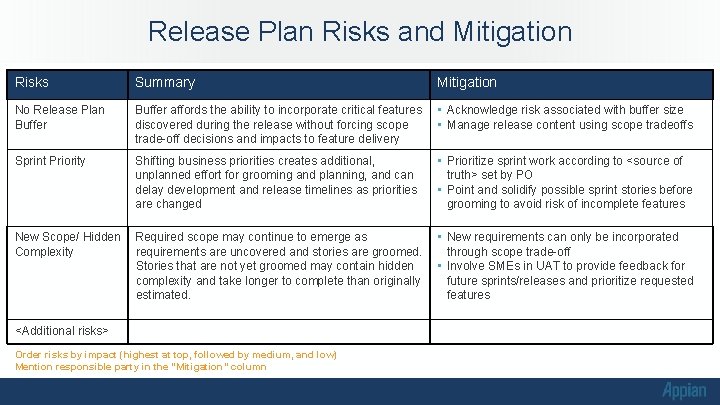
Release Plan Risks and Mitigation Risks Summary Mitigation No Release Plan Buffer affords the ability to incorporate critical features discovered during the release without forcing scope trade-off decisions and impacts to feature delivery • Acknowledge risk associated with buffer size • Manage release content using scope tradeoffs Sprint Priority Shifting business priorities creates additional, unplanned effort for grooming and planning, and can delay development and release timelines as priorities are changed • Prioritize sprint work according to <source of truth> set by PO • Point and solidify possible sprint stories before grooming to avoid risk of incomplete features New Scope/ Hidden Complexity Required scope may continue to emerge as requirements are uncovered and stories are groomed. Stories that are not yet groomed may contain hidden complexity and take longer to complete than originally estimated. • New requirements can only be incorporated through scope trade-off • Involve SMEs in UAT to provide feedback for future sprints/releases and prioritize requested features <Additional risks> Order risks by impact (highest at top, followed by medium, and low) Mention responsible party in the “Mitigation” column
v Appendix
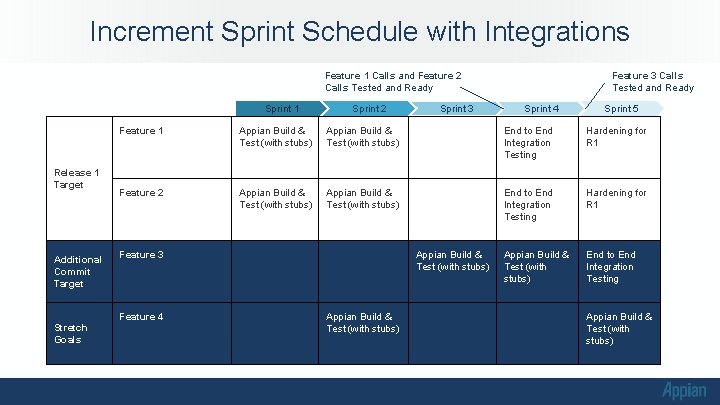
Increment Sprint Schedule with Integrations Feature 3 Calls Tested and Ready Feature 1 Calls and Feature 2 Calls Tested and Ready Sprint 1 Release 1 Target Additional Commit Target Sprint 3 Sprint 4 Sprint 5 Feature 1 Appian Build & Test (with stubs) End to End Integration Testing Hardening for R 1 Feature 2 Appian Build & Test (with stubs) End to End Integration Testing Hardening for R 1 Appian Build & Test (with stubs) End to End Integration Testing Feature 3 Feature 4 Stretch Goals Sprint 2 Appian Build & Test (with stubs)
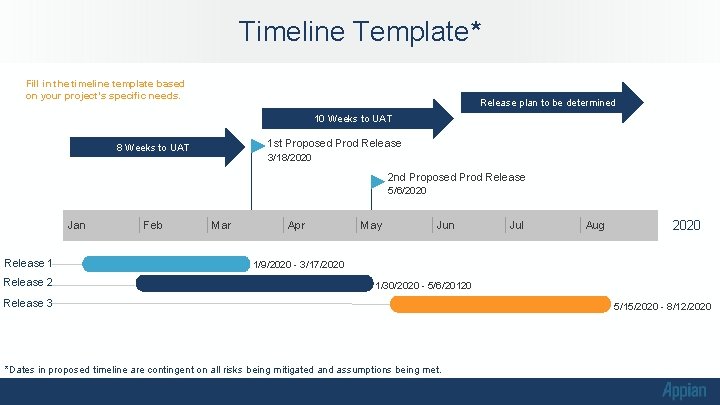
Timeline Template* Fill in the timeline template based on your project’s specific needs. Release plan to be determined 10 Weeks to UAT 1 st Proposed Prod Release 8 Weeks to UAT 3/18/2020 2 nd Proposed Prod Release 5/6/2020 Jan Release 1 Release 2 Feb Mar Apr May Jun Jul Aug 2020 1/9/2020 - 3/17/2020 1/30/2020 - 5/6/20120 Release 3 *Dates in proposed timeline are contingent on all risks being mitigated and assumptions being met. 5/15/2020 - 8/12/2020