
How to use this slide deck This presentation
- Slides: 39
How to use this slide deck • This presentation has been developed to help you to prepare your residents for CBD. • Significant content has been included to assist presenters who may be unfamiliar with CBD. You may edit the presentation to reflect the most relevant slides for residents in your discipline. • This presentation must be customized. You will need to: • Insert your discipline or University where appropriate • Introduce local curriculum • Replace the cartoons on slides 32 -34 with cartoons or pictures relevant to your discipline • Include examples of EPAs and milestones from your discipline • Highlight your local assessment plan and forms • Prepare to demonstrate the electronic platform that your residents will use • Highlight local support for residents • Share and/or modify these slides as needed but source the Royal College. All text and logos contained herein are the property of Royal College of Physicians and Surgeons of Canada. • Questions? Email cbd@royalcollege. ca
Welcome to (insert your discipline) A Resident’s orientation to CBD The best health for all. The best care for all.
Goals and Objectives By the end of this session you will be able to: 1. Explain to a colleague what CBD is and the rationale for its use in medical training 2. Describe the CBD approach to medical training, specifically in (Insert your discipline) 3. Be able to define some new terms: 1. EPA 2. Milestones 3. Work-based assessment 4. Understand your role as a resident in a CBD world.
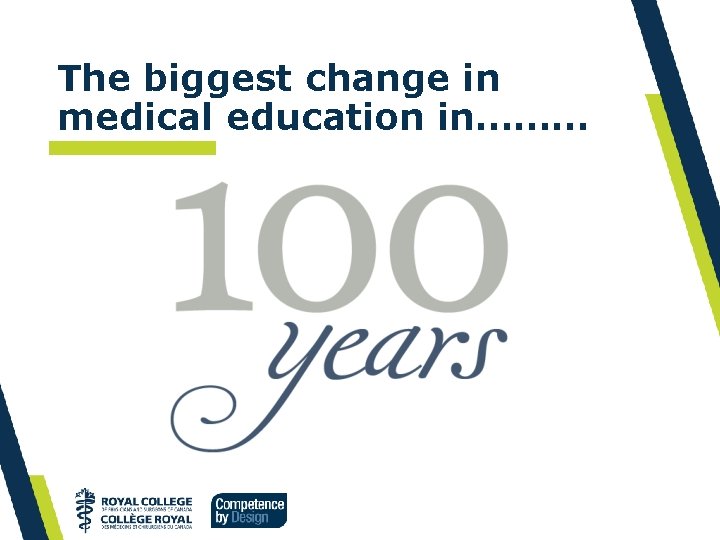
The biggest change in medical education in………
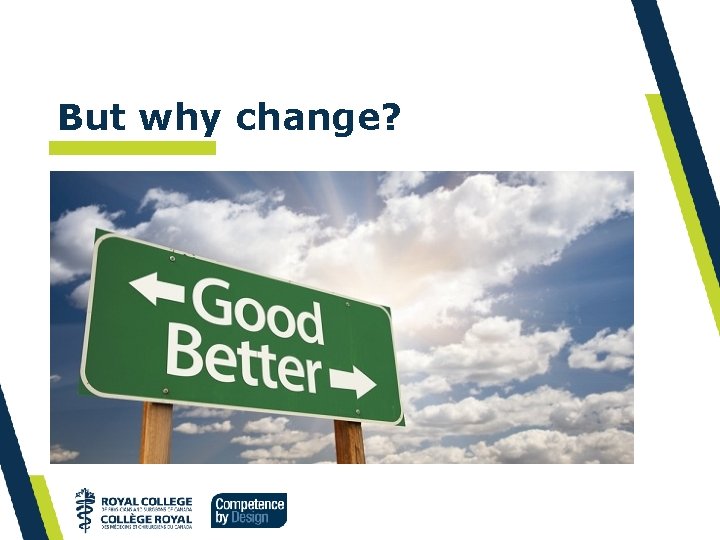
But why change?
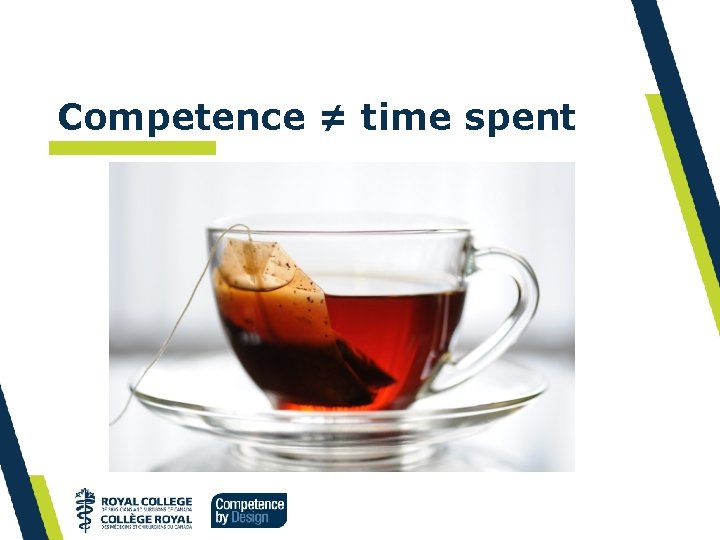
Competence ≠ time spent
What is CBME and what is CBD?
CBME • Competency-based medical education (CBME) is an outcomes-based approach to the design, implementation, assessment, and evaluation of a medical education program using an organizing framework of competencies. • Used around the world including in the United States, Australia and Europe
CBD • Competence by Design (CBD) is the Royal College’s multi-year, medical education, transformational change initiative aimed at implementing a CBME approach to education and assessment to residency training and specialty practice in Canada. • The goal of CBD is to enhance patient care by improving learning and assessment across the continuum (from residency to retirement), ensuring physicians have the skills and behaviours required to continuously meet evolving patient needs.
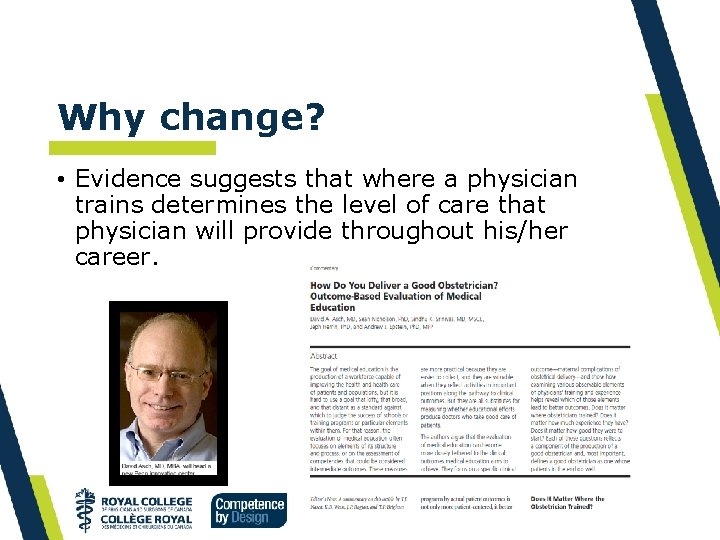
Why change? • Evidence suggests that where a physician trains determines the level of care that physician will provide throughout his/her career.
How does CBD benefit learners? • More frequent assessment and meaningful feedback from faculty • Well-defined learning paths and clarity around the competencies needed to progress to the next stages of training • A learning path that focuses on personal development • Easier transitions between stages • Empowerment of residents in training • The chance to prepare for independent practice by honing skills and working more independently during the final stage of residency
Stages, EPAs and Milestones
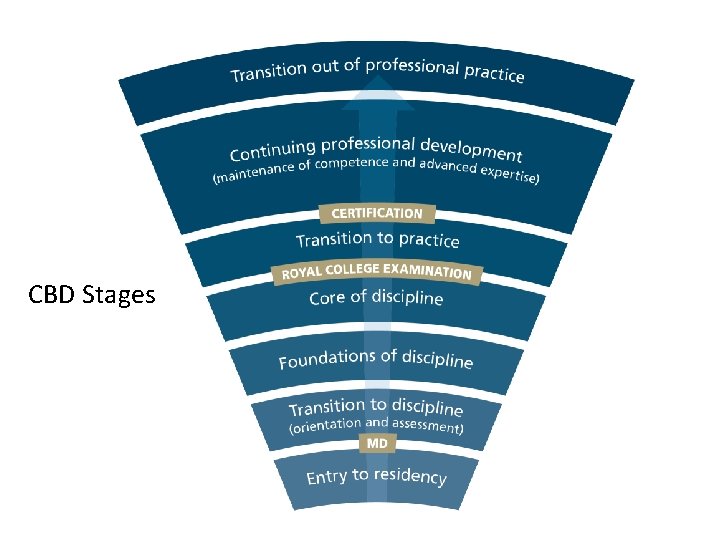
CBD Stages
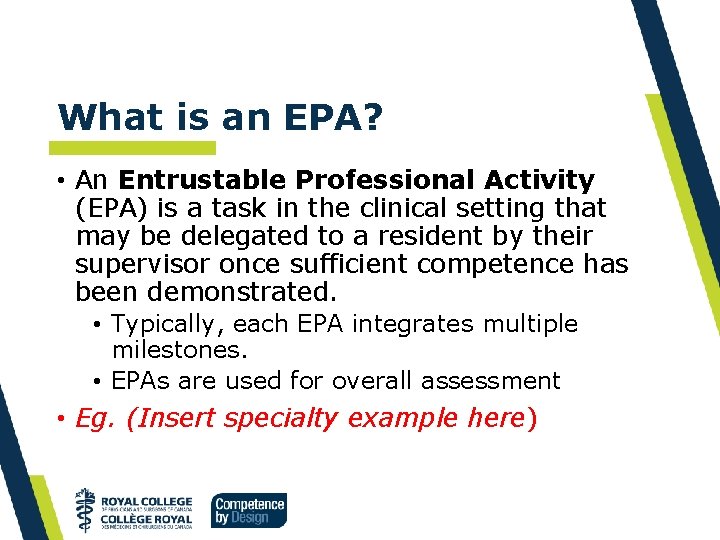
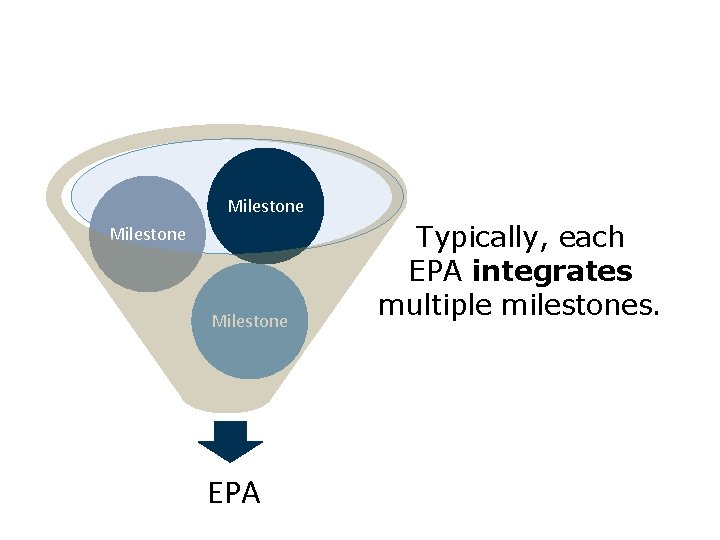
What is an EPA? • An Entrustable Professional Activity (EPA) is a task in the clinical setting that may be delegated to a resident by their supervisor once sufficient competence has been demonstrated. • Typically, each EPA integrates multiple milestones. • EPAs are used for overall assessment • Eg. (Insert specialty example here)
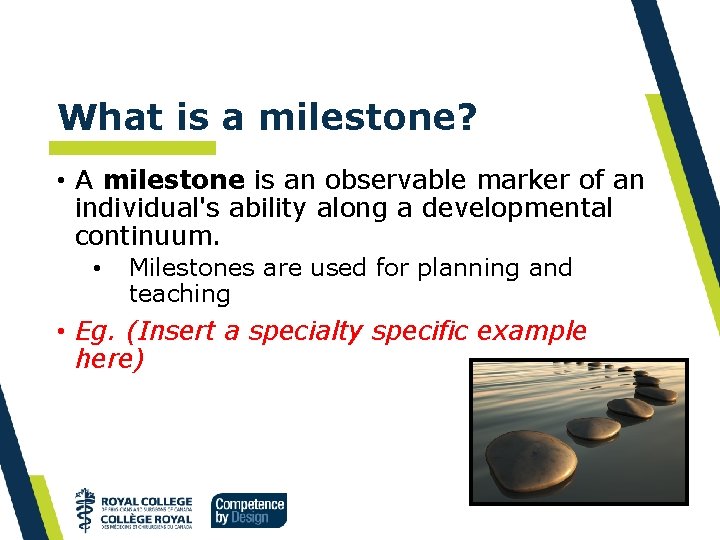
What is a milestone? • A milestone is an observable marker of an individual's ability along a developmental continuum. • Milestones are used for planning and teaching • Eg. (Insert a specialty specific example here)
What is the difference • The key difference between EPAs and milestones is that EPAs are the tasks or activities that must be accomplished, whereas milestones are the abilities of the individual. Understanding Entrustable Professional Activities (EPAs) EPAs - Dr. Lisa Bahrey U of T Anaesthesia
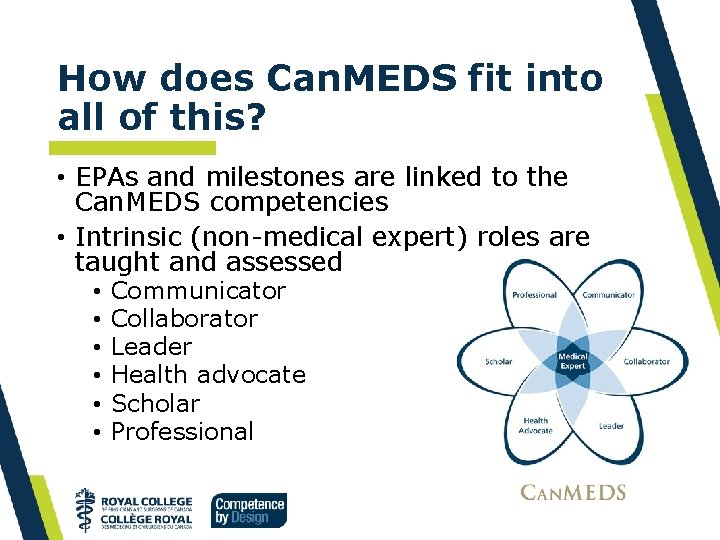
How does Can. MEDS fit into all of this? • EPAs and milestones are linked to the Can. MEDS competencies • Intrinsic (non-medical expert) roles are taught and assessed • • • Communicator Collaborator Leader Health advocate Scholar Professional
An example of an EPA and milestones • Insert example from one of the stages in your specialty with the EPA and milestones together
Milestone EPA Typically, each EPA integrates multiple milestones.
Assessment in CBD
What is work-based assessment? • What is WBA? • How does WBA work?
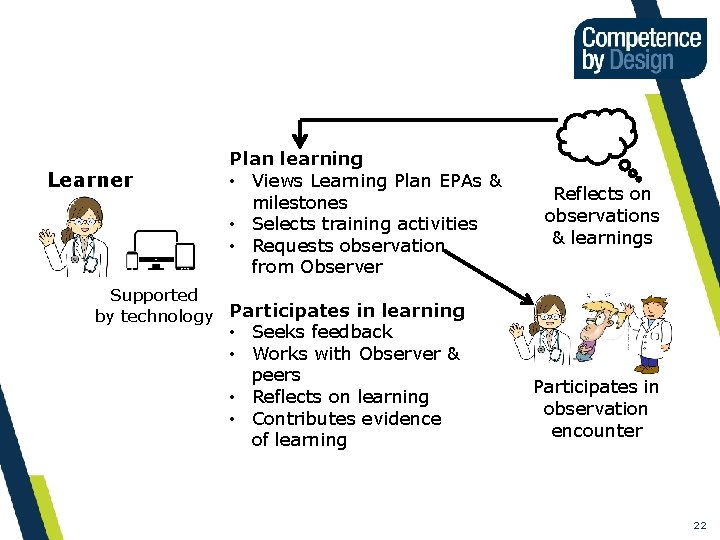
How Will it Work? Learner Plan learning • Views Learning Plan EPAs & milestones • Selects training activities • Requests observation from Observer Reflects on observations & learnings Supported by technology Participates in learning • Seeks feedback • Works with Observer & peers • Reflects on learning • Contributes evidence of learning Participates in observation encounter 22
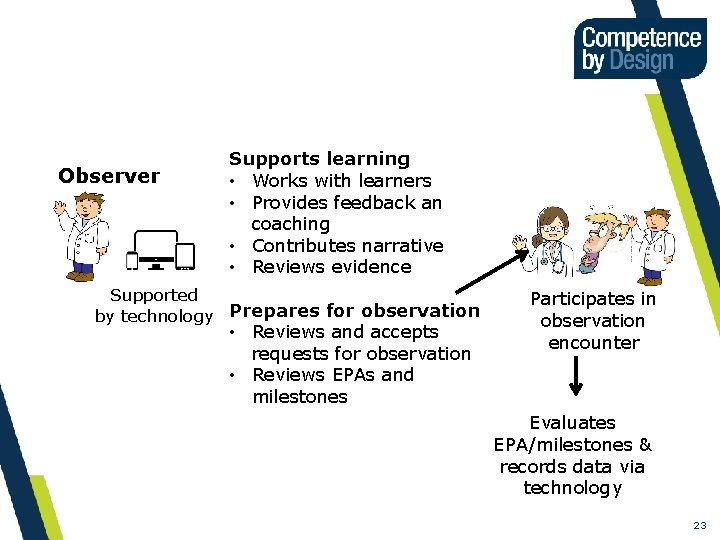
How Will it Work? Observer Supports learning • Works with learners • Provides feedback an coaching • Contributes narrative • Reviews evidence Supported by technology Prepares for observation • Reviews and accepts requests for observation • Reviews EPAs and milestones Participates in observation encounter Evaluates EPA/milestones & records data via technology 23
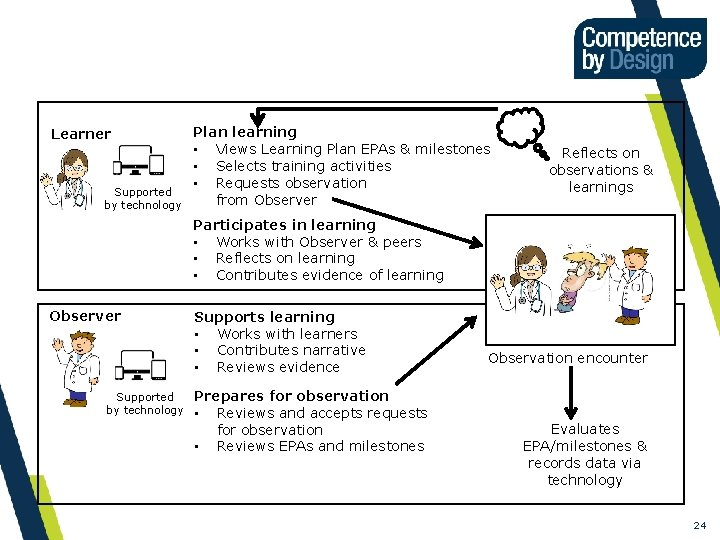
How Will it Work? Learner and Observer Learner Supported by technology Plan learning • Views Learning Plan EPAs & milestones • Selects training activities • Requests observation from Observer Reflects on observations & learnings Participates in learning • Works with Observer & peers • Reflects on learning • Contributes evidence of learning Observer Supported by technology Supports learning • Works with learners • Contributes narrative • Reviews evidence Prepares for observation • Reviews and accepts requests for observation • Reviews EPAs and milestones Observation encounter Evaluates EPA/milestones & records data via technology 24
Assessment Strategy for Medical Oncology EPA: Insert program example here Observation Encounter • Indirect observation Insert program example here • Direct observation Insert program example here • Assessment Strategy and Tools • Insert program example here 25
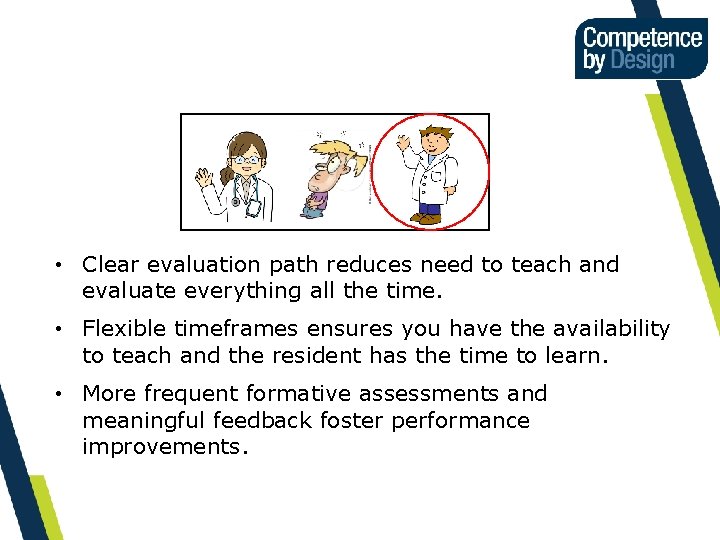
Day in the Life of an Observer • Clear evaluation path reduces need to teach and evaluate everything all the time. • Flexible timeframes ensures you have the availability to teach and the resident has the time to learn. • More frequent formative assessments and meaningful feedback foster performance improvements.
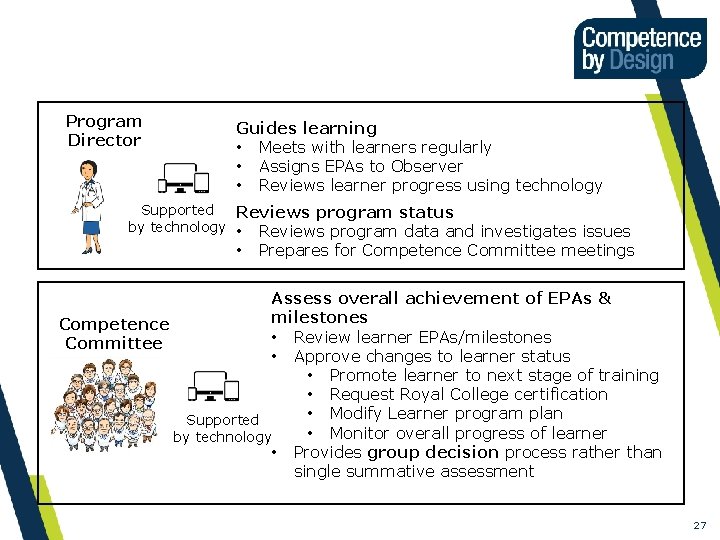
What Happens to the Observation Data? Program Director Guides learning • Meets with learners regularly • Assigns EPAs to Observer • Reviews learner progress using technology Supported Reviews program status by technology • Reviews program data and investigates issues • Prepares for Competence Committee meetings Assess overall achievement of EPAs & milestones Competence • Review learner EPAs/milestones Committee • Approve changes to learner status • Promote learner to next stage of training • Request Royal College certification • Modify Learner program plan Supported • Monitor overall progress of learner by technology • Provides group decision process rather than single summative assessment 27
Remember… • It is the Competence Committee, not a single observer, that will take all of the low stakes assessments and other portfolio information and make a recommendation about your progress in the program
Assessment strategy here at (Insert name of University here) • Go through your local assessment plan, including showing examples of the forms and demonstrating the electronic platform being used
What is your role as a resident in CBD
Background • Residency is for learning, and in order to learn you need to know how to improve • CBD = thinking differently about training, and includes the coaching model to help you improve developmentally • Assessment for learning, as opposed to assessment of learning • This is a culture change – it is about getting regular meaningful feedback and reflecting on it – Embrace it!!
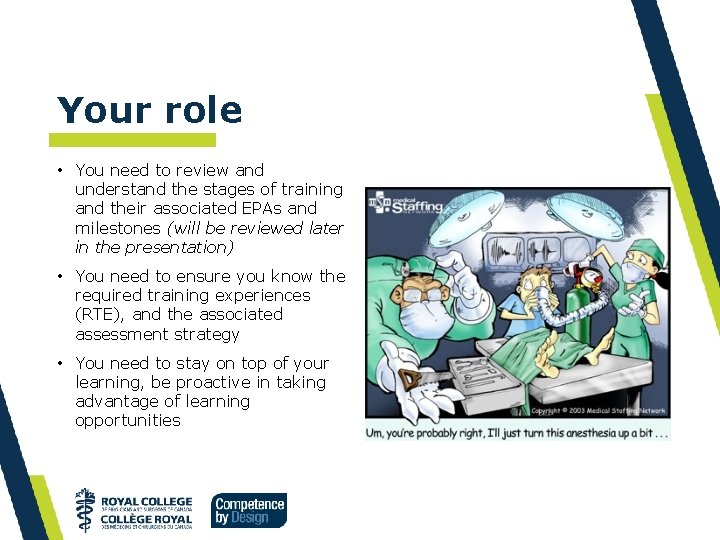
Your role • You need to review and understand the stages of training and their associated EPAs and milestones (will be reviewed later in the presentation) • You need to ensure you know the required training experiences (RTE), and the associated assessment strategy • You need to stay on top of your learning, be proactive in taking advantage of learning opportunities
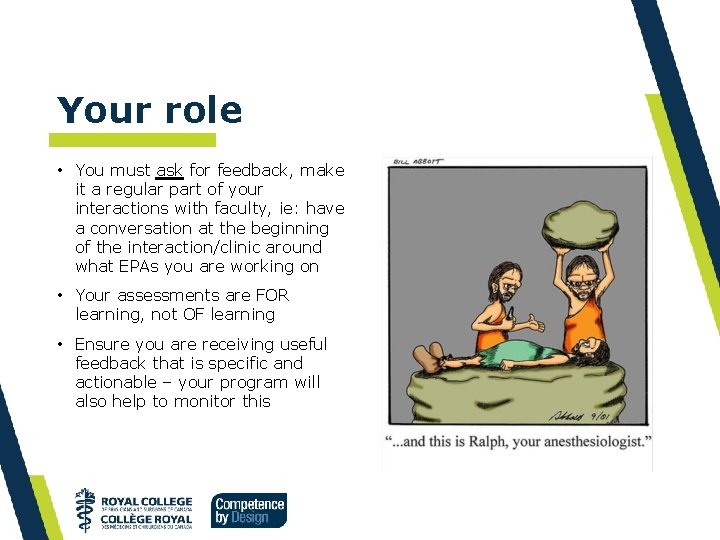
Your role • You must ask for feedback, make it a regular part of your interactions with faculty, ie: have a conversation at the beginning of the interaction/clinic around what EPAs you are working on • Your assessments are FOR learning, not OF learning • Ensure you are receiving useful feedback that is specific and actionable – your program will also help to monitor this
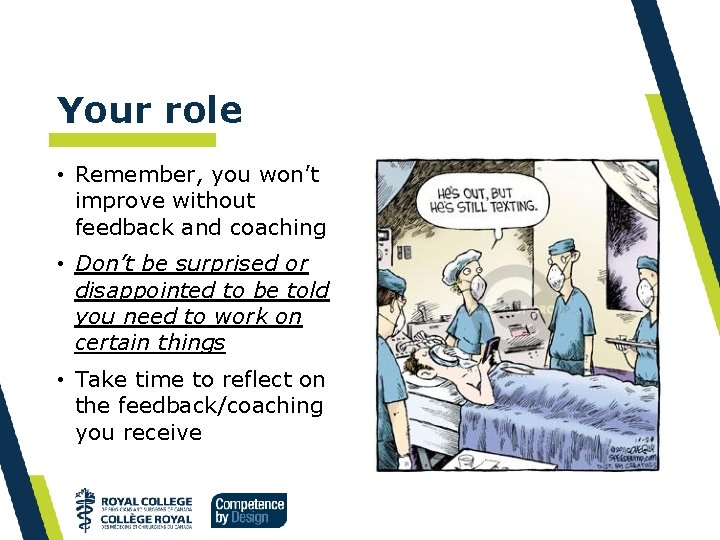
Your role • Remember, you won’t improve without feedback and coaching • Don’t be surprised or disappointed to be told you need to work on certain things • Take time to reflect on the feedback/coaching you receive
Your role • Seek opportunities to be mentored by peers, and to mentor peers both around performance and learning about training opportunities • Provide faculty with feedback – during the feedback session if appropriate or through your program’s online teacher evaluation system. They too need to know how they are doing!
Your role • Need to ensure you get the right number of assessments in the right contexts • Need to ask questions when you don’t know • Need to enjoy this time!
Our role • Teach you the local curriculum including EPAs, milestones and assessment strategy. • Insert information here about how your local curriculum will work: • Where to find the Curriculum and where to find the EPAs and milestones • Where to find the RTEs • How the assessment strategy will work – review the tools and how to know which ones are used in which context (EPA and RTE) • How many assessments are needed and in which contexts
Our role • Ensure Resident wellness and resilience • Review local wellness curriculum here • Review who residents should turn to for any questions about their curriculum, progress, wellness issues etc. • Review the mechanism for providing feedback about the program (ie: PD, RTC, Chief Residents etc. ) • Who to turn to if they get lost in navigating this new system (ie: PD, Chief residents, CBD coordinator) • ? peer support program
Summary – what we said we would do • By the end of this session you will be able to: 1. Explain to a colleague what CBD is and the rationale for its use in medical training 2. Describe the CBD approach to medical training, specifically in (Insert your discipline) 3. Be able to define some new terms: 1. 2. 3. EPA Milestones Work-based assessment 4. Understand your role as a resident in a CBD world.