
How to Use This Presentation To View the
- Slides: 48
How to Use This Presentation • To View the presentation as a slideshow with effects select “View” on the menu bar and click on “Slide Show”, or simply press F 5 on the top row of your keyboard. • To advance to the next slide click the left mouse button once. • From the Chapter screen you can click on any section to go directly to that section’s presentation. • Blank or “missing” areas of a slide will remain hidden until the left mouse button is clicked. • You may exit the slide show at any time by pressing the Esc key. Chapter menu Resources Copyright © by Holt, Rinehart and Winston. All rights reserved.
Resources Bellringers Chapter Presentation Transparencies Standardized Test Prep Visual Concepts Image and Math Focus Bank Chapter menu Resources Copyright © by Holt, Rinehart and Winston. All rights reserved.
Chapter 15 The Atmosphere Table of Contents Section 1 Characteristics of the Atmosphere Section 2 Atmospheric Heating Section 3 Global Winds and Local Winds Section 4 Air Pollution Chapter menu Resources Copyright © by Holt, Rinehart and Winston. All rights reserved.
Chapter 15 Section 1 Characteristics of the Atmosphere Bellringer List the ways that the atmosphere is different from outer space. Write your list in your science journal. Chapter menu Resources Copyright © by Holt, Rinehart and Winston. All rights reserved.
Chapter 15 Section 1 Characteristics of the Atmosphere Review 2/8/12 1. What are the 4 layers of the atmosphere from the surface of the earth to space? 2. What layer contains ozone? 3. What does ozone do to protect us? 4. What defines each atmospheric layer? 5. What are three methods of heat transfer? 6. A hot air balloon rising in the sky would be an example of what type of heat transfer process? Chapter menu Resources Copyright © by Holt, Rinehart and Winston. All rights reserved.
Chapter 15 Section 1 Characteristics of the Atmosphere Review 2/8/12 7. Burning your hand on a hot iron would be an example of what type of heat transfer process? 8. The movement of the tectonic plates is a result of what heat transfer process in the asthenosphere? 9. What heat transfer process would be responsible for tanning your skin on a hot summer day? 10. What is the most common gas in the atmosphere? 11. Besides nitrogen and oxygen name 2 other gases in the atmosphere Chapter menu Resources Copyright © by Holt, Rinehart and Winston. All rights reserved.
Chapter 15 Section 1 Characteristics of the Atmosphere Objectives • Describe the composition of Earth’s atmosphere. • Explain why air pressure changes with altitude. • Explain how air temperature changes with atmospheric composition. • Describe the layers of the atmosphere. Chapter menu Resources Copyright © by Holt, Rinehart and Winston. All rights reserved.
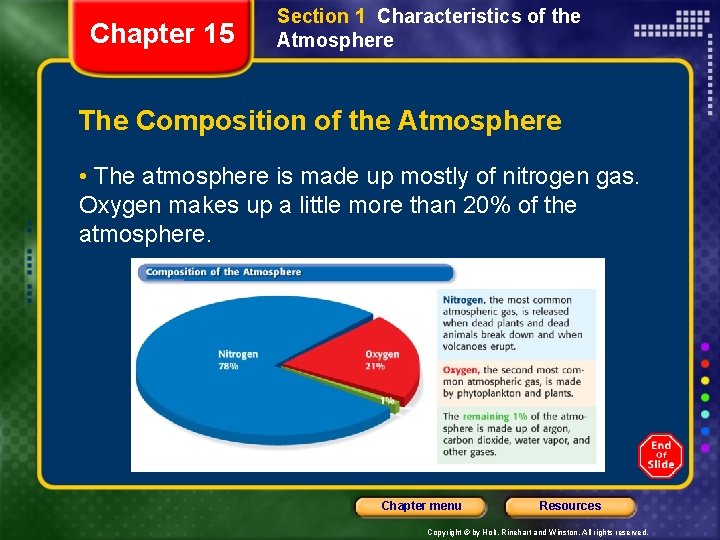
Chapter 15 Section 1 Characteristics of the Atmosphere The Composition of the Atmosphere • The atmosphere is made up mostly of nitrogen gas. Oxygen makes up a little more than 20% of the atmosphere. Chapter menu Resources Copyright © by Holt, Rinehart and Winston. All rights reserved.
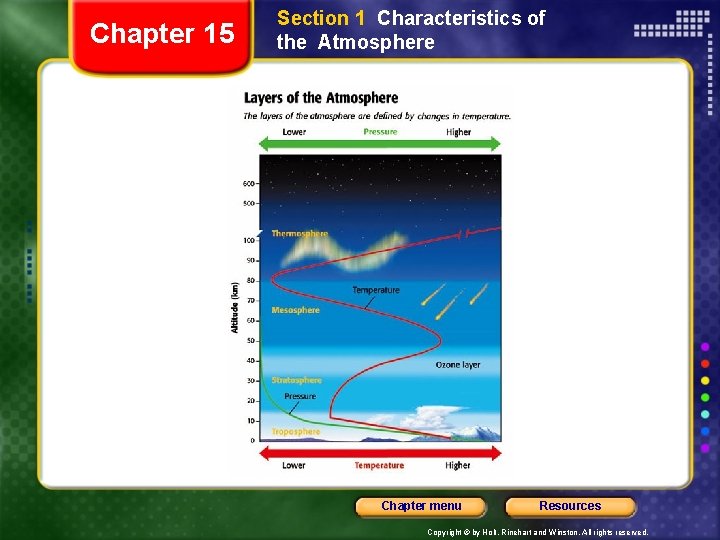
Chapter 15 Section 1 Characteristics of the Atmospheric Pressure and Temperature • The atmosphere is held around the Earth by gravity. Gravity pulls gas molecules in the atmosphere toward the Earth’s surface, causing air pressure. • As altitude increases, air pressure decreases. • Air temperature decreases as altitude increases. Lower parts of the atmosphere are warmer because they contain a high percentage of gases that absorb solar energy. Chapter menu Resources Copyright © by Holt, Rinehart and Winston. All rights reserved.
Chapter 15 Section 1 Characteristics of the Atmosphere Layers of the Atmosphere • The Troposphere: The Layer in Which We Live The lowest layer of the atmosphere, which lies next to the Earth’s surface, is called the troposphere. • The Stratosphere: Home of the Ozone Layer The atmospheric layer above the troposphere is called the stratosphere. • The Mesosphere: The Middle Layer The mesosphere is the middle layer of the atmosphere. It is also the coldest layer. Chapter menu Resources Copyright © by Holt, Rinehart and Winston. All rights reserved.
Chapter 15 Section 1 Characteristics of the Atmosphere Layers of the Atmosphere, continued • Thermosphere: The Edge of the Atmosphere The uppermost atmospheric layer is called thermosphere. • The Ionosphere: Home of the Auroras In the upper mesosphere and the lower thermosphere, nitrogen and oxygen atoms absorb harmful solar energy. This area is called the ionosphere. Chapter menu Resources Copyright © by Holt, Rinehart and Winston. All rights reserved.
Chapter 15 Section 1 Characteristics of the Atmosphere Chapter menu Resources Copyright © by Holt, Rinehart and Winston. All rights reserved.
Chapter 15 Section 2 Atmospheric Heating Bellringer How is food heated in an oven? Record your response in your science journal. Chapter menu Resources Copyright © by Holt, Rinehart and Winston. All rights reserved.
Chapter 15 Section 2 Atmospheric Heating Objectives • Describe what happens to solar energy that reaches Earth. • Summarize the processes of radiation, thermal conduction, and convection. • Explain the relationship between the greenhouse effect and global warming. Chapter menu Resources Copyright © by Holt, Rinehart and Winston. All rights reserved.
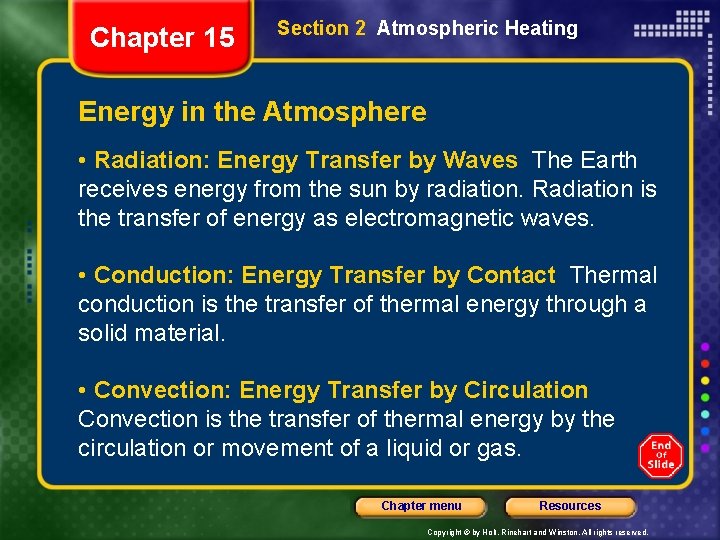
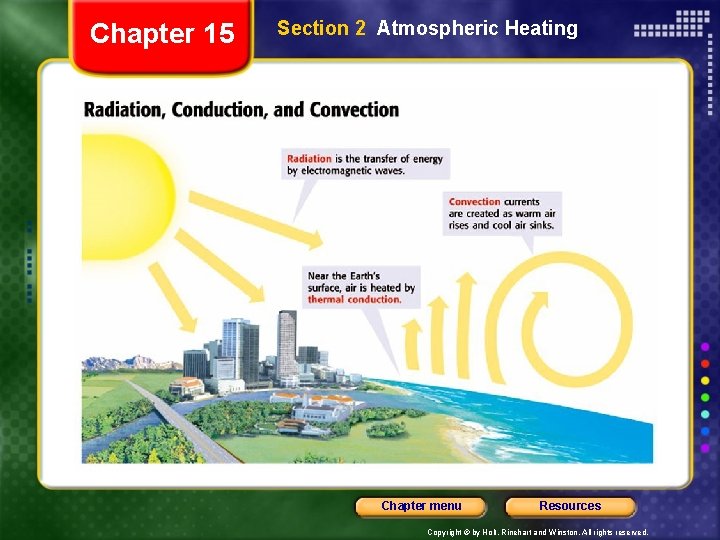
Chapter 15 Section 2 Atmospheric Heating Energy in the Atmosphere • Radiation: Energy Transfer by Waves The Earth receives energy from the sun by radiation. Radiation is the transfer of energy as electromagnetic waves. • Conduction: Energy Transfer by Contact Thermal conduction is the transfer of thermal energy through a solid material. • Convection: Energy Transfer by Circulation Convection is the transfer of thermal energy by the circulation or movement of a liquid or gas. Chapter menu Resources Copyright © by Holt, Rinehart and Winston. All rights reserved.
Chapter 15 Section 2 Atmospheric Heating Chapter menu Resources Copyright © by Holt, Rinehart and Winston. All rights reserved.
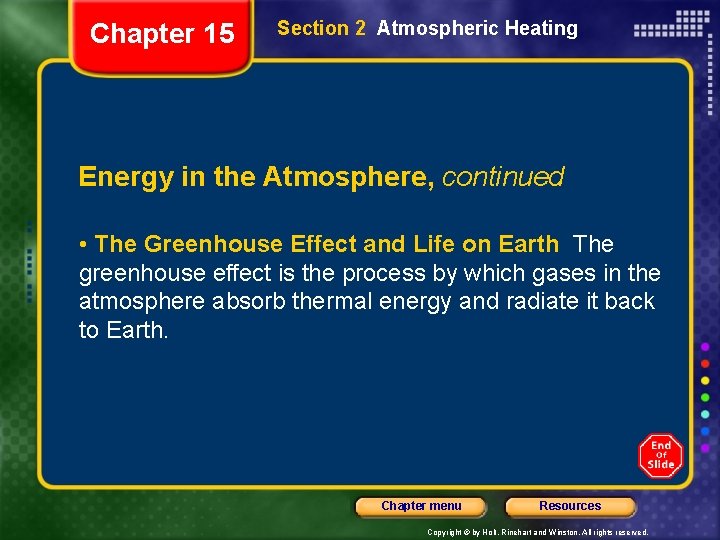
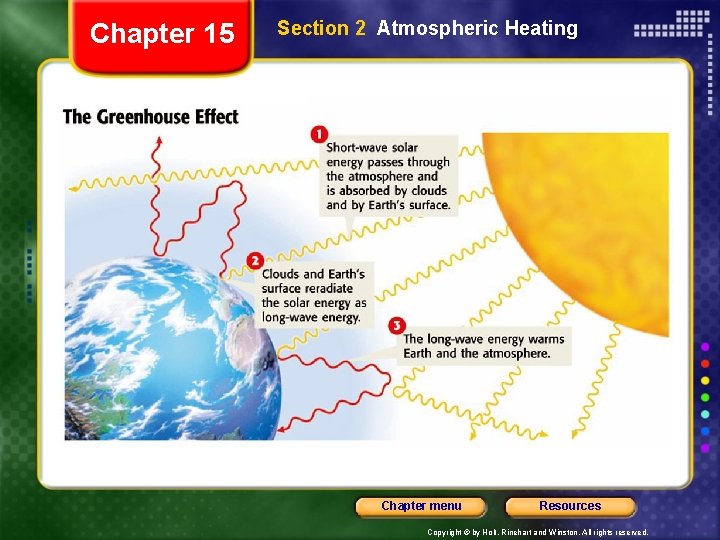
Chapter 15 Section 2 Atmospheric Heating Energy in the Atmosphere, continued • The Greenhouse Effect and Life on Earth The greenhouse effect is the process by which gases in the atmosphere absorb thermal energy and radiate it back to Earth. Chapter menu Resources Copyright © by Holt, Rinehart and Winston. All rights reserved.
Chapter 15 Section 2 Atmospheric Heating Chapter menu Resources Copyright © by Holt, Rinehart and Winston. All rights reserved.
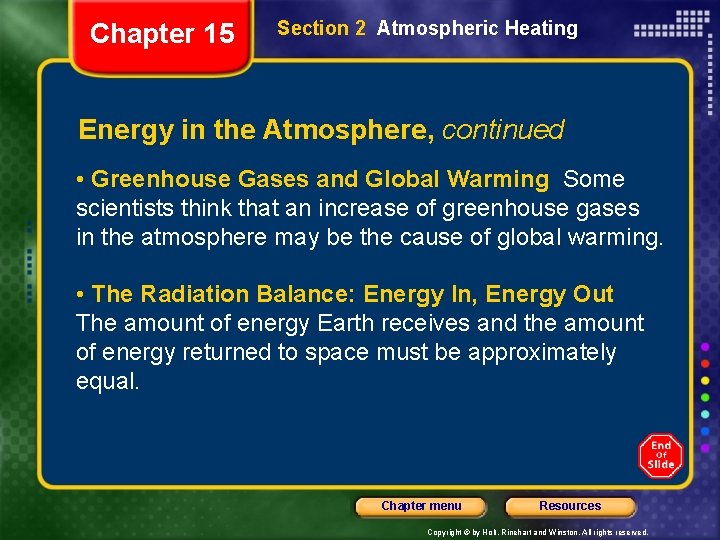
Chapter 15 Section 2 Atmospheric Heating Energy in the Atmosphere, continued • Greenhouse Gases and Global Warming Some scientists think that an increase of greenhouse gases in the atmosphere may be the cause of global warming. • The Radiation Balance: Energy In, Energy Out The amount of energy Earth receives and the amount of energy returned to space must be approximately equal. Chapter menu Resources Copyright © by Holt, Rinehart and Winston. All rights reserved.
Chapter 15 Section 3 Global Winds and Local Winds Bellringer Write a poem about moving air. The poem should include an explanation of why air moves. Record your response in your science journal. Chapter menu Resources Copyright © by Holt, Rinehart and Winston. All rights reserved.
Chapter 15 Section 3 Global Winds and Local Winds Objectives • Explain the relationship between air pressure and wind direction. • Describe global wind patterns. • Explain the causes of local wind patterns. Chapter menu Resources Copyright © by Holt, Rinehart and Winston. All rights reserved.
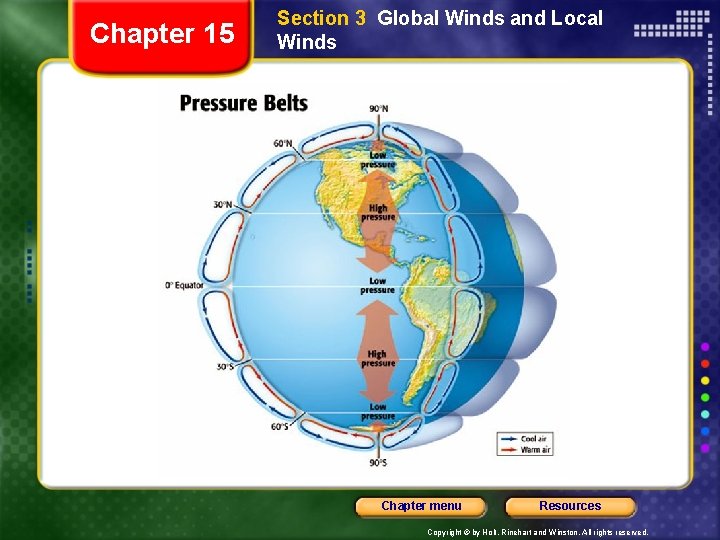
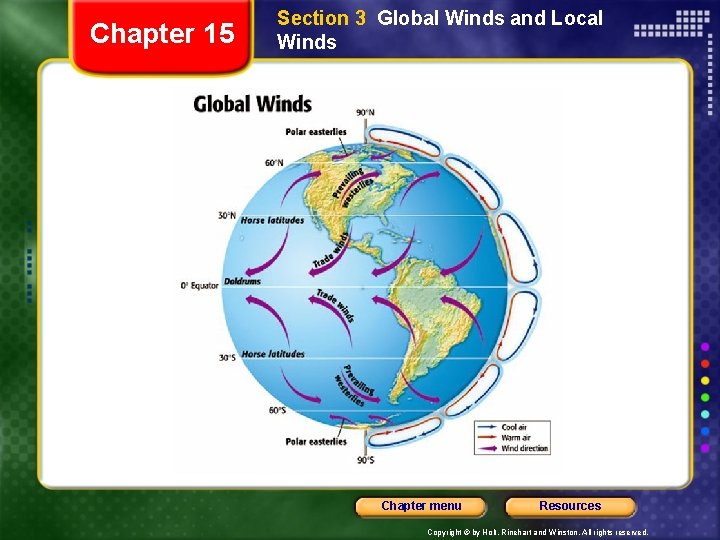
Chapter 15 Section 3 Global Winds and Local Winds Why Air Moves • Air Rises at the Equator and Sinks at the Poles As the cold air sinks, it creates areas of high pressure around the poles. This cold polar air then flows toward the equator. • Pressure Belts Are Found Every 30º Convection cells are separated by pressure belts, bands of high and low pressure. Chapter menu Resources Copyright © by Holt, Rinehart and Winston. All rights reserved.
Chapter 15 Section 3 Global Winds and Local Winds Chapter menu Resources Copyright © by Holt, Rinehart and Winston. All rights reserved.
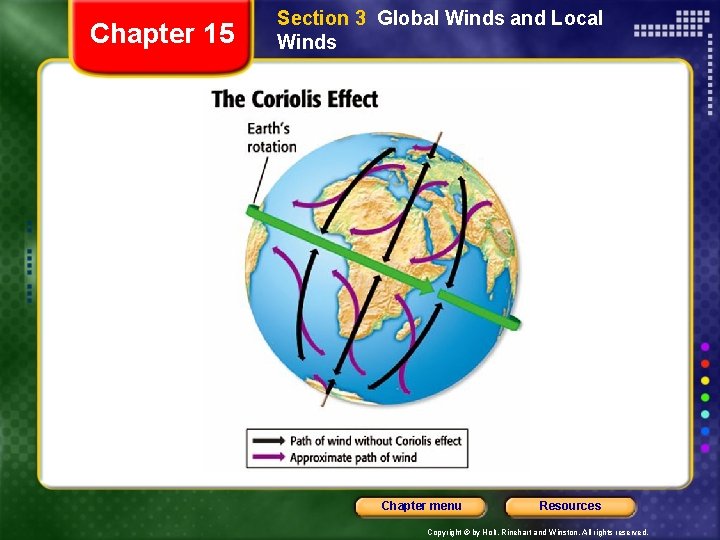
Chapter 15 Section 3 Global Winds and Local Winds Why Air Moves, continued • The Coriolis Effect The apparent curving of the path of currents due to the Earth’s rotation is called the Coriolis effect. Chapter menu Resources Copyright © by Holt, Rinehart and Winston. All rights reserved.
Chapter 15 Section 3 Global Winds and Local Winds Chapter menu Resources Copyright © by Holt, Rinehart and Winston. All rights reserved.
Chapter 15 Section 3 Global Winds and Local Winds Global Winds • Polar Easterlies are the wind belts that extend from the poles to 60° latitude in both hemispheres. • Westerlies are the wind belts found between 30° and 60° latitude in both hemispheres. • Trade Winds are the winds that blow from 30° latitude almost to the equator in both hemispheres. Chapter menu Resources Copyright © by Holt, Rinehart and Winston. All rights reserved.
Chapter 15 Section 3 Global Winds and Local Winds Global Winds, continued • The Doldrums The trade winds of the Northern and Southern Hemispheres meet in an area around the equator called the doldrums. • The Horse Latitudes At about 30° north and 30° south latitude, sinking air creates an area of high pressure called the horse latitudes. • Jet Streams are narrow belts of high-speed winds that blow in the upper troposphere and lower stratosphere. Chapter menu Resources Copyright © by Holt, Rinehart and Winston. All rights reserved.
Chapter 15 Section 3 Global Winds and Local Winds Chapter menu Resources Copyright © by Holt, Rinehart and Winston. All rights reserved.
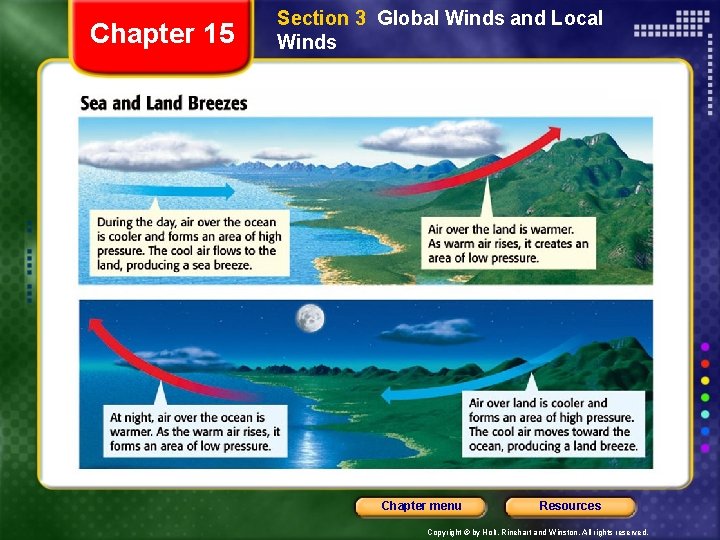
Chapter 15 Section 3 Global Winds and Local Winds • Local winds generally move short distances and can blow from any direction. • Mountain and valley breezes are examples of local winds caused by an area’s geography. • Sea and land breezes are affected by temperature. Chapter menu Resources Copyright © by Holt, Rinehart and Winston. All rights reserved.
Chapter 15 Section 3 Global Winds and Local Winds Chapter menu Resources Copyright © by Holt, Rinehart and Winston. All rights reserved.
Chapter 15 Section 4 Air Pollution Bellringer Examine the filter mask. Make a list of three situations in which one might wear such a mask. Write your list in your science journal. Chapter menu Resources Copyright © by Holt, Rinehart and Winston. All rights reserved.
Chapter 15 Section 4 Air Pollution Objectives • Compare primary and secondary air pollution. • Identify the major sources of pollution. • Explain the effects of the ozone hole. • List five effects of air pollution on the human body. • Identify ways to reduce air pollution. Chapter menu Resources Copyright © by Holt, Rinehart and Winston. All rights reserved.
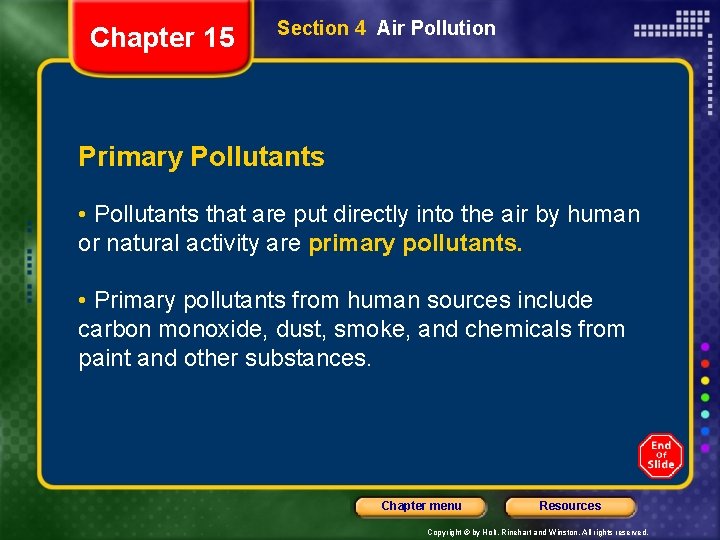
Chapter 15 Section 4 Air Pollution Primary Pollutants • Pollutants that are put directly into the air by human or natural activity are primary pollutants. • Primary pollutants from human sources include carbon monoxide, dust, smoke, and chemicals from paint and other substances. Chapter menu Resources Copyright © by Holt, Rinehart and Winston. All rights reserved.
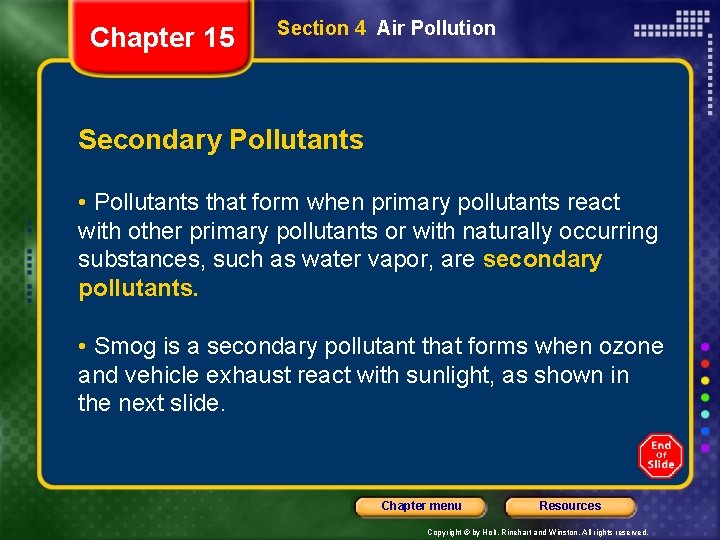
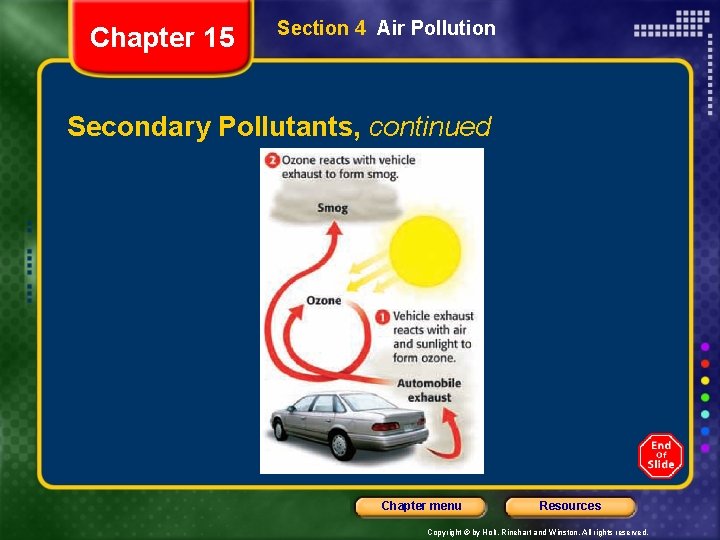
Chapter 15 Section 4 Air Pollution Secondary Pollutants • Pollutants that form when primary pollutants react with other primary pollutants or with naturally occurring substances, such as water vapor, are secondary pollutants. • Smog is a secondary pollutant that forms when ozone and vehicle exhaust react with sunlight, as shown in the next slide. Chapter menu Resources Copyright © by Holt, Rinehart and Winston. All rights reserved.
Chapter 15 Section 4 Air Pollution Secondary Pollutants, continued Chapter menu Resources Copyright © by Holt, Rinehart and Winston. All rights reserved.
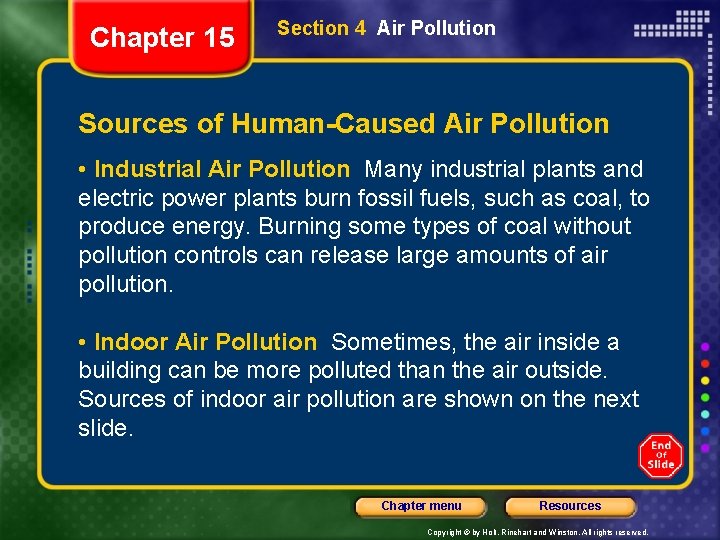
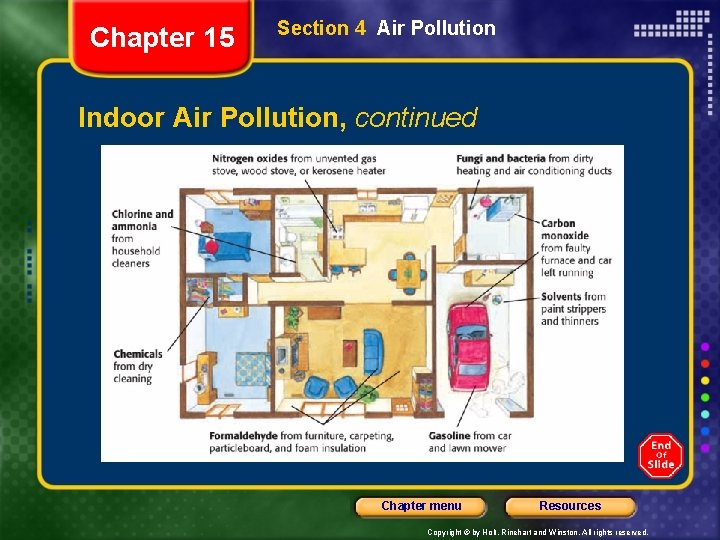
Chapter 15 Section 4 Air Pollution Sources of Human-Caused Air Pollution • Industrial Air Pollution Many industrial plants and electric power plants burn fossil fuels, such as coal, to produce energy. Burning some types of coal without pollution controls can release large amounts of air pollution. • Indoor Air Pollution Sometimes, the air inside a building can be more polluted than the air outside. Sources of indoor air pollution are shown on the next slide. Chapter menu Resources Copyright © by Holt, Rinehart and Winston. All rights reserved.
Chapter 15 Section 4 Air Pollution Indoor Air Pollution, continued Chapter menu Resources Copyright © by Holt, Rinehart and Winston. All rights reserved.
Chapter 15 Section 4 Air Pollution Acid Precipitation • Rain, sleet or snow that contains a high concentration of acids is called acid precipitation. • Acid Precipitation and Plants Acid precipitation cause the acidity of soil to increase. This process, called acidification, changes the balance of a soil’s chemistry and negatively affects plants. Chapter menu Resources Copyright © by Holt, Rinehart and Winston. All rights reserved.
Chapter 15 Section 4 Air Pollution Acid Precipitation, continued • The Effects of Acid Precipitation on Forests In some areas of the world, acid precipitation has damaged large areas of forest. • Acid Precipitation and Aquatic Ecosystems If acid precipitation increases the acidity of a lake or stream, aquatic plants, fish, and other aquatic organisms may die. Chapter menu Resources Copyright © by Holt, Rinehart and Winston. All rights reserved.
Chapter 15 Section 4 Air Pollution The Ozone Hole • The Earth’s protective ozone layer is thinning over the Arctic and Antarctic regions. These ozone holes allow more UV radiation, which damages genes and can cause skin cancer, to reach the earth’s surface. • Cooperation to Reduce the Ozone Hole In 1987, many nations agreed to reduce the use of CFCs, the chemicals that cause ozone depletion. Because CFCs remain active for 60 to 120 years, however, it will take many years for the ozone layer to recover. Chapter menu Resources Copyright © by Holt, Rinehart and Winston. All rights reserved.
Chapter 15 Section 4 Air Pollution Ozone and Ozone Holes Click below to watch the Visual Concept You may stop the video at any time by pressing the Esc key. Chapter menu Resources Copyright © by Holt, Rinehart and Winston. All rights reserved.
Chapter 15 Section 4 Air Pollution and Human Health • Short-Term Effects of air pollution, such as coughing, headaches, and eye irritation can be avoided by staying indoors on days when the air quality is poor. • Long-Term Effects of air pollution, such as lung cancer, are particularly dangerous because they may not be noticed until many years after exposure. Chapter menu Resources Copyright © by Holt, Rinehart and Winston. All rights reserved.
Chapter 15 Section 4 Air Pollution Cleaning up Air Pollution • The EPA sets air quality standards to protect against the effects of air pollution on human health as well as on crops, vegetation, and buildings. • Controlling Air Pollution from Industry The Clean Air Act requires many industries to use pollution-control devices. Chapter menu Resources Copyright © by Holt, Rinehart and Winston. All rights reserved.
Chapter 15 Section 4 Air Pollution Reducing Air Pollution • The Allowance Trading System Companies are fined for exceeding limits and rewarded for low emissions. • Reducing Motor Vehicle Emissions The EPA requires car makers to meet a certain standard for vehicle exhaust. New technology to reduce emissions is under development. • People can make choices to reduce air pollution, such as car-pooling and conserving electricity. Chapter menu Resources Copyright © by Holt, Rinehart and Winston. All rights reserved.
End of Chapter 15 Chapter menu Resources Copyright © by Holt, Rinehart and Winston. All rights reserved.
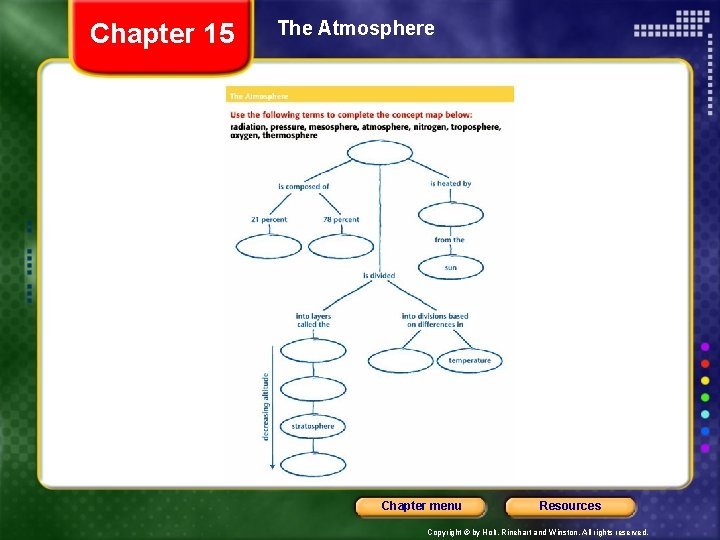
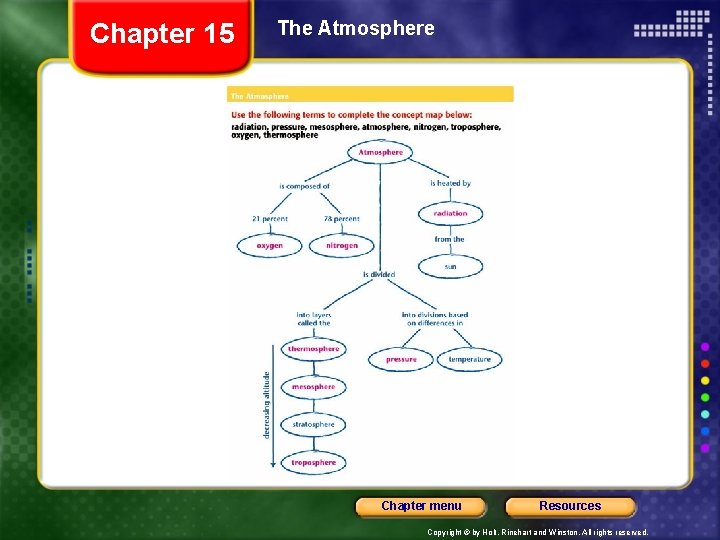
Chapter 15 The Atmosphere Concept Map Use the terms below to complete the concept map on the next slide. radiation pressure mesosphere atmosphere nitrogen troposphere oxygen thermosphere Chapter menu Resources Copyright © by Holt, Rinehart and Winston. All rights reserved.
Chapter 15 The Atmosphere Chapter menu Resources Copyright © by Holt, Rinehart and Winston. All rights reserved.
Chapter 15 The Atmosphere Chapter menu Resources Copyright © by Holt, Rinehart and Winston. All rights reserved.