
How to Use Quotes in Your Writing Remember
How to Use Quotes in Your Writing: Remember to ICE Them! Friday, June 11, 2021
Why Use Quotes in Your Paper? �To provide evidence for your argument �To analyze an idea or passage
Where to Use Quotes �Never: introduction, topic sentences, conclusion �Always: inside body paragraphs
Always ICE Quotes � Introduce � Cite � Explain
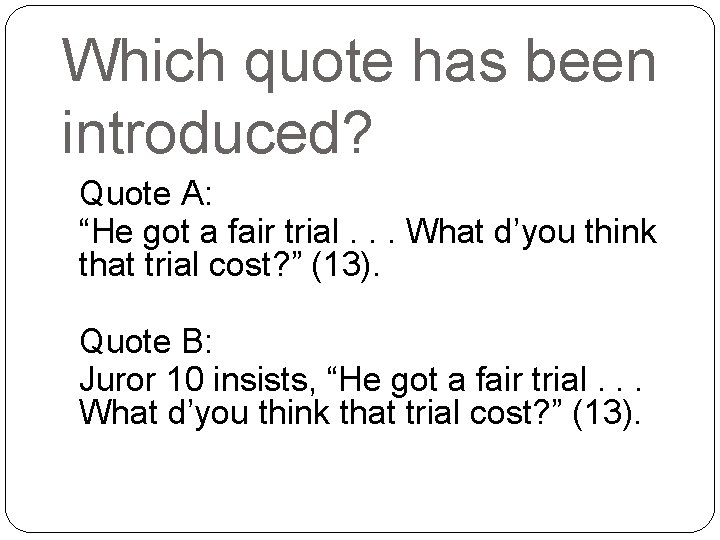
Which quote has been introduced? Quote A: “He got a fair trial. . . What d’you think that trial cost? ” (13). Quote B: Juror 10 insists, “He got a fair trial. . . What d’you think that trial cost? ” (13).
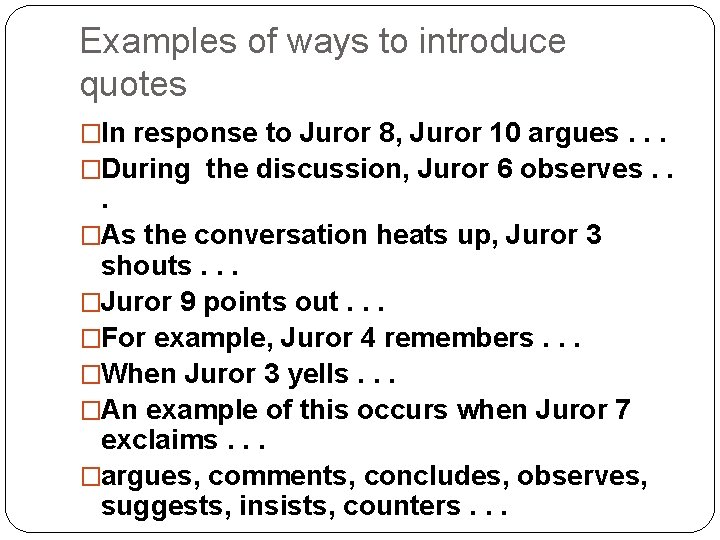
Examples of ways to introduce quotes �In response to Juror 8, Juror 10 argues. . . �During the discussion, Juror 6 observes. . . �As the conversation heats up, Juror 3 shouts. . . �Juror 9 points out. . . �For example, Juror 4 remembers. . . �When Juror 3 yells. . . �An example of this occurs when Juror 7 exclaims. . . �argues, comments, concludes, observes, suggests, insists, counters. . .
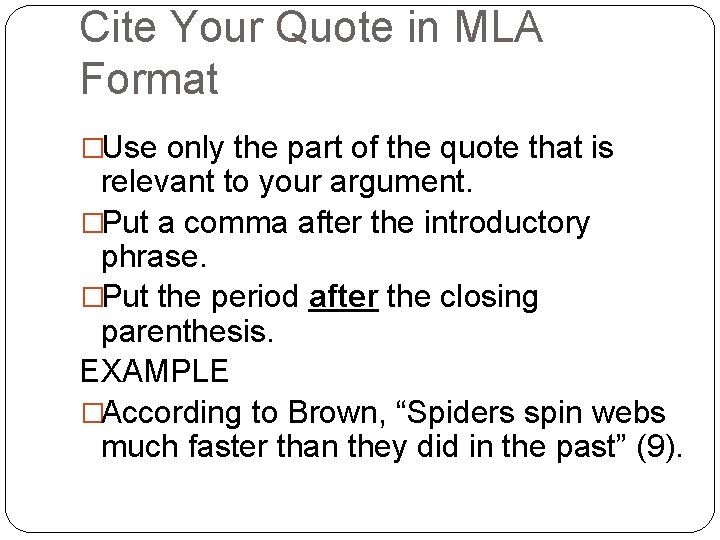
Cite Your Quote in MLA Format �Use only the part of the quote that is relevant to your argument. �Put a comma after the introductory phrase. �Put the period after the closing parenthesis. EXAMPLE �According to Brown, “Spiders spin webs much faster than they did in the past” (9).
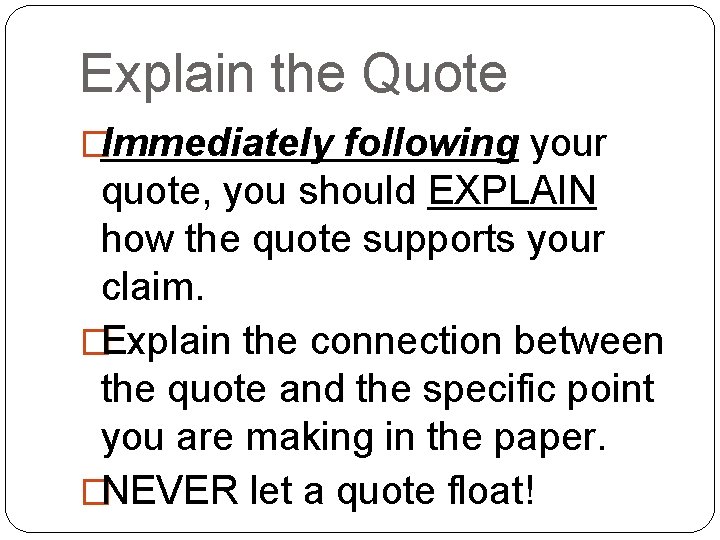
Explain the Quote �Immediately following your quote, you should EXPLAIN how the quote supports your claim. �Explain the connection between the quote and the specific point you are making in the paper. �NEVER let a quote float!
Never Let a Quote Float �Today, we are too self-centered. “We are consumers-on-the-run. . . the very notion of the family meal as a sit-down occasion is vanishing. Adults and children alike eat. . . on the way to their next activity” (Gleick 148). Everything is about what we want.
Effective Quote �Today, Americans are too self-centered. Even our families don't matter as much anymore as they once did. Other people and activities take precedence, as James Gleick says in his book, Faster: “We are consumers-on-the-run. . . The very notion of the family meal as a sit-down occasion is vanishing. Adults and children alike eat. . . on the way to their next activity” (148). Sitdown meals are a time to share and connect with others; however, that connection has become less valued, as families begin to prize individual activities over shared time, promoting selfcenteredness over group identity.
- Slides: 10