
How to Use Games and Activities to Increase
- Slides: 9
How to Use Games and Activities to Increase Mathematical Fluency a presentation by Ben Lindeman, Mathematics Consultant at the 40 th Annual Spring Conference of the Ten County Mathematics Education Association Saturday, March 15, 2014 Ossining High School Ossining, New York
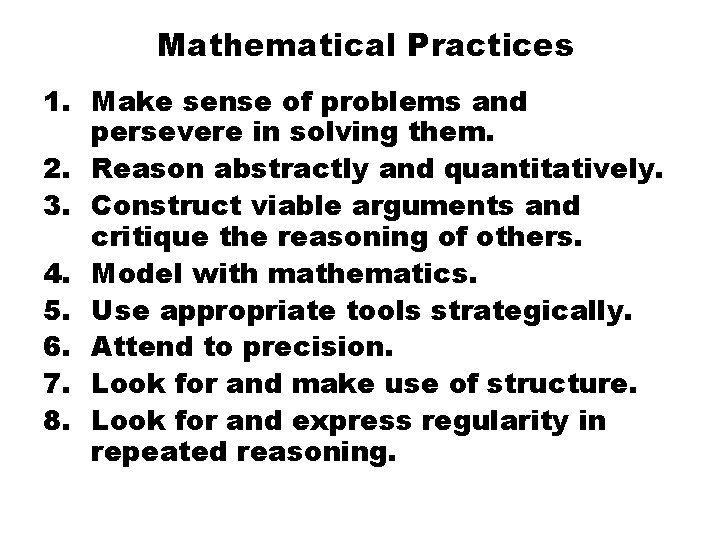
Mathematical Practices 1. Make sense of problems and persevere in solving them. 2. Reason abstractly and quantitatively. 3. Construct viable arguments and critique the reasoning of others. 4. Model with mathematics. 5. Use appropriate tools strategically. 6. Attend to precision. 7. Look for and make use of structure. 8. Look for and express regularity in repeated reasoning.
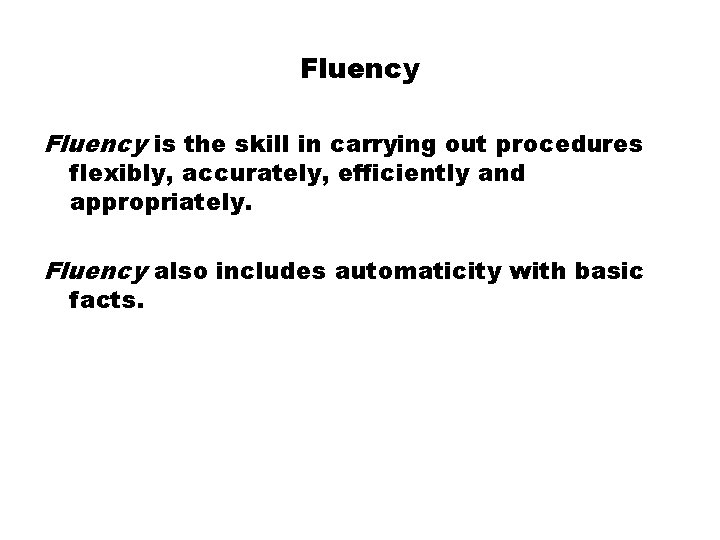
Fluency is the skill in carrying out procedures flexibly, accurately, efficiently and appropriately. Fluency also includes automaticity with basic facts.
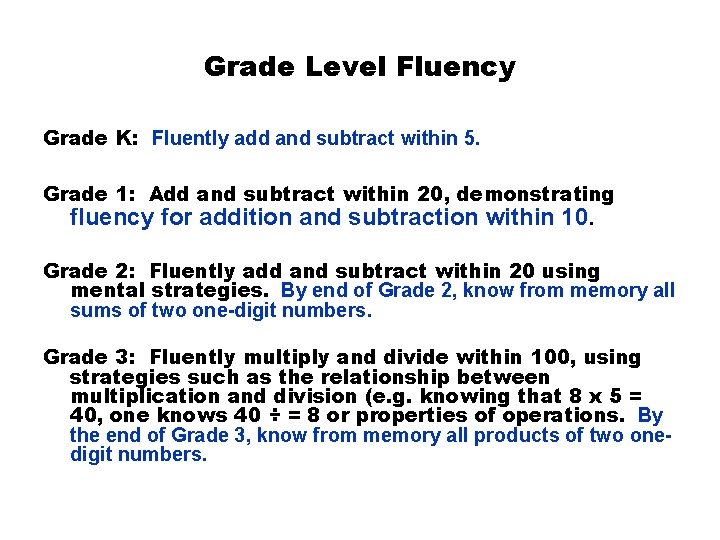
Grade Level Fluency Grade K: Fluently add and subtract within 5. Grade 1: Add and subtract within 20, demonstrating fluency for addition and subtraction within 10. Grade 2: Fluently add and subtract within 20 using mental strategies. By end of Grade 2, know from memory all sums of two one-digit numbers. Grade 3: Fluently multiply and divide within 100, using strategies such as the relationship between multiplication and division (e. g. knowing that 8 x 5 = 40, one knows 40 ÷ = 8 or properties of operations. By the end of Grade 3, know from memory all products of two onedigit numbers.
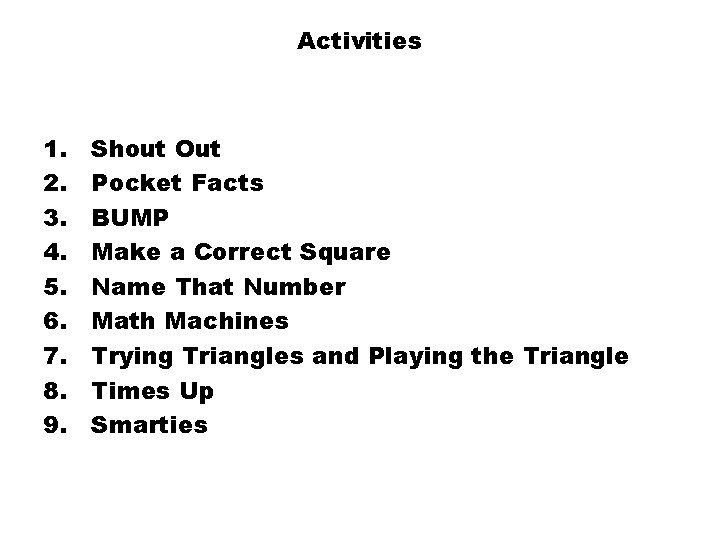
Activities 1. 2. 3. 4. 5. 6. 7. 8. 9. Shout Out Pocket Facts BUMP Make a Correct Square Name That Number Math Machines Trying Triangles and Playing the Triangle Times Up Smarties
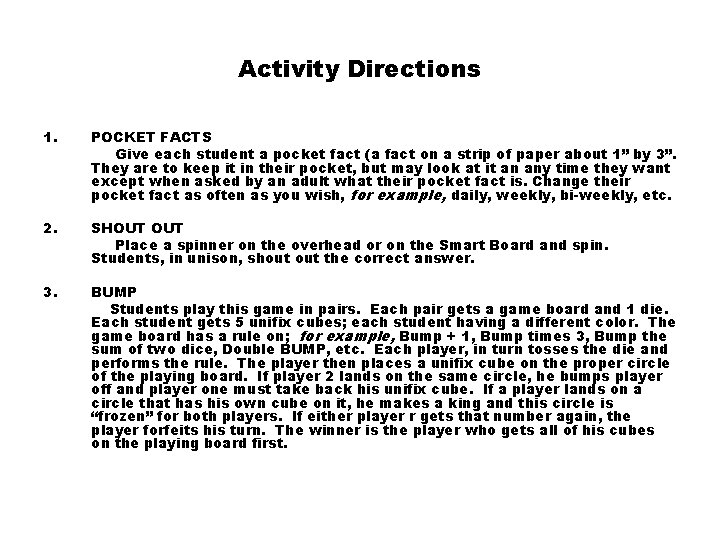
Activity Directions 1. POCKET FACTS Give each student a pocket fact (a fact on a strip of paper about 1” by 3”. They are to keep it in their pocket, but may look at it an any time they want except when asked by an adult what their pocket fact is. Change their pocket fact as often as you wish, for example, daily, weekly, bi-weekly, etc. 2. SHOUT Place a spinner on the overhead or on the Smart Board and spin. Students, in unison, shout the correct answer. 3. BUMP Students play this game in pairs. Each pair gets a game board and 1 die. Each student gets 5 unifix cubes; each student having a different color. The game board has a rule on; for example, Bump + 1, Bump times 3, Bump the sum of two dice, Double BUMP, etc. Each player, in turn tosses the die and performs the rule. The player then places a unifix cube on the proper circle of the playing board. If player 2 lands on the same circle, he bumps player off and player one must take back his unifix cube. If a player lands on a circle that has his own cube on it, he makes a king and this circle is “frozen” for both players. If either player r gets that number again, the player forfeits his turn. The winner is the player who gets all of his cubes on the playing board first.
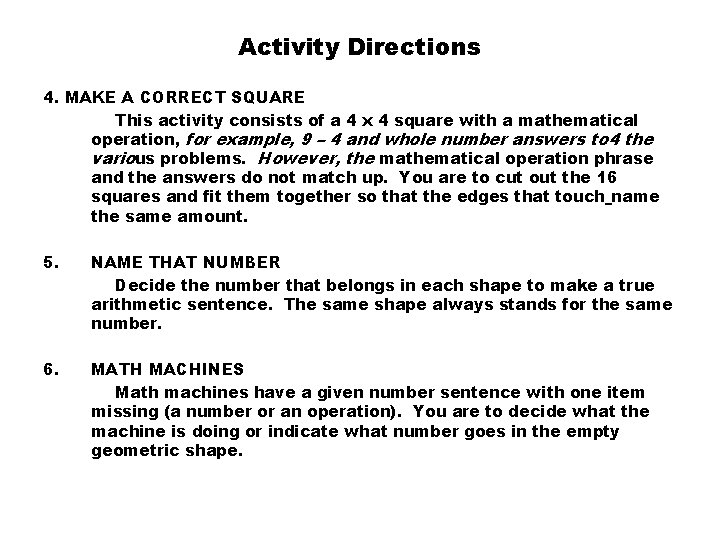
Activity Directions 4. MAKE A CORRECT SQUARE This activity consists of a 4 x 4 square with a mathematical operation, for example, 9 – 4 and whole number answers to 4 the various problems. However, the mathematical operation phrase and the answers do not match up. You are to cut out the 16 squares and fit them together so that the edges that touch name the same amount. 5. NAME THAT NUMBER Decide the number that belongs in each shape to make a true arithmetic sentence. The same shape always stands for the same number. 6. MATH MACHINES Math machines have a given number sentence with one item missing (a number or an operation). You are to decide what the machine is doing or indicate what number goes in the empty geometric shape.
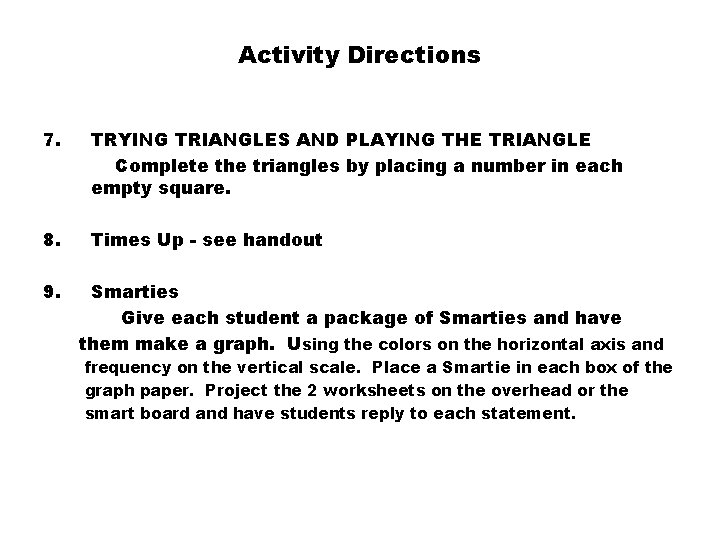
Activity Directions 7. TRYING TRIANGLES AND PLAYING THE TRIANGLE Complete the triangles by placing a number in each empty square. 8. Times Up - see handout 9. Smarties Give each student a package of Smarties and have them make a graph. Using the colors on the horizontal axis and frequency on the vertical scale. Place a Smartie in each box of the graph paper. Project the 2 worksheets on the overhead or the smart board and have students reply to each statement.
The End Thank you for attending this session. Ben Lindeman Mathematics Consultant For information, a copy of this power point, or to schedule a workshop, contact: Ben Lindeman PO Box 79 Poestenkill, NY 12140 518 -852 -4910 bhlind@aol. com