
How to use e GRID for Carbon Footprinting

How to use e. GRID for Carbon Footprinting Electricity Purchases in Greenhouse Gas Emission Inventories 2012 International Emission Inventory Conference Session 3: Greenhouse Gases 8/14/2012
Outline • • Summary of recommendations e. GRID background Recommendations What’s new in e. GRID 2012 Trends Future e. GRID updates Conclusions Questions and comments 2
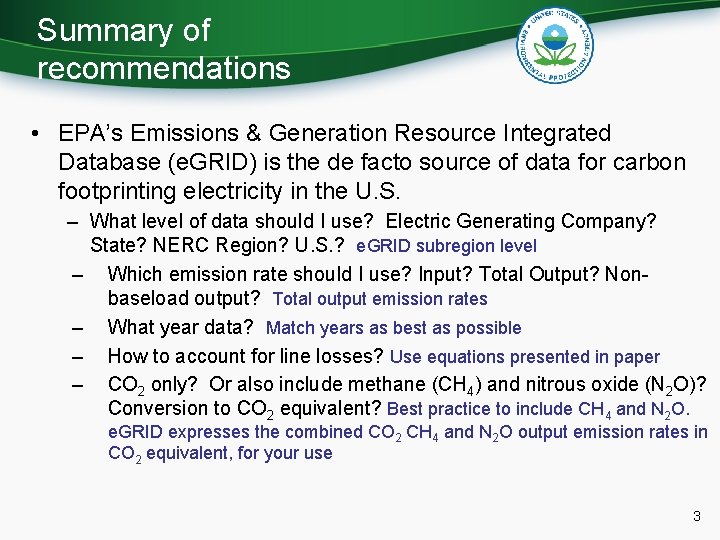
Summary of recommendations • EPA’s Emissions & Generation Resource Integrated Database (e. GRID) is the de facto source of data for carbon footprinting electricity in the U. S. – What level of data should I use? Electric Generating Company? State? NERC Region? U. S. ? e. GRID subregion level – Which emission rate should I use? Input? Total Output? Nonbaseload output? Total output emission rates – What year data? Match years as best as possible – How to account for line losses? Use equations presented in paper – CO 2 only? Or also include methane (CH 4) and nitrous oxide (N 2 O)? Conversion to CO 2 equivalent? Best practice to include CH 4 and N 2 O. e. GRID expresses the combined CO 2 CH 4 and N 2 O output emission rates in CO 2 equivalent, for your use 3
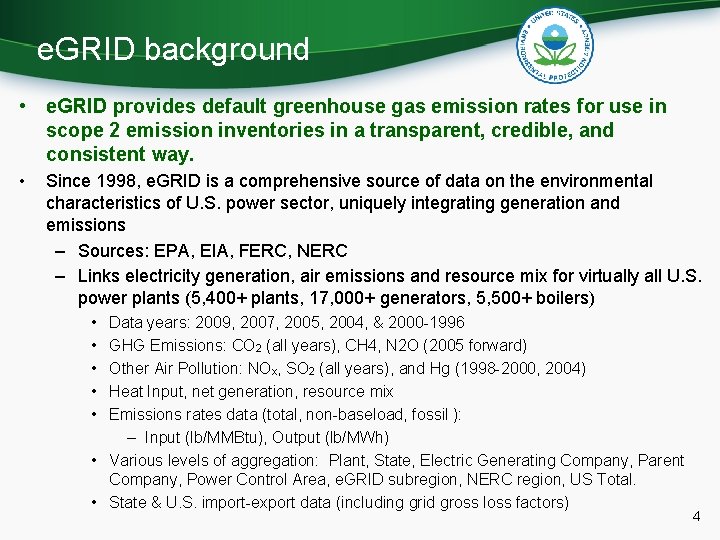
e. GRID background • e. GRID provides default greenhouse gas emission rates for use in scope 2 emission inventories in a transparent, credible, and consistent way. • Since 1998, e. GRID is a comprehensive source of data on the environmental characteristics of U. S. power sector, uniquely integrating generation and emissions – Sources: EPA, EIA, FERC, NERC – Links electricity generation, air emissions and resource mix for virtually all U. S. power plants (5, 400+ plants, 17, 000+ generators, 5, 500+ boilers) • • • Data years: 2009, 2007, 2005, 2004, & 2000 -1996 GHG Emissions: CO 2 (all years), CH 4, N 2 O (2005 forward) Other Air Pollution: NOx, SO 2 (all years), and Hg (1998 -2000, 2004) Heat Input, net generation, resource mix Emissions rates data (total, non-baseload, fossil ): – Input (lb/MMBtu), Output (lb/MWh) • Various levels of aggregation: Plant, State, Electric Generating Company, Parent Company, Power Control Area, e. GRID subregion, NERC region, US Total. • State & U. S. import-export data (including grid gross loss factors) 4
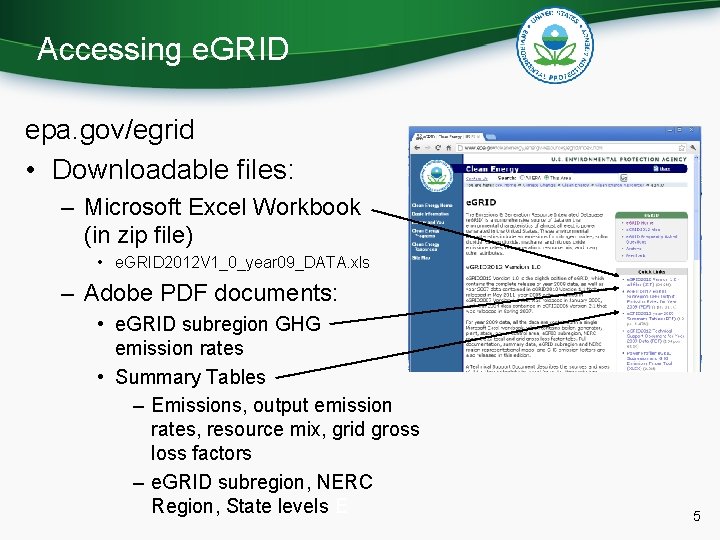
Accessing e. GRID epa. gov/egrid • Downloadable files: – Microsoft Excel Workbook (in zip file) • e. GRID 2012 V 1_0_year 09_DATA. xls – Adobe PDF documents: • e. GRID subregion GHG emission rates • Summary Tables – Emissions, output emission rates, resource mix, grid gross loss factors – e. GRID subregion, NERC Region, State levels E 5
What’s behind e. GRID’s GHG emission factors • CO 2 emissions data reported to EPA per 40 CFR Part 75 (Acid Rain Program, Clean Air Interstate Rule, Regional Greenhouse Gas Initiative, etc. ) • About 96% of CO 2 emissions are sourced from monitored emissions reported to EPA: • Continuous Emission Monitors (CEMS): CO 2 concentration, stack flow • For some oil/gas units: fuel flow monitors and measured carbon content (or default carbon content) • CO 2 for other units, the same methodology for EPA's National GHG Inventory is applied to EIA-923 fuel use data • N 2 O & CH 4 derived from EPA National GHG Inventory methodology and EPA or EIA sourced fuel use • See e. GRID Technical Support Document for more details 6
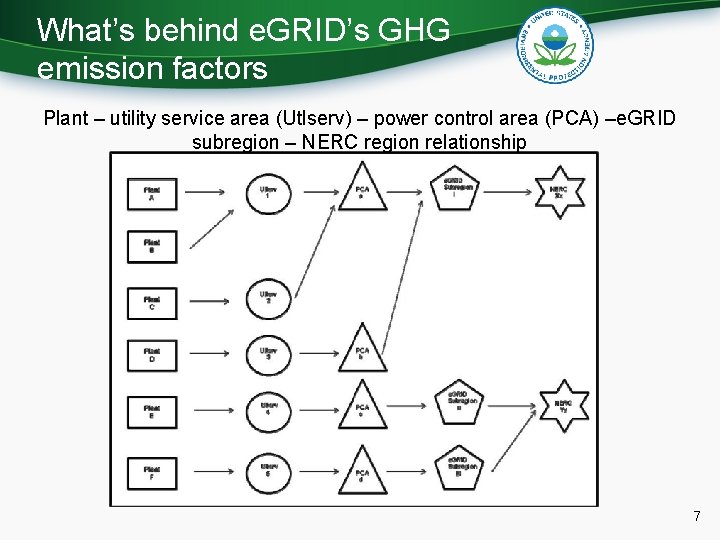
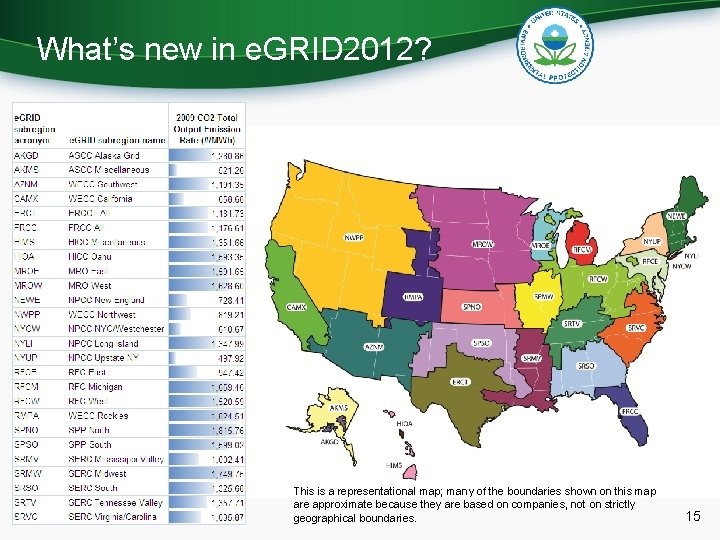
What’s behind e. GRID’s GHG emission factors Plant – utility service area (Utlserv) – power control area (PCA) –e. GRID subregion – NERC region relationship 7
Which rates to use? Which aggregation level? For carbon footprinting generic, grid-supplied electricity: • Use the total output emission rate (a. k. a. “system mix”) • CO 2 in pounds per Megawatt-hour (MWh) • N 2 O and CH 4 in pounds per Gigawatt-hour (GWh) • Use the e. GRID subregion aggregation level – This level strikes a balance between areas that are too big and areas that are too small. • U. S. level covers some irrelevant generation • State level boundaries are unrelated to electric grid boundaries • Power control area (PCA), a. k. a. balancing authority, level or Company (EGC) level may not address significant imported power If purchasing directly from neighboring plant and transmission infrastructure is in place, then use plant specific rate 8
How to determine e. GRID subregion • Power Profiler – Online application www. epa. gov/powerprofiler • Enter ZIP code • Select from list of utilities • Your e. GRID subregion and selected e. GRID data are shown – Power Profiler e. GRID subregion and GHG emission finder tool (spreadsheet) • Available on e. GRID page under quick links • Decodes the e. GRID subregion(s) for each ZIP code • If more than one e. GRID subregion – Go to Power Profiler online application, OR – Use the e. GRID subregion of the predominant utility for the ZIP code • Includes CO 2, CH 4, and N 2 O e. GRID subregion emission rates 9
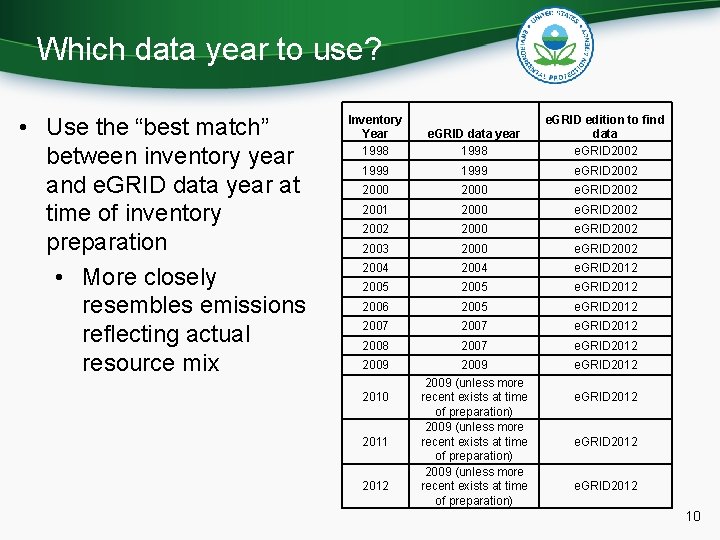
Which data year to use? • Use the “best match” between inventory year and e. GRID data year at time of inventory preparation • More closely resembles emissions reflecting actual resource mix Inventory Year 1998 e. GRID data year 1998 e. GRID edition to find data e. GRID 2002 1999 e. GRID 2002 2000 e. GRID 2002 2001 2000 e. GRID 2002 2003 2000 e. GRID 2002 2004 e. GRID 2012 2005 e. GRID 2012 2006 2005 e. GRID 2012 2007 e. GRID 2012 2008 2007 e. GRID 2012 2009 (unless more recent exists at time of preparation) 2009 (unless more recent exists at time of preparation) e. GRID 2012 2010 2011 2012 e. GRID 2012 10
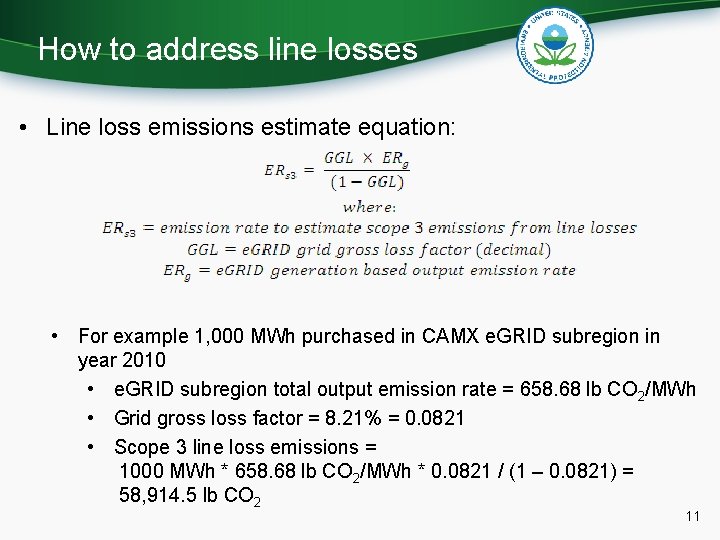
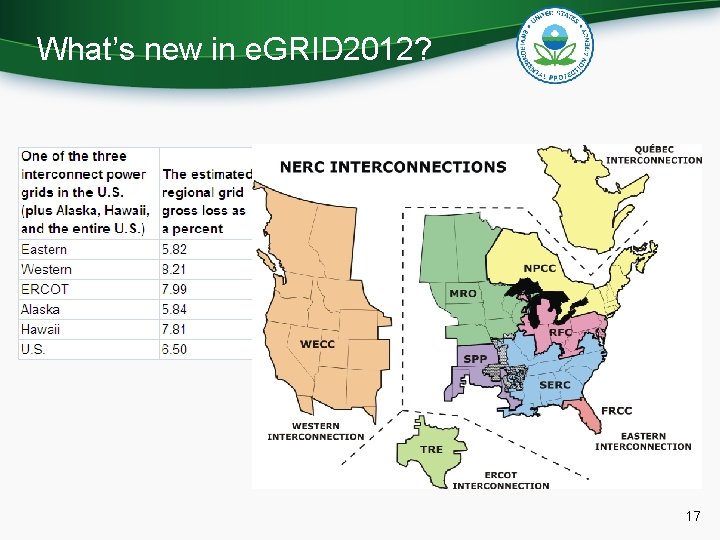
How to address line losses • Line loss emissions estimate equation: • For example 1, 000 MWh purchased in CAMX e. GRID subregion in year 2010 • e. GRID subregion total output emission rate = 658. 68 lb CO 2/MWh • Grid gross loss factor = 8. 21% = 0. 0821 • Scope 3 line loss emissions = 1000 MWh * 658. 68 lb CO 2/MWh * 0. 0821 / (1 – 0. 0821) = 58, 914. 5 lb CO 2 11
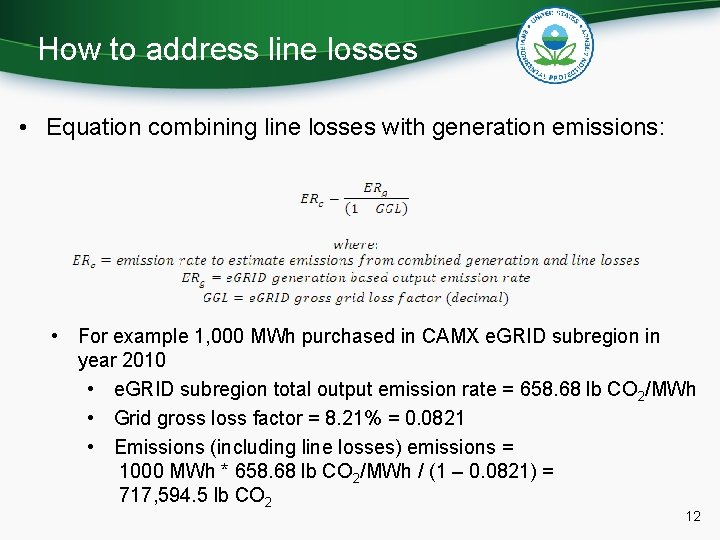
How to address line losses • Equation combining line losses with generation emissions: • For example 1, 000 MWh purchased in CAMX e. GRID subregion in year 2010 • e. GRID subregion total output emission rate = 658. 68 lb CO 2/MWh • Grid gross loss factor = 8. 21% = 0. 0821 • Emissions (including line losses) emissions = 1000 MWh * 658. 68 lb CO 2/MWh / (1 – 0. 0821) = 717, 594. 5 lb CO 2 12
Including CH 4 and N 2 O -> CO 2 equivalent • Including CH 4 and N 2 O from electricity purchases adds less than 1% CO 2 equivalent (CO 2 e) • Note that units for CH 4 and N 2 O output emission rates in e. GRID are in lbs per GWh, rather than lbs per MWh • To convert to CO 2 e, consistent with EPA’s U. S. GHG Inventory, recommend using IPCC Second Assessment Report (SAR) Global Warming Potentials (See e. GRID Technical Support Document for more details) • e. GRID displays separate total output emission rates for each of these GHGs, and also combines into a CO 2 e value in the spreadsheets and summary tables 13
What’s new in e. GRID 2012? • Data not presented at the company or parent company level • What used to be presented in three separate spreadsheets (PLANT, AGGREGATION, STIE_USGC) are now combined into one (DATA) with 10 tabs • Improved methodology for grid gross loss factors – Used FERC-714 data for balancing authority interchanges rather than state based EIA estimates • Plant coordinate improvements 14
What’s new in e. GRID 2012? This is a representational map; many of the boundaries shown on this map are approximate because they are based on companies, not on strictly geographical boundaries. 15
What’s new in e. GRID 2012? 16
What’s new in e. GRID 2012? 17
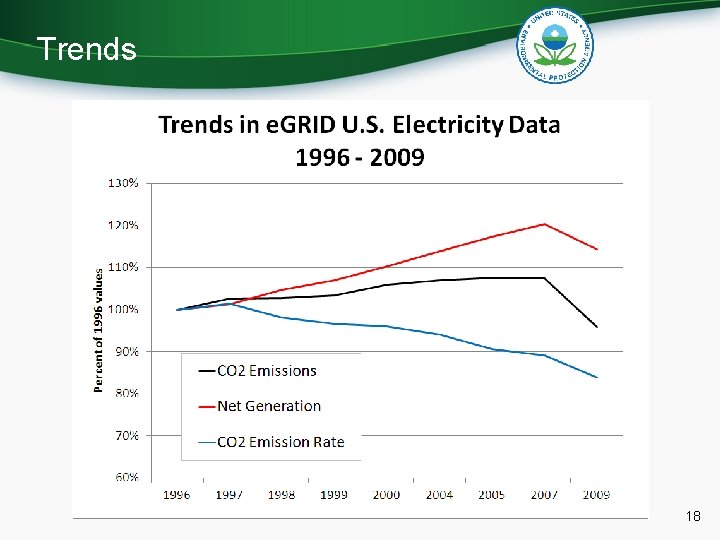
Trends 18
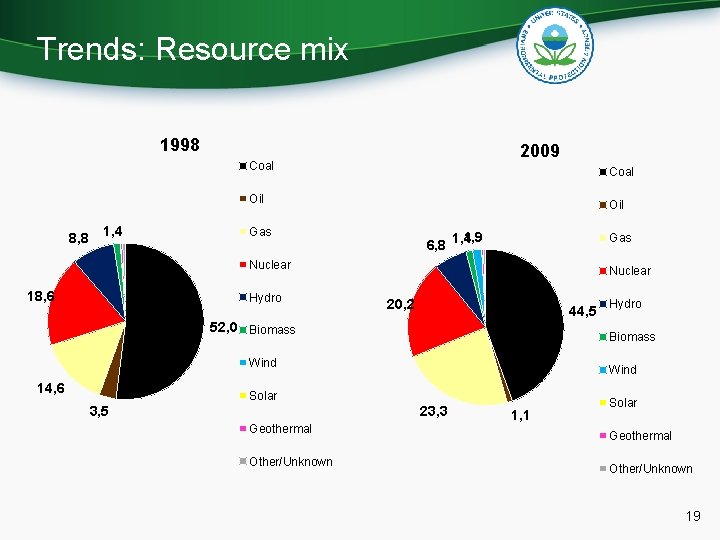
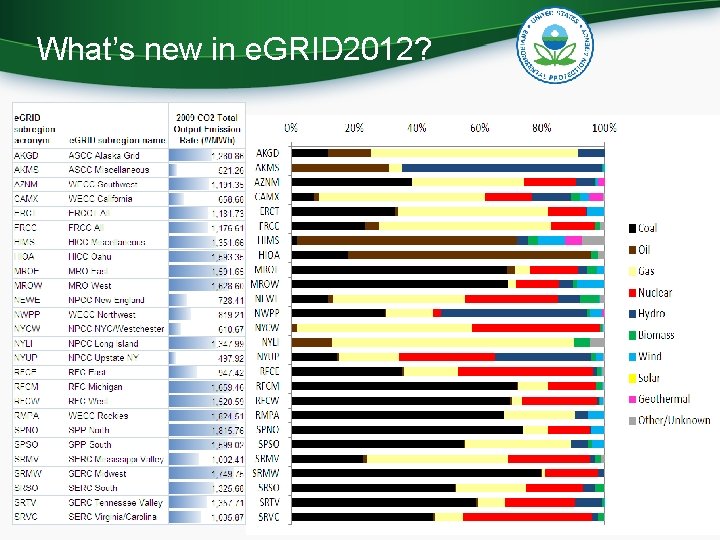
Trends: Resource mix 1998 2009 Coal Oil 8, 8 1, 4 Oil Gas 1, 9 6, 8 1, 4 Gas Nuclear 18, 6 Hydro Nuclear 20, 2 44, 5 52, 0 Biomass Wind 14, 6 Wind Solar 23, 3 3, 5 Geothermal Other/Unknown Hydro 1, 1 Solar Geothermal Other/Unknown 19
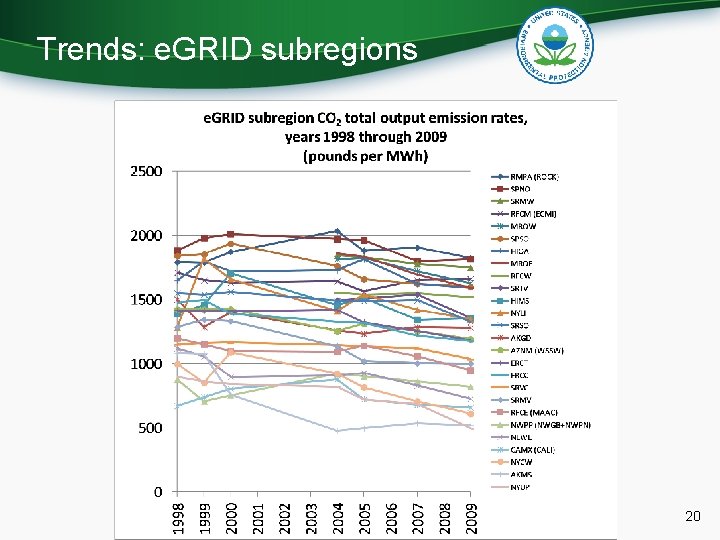
Trends: e. GRID subregions 20
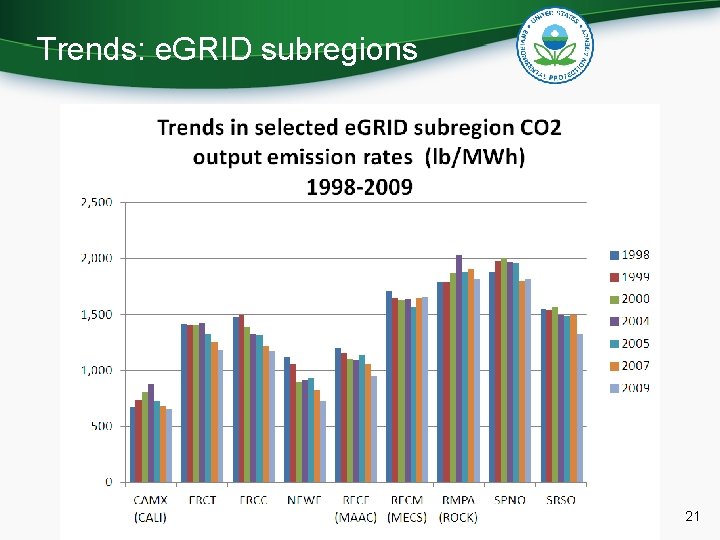
Trends: e. GRID subregions 21
Future e. GRID updates • Currently processing year 2010 data, to be issued in a new edition as soon as possible – Rough estimate fall 2013 • To stay informed when any e. GRID update occurs, please fill out e. GRID feedback form: – www. epa. gov/cleanenergy/energyresources/egrid/feedback. html 22
Conclusion – What level of data should I use? Electric Generating Company? State? NERC Region? U. S. ? e. GRID subregion level – Which emission rate should I use? Input? Total Output? Non-baseload output? Total output emission rates – What year data? Match years as best as possible – How to account for line losses? Use equations presented in paper – CO 2 only? Or also include methane (CH 4) and nitrous oxide (N 2 O)? Conversion to CO 2 equivalent? Best practice to include CH 4 and N 2 O. e. GRID expresses the combined CO 2 CH 4 and N 2 O output emission rates in CO 2 equivalent, for your use 23

Questions and comments epa. gov/egrid Art Diem, Environmental Engineer U. S. EPA 202 -343 -9340 diem. art@epa. gov Cristina Quiroz Tran. Systems|E. H. Pechan 703 -245 -4069 caquirozpacheco@transystems. com 24
- Slides: 24