
How to use classroom questioning and feedback effectively
How to use classroom questioning and feedback effectively in English KLA Salesian Yip Hon Millennium Primary School YUNG Pui-yan, Candy HKTA YYI Chan Lui Chung Tak Memorial School WOO Sze-wan, Emily School-based Curriculum Development (Primary) Section FUNG Ho-kwan Jeanda
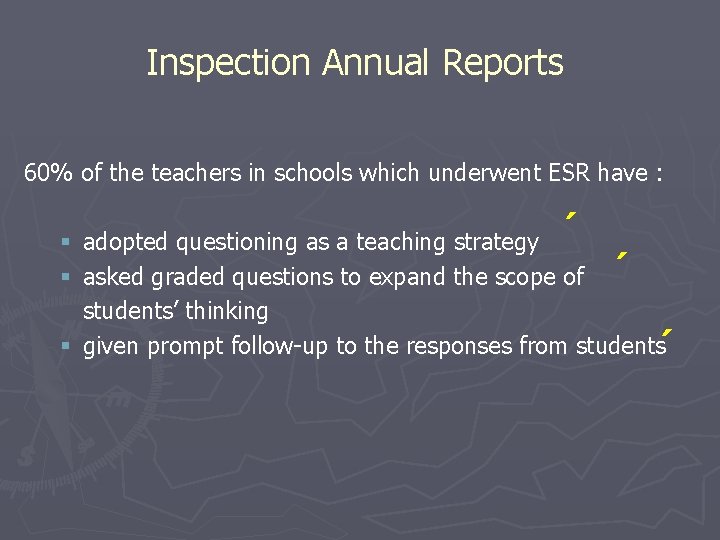
Inspection Annual Reports 60% of the teachers in schools which underwent ESR have : ˊ § adopted questioning as a teaching strategy § asked graded questions to expand the scope of students’ thinking § given prompt follow-up to the responses from students ˊ ˊ
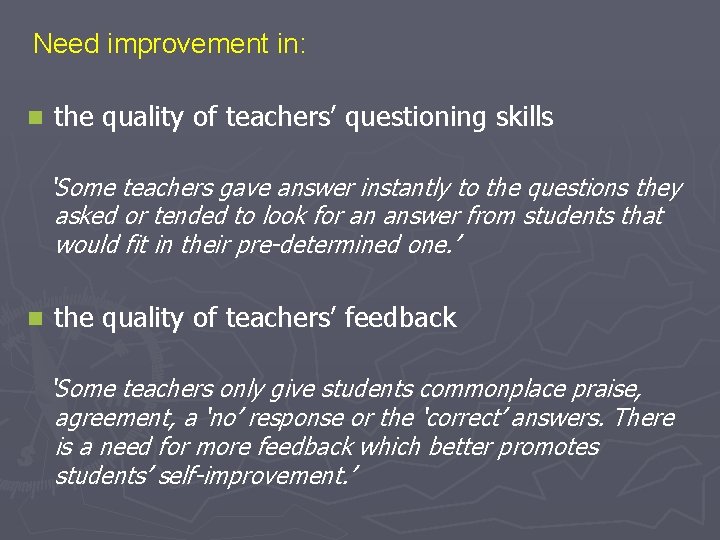
Need improvement in: n the quality of teachers’ questioning skills ‘Some teachers gave answer instantly to the questions they asked or tended to look for an answer from students that would fit in their pre-determined one. ’ n the quality of teachers’ feedback ‘Some teachers only give students commonplace praise, agreement, a ‘no’ response or the ‘correct’ answers. There is a need for more feedback which better promotes students’ self-improvement. ’
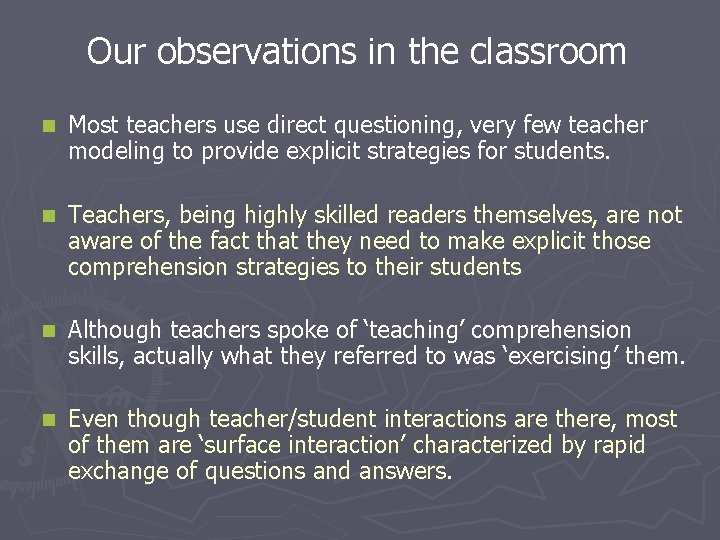
Our observations in the classroom n Most teachers use direct questioning, very few teacher modeling to provide explicit strategies for students. n Teachers, being highly skilled readers themselves, are not aware of the fact that they need to make explicit those comprehension strategies to their students n Although teachers spoke of ‘teaching’ comprehension skills, actually what they referred to was ‘exercising’ them. n Even though teacher/student interactions are there, most of them are ‘surface interaction’ characterized by rapid exchange of questions and answers.
Today’s focus 1. Rationale - Jerome Bruner’s four models of pedagogy 2. Question Design - Bloom’s Taxonomy of questions 3. Tactics in questioning and responding - classroom application
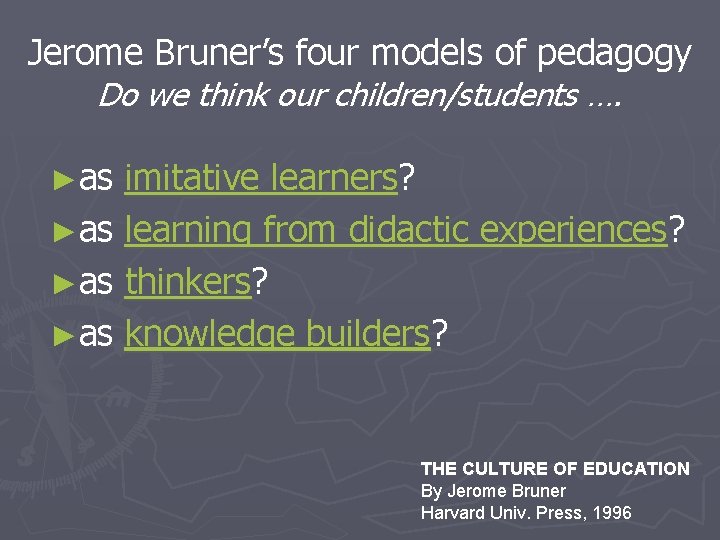
Jerome Bruner’s four models of pedagogy Do we think our children/students …. ►as imitative learners? ►as learning from didactic experiences? ►as thinkers? ►as knowledge builders? THE CULTURE OF EDUCATION By Jerome Bruner Harvard Univ. Press, 1996
► The first views the student as an imitative learner and focuses on passing on skills and "know-how" through example and demonstrative action.
► The second views students as learning from didactic exposure. It is based on the idea that learners should be presented with facts, principles, and rules of action which are to be learned, remembered, and then applied.
► The third sees children as thinkers and focuses on the development of intersubjective interchange. This model revolves around how the child makes sense of his or her world. It stresses the value of discussion and collaboration.
► The fourth model views children as knowledgeable and stresses the management of "objective" knowledge. This perspective holds that teaching should help children grasp the distinction between personal knowledge, on the one hand, and "what is taken to be known" by the culture, on the other.
Bruner stresses that …. ► Modern pedagogy is moving increasingly to the view that the child should be aware of his or her own thought processes (models three and four) and that achieving skills and accumulating knowledge (models one and two) are not enough. ► "What is needed, " Bruner stresses, "is that the four perspectives be fused into some congruent unity
Our belief shapes the way we provide instructions…
The purpose of asking questions
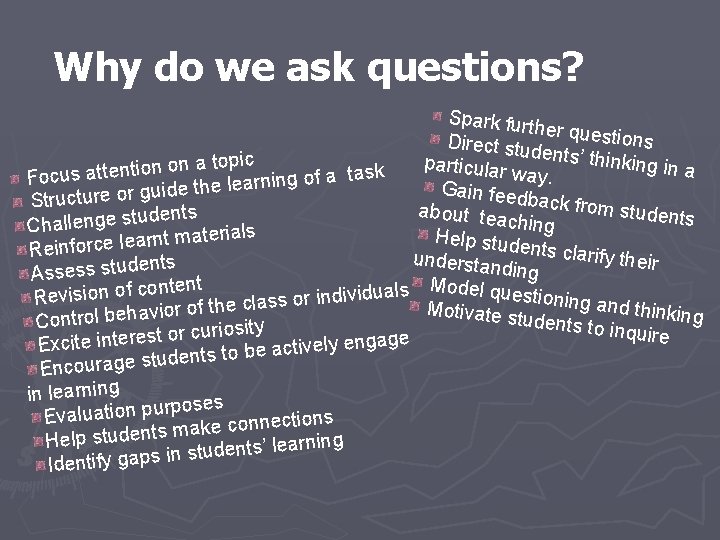
Why do we ask questions? Spark furt her quest ions Direct stu d e nts’ thinki ic p to p a a ng in a n r o t i n c o u ti l n a e k r tt s a w ta s a u a c y f o. F arning o le e th G e id a u i g n r feedback Structure o from stud a b ts o n u e ents d t tu teaching Challenge s aterials Help stud m t n r a le e c r fo ents clarif in e R y their u n d e ts r n s e t d a tu n s d s ing Asses t M n odel ques nte als u id iv d tioning an in Revision of co r o s s la c e th d thinking f M o otivate stu ior v a h e b l o tr n o d C ents to inq ity s io r u c r uire o t s e age g n e ly e Excite inter v ti c a ts to be n e d tu s e g a r Encou in learning rposes u p n o ti a lu a v E tions c e n n o c e k a m Help students arning le ’ ts n e d tu s in Identify gaps
Question design
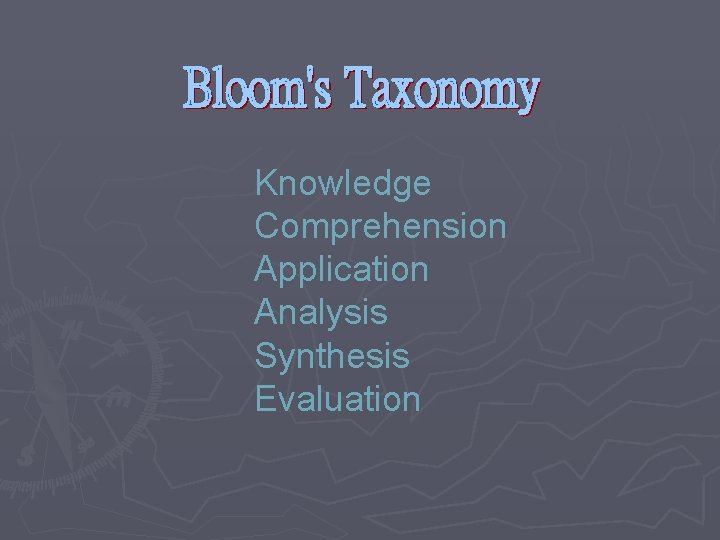
Knowledge Comprehension Application Analysis Synthesis Evaluation
Tactics in questioning and responding Classroom application
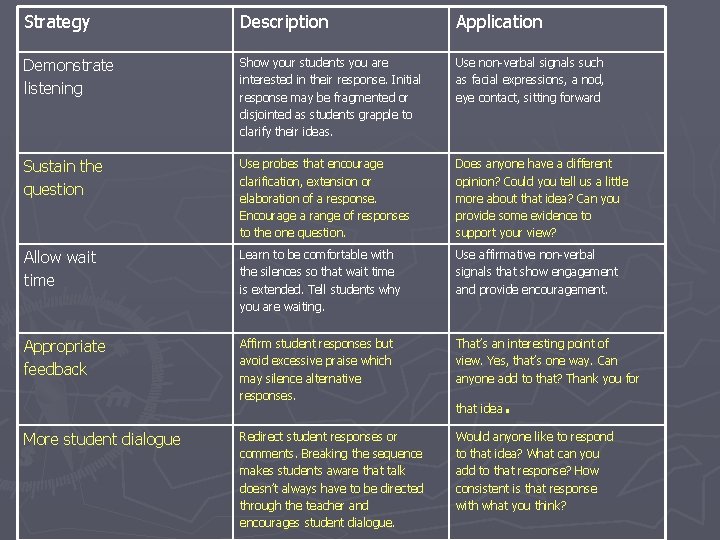
Strategy Description Application Demonstrate listening Show your students you are interested in their response. Initial response may be fragmented or disjointed as students grapple to clarify their ideas. Use non-verbal signals such as facial expressions, a nod, eye contact, sitting forward Sustain the question Use probes that encourage clarification, extension or elaboration of a response. Encourage a range of responses to the one question. Does anyone have a different opinion? Could you tell us a little more about that idea? Can you provide some evidence to support your view? Allow wait time Learn to be comfortable with the silences so that wait time is extended. Tell students why you are waiting. Use affirmative non-verbal signals that show engagement and provide encouragement. Appropriate feedback Affirm student responses but avoid excessive praise which may silence alternative responses. That’s an interesting point of view. Yes, that’s one way. Can anyone add to that? Thank you for Redirect student responses or comments. Breaking the sequence makes students aware that talk doesn’t always have to be directed through the teacher and encourages student dialogue. Would anyone like to respond to that idea? What can you add to that response? How consistent is that response with what you think? More student dialogue . that idea
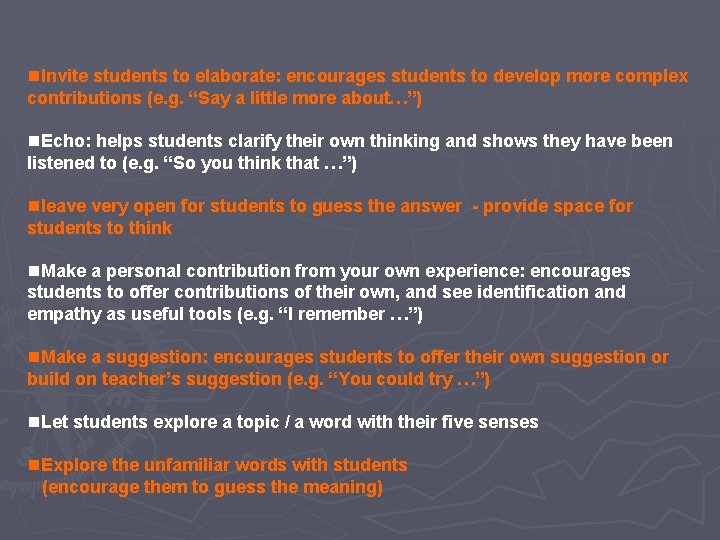
n. Invite students to elaborate: encourages students to develop more complex contributions (e. g. “Say a little more about…”) n. Echo: helps students clarify their own thinking and shows they have been listened to (e. g. “So you think that …”) nleave very open for students to guess the answer - provide space for students to think n. Make a personal contribution from your own experience: encourages students to offer contributions of their own, and see identification and empathy as useful tools (e. g. “I remember …”) n. Make a suggestion: encourages students to offer their own suggestion or build on teacher’s suggestion (e. g. “You could try …”) n. Let students explore a topic / a word with their five senses n. Explore the unfamiliar words with students (encourage them to guess the meaning)
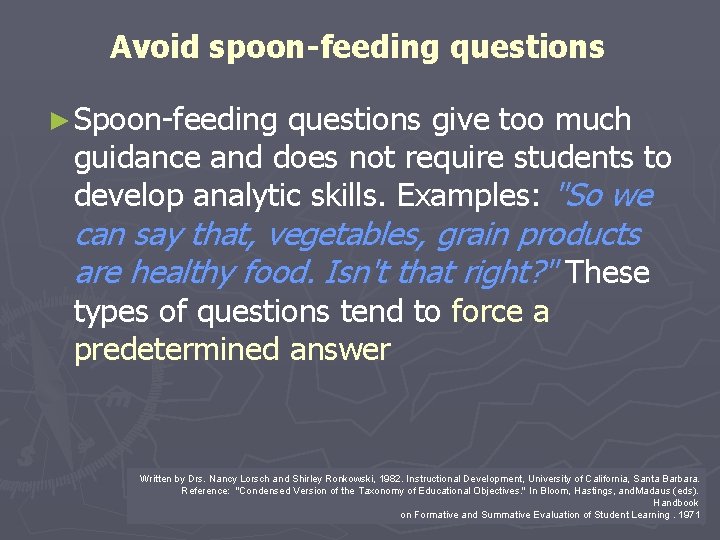
Avoid spoon-feeding questions ► Spoon-feeding questions give too much guidance and does not require students to develop analytic skills. Examples: "So we can say that, vegetables, grain products are healthy food. Isn't that right? " These types of questions tend to force a predetermined answer Written by Drs. Nancy Lorsch and Shirley Ronkowski, 1982. Instructional Development, University of California, Santa Barbara. Reference: "Condensed Version of the Taxonomy of Educational Objectives. " In Bloom, Hastings, and. Madaus (eds). Handbook on Formative and Summative Evaluation of Student Learning. 1971
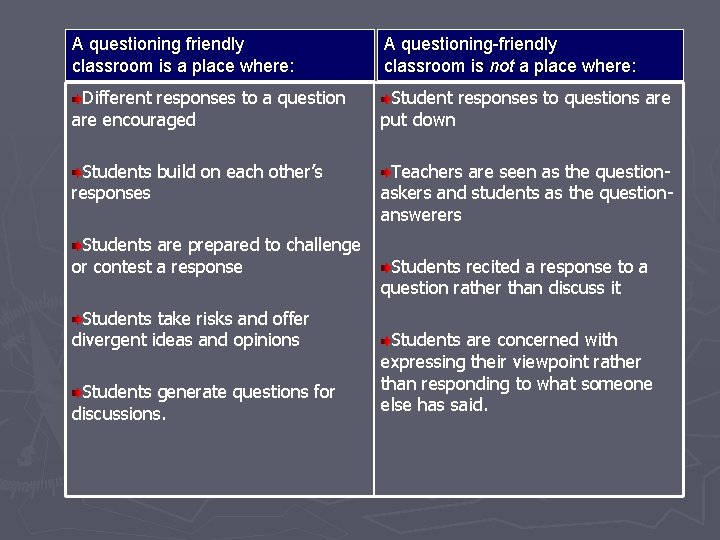
A questioning friendly classroom is a place where: A questioning-friendly classroom is not a place where: Different responses to a question are encouraged Student responses to questions are put down Students build on each other’s responses Teachers are seen as the questionaskers and students as the questionanswerers Students are prepared to challenge or contest a response Students take risks and offer divergent ideas and opinions Students generate questions for discussions. Students recited a response to a question rather than discuss it Students are concerned with expressing their viewpoint rather than responding to what someone else has said.
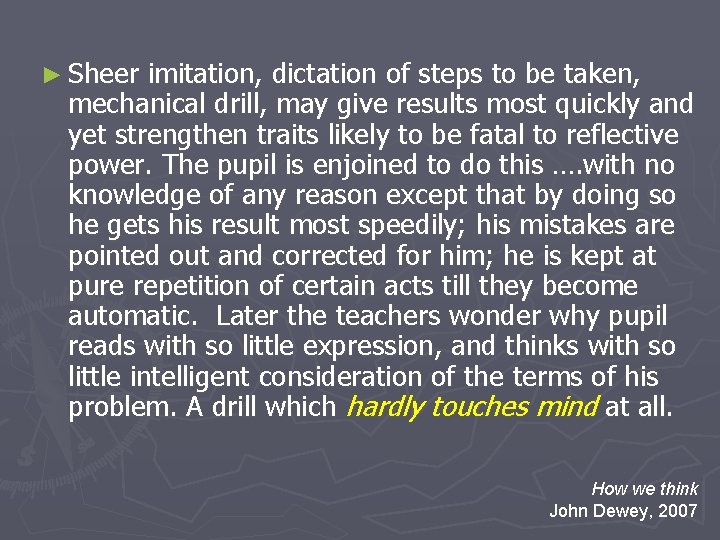
► Sheer imitation, dictation of steps to be taken, mechanical drill, may give results most quickly and yet strengthen traits likely to be fatal to reflective power. The pupil is enjoined to do this …. with no knowledge of any reason except that by doing so he gets his result most speedily; his mistakes are pointed out and corrected for him; he is kept at pure repetition of certain acts till they become automatic. Later the teachers wonder why pupil reads with so little expression, and thinks with so little intelligent consideration of the terms of his problem. A drill which hardly touches mind at all. How we think John Dewey, 2007
► ► ► ► Bruner, J. (1996) The Culture of Education. Cambridge, Mass. : Harvard University Press. Bruner, J. (1990) Acts of Meaning. Cambridge, MA: Harvard University Press. Bruner, J. (1960) The Process of Education. Cambridge, Mass. : Harvard University Press. http: //www. infed. org/thinkers/bruner. htm John Dewey. (2007) How we think. Book Jungle. Brown, G. , & Wragg, E. C. (1993). Questioning. London: Routledge Nancy Lorsch and Shirley Ronkowski. (1982). Condensed Version of the Taxonomy of Educational Objectives. In Bloom, Hastings, and Madaus (eds). Instructional Development, University of California, Santa Barbara. Handbook on Formative and Summative Evaluation of Student Learning. 1971
Thank you
- Slides: 24