
How to translate compound words WELCOME HALA GHABOON
How to translate compound words

WELCOME • • HALA GHABOON 220084196 DANA SHBAIR 220112708

Compound Words • A compound word is made up of two words. Each word is able to stand by itself with its own meaning. The compound word creates a new meaning. • example: sawdust = saw + dust
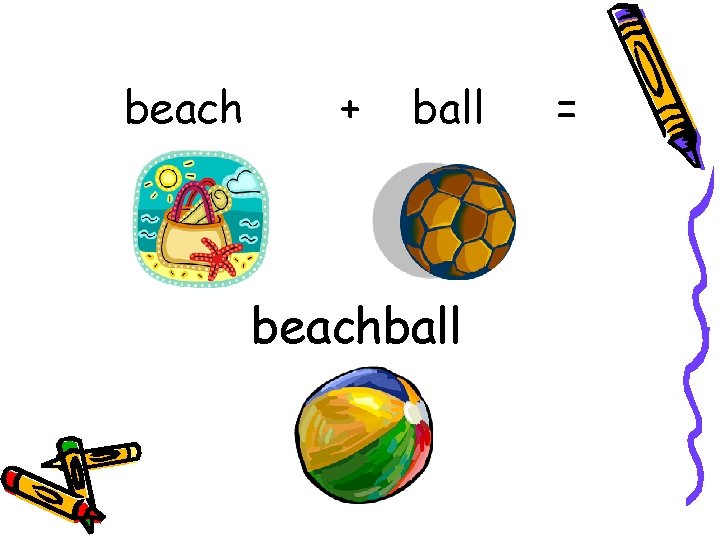
beach + ball beachball =

pan + cake pancake =
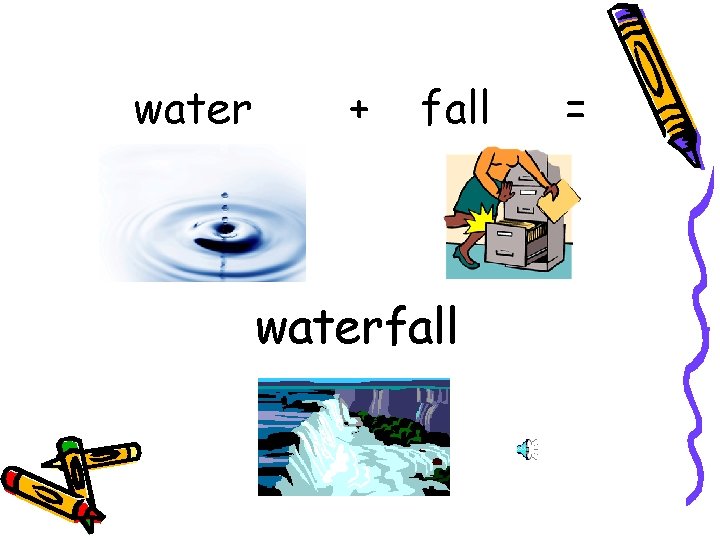
water + fall waterfall =

§ English language has a special process by which new words can be formed from already existing ones. § Single word can be joined together to form a new compound word whose meaning is given by the sum of the two meanings of the matrix words. § In English there are some special types of compound words. §.

compounding § We will now examine compounds formed by only two words, the latter of which is usually the one that establishes the grammatical category. • 1. NOUN + NOUN TROUBLEMAKER = someone who makes trouble WORKPLACE = place where people work
§ 2// ADJECTIVE + NOUN BLACKBOARD = board with a black surface. So An endocentric compound consists of a head, i. e. the categorical part that contains the basic meaning of the whole compound, and modifiers, which restrict this meaning.

• For example, the English compound doghouse, where house is the head and dog is the modifier, is understood as a house intended for a dog. Endocentric compounds tend to be of the same part of speech (word class) as their head, as in the case of doghouse. • Exocentric: compounds do not have a head, and their meaning often cannot be transparently guessed from its constituent parts:

• For example, the English compound white-collar is neither a kind of collar nor a white thing. In an exocentric compound, the word class is determined lexically, disregarding the class of the constituents. For example, sky-dive is not a verb but a noun. English language allows several types of combinations of different word classes:

• • • N + N lipstick , teapot A + N fast food , soft drink V + N breakfast , sky-dive N + V sunshine , babysit N + A capital-intensive , waterproof A + A deaf-mute , bitter-sweet


• main challenges of translating English compounds into Arabic. Compounding is linguistically a common process across many languages where compounds are frequently formed. In English compounding is highly creative and innovative, and often used as a means of introducing new phrases or coining new words into the lexicon.
• In contrast, Arabic is less resourceful. Arabic does not possess similar multiword expressions as an integral linguistic mechanism that merges language items to form a unit of language that can be broken down into single words and display idiosyncratic features.

• The following are illustrative examples of compounds errors: • the term „outdoor‟ is translated as « ﺧﺎﺭﺝ ﺍﻟﻤﻨﺰﻝ • which back translates as “outside the home. • This can mean anywhere and not necessarily outdoors. Therefore some loss in meaning has occurred which is erroneous in this instance. This loss could have been avoided because
• Arabic does have an appropriate expression for it“ ﻓﻲ ﺍﻟﻬﻮﺍﺀ ﺍﻟﻄﻠﻖ which back translates as „in the open air‟. The translator should have been aware of it and used it. • the term „indoor‟ in the expression „indoor workers‟ seemed to cause • problems for the translator.
• It was translated as ﺍﻟﻌﻤﺎﻝ ﺩﺍﺧﻞ ﺍﻟﻤﻨﺎﺯﻝ ﻭﺍﻟﻤﻜﺎﺗﺐ which back translates • as “those working inside houses and offices”. This rendering excluded factory workers and other types of indoor workers, which constituted a loss in meaning. The translator could have used the terms “inside” or “inside buildings” to cover more types of indoor workers.

• • • Fast food Fireman Egghead Turncoat Blackboard Cave man Without Darkroom paleface
- Slides: 21