
How to teach grammar Lecture 4 In this







- Slides: 30
How to teach grammar? Lecture 4
In this lecture… Revision Ways of teaching grammar: overt and covert The E-factor The A-factor Deductive grammar teaching Inductive grammar teaching ◦ Situational language teaching Teaching grammar through texts ◦ Grammar and context Answering questions about microteaching
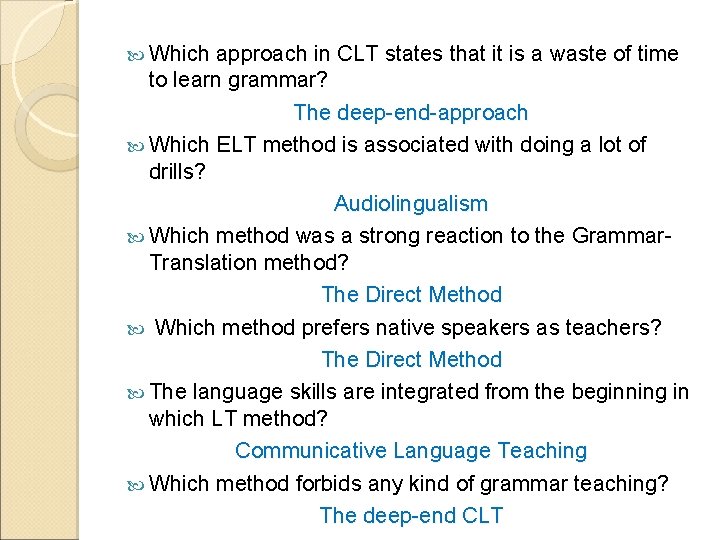
Revision Answer the following questions: Which approach in CLT states that you learn a language in order to use it? The shallow-end-approach Which famous linguist said that language acquisition is more important than learning? Stephen Krashen (Natural Approach) Who introduced the notion of universal grammar (UG)? Noam Chomsky (the natural order of acquisition) Students stop progressing at some point, and their linguistic competence fossilizes. What is that barrier they reach called? The ‘language plateau’
Which approach in CLT states that it is a waste of time to learn grammar? The deep-end-approach Which ELT method is associated with doing a lot of drills? Audiolingualism Which method was a strong reaction to the Grammar. Translation method? The Direct Method Which method prefers native speakers as teachers? The Direct Method The language skills are integrated from the beginning in which LT method? Communicative Language Teaching Which method forbids any kind of grammar teaching? The deep-end CLT
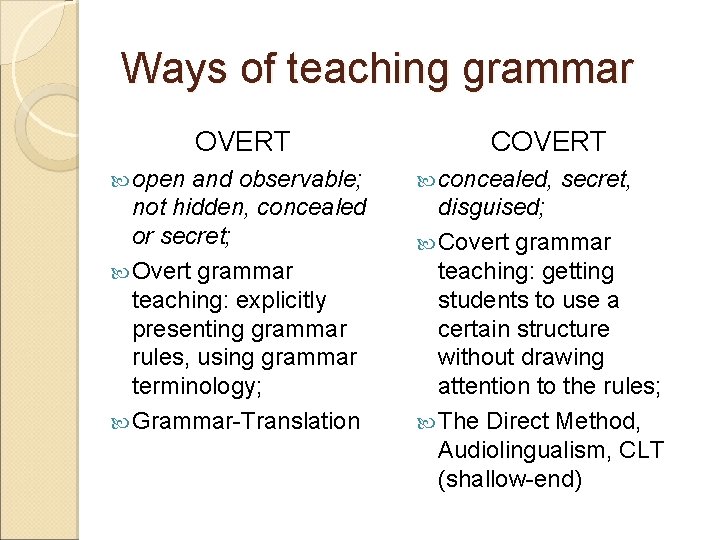
Ways of teaching grammar OVERT open and observable; not hidden, concealed or secret; Overt grammar teaching: explicitly presenting grammar rules, using grammar terminology; Grammar-Translation COVERT concealed, secret, disguised; Covert grammar teaching: getting students to use a certain structure without drawing attention to the rules; The Direct Method, Audiolingualism, CLT (shallow-end)
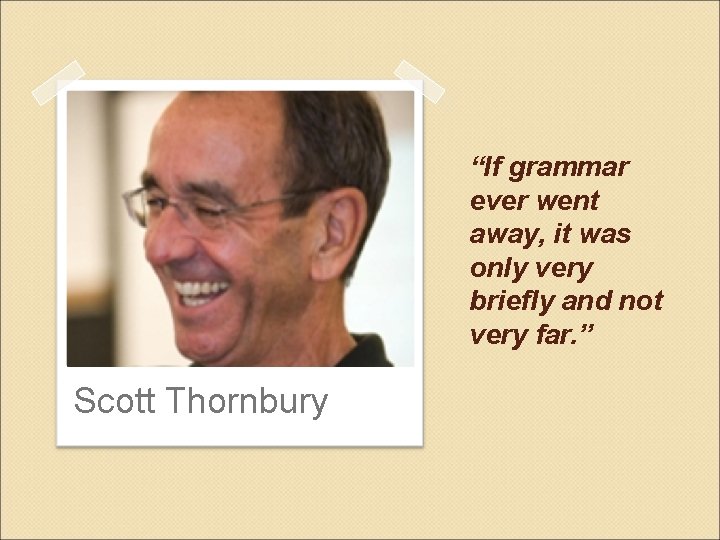
“If grammar ever went away, it was only very briefly and not very far. ” Scott Thornbury
The E-factor When deciding whether to use a grammar activity or present a grammar item, first check how EFFICIENT it is. Are the time and resources spent on preparing and executing a grammar task justified in terms of the possible outcome? Teachers have limited time, resources, etc. Efficiency = economy + ease + efficacy
Economy – KISS (Keep It Short and Simple): don’t confuse students with long, elaborate instructions (driving instructors). Ease – do not dedicate too much time to planning an activity and to finding resources. Efficacy (effectiveness) – will it all work? It’s difficult to know, and you follow your instincts. You cannot be 100% sure your students are learning something.
Efficacy = attention + understanding + memory Attention – exclude anything that can draw their attention, apart from the activity. Understanding – give contextual information, explain and check understanding. Memory – your teaching needs to be memorable.
The A-factor Appropriacy – one activity may work for one group of learners but not for another. ◦ Learners’ age and level; ◦ Group size and constitution (mono or multilingual); ◦ Learners’ needs and interests; ◦ Available materials, resources; ◦ Learners’ expectations; ◦ Cultural factors; ◦ Educational context (private or public school, home or abroad).
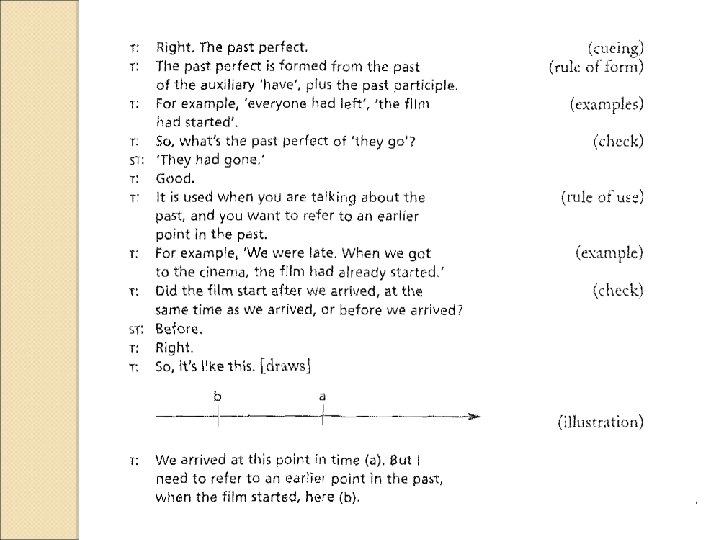
Teaching grammar Deductive A rule is presented and then examples follow. kissing in Serbia Inductive Examples are presented and a rule is inferred.
Think of advantages and disadvantages Deductive teaching (ruledriven) Advantages Time-saving, you get straight to the point; Caters to students’ expectations; Good for learners with analytical learning styles. Disadvantages - - Students may lack the metalanguage to follow the grammar explanation; It is boring for young learners; Teacher-fronted class, no interaction among students; Explanations are not memorable; Students may assume that learning the rules equals learning a language.
What makes a good rule? Truth: although it should be simple and clear, it is still important that the rule you give your students is true. Limitation: show your students what the limits to the use of a form are. Clarity: clarify the rules you give your students (e. g. will spontaneous decisions, going to premeditated decisions). Simplicity: don’t overburden them with subcategories, don’t mention all the possible exceptions. Familiarity: when giving a rule use concepts that are familiar to the students.
Inductive teaching (rulediscovery) Similar to how the 1 st language is acquired – expose students to a massive amount of input, then they induce the rules of form and use. Cases of total immersion into foreign language communities, without any classroom instruction – some succeed and some fail. Successful induction requires more than random, unfocused exposure.
Inductive teaching (rulediscovery) Situational Language Teaching – teacher creates a situation that generates examples of a structure: generative situation (Britain, 1960 s). Situations are typical examples of when to use a structure, and several examples help students induce the form. If there are problems, teachers can do some explicit grammar instruction (which was a big ‘no-no’ in the days of the Direct Method and Audiolingualism).
Situational Language Teaching (example) I am an attractive man in my twenties, blond, tall and fit, seeking a girl to share my life with.
YOU SAID YOU WERE an attractive man in your twenties, but you’re not! YOU SAID YOU WERE blond, but you’re bald! YOU SAID YOU
Inductive teaching (rulediscovery) Think of advantages and disadvantages Advantages Rules which you discover on your own are more memorable; The effort you put in to discover a rule means you’ll remember it better; Students are more involved and motivated; Good for students who like solving problems and noticing patterns; If done in a group, discovering rules creates communication opportunities; If done individually it creates learner autonomy. Disadvantages - - Time and energy consuming; Students may hypothesize the wrong rule, or one that is too broad or too narrow; Complicated for teachers to plan (teachers have to choose really good, representative examples); Some aspects of grammar are difficult to put into rules (modals, articles); Some students prefer to be told the rule.
Teaching grammar through texts Teachers often teach grammar at the sentence level, but context is very important.
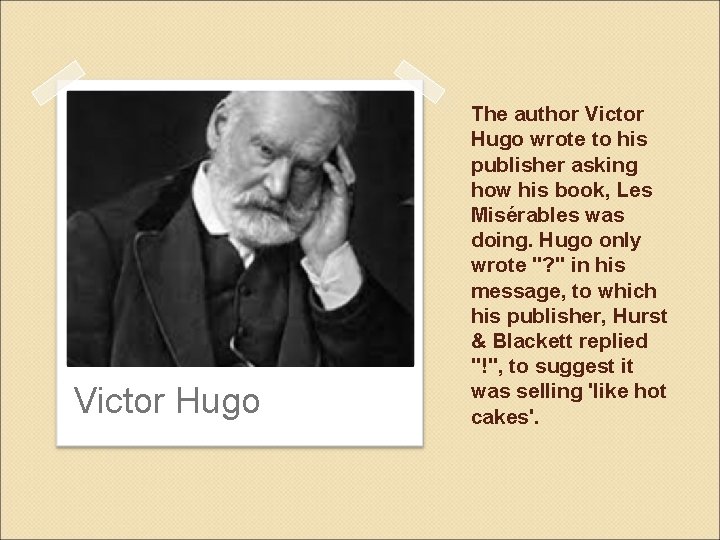
Victor Hugo The author Victor Hugo wrote to his publisher asking how his book, Les Misérables was doing. Hugo only wrote "? " in his message, to which his publisher, Hurst & Blackett replied "!", to suggest it was selling 'like hot cakes'.
Context of a text – some sentences make no sense without the rest of the text. ◦ “Voldemort put a bit of himself in me? ” Harry said, thunderstruck. Context of a situation – some texts make no sense without knowing the situation they are used in (roles and relationships of speakers, modes of communication). ◦ Port does not exist. (a message on your computer) Context of a culture – some situations make no sense without knowing the culture they are used in. ◦ Celebrating Valentine’s Day in western cultures, e. g.
Grammar and context It is easier to examine a fish out of water. The same rule applies to grammar, but taking grammar items out of context can be dangerous. ◦ Ben is playing football right now, he can’t take your call. ◦ Ben is playing football with his friends tomorrow morning. ◦ Ben is playing football a lot these days. ◦ Ben is always playing football when I need his
Grammar and context Sometimes we end up with bad exercises: Which of these sentences is grammatically correct? 1. They will have a party next week. 2. A: The phone’s ringing. B: I’m going to get it. 3. We’re going to India next summer. 4. A: Beer? B: No, thanks. I’m not drinking. All of the sentences are grammatically correct and can be uttered in certain
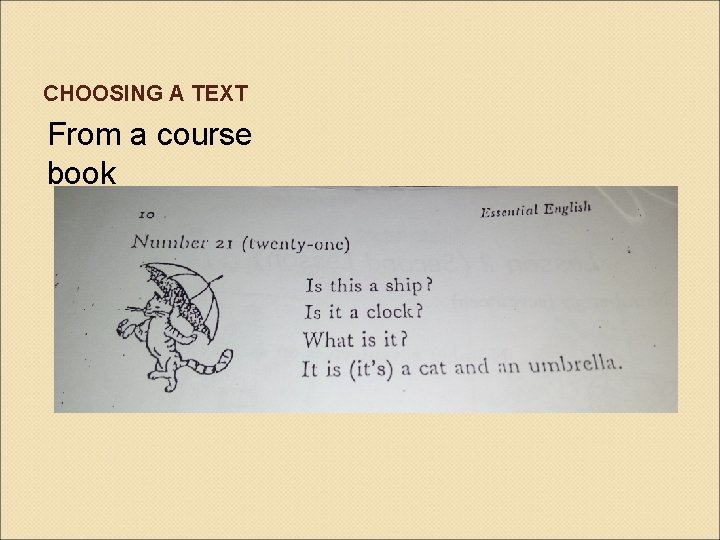
CHOOSING A TEXT From a course book
CHOOSING A TEXT Authentic texts: newspapers, songs, literary texts, the Internet, etc.
CHOOSING A TEXT Teacher’s text Very rarely exploited; teacher’s travel plans, routine, childhood memory, etc. , these are interesting to students, and the teacher knows how to address the students and check understanding.
CHOOSING A TEXT Students’ text The topics students are interested in are more memorable than course books, the Internet, newspapers, teacher’s stories…
FAQ about microteaching Sign up when you pick a time slot (the lists are on the notice board next to room 215 and will be there for a week); We start microteaching from November 21; If there is 6 or 4 members in your group, it is not a problem; If you do not have a group, tell me, I’ll help out; You are to prepare a 5 -minute grammar presentation to imaginary students (deductive, inductive approach or teaching through texts) – more details next time.