
How to tackle the math problem Pam Dunn
How to tackle the math problem? Pam Dunn Medical Education Manager Harrogate and District NHS Foundation Trust
Background � Clinical and Analytical Biochemistry module exam. (stage 2, Biomedical Science programme) � 25% of cohort obtained 0 marks for a mole/mass/volume calculation � Practical interventions
Who? � Up to approximately half the cohort � Most prevalent in those who had not taken ‘A’ level chemistry � Least prevalent in those on Clinical Science programme (high tariff entry)

Why? � Self-selection? � Lack of secure understanding early in maths learning pathway? � Motivation/ � previous avoidance? learning experiences? � Time-lapse since maths learning?
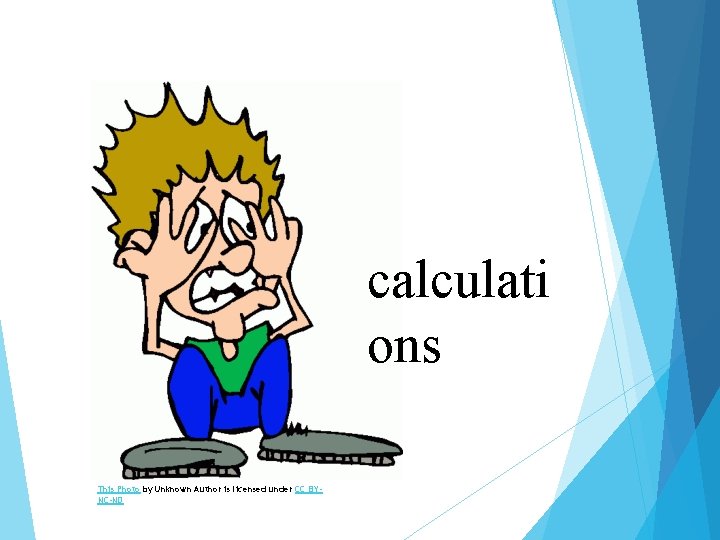
calculati ons This Photo by Unknown Author is licensed under CC BYNC-ND
Interventions: avoidance / motivation � Explicit expectations at beginning of module � Practice assessments to selfadminister and mark spaced throughout module � Continued emphasis that end of module assessment will include calculations
Interventions: avoidance / motivation This Photo by Unknown Author is licensed under CC BYSA-NC vs This Photo by Unknown Author is licensed under CC BY-ND
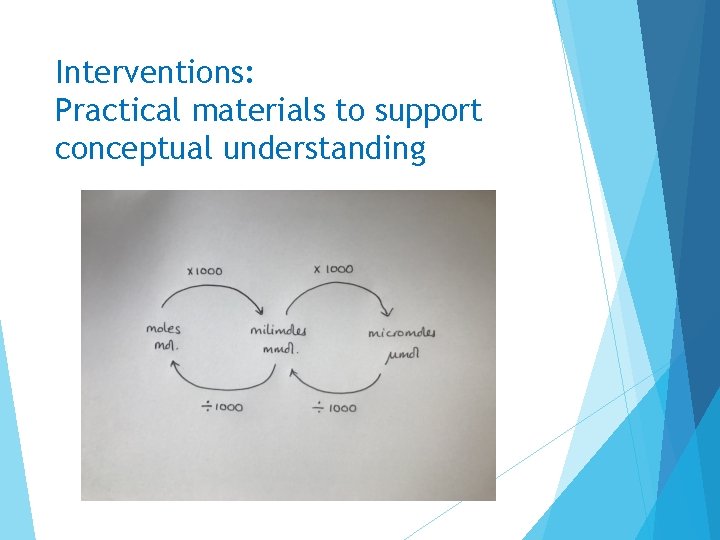
Interventions: Practical materials to support conceptual understanding
Interventions: Structured learning and materials � Structured workshop questions with opportunity for developing mathematical technique � Q 1 You have a 2 M solution of sodium chloride. How many moles are there in: (a) 2 litres � (b) 500 mls? � (c) 300 mls ? � (d) 1245 mls? �
Interventions: Structured learning and materials � Q 1 You have a 2 M solution of sodium chloride. How many moles are there in: (a) 2 litres � 2 M = 2 moles per litre � So moles in 2 litres = 2 moles x 2 litres � (b) 500 mls? � 2 M = 2 moles per litre, 500 mls = 0. 5 litres � So moles in 2 litres = 2 moles x 0. 5 litres � (c) 300 mls ? � (d) 1245 mls? �
Interventions: supporting conceptual understanding Pseudohyponatraemia Patients with very high levels of triacylglycerol in their blood sometimes get an artificially low serum sodium level when measured by ‘indirect’ Ionselective electrode. Why? (‘indirect ISE’ are those in which the serum is diluted in buffer before being measured by the electrode)
Outcomes � Improvement in calculation outcomes, though varied by cohort � Consistently improved module feedback results � Some dramatic impact for some individuals � Moves towards development of a programme-wide strategy

Observations/suggestions?
- Slides: 13