
How to successfully complete your science project using





- Slides: 22
How to successfully complete your science project using the… The Scientific Method Created by: Alicia R. Martinez
Getting Started Oh, no…you’ve been assigned by your teacher to do a science project and you don't know where to begin. Well, a science experiment is nothing more than a way to solve a problem.
Taking a closer look at the… Scientific Method
Choosing a Topic A good topic has a problem that can be answered only by experimenting. If the topic is broad or general, too many factors (variables) will exist that cannot be controlled and you will find it hard to produce reliable results. Visit the following sites if you need ideas for a topic: http: //school. discovery. com/siencefaircentral/scifailstudio/ideas. html http: //www. infowest. com/life/projects/htm http: //www. ipl. org/div/kidscplace/projectguide/sci_method. html http: //www. scifair. org/articles/sm. shtml http: //www. madscience. org http: //edweb. tusd. k 12. az. us. /jtindell/
Title Your project will need a title because it lets people know what you have worked on. The title should be in the form of a statement, unless you use the problem statement as your title. Then it should be in the form of a question. Examples: Poor Title: Soap Powder Better General Title: Cleaning Power Of Soap Powder Problem Statement as Title: Which Detergent Powder Is the Best Cleaner of Ketchup Stains?
Problem Statement The problem is the scientific question to be solved, in other words…the question tells people what you are trying to find out. It is always written in the form of a question, even if it is used as the title. Example: Poor Problem Statement: How does detergent work? Better Problem Statement: Which powder detergent works best in removing ketchup stains on cotton fabric? (Gain,
Background Information Books, encyclopedias, magazines, or experts in a field can give you background information to help you understand your topic. This information will not answer your questions, but it will give you ideas about your topic. For example, you may read about soap and what it is made of, and include it in your project report, but you still have to do the experiment to get the answer to your questions. Begin collecting information for your bibliography. Access to online resources (subscription paid for by M-DCPS) http: //virtuallibrary. dadeschools. net username: miamidade password: miamidade
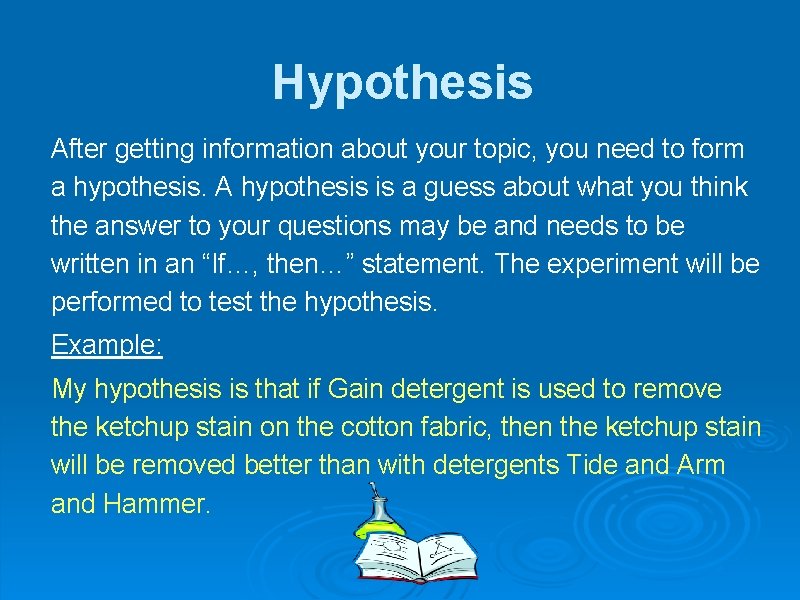
Hypothesis After getting information about your topic, you need to form a hypothesis. A hypothesis is a guess about what you think the answer to your questions may be and needs to be written in an “If…, then…” statement. The experiment will be performed to test the hypothesis. Example: My hypothesis is that if Gain detergent is used to remove the ketchup stain on the cotton fabric, then the ketchup stain will be removed better than with detergents Tide and Arm and Hammer.
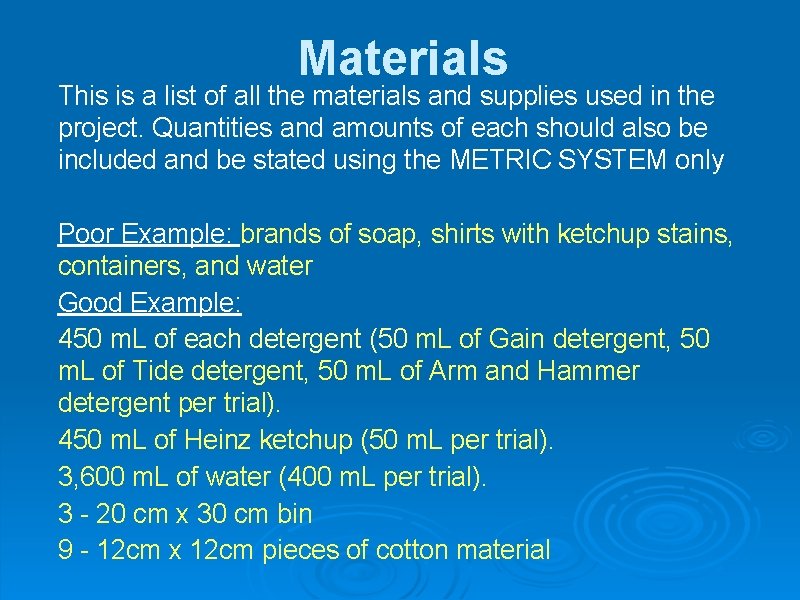
Materials This is a list of all the materials and supplies used in the project. Quantities and amounts of each should also be included and be stated using the METRIC SYSTEM only Poor Example: brands of soap, shirts with ketchup stains, containers, and water Good Example: 450 m. L of each detergent (50 m. L of Gain detergent, 50 m. L of Tide detergent, 50 m. L of Arm and Hammer detergent per trial). 450 m. L of Heinz ketchup (50 m. L per trial). 3, 600 m. L of water (400 m. L per trial). 3 - 20 cm x 30 cm bin 9 - 12 cm x 12 cm pieces of cotton material
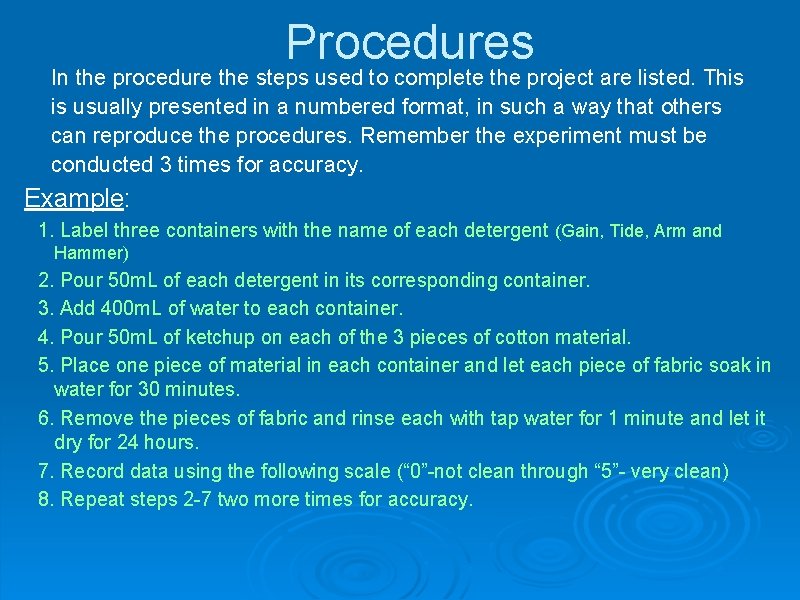
Procedures In the procedure the steps used to complete the project are listed. This is usually presented in a numbered format, in such a way that others can reproduce the procedures. Remember the experiment must be conducted 3 times for accuracy. Example: 1. Label three containers with the name of each detergent (Gain, Tide, Arm and Hammer) 2. Pour 50 m. L of each detergent in its corresponding container. 3. Add 400 m. L of water to each container. 4. Pour 50 m. L of ketchup on each of the 3 pieces of cotton material. 5. Place one piece of material in each container and let each piece of fabric soak in water for 30 minutes. 6. Remove the pieces of fabric and rinse each with tap water for 1 minute and let it dry for 24 hours. 7. Record data using the following scale (“ 0”-not clean through “ 5”- very clean) 8. Repeat steps 2 -7 two more times for accuracy.
Controlled Variables/Constants This is what stays the same in your experiment to ensure that you will be fair and unbiased when conducting the tests. For example, for the mentioned experiment the controls would be the following: - Using the same amount of water and detergent in all trials. - Same amount of ketchup - Letting the pieces of fabric soak in the water for the same amount of time to ensure that all three detergents get the same amount of time to remove the stain. - Same amount time each piece of material is rinsed under the tap water.
Independent Variable This is the one element that you are testing or manipulating. - the different brands of detergent
Dependent Variable This is the one element that is responding. - the ketchup stain
Data What did you see? Record all your observations in a log or lab sheet. Create tables, graphs, charts, illustrations and other visual data. Data will not be discussed in this section. Don’t forget to take pictures.
Results The results are a statement of what was found according to the data. It should be quantitative data, if not, create a scale for your observations. For example utilize a scale of “ 0” (not clean) through “ 5” (very clean). Example: After conducting my experiment 3 times, the results were that Gain detergent had an average of 5, Tide detergent had an average of 3 and Arm and Hammer detergent had an average of 2.
Conclusion In the conclusion, the results of the experiment is evaluated and interpreted as it relates to the problem statement. Answers the questions, “What was the purpose of the investigation? ”, “Was your hypothesis supported by the data? ”, “What were the major findings? ”, and “What are possible reasons for the results? ”. Gain removed the entire ketchup stain, while the other two detergents partially removed the ketchup stain. Therefore I accept my hypothesis that Gain was going to remove the ketchup stains the best on cotton fabric. The purpose of this investigation was to find the most effective detergent in removing stains. A possible reason for the fact that Gain was the most effective could be that it is the most expensive of the three detergents tested.
Applications Answers the questions, “How can the investigation be improved? ”, “How can you use the findings from this investigation in your daily life? ”, and “What new question(s) has your experiment lead you to ask that could be tested in a new investigation? ”. Example: My investigation can be improved by including additional brands of detergents and possibly an extra trial. The information I learned can be useful because it will help consumers purchase the best type of detergent to remove ketchup stains. After conducting my experiment, I wonder if different temperature of the water will really have an effect on removing ketchup stains.
Acknowledgments You should make a list of anyone who may have helped you, including your parents, teacher, companies, etc. Be specific and tell what they did to assist you in this project.
Abstract This is a short summary of the entire project. It must include purpose, procedure, and results in a paragraph form. You should limit yourself to no more that 250 words. The abstract is usually the first item the judge looks at after the title. ABSTRACT The purpose of this scientific investigation was to (PROBLEM STATEMENT) ________________________________. My hypothesis is that if _______________, then _____. In order to conduct my experiment, I (PROCEDURES) _______________________________________________________________ After my experiment the results were that : (RESULTS)________________________________ Therefore, I accept/reject my hypothesis that (HYPOTHESIS)________________________________ (If rejected…) My hypothesis was not supported by the results because…(state a possible reason) __________________________. One way that I can improve my project is by… (more trials, duration, other changes) _______________________________.
Project Report This report contains all of the components included in the science display board, plus a title page, background information, table of contents and acknowledgements. It is preferable for the report to be processed on a computer, but a neat handwritten copy will be accepted. Table of Content Abstract. . . . . 2 Problem Statement. . . . 3 Cleaning Power of Detergent Powder Background Information. . . 4 Hypothesis……. ………………. . 5 Materials…………………. . 6 Procedures………………. . 7 Variables…………. …. . 8 Data…………………. . 9 Results…………. …… 10 Conclusion…………. . 11 Grade 5 Room 205 Application…………. . 12 Acknowledgements……. …. . … 13 Bibliography………. …………. . 14 Pages must be numbered!
Very Important to Remember ●Mom and Dad can help, but YOU have to do the experiment YOURSELF. ●Keep it simple. ●Include all of the components and steps in your experiment. ●The science project is worth 10 -12 grades! ●Turn in the components and the display board on time. ●HAVE FUN!
We hope that you will find this process educational AND enjoyable! Questions? ? ?