
How to Submit a Successful Grant Application Julio
How to Submit a Successful Grant Application Julio A. Panza, MD Director, Division of Cardiology, Washington Hospital Center Professor of Medicine, Georgetown University Washington, DC Chair, Clinical Trials Review Committee National Heart, Lung, and Blood Institute Bethesda, MD CRT 2012 There are no conflicts of interest related to this presentation
Julio A. Panza, MD I have no real or apparent conflicts of interest to report.
Basic Principles ü Know your target source of funding ü Align the objectives of your application with those of the target funding source ü Learn the review criteria ü Understand the mechanism for review ü Meet with (or talk to) funding source personnel
First Steps üGather your thoughts such that you can clearly formulate them in the form of questions, aims, and hypotheses üEstablish your investigational team üDesign a research approach strategy üSeek help for grant application writing
What Will Your Application Be Judged On? Significance üDoes the project address an important problem or a critical barrier to progress in the field? üIf the aims of the project are achieved, how will scientific knowledge, technical capability, and/or clinical practice be improved? üHow will successful completion of the aims change the concepts, methods, technologies, treatments, services, or preventative interventions that drive this field?
What Will Your Application Be Judged On? Investigator(s) üAre the PD/PIs, collaborators, and other researchers well suited to the project? üIf Early Stage Investigators or New Investigators, or in the early stages of independent careers, do they have appropriate experience and training? üIf established, have they demonstrated an ongoing record of accomplishments that have advanced their field(s)? ü If the project is collaborative or multi-PD/PI, do the investigators have complementary and integrated expertise; are their leadership approach, governance and organizational structure appropriate for the project?
What Will Your Application Be Judged On? Innovation üDoes the application challenge and seek to shift current research or clinical practice paradigms by utilizing novel theoretical concepts, approaches or methodologies, instrumentation, or interventions? üAre the concepts, approaches or methodologies, instrumentation, or interventions novel to one field of research or novel in a broad sense? üIs a refinement, improvement, or new application of theoretical concepts, approaches or methodologies, instrumentation, or interventions proposed?
What Will Your Application Be Judged On? Approach üAre the overall strategy, methodology, and analyses well-reasoned and appropriate to accomplish the specific aims of the project? üAre potential problems, alternative strategies, and benchmarks for success presented? üIf the project is in the early stages of development, will the strategy establish feasibility and will particularly risky aspects be managed? üIf the project involves clinical research, are the plans for 1) protection of human subjects from research risks, and 2) inclusion of minorities and members of both sexes/genders, as well as the inclusion of children, justified in terms of the scientific goals and research strategy proposed?
What Will Your Application Be Judged On? Environment üWill the scientific environment in which the work will be done contribute to the probability of success? üAre the institutional support, equipment and other physical resources available to the investigators adequate for the project proposed? üWill the project benefit from unique features of the scientific environment, subject populations, or collaborative arrangements?
What Will Your Application Be Judged On? Additional review criteria • Protections for Human Subjects Ø risk to subjects Ø adequacy of protection against risks Ø potential benefits to the subjects and others Ø importance of the knowledge to be gained Ø data and safety monitoring for clinical trials • Inclusion of Women, Minorities, and Children • Vertebrate Animals Ø justification for the proposed use of the animals, species, strains, ages, sex, and numbers Ø adequacy of veterinary care Ø procedures for limiting discomfort, distress, pain and injury Ø methods of euthanasia and reason for selection • Biohazards
What Will Your Application Be Judged On? Overall Impact üReflects the reviewers’ assessment of the likelihood for the project to exert a sustained and powerful influence on the research field(s) involved.
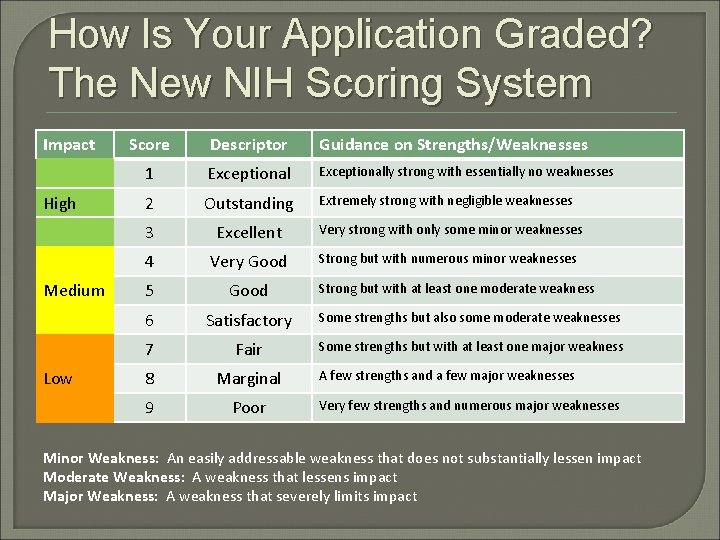
How Is Your Application Graded? The New NIH Scoring System Impact High Medium Low Score Descriptor Guidance on Strengths/Weaknesses 1 Exceptionally strong with essentially no weaknesses 2 Outstanding Extremely strong with negligible weaknesses 3 Excellent Very strong with only some minor weaknesses 4 Very Good Strong but with numerous minor weaknesses 5 Good 6 Satisfactory Some strengths but also some moderate weaknesses 7 Fair Some strengths but with at least one major weakness 8 Marginal 9 Poor Strong but with at least one moderate weakness A few strengths and a few major weaknesses Very few strengths and numerous major weaknesses Minor Weakness: An easily addressable weakness that does not substantially lessen impact Moderate Weakness: A weakness that lessens impact Major Weakness: A weakness that severely limits impact
The Outcome ü Be prepared for rejection Most applications are not funded on first pass ü Learn how to interpret the review ü Determine the potential for resubmission If you resubmit, structure the revisions around the critiques ü Don’t give up If resubmission is not an option, choose another target funding source
- Slides: 13