
HOW TO STRATEGICALLY ANSWER MULTIPLE CHOICE QUESTIONS required
- Slides: 12
HOW TO STRATEGICALLY ANSWER MULTIPLE CHOICE QUESTIONS *required April 27 th 2015 2 sets of 35 -38 MC questions
2 About Multiple Choice Questions Most commonly used objective test question. Consists of two (2) parts: � Stem (statement or question) � Answer Choices (known as distractors or foils) Multiple choice questions assess � Memory of facts, details and/or relationships � Ability to reason Two rules to remember when taking multiple choice questions. � Budget Time Wisely � Relax and Don’t Panic!
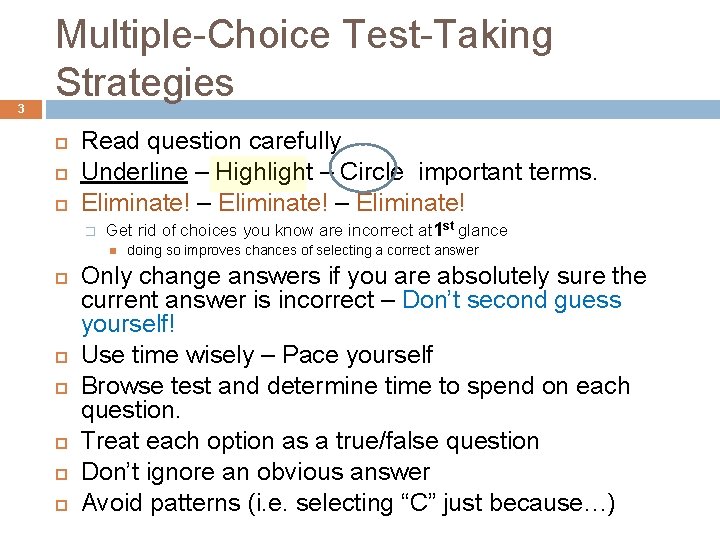
3 Multiple-Choice Test-Taking Strategies Read question carefully Underline – Highlight – Circle important terms. Eliminate! – Eliminate! � Get rid of choices you know are incorrect at 1 st glance doing so improves chances of selecting a correct answer Only change answers if you are absolutely sure the current answer is incorrect – Don’t second guess yourself! Use time wisely – Pace yourself Browse test and determine time to spend on each question. Treat each option as a true/false question Don’t ignore an obvious answer Avoid patterns (i. e. selecting “C” just because…)
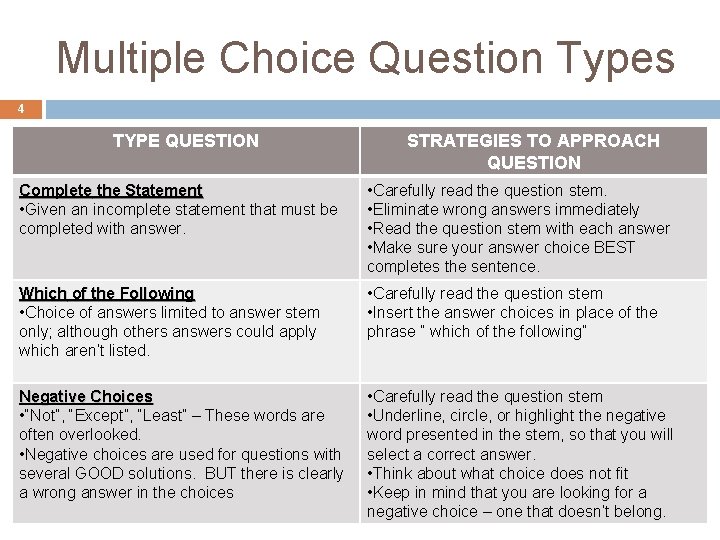
Multiple Choice Question Types 4 TYPE QUESTION STRATEGIES TO APPROACH QUESTION Complete the Statement • Given an incomplete statement that must be completed with answer. • Carefully read the question stem. • Eliminate wrong answers immediately • Read the question stem with each answer • Make sure your answer choice BEST completes the sentence. Which of the Following • Choice of answers limited to answer stem only; although others answers could apply which aren’t listed. • Carefully read the question stem • Insert the answer choices in place of the phrase “ which of the following” Negative Choices • “Not”, “Except”, “Least” – These words are often overlooked. • Negative choices are used for questions with several GOOD solutions. BUT there is clearly a wrong answer in the choices • Carefully read the question stem • Underline, circle, or highlight the negative word presented in the stem, so that you will select a correct answer. • Think about what choice does not fit • Keep in mind that you are looking for a negative choice – one that doesn’t belong.
History Multiple Choice 5 Look for context clues � Presidents/Wars � Dates and Time Periods � North/South (Civil War); North Korea/South Korea; North Vietnam/South Vietnam Obvious contexts Flappers=1920 s; Red Scares=Right after a World War; Beatnik=1950 s We like to divide things in half � A quote or saying can be difference between a question about abolitionism or segregation (pre-Civil War or after); or fighting Germans or the Soviet Union (WWI/WW 2 or Cold War) Language Used � US History is divided by presidential terms and wars fought Know your dividing lines and you can guess better Know your programs and presidents (Johnson=Great Society; Roosevelt=New Deal) Mentions ‘trenches’ or ‘machine guns’, probably World War I Mentions ‘jungle’, probably Vietnam Pictures and styles in pictures (hair or dress) Eliminate choices as you discover the meaning of the question
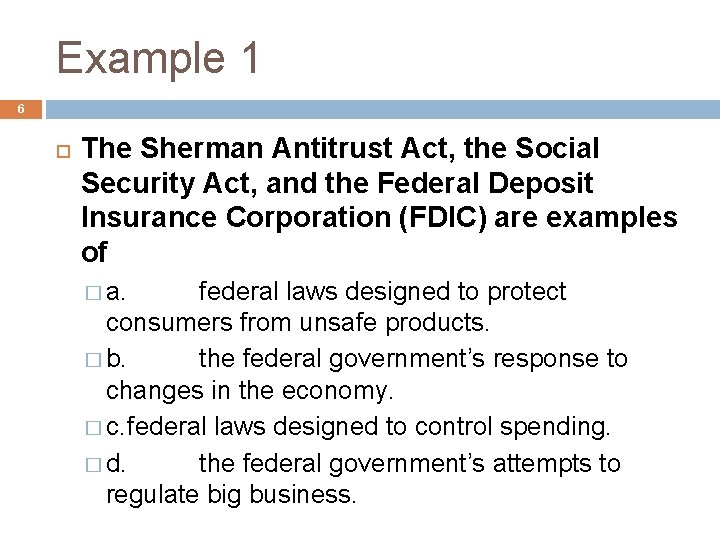
Example 1 6 The Sherman Antitrust Act, the Social Security Act, and the Federal Deposit Insurance Corporation (FDIC) are examples of � a. federal laws designed to protect consumers from unsafe products. � b. the federal government’s response to changes in the economy. � c. federal laws designed to control spending. � d. the federal government’s attempts to regulate big business.
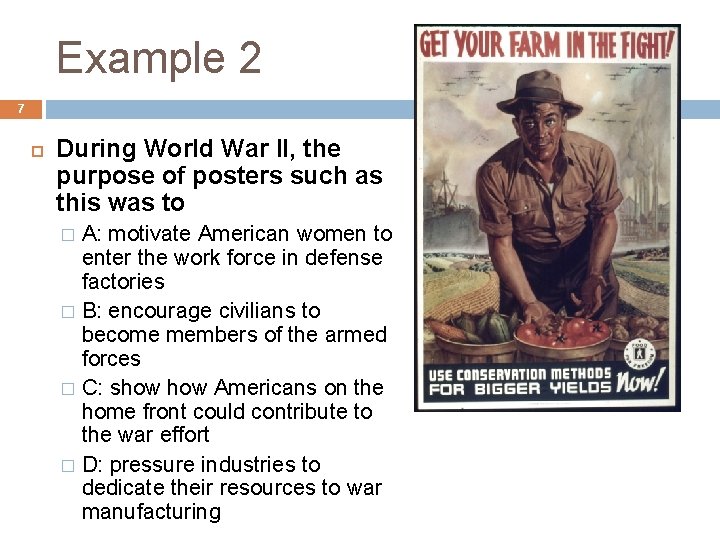
Example 2 7 During World War II, the purpose of posters such as this was to A: motivate American women to enter the work force in defense factories � B: encourage civilians to become members of the armed forces � C: show Americans on the home front could contribute to the war effort � D: pressure industries to dedicate their resources to war manufacturing �
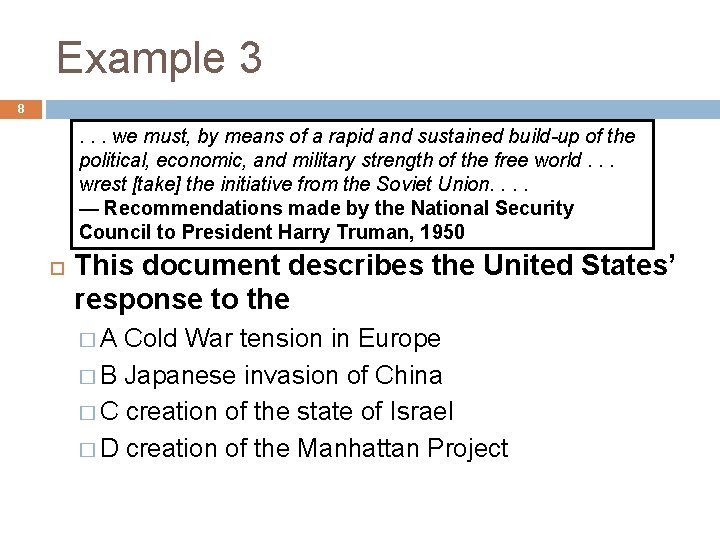
Example 3 8 . . . we must, by means of a rapid and sustained build-up of the political, economic, and military strength of the free world. . . wrest [take] the initiative from the Soviet Union. . — Recommendations made by the National Security Council to President Harry Truman, 1950 This document describes the United States’ response to the �A Cold War tension in Europe � B Japanese invasion of China � C creation of the state of Israel � D creation of the Manhattan Project
The Power of Panic 9 A person who panics… � � Relies on instincts instead of knowledge Lacks an understanding of exam content What happens when you panic? � � � Memory is inhibited Ability to focus decreases Tend to overlook stated facts Easily become confused Emotions take precedence over reason Guessing is not strategic
Process of Elimination 10 Process of elimination is the most effective way to improve your chances of selecting a correct answer. Eliminating Incorrect Answers � Details are important – watch the subtle differences in answers choices. (use question stem to find key text). � Answer choices must be logical If reasoning for answer choice is not correct, then answer is not correct. Incorrect Answers… • Misrepresent a fact(s) • Ignore the central issue in the question • Have faulty reasoning Correct Answers… • State a fact(s) • Address the central issue in the question • Have sound reasoning
Process of Elimination 11 Process of elimination is the most effective way to improve your chances of selecting a correct answer. � Answers that are jokes � Options with absolutes � Unfamiliar terms Faulty reasoning includes: � Blatant contradictions � Goes beyond the facts � Assumes facts in dispute are true When can a right answer be wrong? � When the answer choices include an option that is MORE CORRECT <OR> a BETTER OPTION.
12 The Guessing Game (intelligent deduction) Do not guess until you have eliminated all known wrong answers On tests (not math) asking for numbers as answers, most of the time you can eliminate the highest or lowest number Look at the facts in the question stem � What issue(s) stand out? <then> look for answer choice(s) that address the issue(s) presented in the question stem. Beware of the following: Distractors or Foils (incorrect answers that appear to be correct) � Absolute certainties (always, never, cannot must) � If two answers are opposites, one is probably correct. �