
How to Start a Training Session Why should

- Slides: 19
How to Start a Training Session
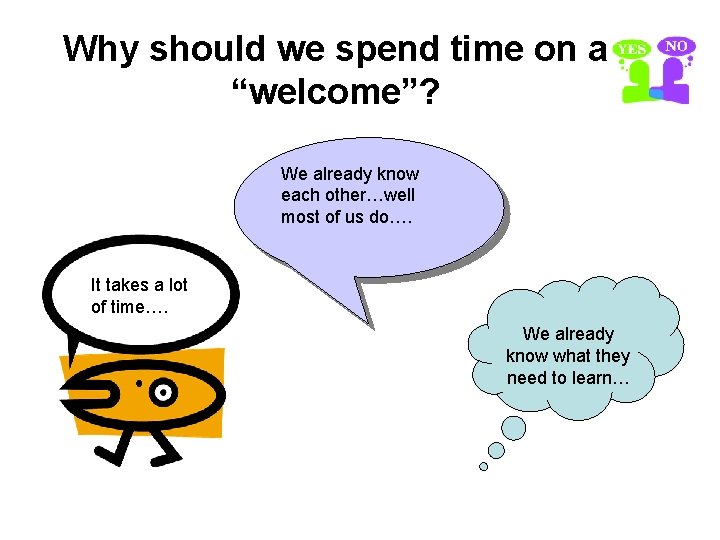
Why should we spend time on a “welcome”? We already know each other…well most of us do…. It takes a lot of time…. We already know what they need to learn…
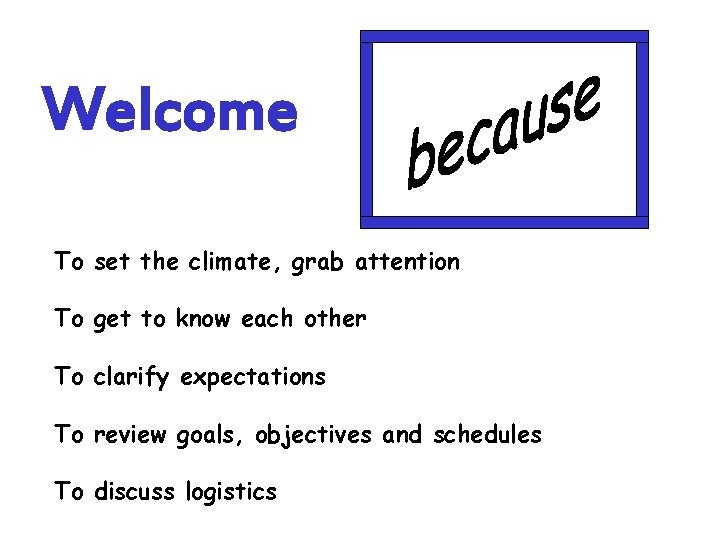
Welcome To set the climate, grab attention To get to know each other To clarify expectations To review goals, objectives and schedules To discuss logistics
Every meeting must reserve time for an opening The time taken and activities chosen will depend on the total length of the event the number of participants the ‘culture’ of the group
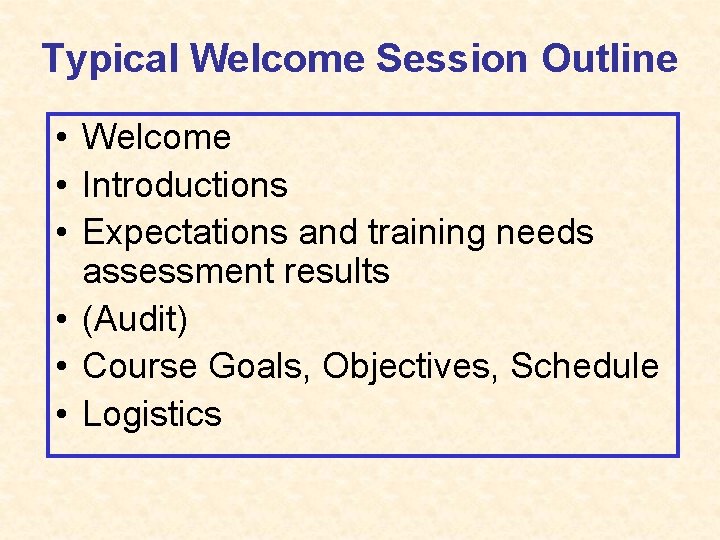
Typical Welcome Session Outline • Welcome • Introductions • Expectations and training needs assessment results • (Audit) • Course Goals, Objectives, Schedule • Logistics
And now a word from. . . you! As the facilitator you should spend the first few moments to • • • Welcome participants Express appreciation for participation Introduce yourself State briefly the background of the event Provide a brief overview of what is to come
Introductions Every session no matter how short nor how well you think people already know each other, must dedicate time for some type of introduction
What methods of introduction have you encountered in your experiences of attending workshops? Write down a few now for use later on!
Some introductory ideas! • Name-learning assignment • Alphabetical sign-in • Name chain • Do you know your neighbors? • Alphabetical lineup • Name bingo • Personalized name tags • Name toss • Name tag mix-up • Group CVs See 10 Techniques for Learning Names for explanations
Expectations • Why do we ask for participant expectations? • How do we ask for participant expectations? • What do we expect to learn? • What do we do with the results?
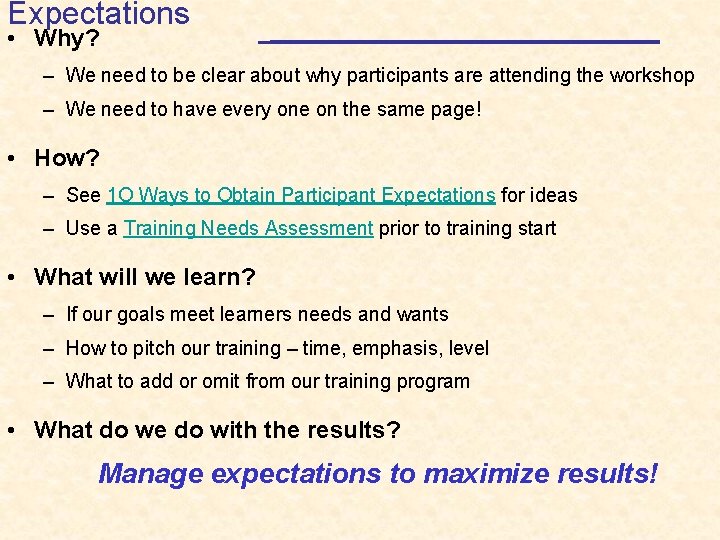
Expectations • Why? – We need to be clear about why participants are attending the workshop – We need to have every one on the same page! • How? – See 1 O Ways to Obtain Participant Expectations for ideas – Use a Training Needs Assessment prior to training start • What will we learn? – If our goals meet learners needs and wants – How to pitch our training – time, emphasis, level – What to add or omit from our training program • What do we do with the results? Manage expectations to maximize results!
Training Needs Assessment • A survey sent to potential participants prior to a training event • Asks for what the participants would like covered in the training and what they already know • Helpful to design meaningful training modules • Should minimize off beat expectations when participants arrive A method to gain expectations
What do participants know about the subject matter?
Method to gain information on what the group knows about the technical content To evaluate knowledge gained at the end of the training To refine training objectives and To assign participants to subgroups
Matching goals and expectations with the schedule is the next step Clearly point out which expectations will not be met Offer alternative ways to have those expectations met
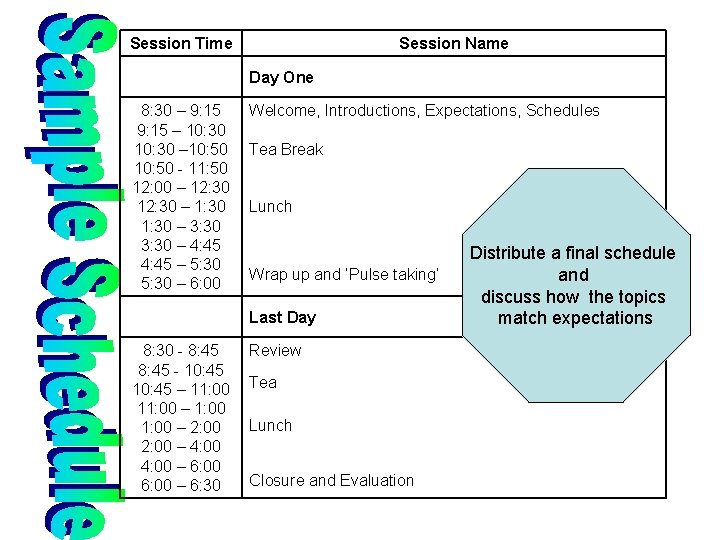
Session Time Session Name Day One 8: 30 – 9: 15 – 10: 30 – 10: 50 - 11: 50 12: 00 – 12: 30 – 1: 30 – 3: 30 – 4: 45 – 5: 30 – 6: 00 Welcome, Introductions, Expectations, Schedules Tea Break Lunch Wrap up and ‘Pulse taking’ Last Day 8: 30 - 8: 45 - 10: 45 – 11: 00 – 2: 00 – 4: 00 – 6: 30 Review Tea Lunch Closure and Evaluation Distribute a final schedule and discuss how the topics match expectations
Review Logistics Per diems? Rest rooms? Coffee? Re-confirmations? Break out rooms? Tourist attractions? . .
Closure Summarize session Take Questions Link to next session
Taking time to warm up and acknowledge your audience will yield positive training results! Now you can move forward to content!