
How to Select a PNA IFBW with Performance
How to Select a PNA IFBW with Performance Comparable to an 8510
How to select a PNA IFBW with performance comparable to an 8510 • IFBW and averaging • Example • Noise reduction comparison • PNA superiority • Determining PNA IFBW • Example • Point & trace averaging
Purpose of IFBW and Averaging • Improve signal-to-noise • Noise reduction • reducing IFBW • increasing averaging • Corrupting signals are reduced too • Spurs, TOI, . . .
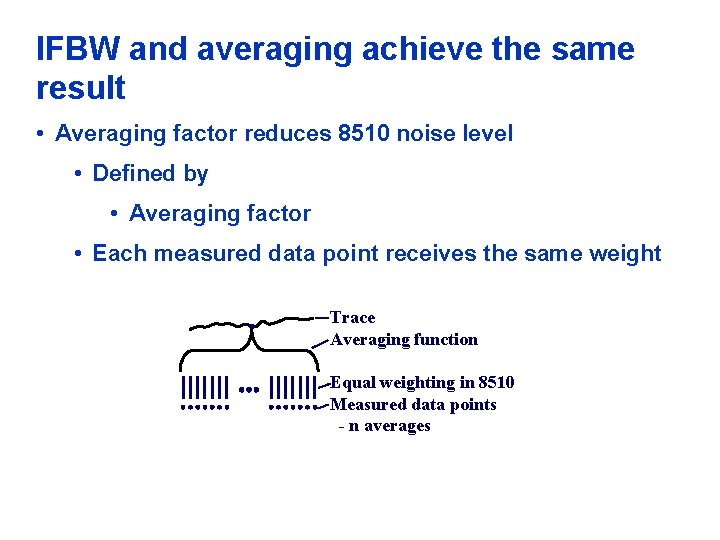
IFBW and averaging achieve the same result • Averaging factor reduces 8510 noise level • Defined by • Averaging factor • Each measured data point receives the same weight Trace Averaging function Equal weighting in 8510 Measured data points - n averages

IFBW and averaging achieve the same result • IFBW reduction lowers PNA noise level • IFBW defined by • number of taps (averages) & • shape factor or measured data point weighting Trace DSP IFBW function (averaging) shape factor (weighting) Measured data points - n taps (averages)
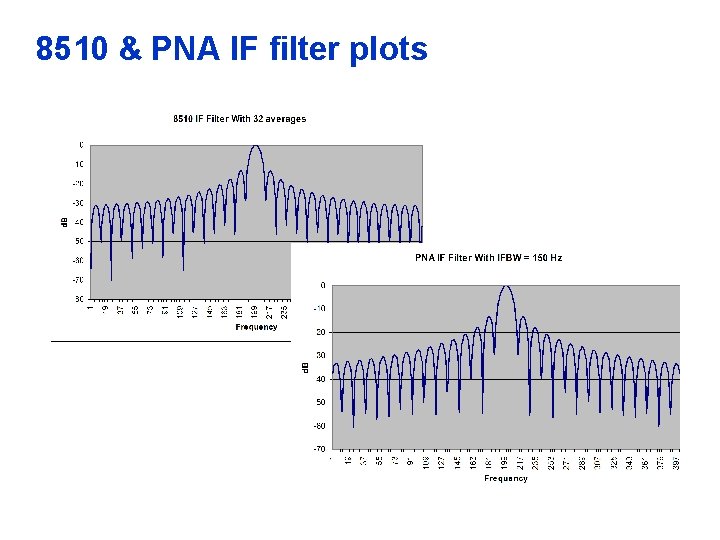
8510 & PNA IF filter plots
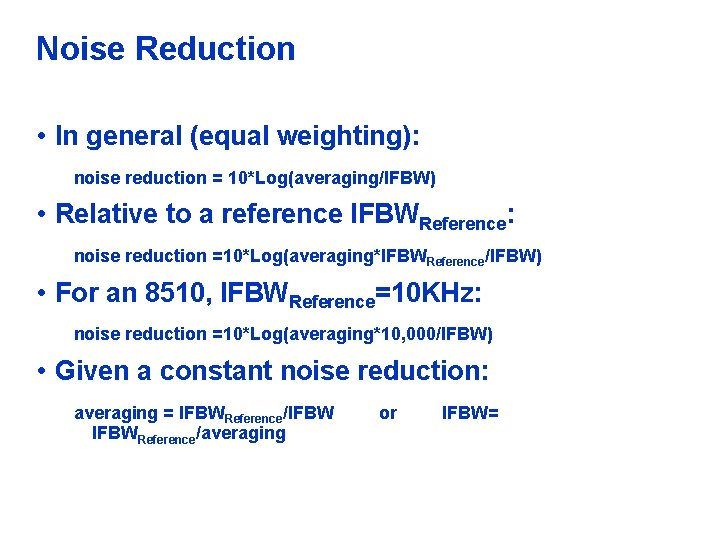
Noise Reduction • In general (equal weighting): noise reduction = 10*Log(averaging/IFBW) • Relative to a reference IFBWReference: noise reduction =10*Log(averaging*IFBWReference/IFBW) • For an 8510, IFBWReference=10 KHz: noise reduction =10*Log(averaging*10, 000/IFBW) • Given a constant noise reduction: averaging = IFBWReference/IFBWReference/averaging or IFBW=
How to Select a PNA IFBW with Performance Comparable to an 8510 • IFBW and averaging • Example • Noise reduction comparison • PNA superiority • Determining PNA IFBW • Example • Point & trace averaging
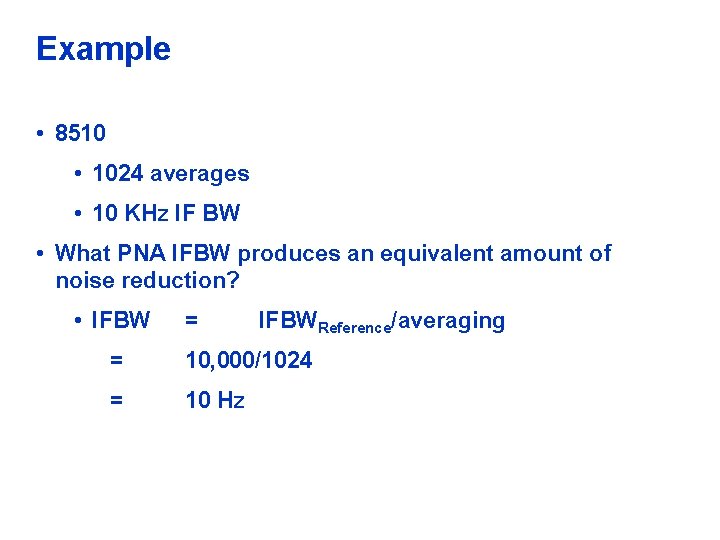
Example • 8510 • 1024 averages • 10 KHz IF BW • What PNA IFBW produces an equivalent amount of noise reduction? • IFBW = IFBWReference/averaging = 10, 000/1024 = 10 Hz
How to Select a PNA IFBW with Performance Comparable to an 8510 • IFBW and averaging • Example • Noise reduction comparison • PNA superiority • Determining PNA IFBW • Example • Point & trace averaging
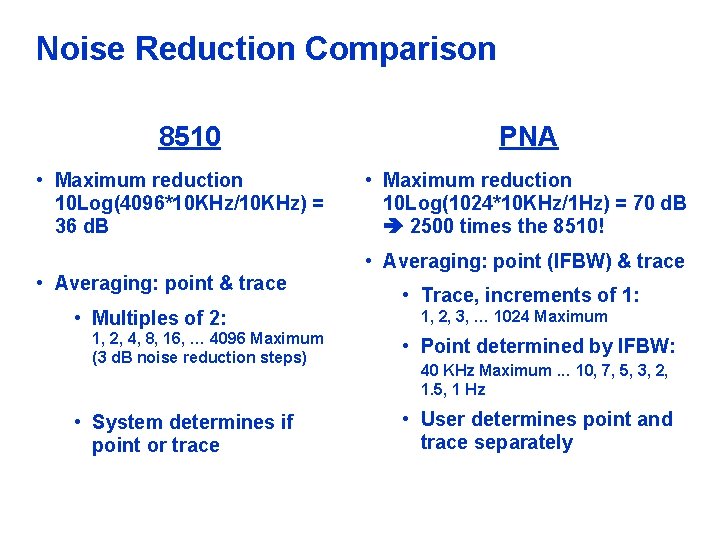
Noise Reduction Comparison 8510 • Maximum reduction 10 Log(4096*10 KHz/10 KHz) = 36 d. B • Averaging: point & trace • Multiples of 2: 1, 2, 4, 8, 16, … 4096 Maximum (3 d. B noise reduction steps) • System determines if point or trace PNA • Maximum reduction 10 Log(1024*10 KHz/1 Hz) = 70 d. B 2500 times the 8510! • Averaging: point (IFBW) & trace • Trace, increments of 1: 1, 2, 3, … 1024 Maximum • Point determined by IFBW: 40 KHz Maximum. . . 10, 7, 5, 3, 2, 1. 5, 1 Hz • User determines point and trace separately
How to Select a PNA IFBW with Performance Comparable to an 8510 • IFBW and averaging • Example • Noise reduction comparison • PNA superiority • Determining PNA IFBW • Example • Point & trace averaging
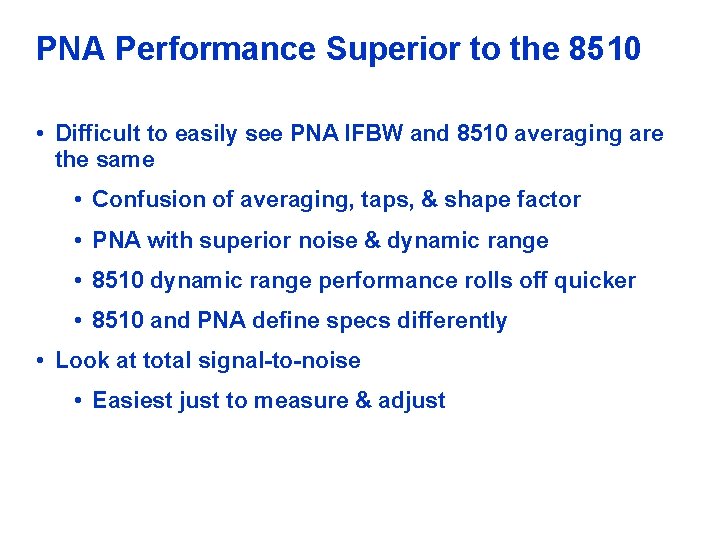
PNA Performance Superior to the 8510 • Difficult to easily see PNA IFBW and 8510 averaging are the same • Confusion of averaging, taps, & shape factor • PNA with superior noise & dynamic range • 8510 dynamic range performance rolls off quicker • 8510 and PNA define specs differently • Look at total signal-to-noise • Easiest just to measure & adjust
How to Select a PNA IFBW with Performance Comparable to an 8510 • IFBW and averaging • Example • Noise reduction comparison • PNA superiority • Determining PNA IFBW • Example • Point & trace averaging
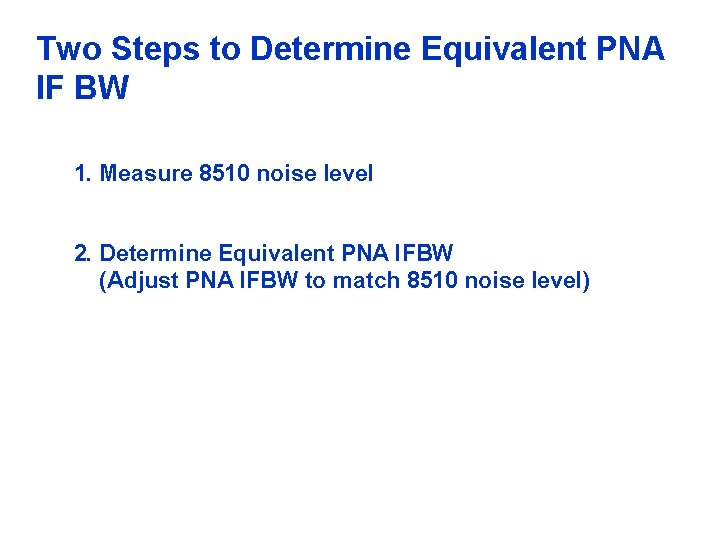
Two Steps to Determine Equivalent PNA IF BW 1. Measure 8510 noise level 2. Determine Equivalent PNA IFBW (Adjust PNA IFBW to match 8510 noise level)
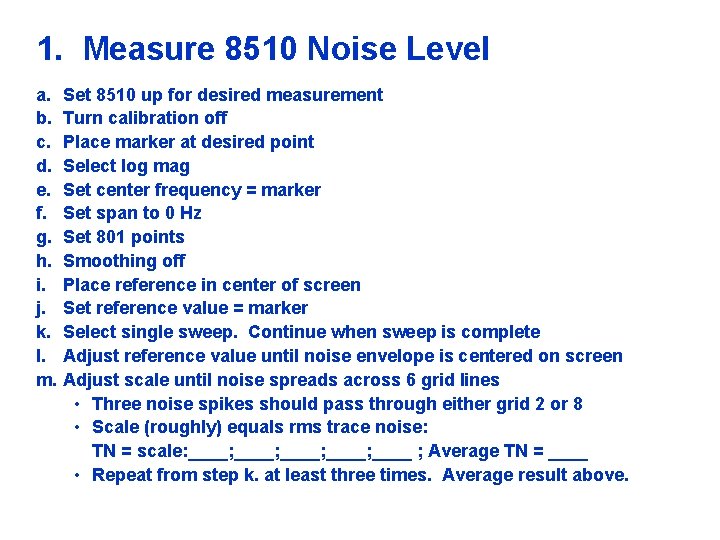
1. Measure 8510 Noise Level a. b. c. d. e. f. g. h. i. j. k. l. m. Set 8510 up for desired measurement Turn calibration off Place marker at desired point Select log mag Set center frequency = marker Set span to 0 Hz Set 801 points Smoothing off Place reference in center of screen Set reference value = marker Select single sweep. Continue when sweep is complete Adjust reference value until noise envelope is centered on screen Adjust scale until noise spreads across 6 grid lines • Three noise spikes should pass through either grid 2 or 8 • Scale (roughly) equals rms trace noise: TN = scale: ____; ____ ; Average TN = ____ • Repeat from step k. at least three times. Average result above.
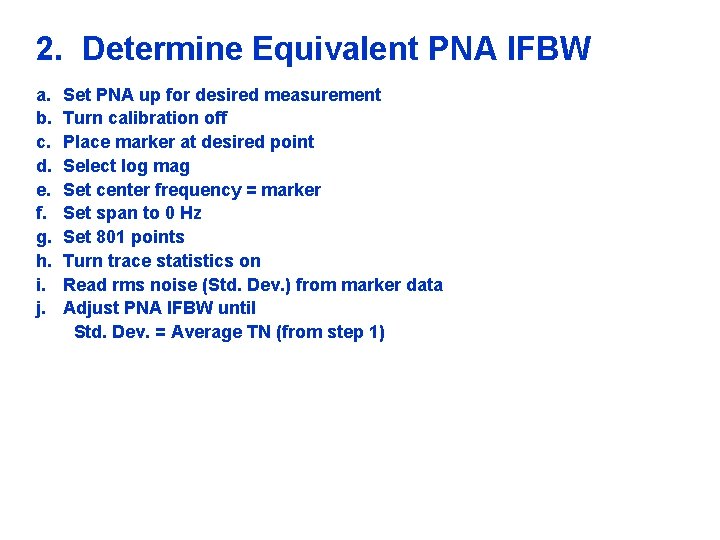
2. Determine Equivalent PNA IFBW a. b. c. d. e. f. g. h. i. j. Set PNA up for desired measurement Turn calibration off Place marker at desired point Select log mag Set center frequency = marker Set span to 0 Hz Set 801 points Turn trace statistics on Read rms noise (Std. Dev. ) from marker data Adjust PNA IFBW until Std. Dev. = Average TN (from step 1)
How to Select a PNA IFBW with Performance Comparable to an 8510 • IFBW and averaging • Example • Noise reduction comparison • PNA superiority • Determining PNA IFBW • Example • Point & trace averaging
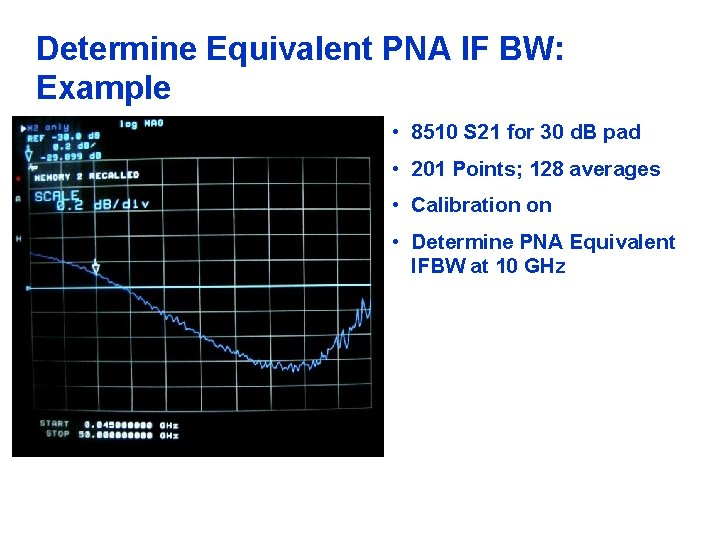
Determine Equivalent PNA IF BW: Example • 8510 S 21 for 30 d. B pad • 201 Points; 128 averages • Calibration on • Determine PNA Equivalent IFBW at 10 GHz
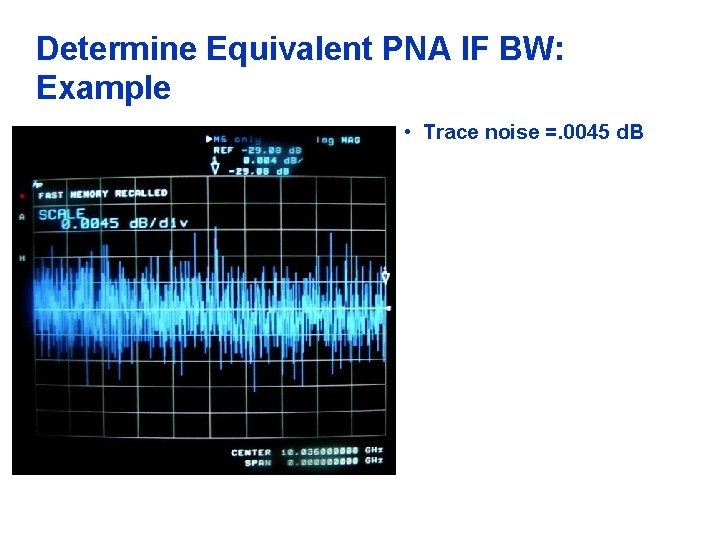
Determine Equivalent PNA IF BW: Example • Trace noise =. 0045 d. B
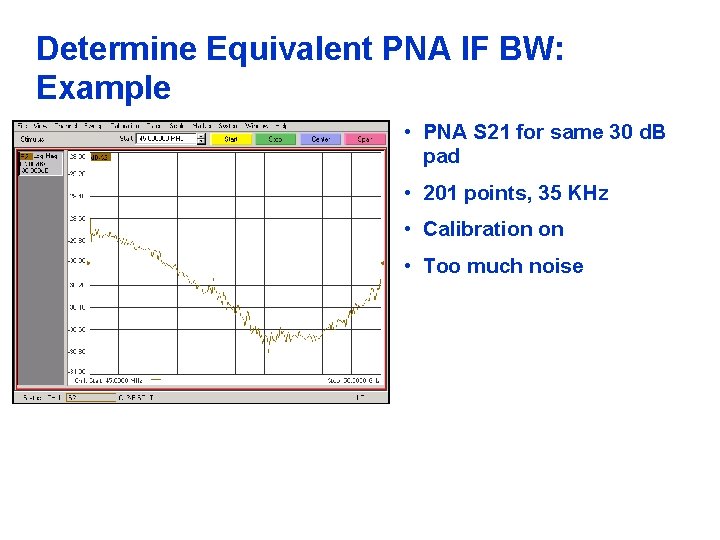
Determine Equivalent PNA IF BW: Example • PNA S 21 for same 30 d. B pad • 201 points, 35 KHz • Calibration on • Too much noise
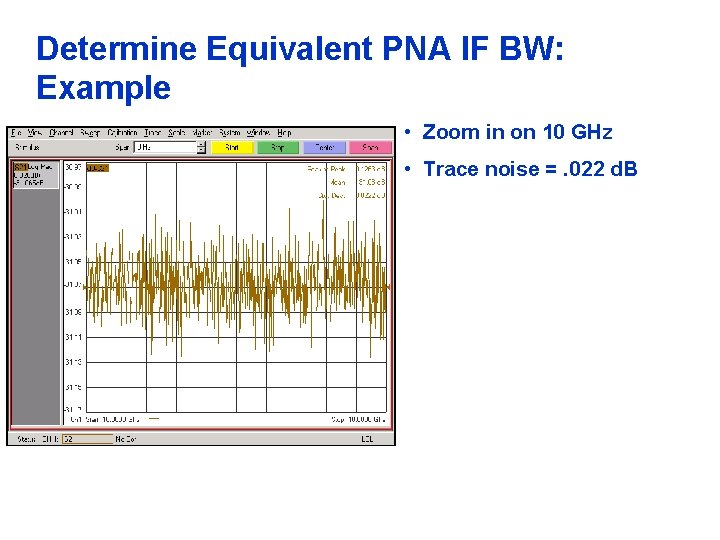
Determine Equivalent PNA IF BW: Example • Zoom in on 10 GHz • Trace noise =. 022 d. B
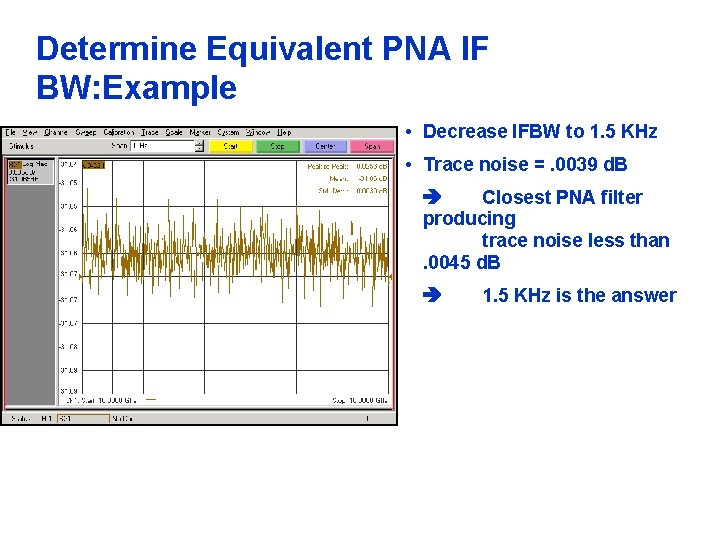
Determine Equivalent PNA IF BW: Example • Decrease IFBW to 1. 5 KHz • Trace noise =. 0039 d. B Closest PNA filter producing trace noise less than. 0045 d. B 1. 5 KHz is the answer
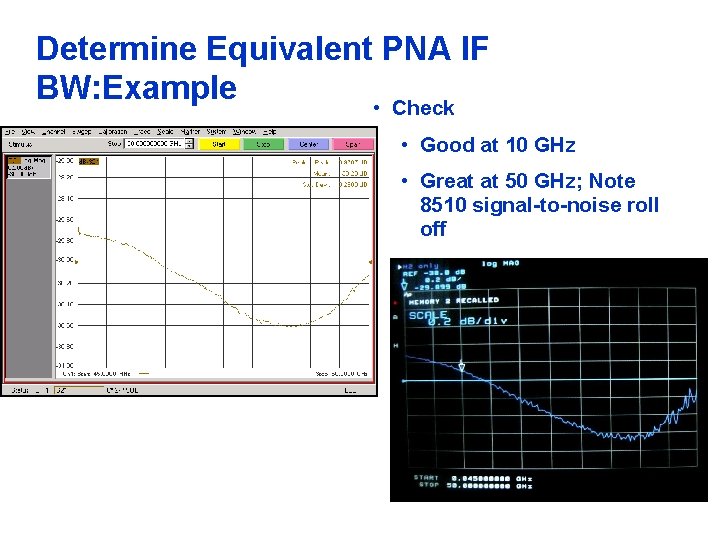
Determine Equivalent PNA IF BW: Example • Check • Good at 10 GHz • Great at 50 GHz; Note 8510 signal-to-noise roll off
How to Select a PNA IFBW with Performance Comparable to an 8510 • IFBW and averaging • Example • Noise reduction comparison • PNA superiority • Determining PNA IFBW • Example • Point & trace averaging
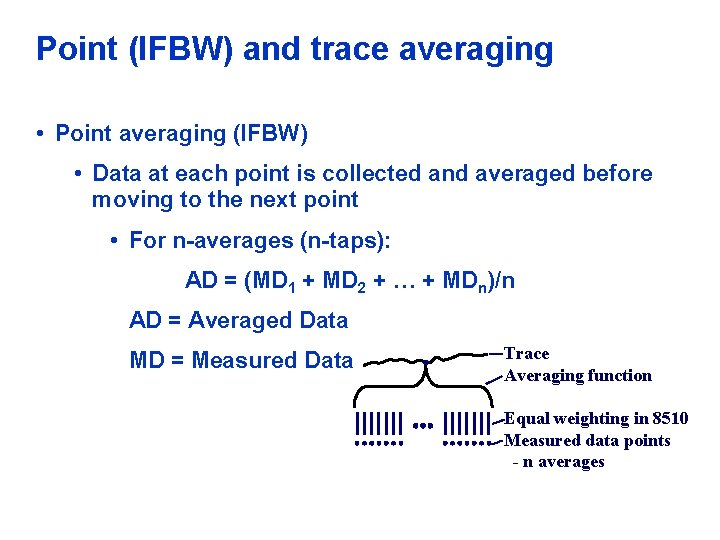
Point (IFBW) and trace averaging • Point averaging (IFBW) • Data at each point is collected and averaged before moving to the next point • For n-averages (n-taps): AD = (MD 1 + MD 2 + … + MDn)/n AD = Averaged Data MD = Measured Data Trace Averaging function Equal weighting in 8510 Measured data points - n averages
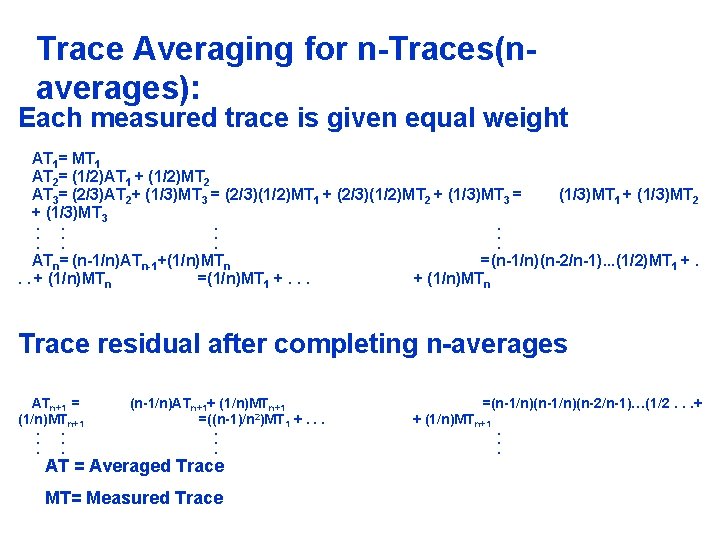
Trace Averaging for n-Traces(naverages): Each measured trace is given equal weight AT 1= MT 1 AT 2= (1/2)AT 1 + (1/2)MT 2 AT 3= (2/3)AT 2+ (1/3)MT 3 = (2/3)(1/2)MT 1 + (2/3)(1/2)MT 2 + (1/3)MT 3 = (1/3)MT 1 + (1/3)MT 2 + (1/3)MT 3. . . ATn= (n-1/n)ATn-1+(1/n)MTn =(n-1/n)(n-2/n-1). . . (1/2)MT 1 +. . . + (1/n)MTn =(1/n)MT 1 +. . . + (1/n)MTn Trace residual after completing n-averages ATn+1 = (1/n)MTn+1 . . . (n-1/n)ATn+1+ (1/n)MTn+1 =((n-1)/n 2)MT 1 +. . . AT = Averaged Trace MT= Measured Trace =(n-1/n)(n-2/n-1)…(1/2. . . + + (1/n)MTn+1 . . .
- Slides: 27