
HOW TO SAY NO TO A JOB OFFER
HOW TO SAY “NO” TO A JOB OFFER! Presenter: • TOM PURDY, CISSP – Career Support Director, Raleigh ISSA Chapter • Vice President of Strategic Initiatives, Morse Code IT Reference Article: • Andrew Seaman - Senior Editor for Job Search & Careers at Linked. In News • Posted on Linked. In
HOW TO SAY “NO” TO A JOB OFFER Background Be honest Don’t keep people waiting Ghosting isn’t an option Try to avoid a Dear John email Be grateful MAIN POINTS
One statement that is consistently supported by every job search and career expert I speak to is that a person should focus on finding the right job — not just any job. Even if you view your job as simply a means to support your family, a person still deserves to enjoy what they do at work. To get those “right” jobs, it’s sometimes necessary to turn down offers when the wrong opportunities pop up. Some of the most awkward career interactions I’ve had over the years involved me turning down job offers. My thought is that there must be some steps a person can take to guard against making recruiters or hiring managers upset. I reached out to the Linked. In community to learn what strategies they suggest for tactfully turning down a job offer. While I can’t highlight all of them, you can read their comments by clicking here. Their strategies will be summarized in this presentation. BACKGROUND …
Before we get into the meat of this topic, I want to mention two caveats about turning down job offers. First, turning down a job is often a luxury. Not everyone is in a position to say no to a job, especially if finances are stretched thin. Bridge jobs, as those necessary roles are often called, are sometimes a part of life. Don’t feel guilty if you must take a bridge job until an opportunity you want comes along. Also, you can’t control another person’s emotions. Unfortunately, hiring managers and recruiters will sometimes reply in uncomfortable tones regardless of how you handled the situation. Though, I hope this edition of #Get. Hired will offer you some tips for reducing the odds of that happening. … BACKGROUND …
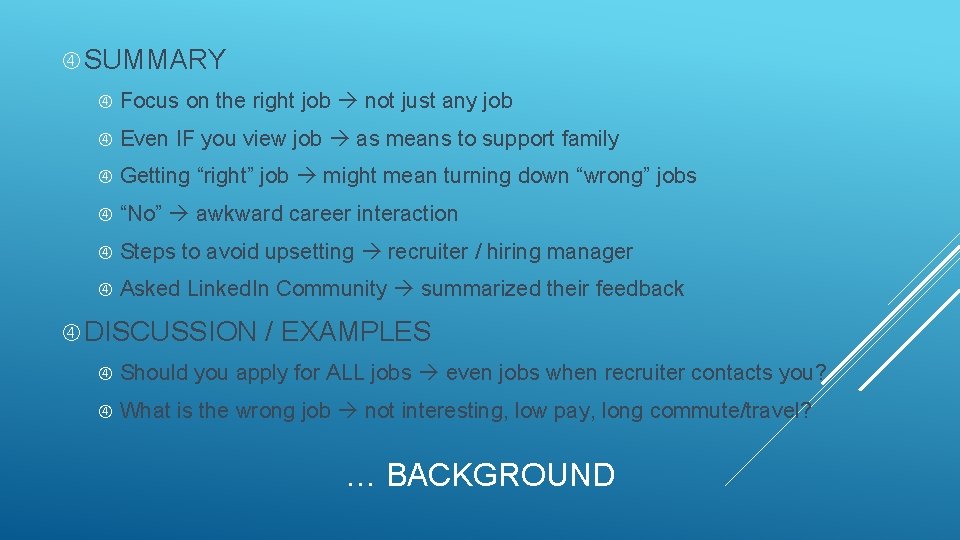
SUMMARY Focus on the right job not just any job Even IF you view job as means to support family Getting “right” job might mean turning down “wrong” jobs “No” awkward career interaction Steps to avoid upsetting recruiter / hiring manager Asked Linked. In Community summarized their feedback DISCUSSION / EXAMPLES Should you apply for ALL jobs even jobs when recruiter contacts you? What is the wrong job not interesting, low pay, long commute/travel? … BACKGROUND
As with most parts of life and job searching, honesty is one of the most important pieces of the equation. “I found that being honest about what is making you say no is helpful and bridgebuilding, ” wrote Kerri Twigg, a stories strategy coach. “I used to apply for jobs to see how far I would get and ended up turning a lot down. But, it didn't [burn] any bridges, and often my insight and reasons helped the company in the end. ” Honest feedback also provides recruiters and hiring managers with information in case they can come back with a better offer in the near or distant future. “If they so much wanted you, it means that they understand you are in demand as well, ” wrote Divan Gamaliel, who is the founder of Zaphire LLC. “Honesty always wins and earns long term connections. ” Also, it’s always best to lead with honesty in case the recruiter or hiring manager somehow finds out you turned down the job or applied for a reason different from what you told them. BE HONEST …
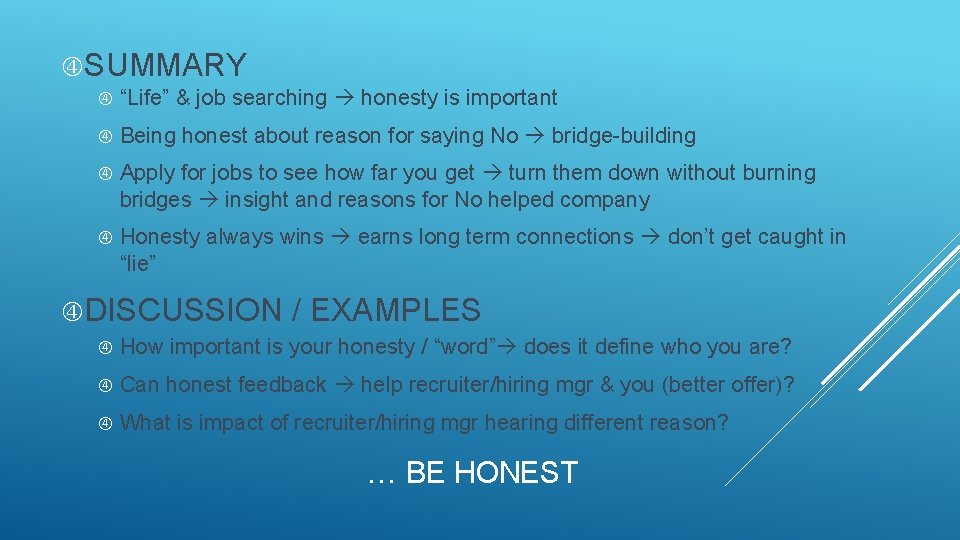
SUMMARY “Life” & job searching honesty is important Being honest about reason for saying No bridge-building Apply for jobs to see how far you get turn them down without burning bridges insight and reasons for No helped company Honesty always wins earns long term connections don’t get caught in “lie” DISCUSSION / EXAMPLES How important is your honesty / “word” does it define who you are? Can honest feedback help recruiter/hiring mgr & you (better offer)? What is impact of recruiter/hiring mgr hearing different reason? … BE HONEST
The hiring process at any company is serious business. Recruiters and hiring managers put in a lot of effort to create a slate of potential candidates that is eventually narrowed down to the top contenders. If you don’t want a job, telling the company early allows the hiring team to move on to other candidates before they accept offers from other employers. “If you know you're going to turn down an offer, I would suggest telling the employer as quickly as possible, ” wrote Tristan Layfield, who is the founder and head career coach of Layfield Resume Consulting. Alexander Ratford, who is a marketing manager, wrote that he knew time was important when he had to pick one of two offers. “Saying ‘No’ to someone after you've spoken with a potential future manager, after you've started to build a relationship, is really tough, ” he wrote. “For me, I had to be sincere in my response, I had to tell the truth about why I didn't choose the company, and I had to be timely. ” DON’T KEEP PEOPLE WAITING …

SUMMARY Hiring process Serious / time consuming ID candidates, interview(s) … Not interested tell early focus on candidates still available Picking 1 of 2 offers time is important started building relationship Sincere response tell truth about why “No” Has to be timely DISCUSSION / EXAMPLES What is down-side to say No IF not interested/wrong You/ other candidates 2 offers Is it OK to delay saying No to 2 nd choice Impact on you/company … DON’T KEEP PEOPLE WAITING
We’ve discussed the ghosting phenomenon in a previous edition of this newsletter. Ghosting occurs when someone you’ve communicated with meaningfully in the past disappears without follow-up or any other communication. Unfortunately, recruiters and hiring managers do this to candidates, too. Regardless of who does the ghosting, it’s not right. “As an HR Professional, I have always appreciated candidates who have been straightforward with providing feedback early on rather than prolonging the process, ” wrote Tequesta De. Souza, who is certified senior human resources professional. “Ghosting employers is by far the worst thing they could do. ” GHOSTING ISN’T AN OPTION …
SUMMARY Ghosting someone you’ve communicated with disappears without followup Recruiters & hiring managers ghost candidates Regardless of who it’s not right HR appreciates candidates provide feedback early avoid prolonging process “Ghosting employers is by far the worst thing candidates can do” DISCUSSION / EXAMPLES Example of situation when ghosting is appropriate for candidate, recruiter, employer? What is allowable time to delay “Not Interested” for candidate, recruiter, employer? What is allowable time to delay “Yes to Offer” for candidate, recruiter, employer? … GHOSTING ISN’T AN OPTION
Email communication is sometimes acceptable when turning down an offer, such as when you’ve only had initial conversations with a recruiter or hiring manager. But you should try having a direct conversation with the person over the phone whenever possible in these situations. “If you can turn down the offer by a virtual meeting or phone, you’ll be sure to convey the right tone and messaging as opposed to doing so by email, ” wrote Stephen Lau, who is a career coach. A phone call also offers the opportunity to leave your connection with the recruiter or hiring manager on the best terms since they can ask follow-up questions and get all the information they need about why you’d rather look elsewhere. “Organizations put a lot of resources into the hiring process. If they are extending you an offer and you want to decline, it should be a phone call, ” wrote Teegan Bartos, who is a career coach. “In the same way candidates want feedback, so do organizations. ” TRY TO AVOID A DEAR JOHN EMAIL …
SUMMARY Email sometimes acceptable turning down offer IF only initial conversations Have direct conversation with person on phone whenever possible Turning down offer by virtual meeting or phone conveys right tone & messaging Phone call offers opportunity to leave connection w/ recruiter/hiring mgr on best terms They can ask questions & get feedback on why you looked elsewhere. DISCUSSION / EXAMPLES Are there job search related communications when emails can be misunderstood? Are there situations when a phone call is not appropriate? Can a candidate receive valuable feedback when calling to say No? … TRY TO AVOID A DEAR JOHN EMAIL
Gratitude can be difficult to muster when you’re in the middle of a difficult job search, but — as I said before — turning down an offer is usually a luxury. Many other people would be very thankful to receive the same job offer. It’s important to express that in your communication with the employer. “Call your primary contact at the company to say ‘thank you’ and explain your reasoning for turning down the offer. You don't have to go into significant detail, but they'll appreciate the feedback, ” wrote Matt Glodz, who is an executive resume and CV writer. Sonal Bahl, who is a career coach, wrote that expressing gratitude when turning down an offer helped her. “I expressed a lot of gratitude and courteously explained why I was going in another direction. This was well received, in spite of obvious disappointment. ” BE GRATEFUL …
SUMMARY Gratitude can be difficult during job search turning down offer is usually a luxury Others would be thankful to receive same offer important to express that! Call primary contact to say ‘thank you’ explain reason for turning down offer Don’t need to provide significant detail they'll appreciate your feedback. Expressing gratitude turning down offer can help candidate, recruiter & hiring manager express gratitude and courteously explain why bridge building DISCUSSION / EXAMPLES How is expressing gratitude saying NO beneficial for candidate, recruiter, hiring mgr? Is expressing gratitude saying NO good for short-term and/or long-term? How are most No’s delivered – candidates, recruiters, hiring managers? … BE GRATEFUL
What strategies do you suggest for turning down a job offer? Join the conversation. ++++++++ Andrew Seaman goes live each Friday at 12: 00 p. m. ET from the Linked. In News page to discuss important issues affecting job seekers and answer your questions about looking for work. Click here or the image below to RSVP for the next #Get. Hired Live. You just need to click the "Remind Me" button below the post. ▶ WANT MORE #GETHIRED?
ISSA RALEIGH CHAPTER CAREER SERVICE TEAM MEMBERS • Chris Uhlig - Chris. Uhlig@disys. com • Elizabeth Cole-Walker – elizabeth. colewalker 2@gmail. com • Evan Strickland - tacitum@gmail. com • Jon Lee - me@jonlee. us • Tom Purdy – tepurdy@att. net +++++ CAREER SERVICE RESOURCES ++++++ • Chapter Website Jobs Board https: //raleigh. issa. org/career-services/ • Chapter Linked. In https: //www. linkedin. com/company/issa-raleigh-chapter • Chapter Facebook https: //www. facebook. com/groups/raleighissa/ • Chapter Twitter https: //twitter. com/Raleigh. ISSA
- Slides: 17