
How to Run a Local Competition Power Point

- Slides: 37
How to Run a Local Competition Power. Point Presentation - Jack Colpas Photos - Kathy Colpas © 2005, 2009, 2012, 2013, 2014, 2016, 2017, 2018, 2019, 2020, 2021 All rights reserved Use arrow keys to move through program
RFTS & Corona Virus Guidelines The Reach for the Stars ~ National Rocket Competition lends itself to the Social Distancing Guidelines for halting the spread of flu and virus. As the Pandemic eases and groups begin to gather RFTS local competitions can be run with as few as 12 competitors. There is no maximum. Photos in this presentation taken before Pandemic
RFTS & Corona Virus Guidelines «Competitors do not need to come in contact with each other. «Competitors do not share supplies or equipment. «Each competitor receives their own rocket kit «in a factory sealed plastic bag. Note: Check website for current deadline.
RFTS & Corona Virus Guidelines «Each competitor preps and launches their own rocket. «Packs parachute, inserts engine – presses launch key! «Adults handle the launch pad for all competitors. «Inserts igniter, places rocket on launch rod, attaches alligator clips, aims rocket as directed by competitor. «No travel involved to compete. «You run the RFTS Competition at your location.
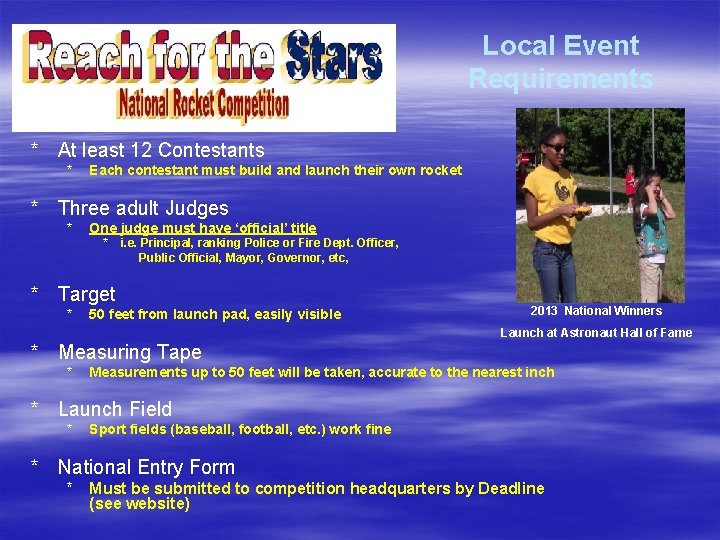
Local Event Requirements * At least 12 Contestants * Each contestant must build and launch their own rocket * Three adult Judges * One judge must have ‘official’ title * i. e. Principal, ranking Police or Fire Dept. Officer, Public Official, Mayor, Governor, etc, * Target * 50 feet from launch pad, easily visible 2013 National Winners Launch at Astronaut Hall of Fame * Measuring Tape * Measurements up to 50 feet will be taken, accurate to the nearest inch * Launch Field * Sport fields (baseball, football, etc. ) work fine * National Entry Form * Must be submitted to competition headquarters by Deadline (see website)
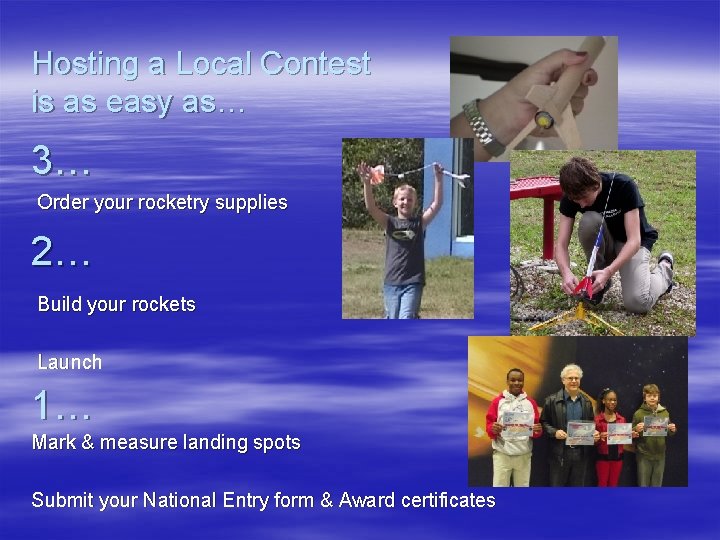
Hosting a Local Contest is as easy as… 3… Order your rocketry supplies 2… Build your rockets Launch 1… Mark & measure landing spots Submit your National Entry form & Award certificates
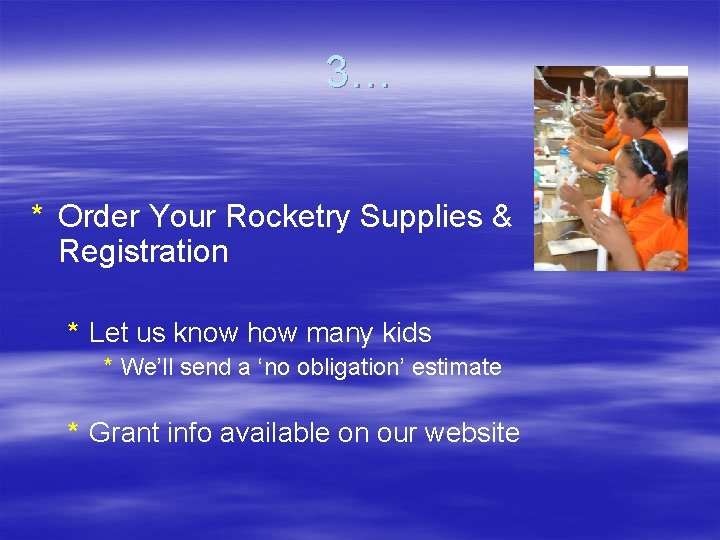
3… * Order Your Rocketry Supplies & Registration * Let us know how many kids * We’ll send a ‘no obligation’ estimate * Grant info available on our website
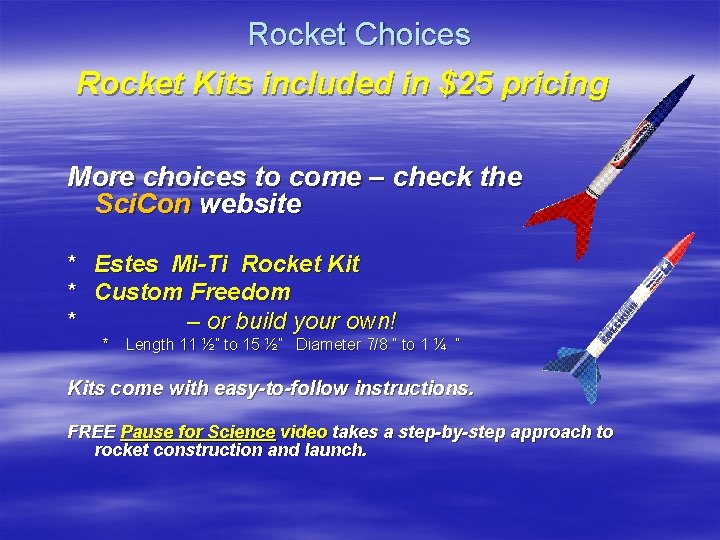
Rocket Choices Rocket Kits included in $25 pricing More choices to come – check the Sci. Con website * Estes Mi-Ti Rocket Kit * Custom Freedom * – or build your own! * Length 11 ½” to 15 ½” Diameter 7/8 ” to 1 ¼ ” Kits come with easy-to-follow instructions. FREE Pause for Science video takes a step-by-step approach to rocket construction and launch.
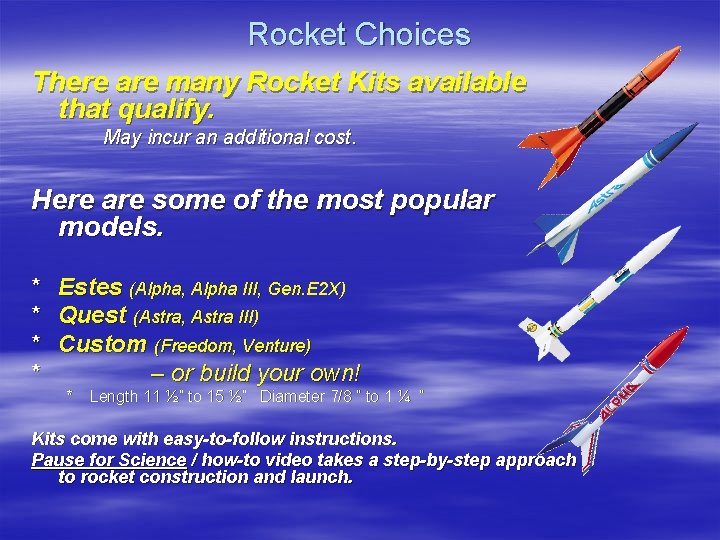
Rocket Choices There are many Rocket Kits available that qualify. May incur an additional cost. Here are some of the most popular models. * * Estes (Alpha, Alpha III, Gen. E 2 X) Quest (Astra, Astra III) Custom (Freedom, Venture) – or build your own! * Length 11 ½” to 15 ½” Diameter 7/8 ” to 1 ¼ ” Kits come with easy-to-follow instructions. Pause for Science / how-to video takes a step-by-step approach to rocket construction and launch.
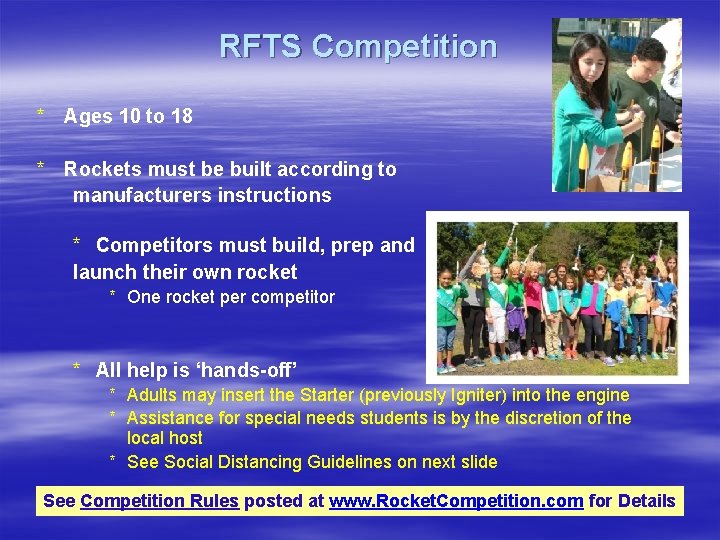
RFTS Competition * Ages 10 to 18 * Rockets must be built according to manufacturers instructions * Competitors must build, prep and launch their own rocket * One rocket per competitor * All help is ‘hands-off’ * Adults may insert the Starter (previously Igniter) into the engine * Assistance for special needs students is by the discretion of the local host * See Social Distancing Guidelines on next slide See Competition Rules posted at www. Rocket. Competition. com for Details
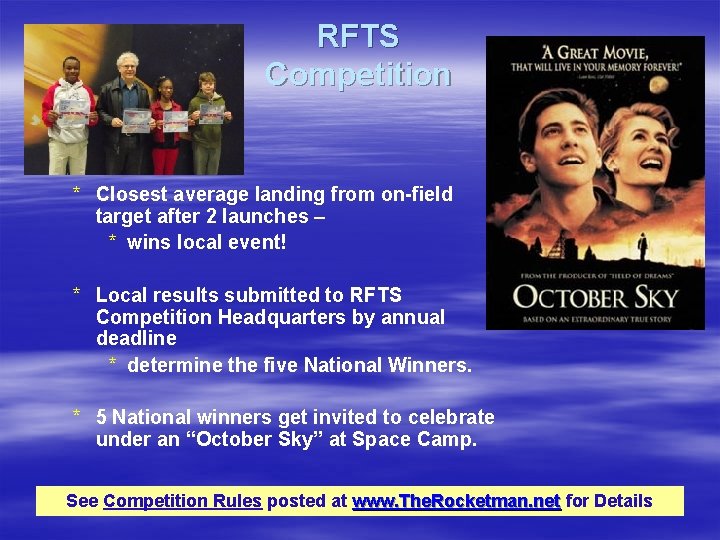
RFTS Competition * Closest average landing from on-field target after 2 launches – * wins local event! * Local results submitted to RFTS Competition Headquarters by annual deadline * determine the five National Winners. * 5 National winners get invited to celebrate under an “October Sky” at Space Camp. See Competition Rules posted at www. The. Rocketman. net for Details
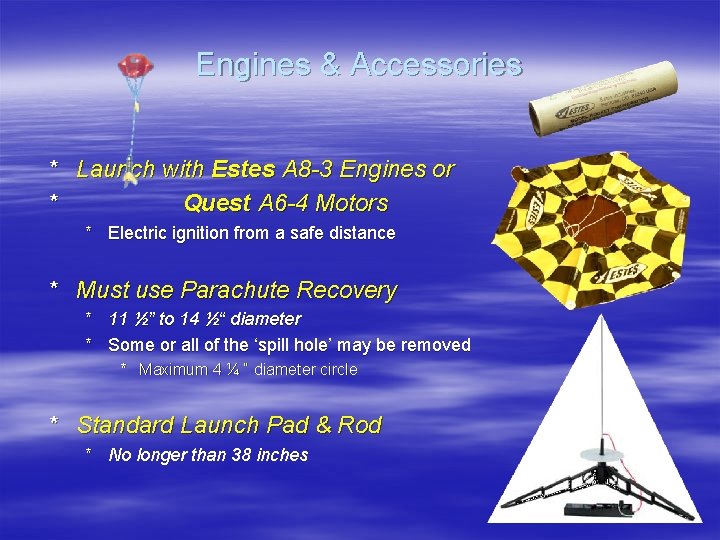
Engines & Accessories * Launch with Estes A 8 -3 Engines or * Quest A 6 -4 Motors * Electric ignition from a safe distance * Must use Parachute Recovery * 11 ½” to 14 ½“ diameter * Some or all of the ‘spill hole’ may be removed * Maximum 4 ¼ “ diameter circle * Standard Launch Pad & Rod * No longer than 38 inches
Rocketry Supplies To order go to www. Rocket. Competition. com Click on Sci. Con Services “ Rocketry Supplies” RFTS Competition Packs Only $25 per Competitor! Rocket Kit Supplies for 2 Launches Certificate Individual Registration ? ? ? Not certain what to order ? ? ? Just e-mail or call (941) 955 -3958 Rocket. Competition@gmail. com Tell us how many kids. We’ll send a ‘no cost - no obligation’ estimate.
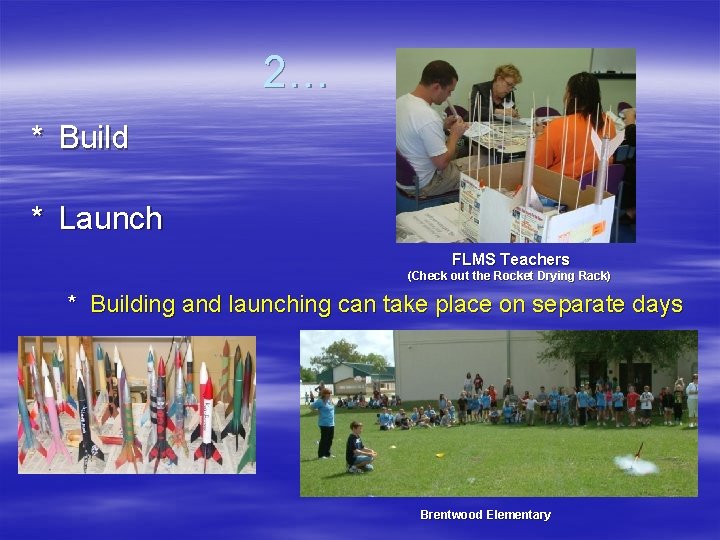
2… * Build * Launch FLMS Teachers (Check out the Rocket Drying Rack) * Building and launching can take place on separate days Brentwood Elementary
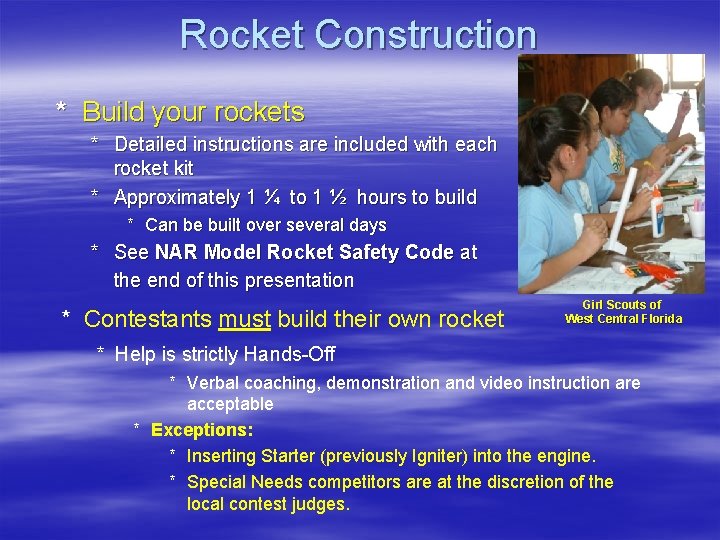
Rocket Construction * Build your rockets * Detailed instructions are included with each rocket kit * Approximately 1 ¼ to 1 ½ hours to build * Can be built over several days * See NAR Model Rocket Safety Code at the end of this presentation * Contestants must build their own rocket Girl Scouts of West Central Florida * Help is strictly Hands-Off * Verbal coaching, demonstration and video instruction are acceptable * Exceptions: * Inserting Starter (previously Igniter) into the engine. * Special Needs competitors are at the discretion of the local contest judges.
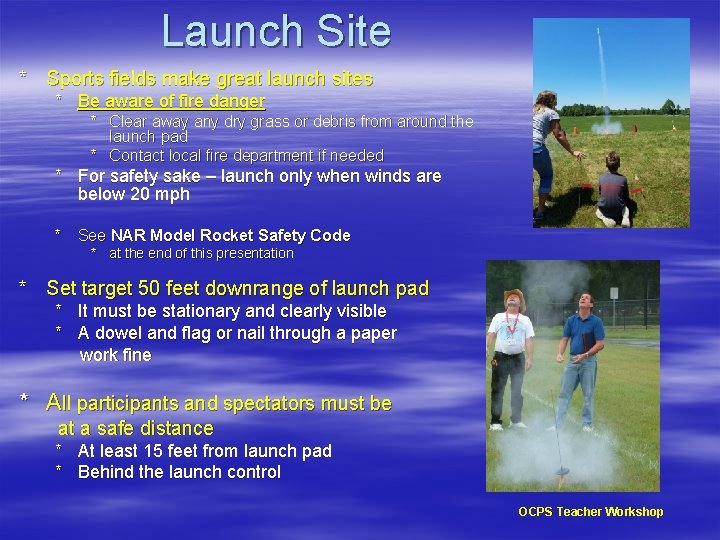
Launch Site * Sports fields make great launch sites * Be aware of fire danger * Clear away any dry grass or debris from around the launch pad * Contact local fire department if needed * For safety sake – launch only when winds are below 20 mph * See NAR Model Rocket Safety Code * at the end of this presentation * Set target 50 feet downrange of launch pad * It must be stationary and clearly visible * A dowel and flag or nail through a paper work fine * All participants and spectators must be at a safe distance * At least 15 feet from launch pad * Behind the launch control OCPS Teacher Workshop
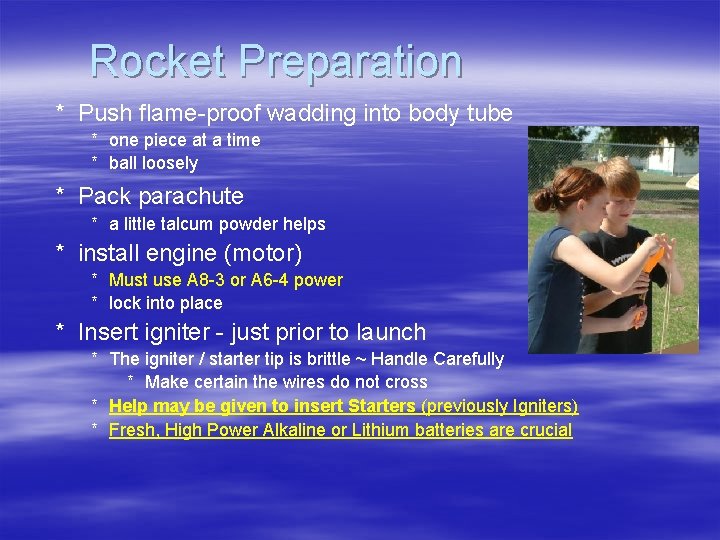
Rocket Preparation * Push flame-proof wadding into body tube * one piece at a time * ball loosely * Pack parachute * a little talcum powder helps * install engine (motor) * Must use A 8 -3 or A 6 -4 power * lock into place * Insert igniter - just prior to launch * The igniter / starter tip is brittle ~ Handle Carefully * Make certain the wires do not cross * Help may be given to insert Starters (previously Igniters) * Fresh, High Power Alkaline or Lithium batteries are crucial
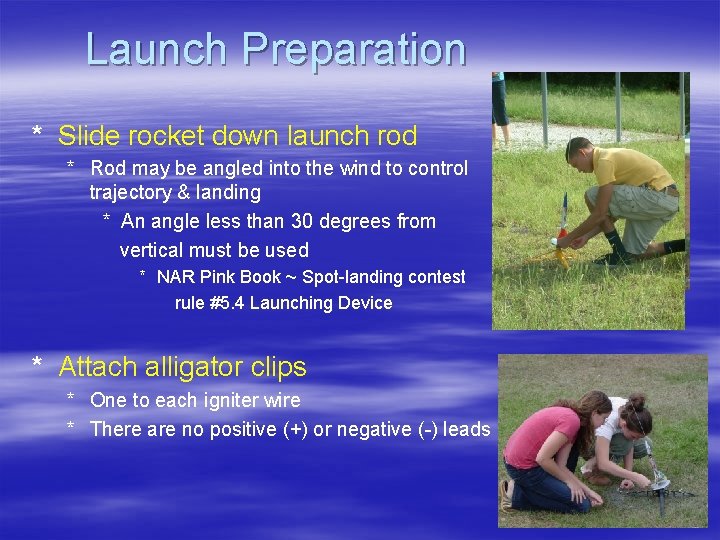
Launch Preparation * Slide rocket down launch rod * Rod may be angled into the wind to control trajectory & landing * An angle less than 30 degrees from vertical must be used * NAR Pink Book ~ Spot-landing contest rule #5. 4 Launching Device * Attach alligator clips * One to each igniter wire * There are no positive (+) or negative (-) leads
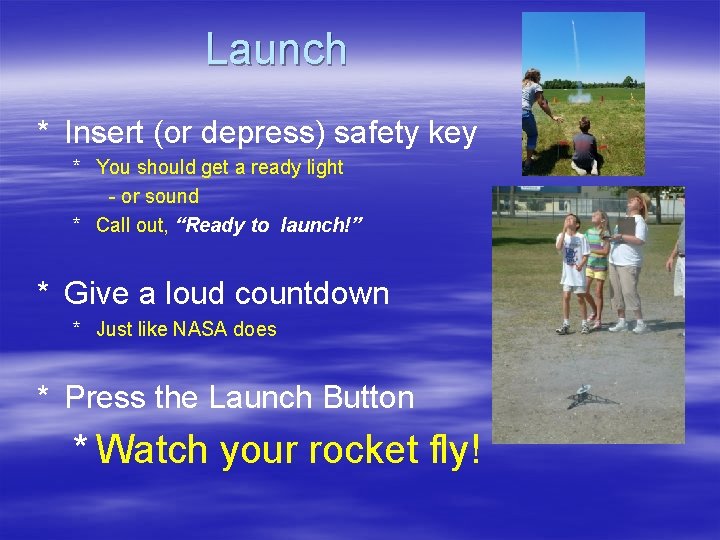
Launch * Insert (or depress) safety key * You should get a ready light - or sound * Call out, “Ready to launch!” * Give a loud countdown * Just like NASA does * Press the Launch Button * Watch your rocket fly!
1… « Mark landing spot of the tip of the nosecone « Underground cable flags or bamboo skewers with tape flags work fine « Launch a 2 nd time « Measure the landings
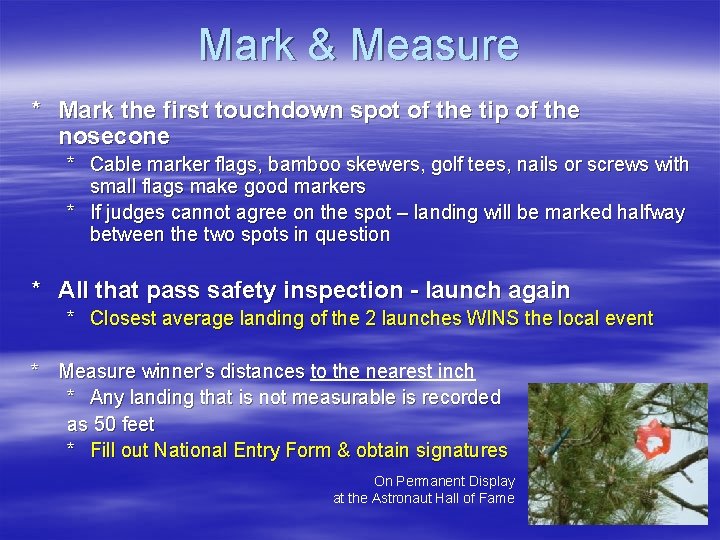
Mark & Measure * Mark the first touchdown spot of the tip of the nosecone * Cable marker flags, bamboo skewers, golf tees, nails or screws with small flags make good markers * If judges cannot agree on the spot – landing will be marked halfway between the two spots in question * All that pass safety inspection - launch again * Closest average landing of the 2 launches WINS the local event * Measure winner’s distances to the nearest inch * Any landing that is not measurable is recorded as 50 feet * Fill out National Entry Form & obtain signatures On Permanent Display at the Astronaut Hall of Fame
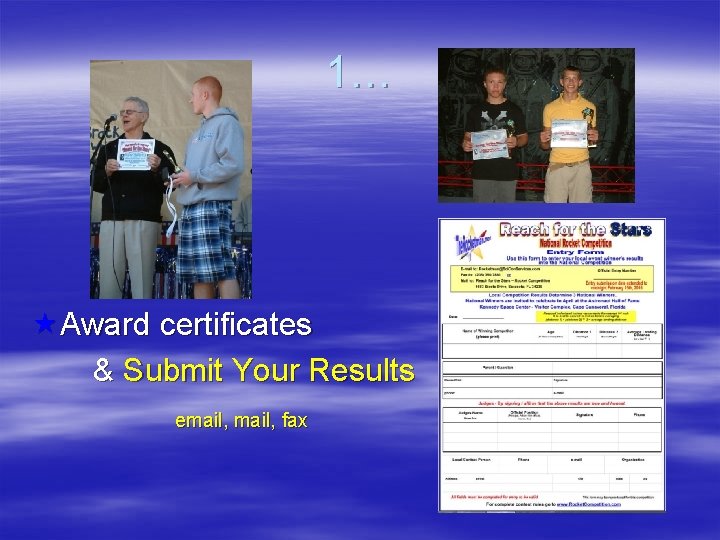
1… «Award certificates & Submit Your Results email, fax
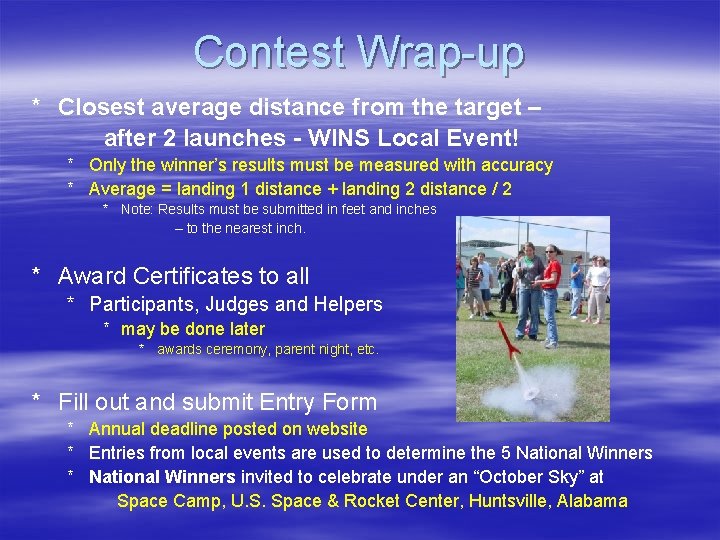
Contest Wrap-up * Closest average distance from the target – after 2 launches - WINS Local Event! * Only the winner’s results must be measured with accuracy * Average = landing 1 distance + landing 2 distance / 2 * Note: Results must be submitted in feet and inches – to the nearest inch. * Award Certificates to all * Participants, Judges and Helpers * may be done later * awards ceremony, parent night, etc. * Fill out and submit Entry Form * Annual deadline posted on website * Entries from local events are used to determine the 5 National Winners * National Winners invited to celebrate under an “October Sky” at Space Camp, U. S. Space & Rocket Center, Huntsville, Alabama
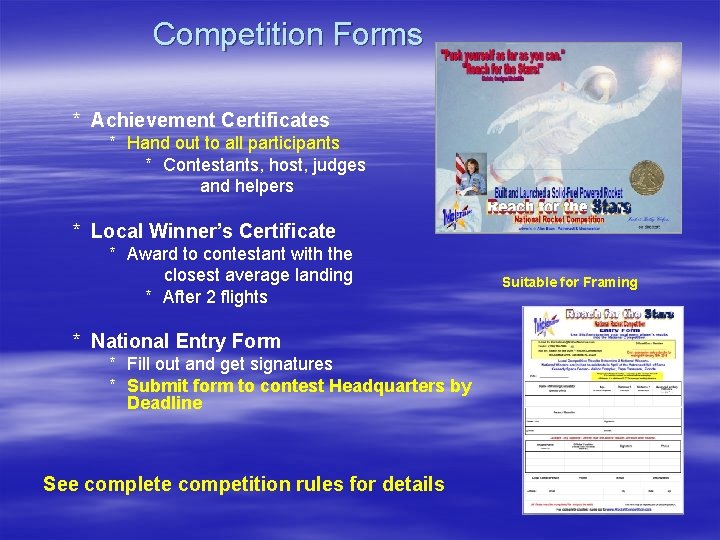
Competition Forms * Achievement Certificates * Hand out to all participants * Contestants, host, judges and helpers * Local Winner’s Certificate * Award to contestant with the closest average landing * After 2 flights * National Entry Form * Fill out and get signatures * Submit form to contest Headquarters by Deadline See complete competition rules for details Suitable for Framing
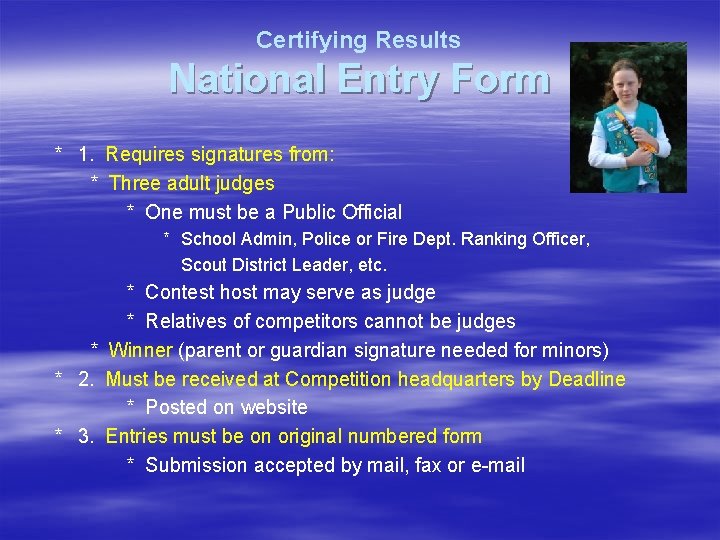
Certifying Results National Entry Form * 1. Requires signatures from: * Three adult judges * One must be a Public Official * School Admin, Police or Fire Dept. Ranking Officer, Scout District Leader, etc. * Contest host may serve as judge * Relatives of competitors cannot be judges * Winner (parent or guardian signature needed for minors) * 2. Must be received at Competition headquarters by Deadline * Posted on website * 3. Entries must be on original numbered form * Submission accepted by mail, fax or e-mail
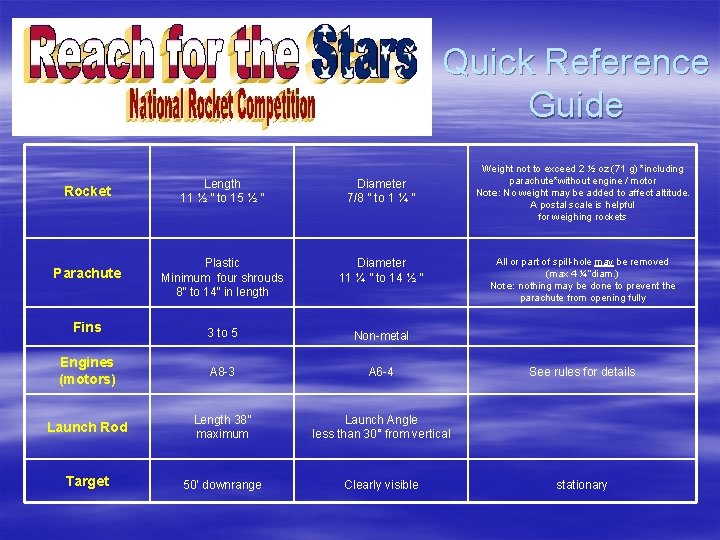
Quick Reference Guide Rocket Length 11 ½ ” to 15 ½ ” Diameter 7/8 ” to 1 ¼ ” Parachute Plastic Minimum four shrouds 8” to 14” in length Diameter 11 ¼ ” to 14 ½ ” Fins 3 to 5 Non-metal Engines (motors) A 8 -3 A 6 -4 Launch Rod Length 38” maximum Launch Angle less than 30° from vertical Target 50’ downrange Clearly visible Weight not to exceed 2 ½ oz (71 g) *including parachute*without engine / motor Note: No weight may be added to affect altitude. A postal scale is helpful for weighing rockets All or part of spill-hole may be removed (max 4 ¼”diam. ) Note: nothing may be done to prevent the parachute from opening fully See rules for details stationary
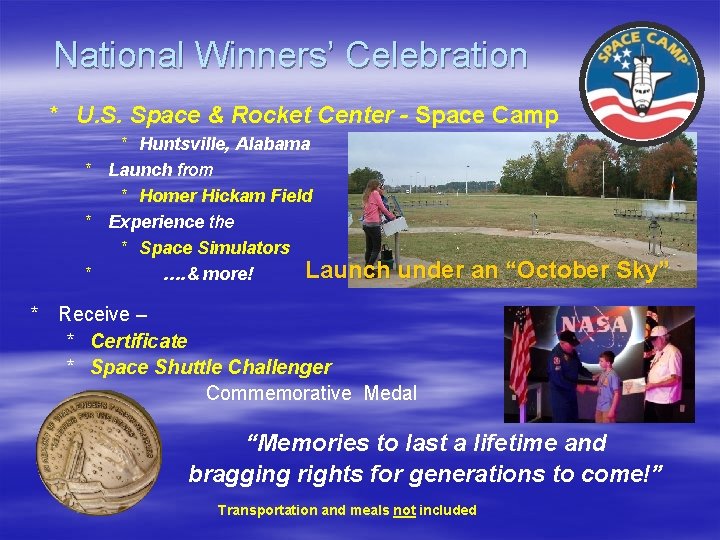
National Winners’ Celebration * U. S. Space & Rocket Center - Space Camp * Huntsville, Alabama * Launch from * Homer Hickam Field * Experience the * Space Simulators Launch * …. & more! under an “October Sky” * Receive – * Certificate * Space Shuttle Challenger Commemorative Medal “Memories to last a lifetime and bragging rights for generations to come!” Transportation and meals not included
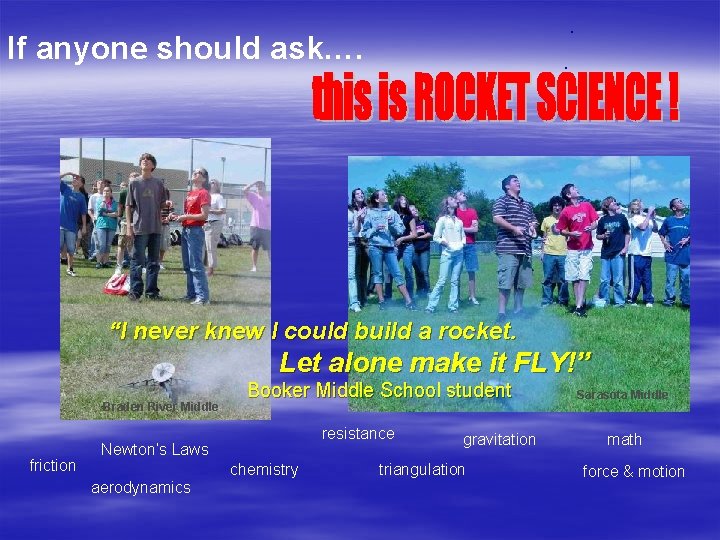
. If anyone should ask…. . “I never knew I could build a rocket. Let alone make it FLY!” Braden River Middle friction Booker Middle School student resistance Newton’s Laws chemistry aerodynamics gravitation triangulation Sarasota Middle math force & motion
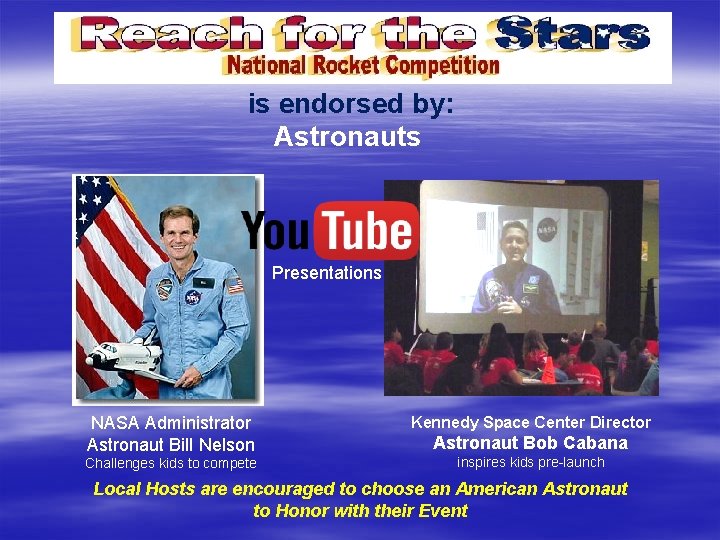
is endorsed by: Astronauts Presentations NASA Administrator Astronaut Bill Nelson Challenges kids to compete Kennedy Space Center Director Astronaut Bob Cabana inspires kids pre-launch Local Hosts are encouraged to choose an American Astronaut to Honor with their Event
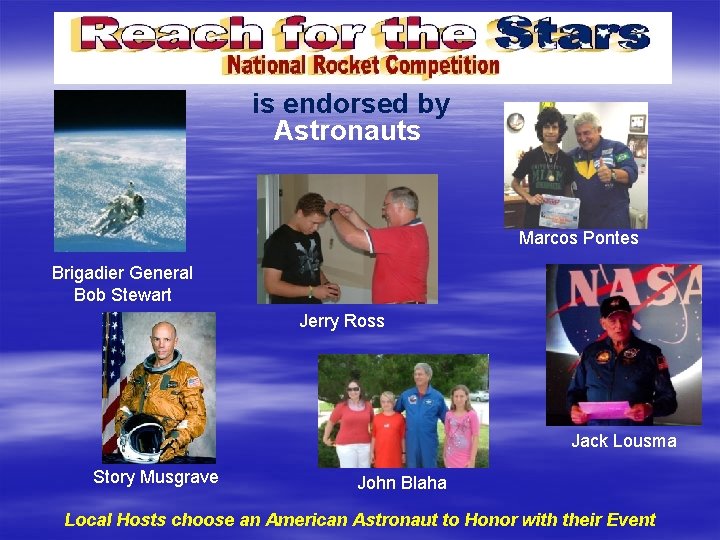
is endorsed by Astronauts Marcos Pontes Brigadier General Bob Stewart Jerry Ross Jack Lousma Story Musgrave John Blaha Local Hosts choose an American Astronaut to Honor with their Event
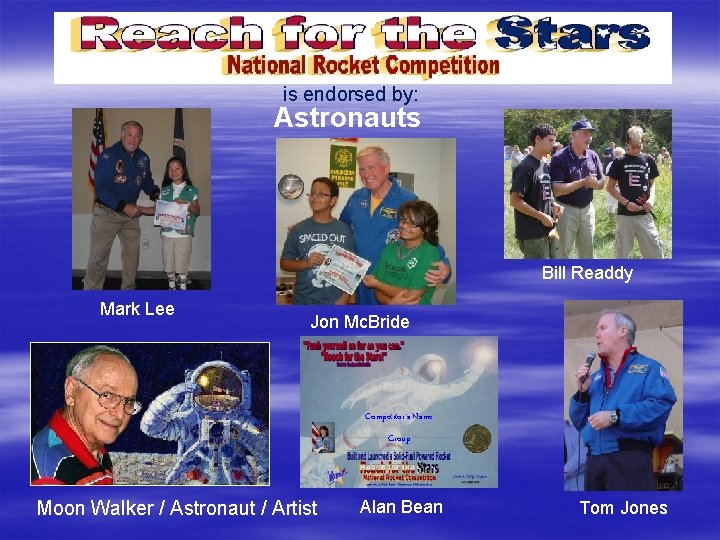
is endorsed by: Astronauts Bill Readdy Mark Lee Jon Mc. Bride Competitor’s Name Group Moon Walker / Astronaut / Artist Alan Bean Tom Jones
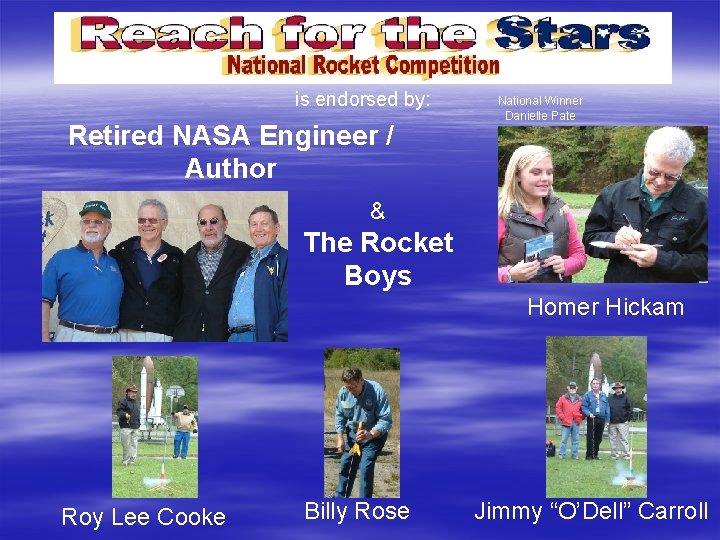
is endorsed by: Retired NASA Engineer / Author National Winner Danielle Pate & The Rocket Boys Homer Hickam Roy Lee Cooke Billy Rose Jimmy “O’Dell” Carroll
In partnership with American Institute for Aeronautics and Astronautics and the National Space Society Recognized by National Association of Rocketry
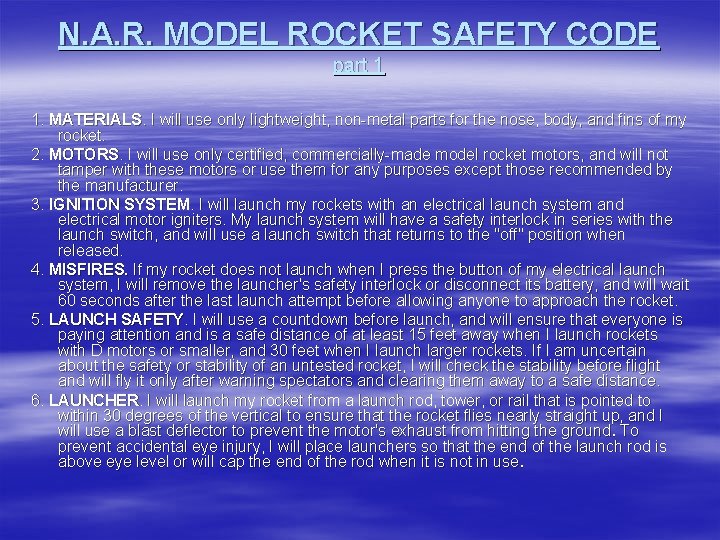
N. A. R. MODEL ROCKET SAFETY CODE part 1 1. MATERIALS. I will use only lightweight, non-metal parts for the nose, body, and fins of my rocket. 2. MOTORS. I will use only certified, commercially-made model rocket motors, and will not tamper with these motors or use them for any purposes except those recommended by the manufacturer. 3. IGNITION SYSTEM. I will launch my rockets with an electrical launch system and electrical motor igniters. My launch system will have a safety interlock in series with the launch switch, and will use a launch switch that returns to the "off" position when released. 4. MISFIRES. If my rocket does not launch when I press the button of my electrical launch system, I will remove the launcher's safety interlock or disconnect its battery, and will wait 60 seconds after the last launch attempt before allowing anyone to approach the rocket. 5. LAUNCH SAFETY. I will use a countdown before launch, and will ensure that everyone is paying attention and is a safe distance of at least 15 feet away when I launch rockets with D motors or smaller, and 30 feet when I launch larger rockets. If I am uncertain about the safety or stability of an untested rocket, I will check the stability before flight and will fly it only after warning spectators and clearing them away to a safe distance. 6. LAUNCHER. I will launch my rocket from a launch rod, tower, or rail that is pointed to within 30 degrees of the vertical to ensure that the rocket flies nearly straight up, and I will use a blast deflector to prevent the motor's exhaust from hitting the ground. To prevent accidental eye injury, I will place launchers so that the end of the launch rod is above eye level or will cap the end of the rod when it is not in use.
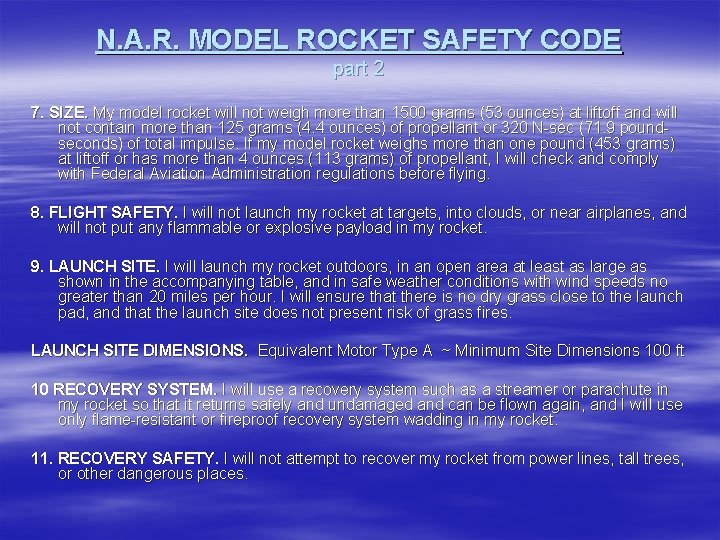
N. A. R. MODEL ROCKET SAFETY CODE part 2 7. SIZE. My model rocket will not weigh more than 1500 grams (53 ounces) at liftoff and will not contain more than 125 grams (4. 4 ounces) of propellant or 320 N-sec (71. 9 poundseconds) of total impulse. If my model rocket weighs more than one pound (453 grams) at liftoff or has more than 4 ounces (113 grams) of propellant, I will check and comply with Federal Aviation Administration regulations before flying. 8. FLIGHT SAFETY. I will not launch my rocket at targets, into clouds, or near airplanes, and will not put any flammable or explosive payload in my rocket. 9. LAUNCH SITE. I will launch my rocket outdoors, in an open area at least as large as shown in the accompanying table, and in safe weather conditions with wind speeds no greater than 20 miles per hour. I will ensure that there is no dry grass close to the launch pad, and that the launch site does not present risk of grass fires. LAUNCH SITE DIMENSIONS. Equivalent Motor Type A ~ Minimum Site Dimensions 100 ft 10 RECOVERY SYSTEM. I will use a recovery system such as a streamer or parachute in my rocket so that it returns safely and undamaged and can be flown again, and I will use only flame-resistant or fireproof recovery system wadding in my rocket. 11. RECOVERY SAFETY. I will not attempt to recover my rocket from power lines, tall trees, or other dangerous places.
Your kids can’t win it – if they’re not in it! Jack & Kathy Colpas program directors (941) 955 -3958 Rocket. Competition@gmail. com www. Rocket. Competition. com Wishing you light winds on launch day! Over 50 years of combined experience as educators.