
How to reduce water consumption and reduce costs
- Slides: 13
How to reduce water consumption and reduce costs
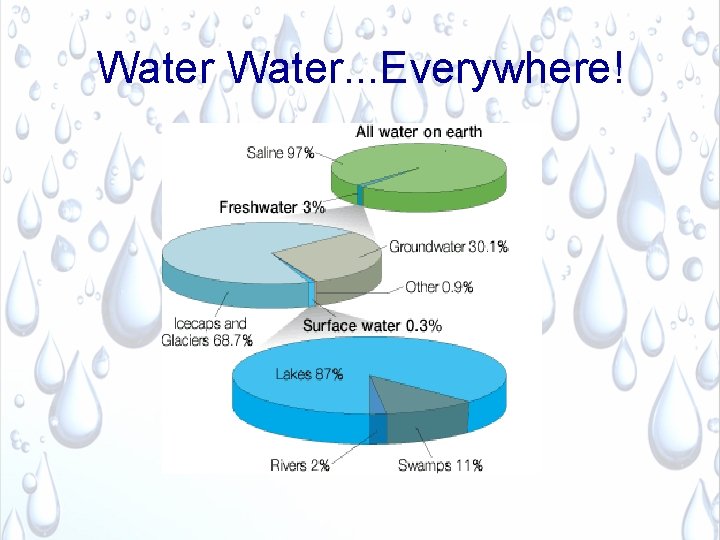
Water. . . Everywhere!
Why reduce your water use • Why take action? – To save your company money – Compliance with current and future environmental legislation – To improve your company’s environmental performance and benefit from positive PR • The true cost of water Water has many uses and many hidden costs. It is not just what you pay for its supply. Other costs may include: – Water treatment – Pumping – Maintenance – Effluent treatment and discharge – Capital depreciation and the value of lost raw materials and product
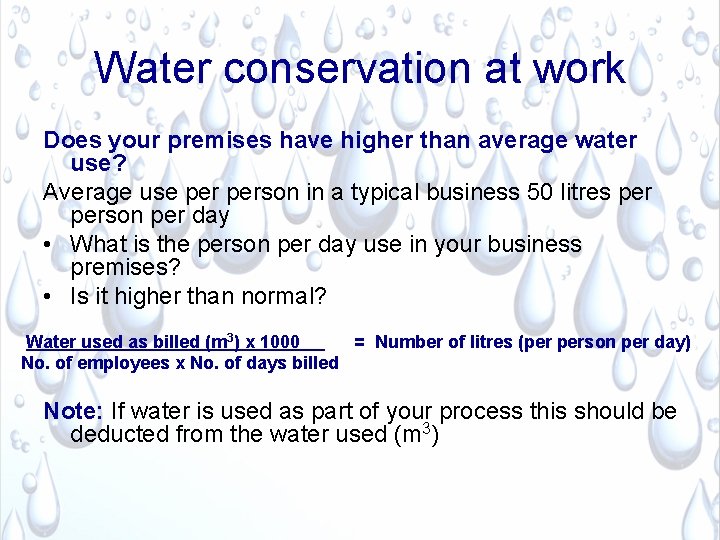
Water conservation at work Does your premises have higher than average water use? Average use person in a typical business 50 litres person per day • What is the person per day use in your business premises? • Is it higher than normal? Water used as billed (m 3) x 1000 = Number of litres (per person per day) No. of employees x No. of days billed Note: If water is used as part of your process this should be deducted from the water used (m 3)
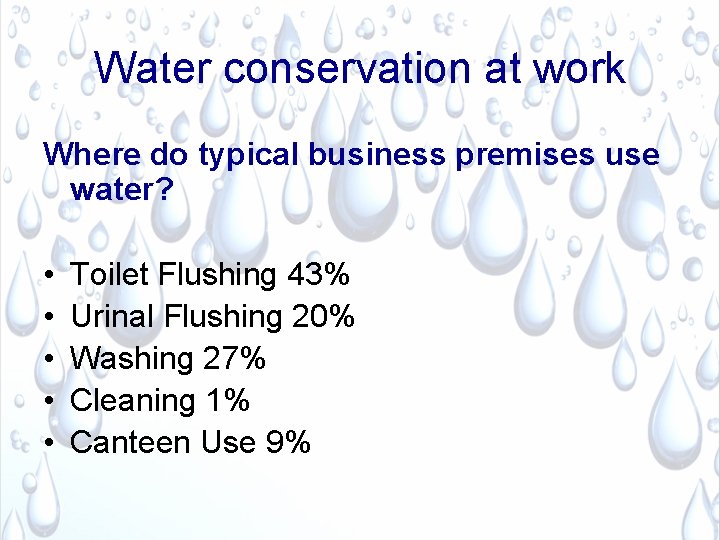
Water conservation at work Where do typical business premises use water? • • • Toilet Flushing 43% Urinal Flushing 20% Washing 27% Cleaning 1% Canteen Use 9%
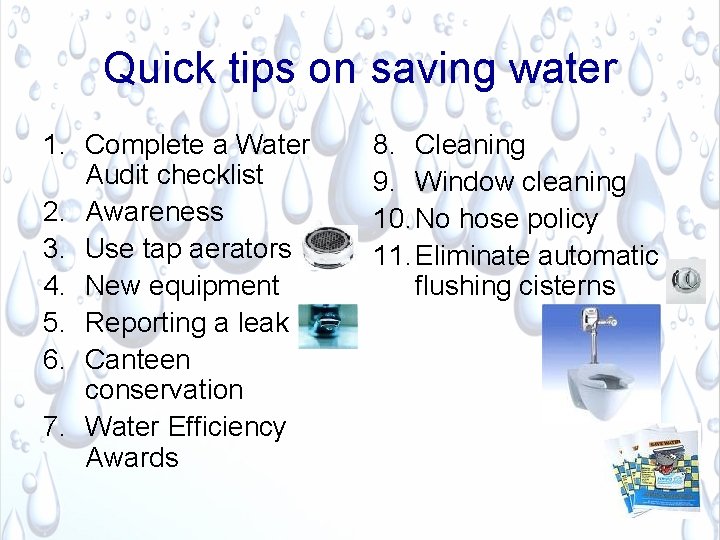
Quick tips on saving water 1. Complete a Water Audit checklist 2. Awareness 3. Use tap aerators 4. New equipment 5. Reporting a leak 6. Canteen conservation 7. Water Efficiency Awards 8. Cleaning 9. Window cleaning 10. No hose policy 11. Eliminate automatic flushing cisterns
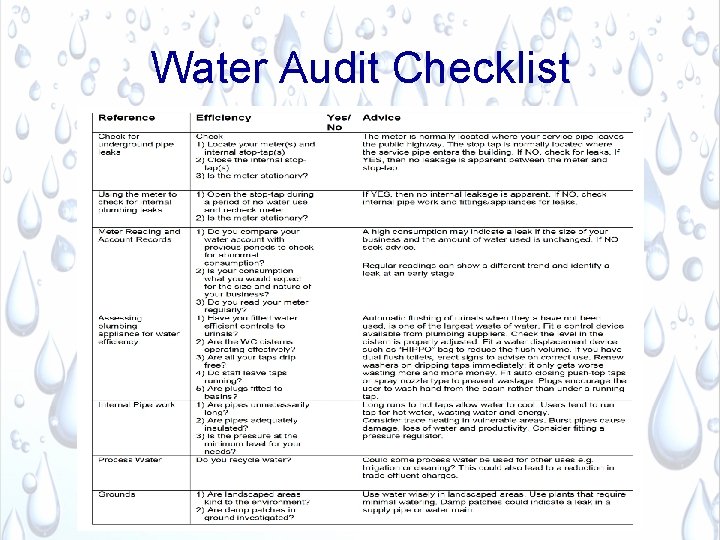
Water Audit Checklist
Rainwater Harvesting
What is Rainwater Harvesting? Rainwater harvesting is the accumulation and storage of rainwater that falls upon your roof for use in landscaping and other purposes. Rainwater may be utilized for nonpotable requirements such as. . . • • toilet flushing, machine wash down, gardening, landscape irrigation, car and fleet washing, clothes washing, and some industrial processes
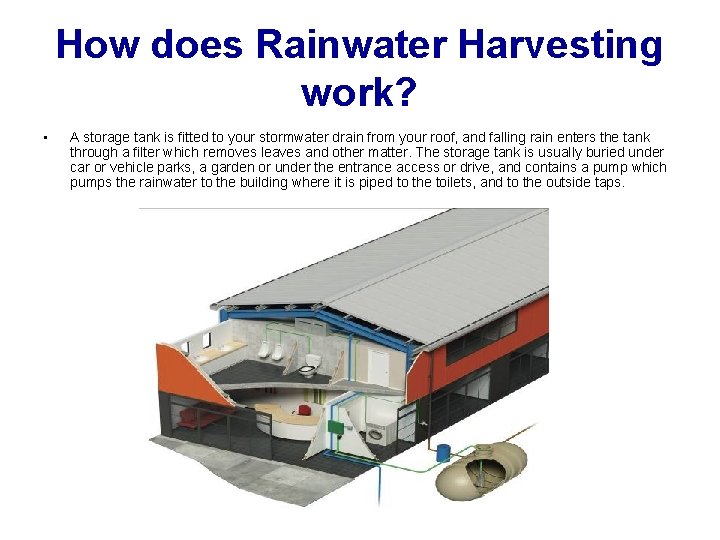
How does Rainwater Harvesting work? • A storage tank is fitted to your stormwater drain from your roof, and falling rain enters the tank through a filter which removes leaves and other matter. The storage tank is usually buried under car or vehicle parks, a garden or under the entrance access or drive, and contains a pump which pumps the rainwater to the building where it is piped to the toilets, and to the outside taps.
Benefits of Rainwater Harvesting • • • Easy to install & simple to maintain Automatic in operation; 'fit-and-forget' system, ensuring an automatic supply of harvested rainwater Designed to be as user-friendly as possible, the system utilises much of the existing pipework within the building The main requirement being the installation of a rainwater storage tank with internal pump, selected to meet the roof area's water catchment yield and premises’ requirements Reduces water consumption Makes efficient use of a valuable resource Reduces flooding, erosion, and contamination of surface water Money saved though reduced water bills means the system can payback its purchase costs It is good for irrigation and plants thrive because stored rainwater is free from pollutants as well as salts, minerals, and other natural and man-made contaminants. It is good for laundry use as rainwater is soft and lowers the need for detergents. It adds life to equipment dependent on water to operate, as rainwater does not produce corrosion or scale like hard water
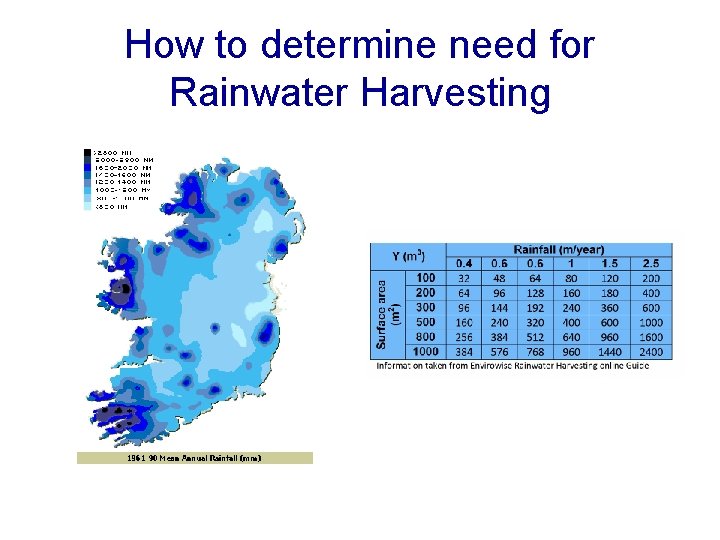
How to determine need for Rainwater Harvesting • Step 1: Quantify the amount of water you currently use • Step 2: Quantify the maximum water you can harvest in a year Annual rainwater yield (Y) in m 3 = P x A x 0. 8 Where P = annual precipitation in metres A = collection area in m 2 0. 8 = typically you should expect to collect 80% of this rainwater each year due to losses in filtering and small rainfalls that do not generate enough runoff • Step 3: Quantify the cost
How to determine need for Rainwater Harvesting