
How to recognize report and prevent abuse and
How to recognize, report and prevent abuse and neglect of children. CHILD ABUSE & NEGLECT
What is it? � According to The Federal Child Abuse Prevention and Treatment Act (CAPTA), child abuse and neglect is defined as: �“Any recent act or failure to act on the part of a parent or caretaker, which results in death, serious physical or emotional harm, sexual abuse, or exploitation, or an act or failure to act which presents imminent risk of serious harm”
Forms of Abuse CAPTA defines sexual abuse as “The employment, use, persuasion, inducement, enticement, or coercion of any child to engage in, or assist any other person to engage in, any sexually explicit conduct or simulation of such conduct for the purpose of producing a visual depiction of such conduct” or “The rape, and in some cases of caretaker or interfamilial relations, statutory rape, molestation, prostitution, or other forms of sexual exploitation of children, or incest with children” � CAPTA defines physical abuse as “any non-accidental, physical injury to a child”. � CAPTA defines neglect as “the failure of a parent or other person with responsibility for the child to provide needed food, clothing, shelter, medical care, or supervision such that the child’s health, safety, and well-being are threatened with harm”. � CAPTA defines emotional abuse as “injury to the psychological capacity or emotional stability of the child as evidenced by an observable or substantial change in behavior, emotional response, or cognitive”, or “as evidenced by anxiety, depression, withdrawal, or aggressive behavior” �
Sexual Abuse Child sexual abuse victims are tormented by guilt and shame. They are usually afraid to come forward because of this, and they are concerned that people will not believe them, will be angry with them or it will tear their families apart. These reasons tend to get in the way of reports of sexual abuse, and false reports are not likely to be made. � Warning signs include: � � Trouble walking or sitting, � Displays knowledge or interest in sexual acts inappropriate for his or her age, or even seductive behavior, � Makes strong efforts to avoid a specific person, without an obvious reason, � Doesn’t want to change clothes in front of others or participate in physical activities, � An STD or pregnancy, especially under the age of 14, � Runs away from home
Physical Abuse Physical abuse is usually the easiest form of abuse to recognize, and it leaves marks, bruises, burns, cuts, etc. � It can result from severe discipline or intentional attempts to hurt the child. � Warning signs of physical abuse include: � � Unexplained injuries or unexplained bruises, welts or cuts, � Is always watchful and “on alert”, as if waiting for something bad to happen, � Injuries appear to have a pattern such as marks from a hand or belt, � Shies away from touch, flinches at sudden movements, or seems afraid to go home, � Wears inappropriate clothing to cover up injuries, such as long-sleeved shirts on hot days
Neglect is a very common form of child abuse and sometimes very difficult to recognize. � Sometimes a parent may be unable to care for their child due to serious injury, mental illness, drug and alcohol abuse, untreated depression, or anxiety. � Older children can be good at masking neglect signs by putting a brave, happy face forward to the world or even taking the role of parent to younger children in the home. � Some warning signs of neglect are: � � Clothes are ill-fitting, filthy, or inappropriate for the weather, � Hygiene is consistently bad (un-bathed, matted and unwashed hair, noticeable body odor), � Untreated illnesses and physical injuries, � Is frequently unsupervised or left alone or allowed to play in unsafe situations and environments, � Is frequently late or missing from school
Emotional Abuse � Examples of emotional abuse include: � Constant belittling, shaming, and humiliating a child, calling names and making negative comparisons to others � Telling a child he or she is “no good”, “bad”, or “a mistake”. � Frequent yelling, bullying or threatening � Ignoring or rejecting a child as punishment � Limited physical contact with the child – no hugs, kisses or other signs of affection � Exposing the child to violence or abuse. � Warning signs of emotional abuse include: � Excessively withdrawn, fearful, or anxious about doing something wrong, � Shows extremes in behavior (extremely compliant or extremely demanding; extremely passive or extremely aggressive), � Doesn’t seem to be attached to parent or caregiver, � Acts either inappropriately adult (taking care of other children) or inappropriately infantile (rocking, thumb-sucking, tantruming).
Risk Factors � � � Child abuse and neglect spans all racial, economic and cultural lines and the abuser is usually someone the child knows and should be able to trust. Domestic Violence – Witnessing domestic violence is emotionally abusive, even if the abused parent does their best to shelter the child and protect them from physical abuse. Alcohol & Drug Abuse – Parents and caretakers who are drunk or high are highly likely to abuse or neglect their children. Untreated mental illness – If a parent or caretaker has untreated depression or anxiety, or other mental illness, they may have trouble taking care of themselves, let alone their children. Lack of parenting skills – Teen parents especially may lack the skills necessary to care for infants or small children. Their unrealistic ideas of parenting may lead to abuse and neglect. Stress and lack of support – Parenting can be very time consuming and a difficult job. Parents with special needs children or difficult behaviors that do not have support are likely to abuse their children
Reporting Abuse & Neglect � � � There are two types of reporters; mandated and non-mandated. A mandated reporter includes medical professionals, school staff and law enforcement officials. Non-mandated reporters includes everyone else (relatives, friends, neighbors, etc. ) Non-mandated reporters are frequently the first people to notice possible abuse. These people may see abuse early enough to play an active role in getting help for the victim and abuser. The New York State Office of Children and Family Services gives a summary of reporting guidelines for NYS. In NYS, a mandated reporter must provide a written and signed report within 48 hours of orally reporting suspected abuse. The OCFS website has a form that the reporter can fill out. NYS OCFS also supplies a hotline for reporters to call. The number is 1 -800 -342 -3720. It is available 24 hours a day.
Prevention Child abuse prevention begins with awareness, then early detection and intervention. � Educate kids to recognize inappropriate behaviors (sexual and physical), and report possible abuse as early as possible. � Early detection and identification of possible abusers can stop abuse before it begins. � Behavioral programs for potential abusers are the best hope for preventing child abuse. �
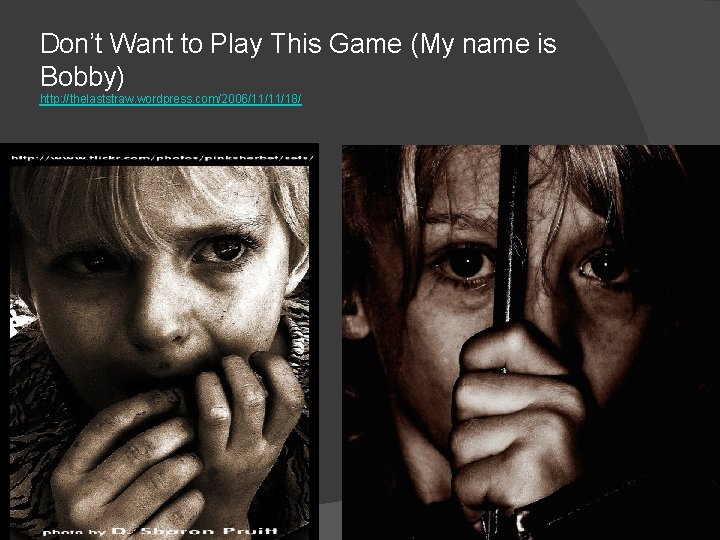
Don’t Want to Play This Game (My name is Bobby) http: //thelaststraw. wordpress. com/2006/11/11/18/
Resources � International Child Abuse Network – Gives a lot of information on child abuse, how to recognize and report. � �http: //www. yesican. org/index. html New York State Office of Children & Family Services – NYS Website, information on reporting suspected abuse �www. ocfs. state. ny. us � Childhelp – Obtains information on what to expect when reporting suspected abuse, what information you will need, and generally what to expect when reporting. �www. childhelp. org
- Slides: 12