
HOW TO READ ARGUMENT STRATEGIES Composition II Mrs
- Slides: 10
HOW TO READ ARGUMENT: STRATEGIES Composition II Mrs. Hernandez Chapter 19, Pt. 2
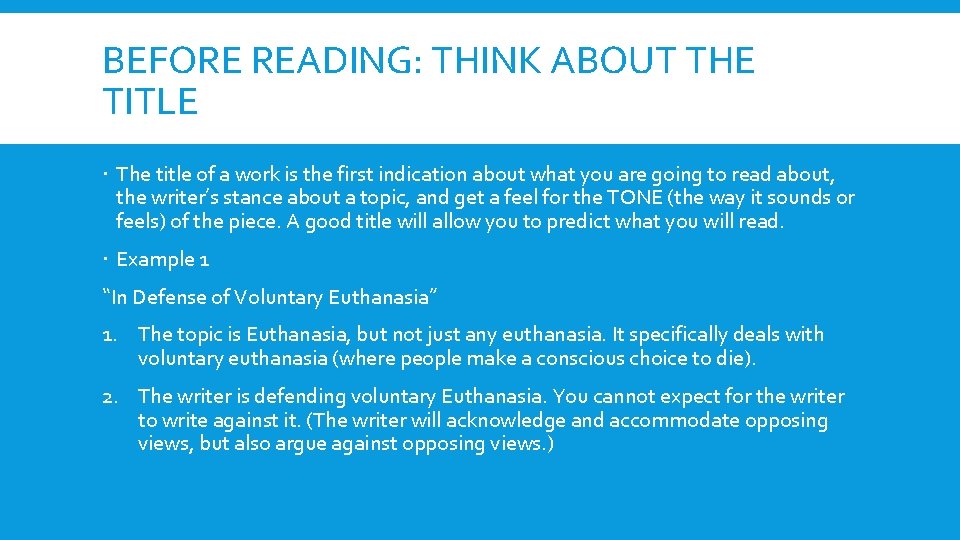
BEFORE READING: THINK ABOUT THE TITLE The title of a work is the first indication about what you are going to read about, the writer’s stance about a topic, and get a feel for the TONE (the way it sounds or feels) of the piece. A good title will allow you to predict what you will read. Example 1 “In Defense of Voluntary Euthanasia” 1. The topic is Euthanasia, but not just any euthanasia. It specifically deals with voluntary euthanasia (where people make a conscious choice to die). 2. The writer is defending voluntary Euthanasia. You cannot expect for the writer to write against it. (The writer will acknowledge and accommodate opposing views, but also argue against opposing views. )
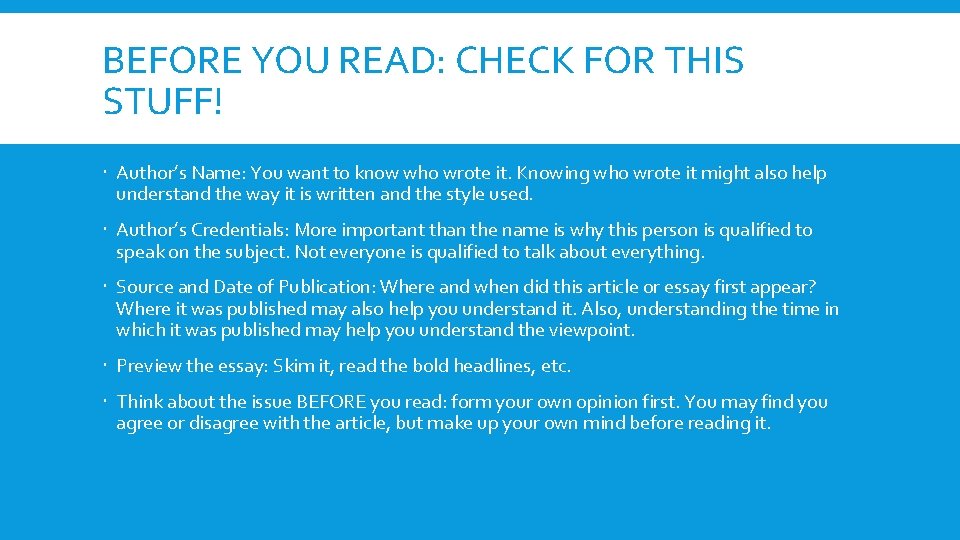
BEFORE YOU READ: CHECK FOR THIS STUFF! Author’s Name: You want to know who wrote it. Knowing who wrote it might also help understand the way it is written and the style used. Author’s Credentials: More important than the name is why this person is qualified to speak on the subject. Not everyone is qualified to talk about everything. Source and Date of Publication: Where and when did this article or essay first appear? Where it was published may also help you understand it. Also, understanding the time in which it was published may help you understand the viewpoint. Preview the essay: Skim it, read the bold headlines, etc. Think about the issue BEFORE you read: form your own opinion first. You may find you agree or disagree with the article, but make up your own mind before reading it.
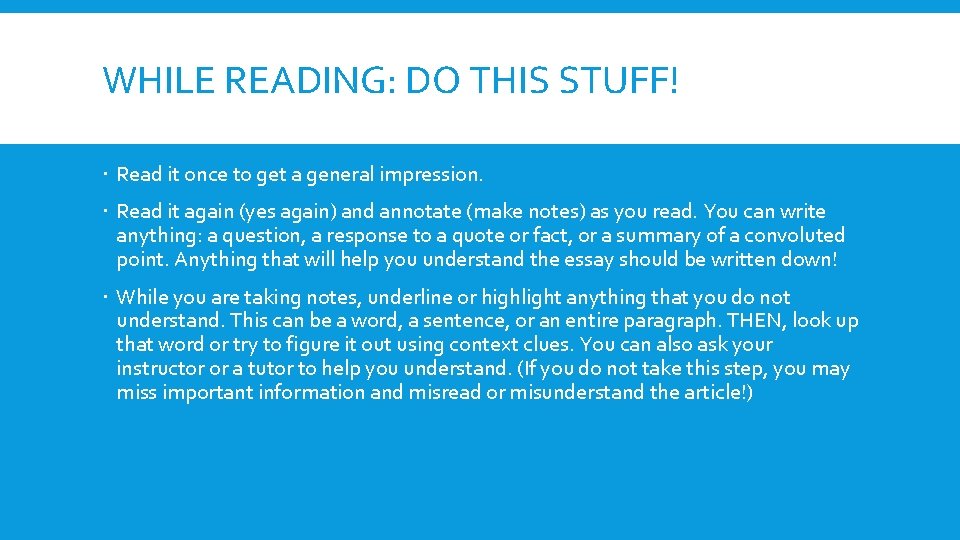
WHILE READING: DO THIS STUFF! Read it once to get a general impression. Read it again (yes again) and annotate (make notes) as you read. You can write anything: a question, a response to a quote or fact, or a summary of a convoluted point. Anything that will help you understand the essay should be written down! While you are taking notes, underline or highlight anything that you do not understand. This can be a word, a sentence, or an entire paragraph. THEN, look up that word or try to figure it out using context clues. You can also ask your instructor or a tutor to help you understand. (If you do not take this step, you may miss important information and misread or misunderstand the article!)
UNDERSTANDING ARGUMENTS: SUMMARY Summaries are shortened forms of the articles or essays you read. This is where you take someone’s ideas and paraphrase them down to their simplest forms. To create a summary, you should 1. Read the essay more than once to better gather information. 2. Divide the argument into sections or parts for easier understanding. Label the claim, issue, etc. 3. Write marginal notes (annotate) the main point of each paragraph or related paragraph groups. 4. Summarize your notes into a paragraph or two.
ANALYZING THE ELEMENTS AND REASONING OF AN ARGUMENT: BASICS How do you know if what you are reading is valid or not? Well, first you have to analyze the key elements of the piece. What is the writer’s purpose for writing? What does the writer gain by writing this essay? Beware the writer that stands to gain something personally. Who is the intended audience? Are any key terms clearly defined? Is the writer credible? Does the writer provide good, clear, and relevant support to back up his or her claim?
ANALYZING THE ELEMENTS AND REASONING OF AN ARGUMENT: APPEALS AND REBUTTALS Remember, emotional appeals can be legitimate; however, do not attempt to manipulate readers’ emotions to distract them from the issue and evidence or use emotions to cover unsound reasoning (530). An argument should take into account opposing viewpoints. It allows the writer to appear magnanimous and also gives them a chance to further strengthen their own argument by countering opposing views. When evaluating, look for the following: 1. Does the author state the opposing viewpoint clearly as well as present it fairly and completely and treat it with respect? 2. Does the author refute the opposing view and show it is wrong or inappropriate? Is the refutation logical with sound reasoning? 3. Does the author acknowledge points that cannot be refuted?
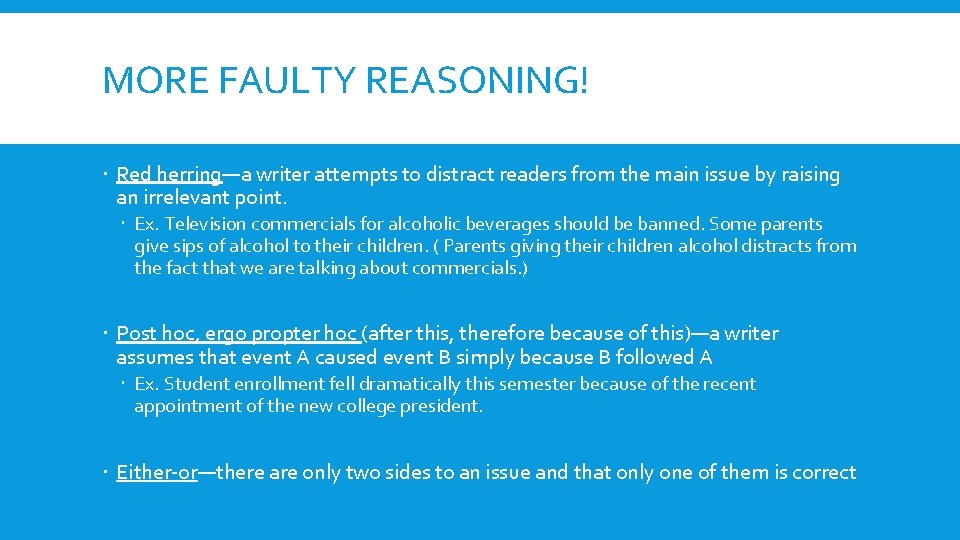
ANALYZING THE ELEMENTS AND REASONING OF AN ARGUMENT: REASONING Beware the fallacy, an error in reasoning or thinking. Fallacies can weaken arguments and undermine a writer’s claim or the writer himself! Circular reasoning (begging the question)—a writer uses the claim or part of it as evidence by simply repeating it in different words Ex. Cruel and unusual experimentation on helpless animals is inhumane. (Just like a term cannot define itself, a claim cannot prove itself. ) Hasty generalization—a writer draws a conclusion based on insufficient evidence or isolated examples Sweeping generalization—a writer claims that something applies to all situations without example False analogy—a writer compares two situations that are not sufficiently similar Non sequitur (it does not follow)—no logical relationship exists between two or more ideas
MORE FAULTY REASONING! Red herring—a writer attempts to distract readers from the main issue by raising an irrelevant point. Ex. Television commercials for alcoholic beverages should be banned. Some parents give sips of alcohol to their children. ( Parents giving their children alcohol distracts from the fact that we are talking about commercials. ) Post hoc, ergo propter hoc (after this, therefore because of this)—a writer assumes that event A caused event B simply because B followed A Ex. Student enrollment fell dramatically this semester because of the recent appointment of the new college president. Either-or—there are only two sides to an issue and that only one of them is correct
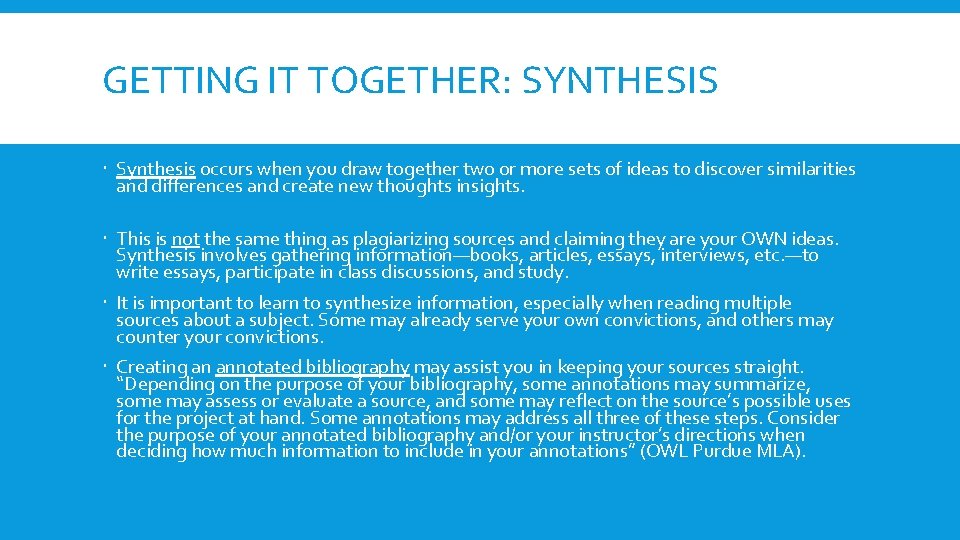
GETTING IT TOGETHER: SYNTHESIS Synthesis occurs when you draw together two or more sets of ideas to discover similarities and differences and create new thoughts insights. This is not the same thing as plagiarizing sources and claiming they are your OWN ideas. Synthesis involves gathering information—books, articles, essays, interviews, etc. —to write essays, participate in class discussions, and study. It is important to learn to synthesize information, especially when reading multiple sources about a subject. Some may already serve your own convictions, and others may counter your convictions. Creating an annotated bibliography may assist you in keeping your sources straight. “Depending on the purpose of your bibliography, some annotations may summarize, some may assess or evaluate a source, and some may reflect on the source’s possible uses for the project at hand. Some annotations may address all three of these steps. Consider the purpose of your annotated bibliography and/or your instructor’s directions when deciding how much information to include in your annotations” (OWL Purdue MLA).