
How to Read A Primer on Purposeful Reading


- Slides: 10
How to Read A Primer on Purposeful Reading
General Approach Your environment matters for effective reading. The right environment will increase understanding and cut the time it takes: Silence or soft music without words Eliminate distractions – television, phone, computer, and friends are all bad for reading. Time matters. Good reading takes time. You can’t rush it. Often, you need to read something two or three or more times. You should always have a purpose for reading.
General Approach Reading should always be Active, rather than Passive This means that if your mind isn’t 100% devoted to the text, you won’t “get it”. Have you ever read a page and then realized that you were thinking about something else the entire time? That’s Passive reading. We will use these seven strategies to stay Active…
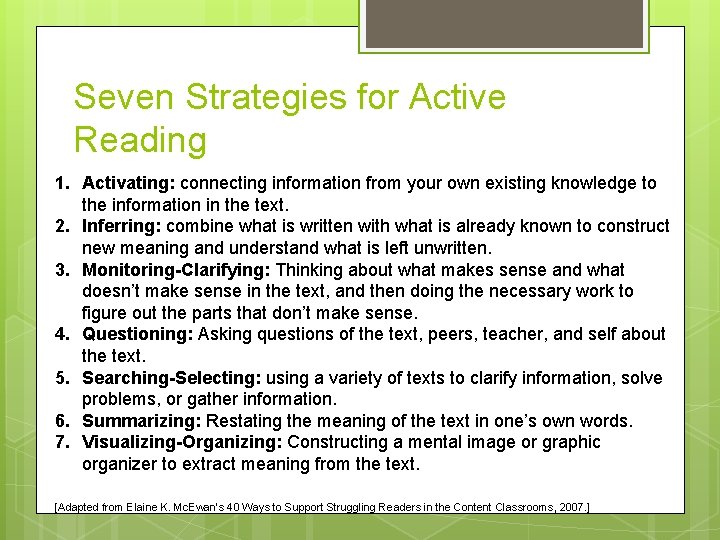
Seven Strategies for Active Reading 1. Activating: connecting information from your own existing knowledge to the information in the text. 2. Inferring: combine what is written with what is already known to construct new meaning and understand what is left unwritten. 3. Monitoring-Clarifying: Thinking about what makes sense and what doesn’t make sense in the text, and then doing the necessary work to figure out the parts that don’t make sense. 4. Questioning: Asking questions of the text, peers, teacher, and self about the text. 5. Searching-Selecting: using a variety of texts to clarify information, solve problems, or gather information. 6. Summarizing: Restating the meaning of the text in one’s own words. 7. Visualizing-Organizing: Constructing a mental image or graphic organizer to extract meaning from the text. [Adapted from Elaine K. Mc. Ewan’s 40 Ways to Support Struggling Readers in the Content Classrooms, 2007. ]
Personal Glossary In this class, you will keep a personal glossary in order to identify, research, and practice words you don’t know from the reading. Alphabetized Consist of any word you find in your reading that you don’t know Also include the daily SAT Vocabulary words Will serve as your Vocabulary study guide
Reading Types: Fast, Slow, Close Fast Reading How you read when you just need to get the basic idea of something. Common for pleasure reading. Don’t stop when you don’t understand something, just keep pushing forward. Good for a first-read of a text. Good for getting general concepts, big-picture view.
Reading Types: Fast, Slow, Close Slow Reading Most common type for English course assignments. Known as the Art of Philology Focus on understanding all concepts, arguments, events, descriptions in the text. Stop frequently to connect ideas to other knowledge and experiences you have. Stop frequently to look words up, reflect on difficult ideas, re-read difficult sections. If at all possible, this should include annotation (see “How to Mark a Book” by Mortimer J. Adler)
Reading Types: Fast, Slow, Close Reading Used to understand HOW a text achieves the meaning it does. Examines and analyzes the ways the author communicates his/her ideas, not just what the author communicates. Requires re-reading many times. Very time-consuming and detail-oriented.
Reading Types: Fast, Slow, Close Reading (continued) Find everything you can about the text, including: Figurative Language Diction Syntax Imagery Patterns Allusion Tone …and any other tool the author is using Then, analyze how the author used those particular things to form the effect he/she created.
Reading Literature Special considerations when reading creative literature, like short stories, poetry, novels, or plays: Memory Events’ resemblance to earlier works Characters’ resemblance to other works Pattern Archetypal Biblical, Mythological (including Fairy Tales), Shakespearean Symbol Any object, place, person, event, color, image, sound, etc. that represents an idea or emotion Interpretation of a symbol is tricky because it is personal, no right or wrong answer, but your idea must be supported by what is in the text.