
HOW TO PROMOTE COMMUNITY COHESION IN A MULTICULTURAL
- Slides: 39
HOW TO PROMOTE COMMUNITY COHESION IN A MULTICULTURAL SOCIETY: KEY INSIGHTS FROM SOCIAL PSYCHOLOGY WINNIFRED R. LOUIS SCHOOL OF PSYCHOLOGY, THE UNIVERSITY OF QUEENSLAND HEATHER GRIDLEY THE AUSTRALIAN PSYCHOLOGICAL SOCIETY, MELBOURNE
• Our aim in building social cohesion is not necessarily to stress the positive, but to provide a safe way of expressing and negotiating conflict 2
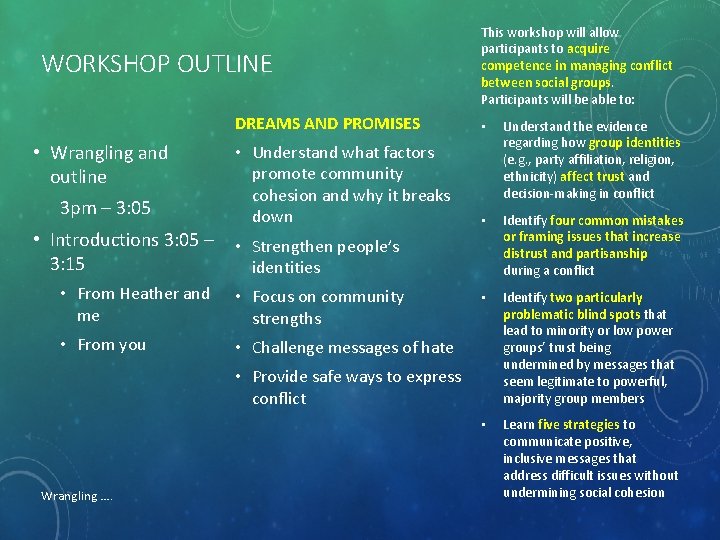
WORKSHOP OUTLINE • Wrangling and outline 3 pm – 3: 05 This workshop will allow participants to acquire competence in managing conflict between social groups. Participants will be able to: DREAMS AND PROMISES • • Understand what factors promote community cohesion and why it breaks down Understand the evidence regarding how group identities (e. g. , party affiliation, religion, ethnicity) affect trust and decision-making in conflict • Identify four common mistakes or framing issues that increase distrust and partisanship during a conflict • Identify two particularly problematic blind spots that lead to minority or low power groups’ trust being undermined by messages that seem legitimate to powerful, majority group members • Learn five strategies to communicate positive, inclusive messages that address difficult issues without undermining social cohesion • Introductions 3: 05 – • Strengthen people’s 3: 15 identities • From Heather and me • Focus on community strengths • From you • Challenge messages of hate • Provide safe ways to express conflict Wrangling ….
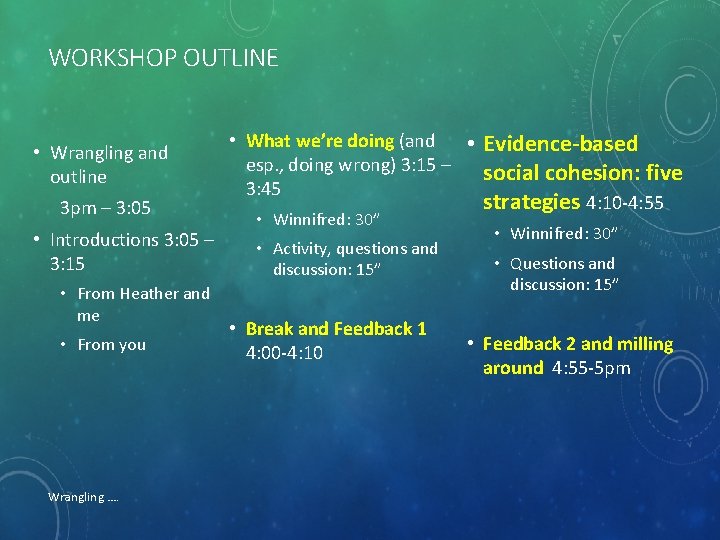
WORKSHOP OUTLINE • Wrangling and outline 3 pm – 3: 05 • Introductions 3: 05 – 3: 15 • From Heather and me • From you Wrangling …. • What we’re doing (and • Evidence-based esp. , doing wrong) 3: 15 – social cohesion: five 3: 45 strategies 4: 10 -4: 55 • Winnifred: 30” • Activity, questions and discussion: 15” • Break and Feedback 1 4: 00 -4: 10 • Winnifred: 30” • Questions and discussion: 15” • Feedback 2 and milling around 4: 55 -5 pm
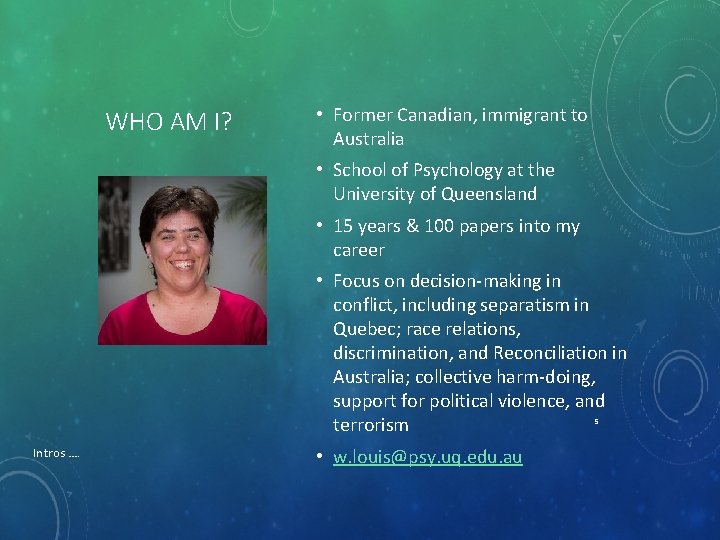
WHO AM I? • Former Canadian, immigrant to Australia • School of Psychology at the University of Queensland • 15 years & 100 papers into my career • Focus on decision-making in conflict, including separatism in Quebec; race relations, discrimination, and Reconciliation in Australia; collective harm-doing, support for political violence, and terrorism 5 Intros …. • w. louis@psy. uq. edu. au
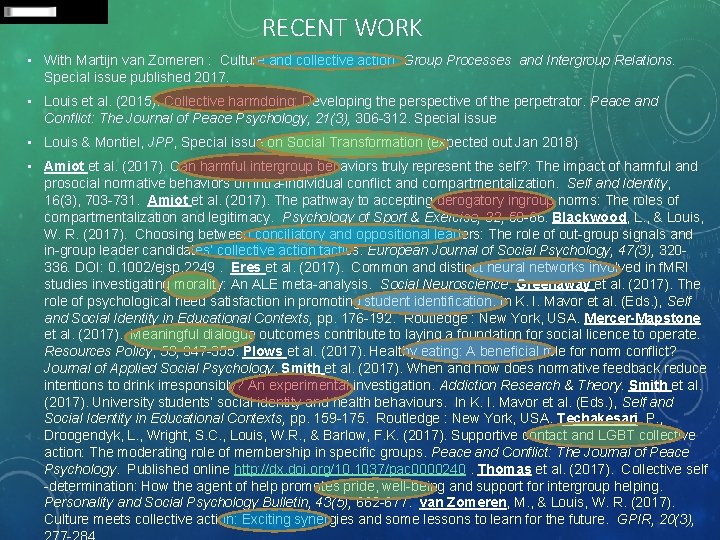
RECENT WORK • With Martijn van Zomeren : Culture and collective action. Group Processes and Intergroup Relations. Special issue published 2017. • Louis et al. (2015). Collective harmdoing: Developing the perspective of the perpetrator. Peace and Conflict: The Journal of Peace Psychology, 21(3), 306 -312. Special issue • Louis & Montiel, JPP, Special issue on Social Transformation (expected out Jan 2018) • Amiot et al. (2017). Can harmful intergroup behaviors truly represent the self? : The impact of harmful and prosocial normative behaviors on intra-individual conflict and compartmentalization. Self and Identity, 16(3), 703 -731. Amiot et al. (2017). The pathway to accepting derogatory ingroup norms: The roles of compartmentalization and legitimacy. Psychology of Sport & Exercise, 32, 58 -66. Blackwood, L. , & Louis, W. R. (2017). Choosing between conciliatory and oppositional leaders: The role of out-group signals and in-group leader candidates’ collective action tactics. European Journal of Social Psychology, 47(3), 320336. DOI: 0. 1002/ejsp. 2249. Eres et al. (2017). Common and distinct neural networks involved in f. MRI studies investigating morality: An ALE meta-analysis. Social Neuroscience. Greenaway et al. (2017). The role of psychological need satisfaction in promoting student identification. In K. I. Mavor et al. (Eds. ), Self and Social Identity in Educational Contexts, pp. 176 -192. Routledge : New York, USA. Mercer-Mapstone et al. (2017). Meaningful dialogue outcomes contribute to laying a foundation for social licence to operate. Resources Policy, 53, 347 -355. Plows et al. (2017). Healthy eating: A beneficial role for norm conflict? Journal of Applied Social Psychology. Smith et al. (2017). When and how does normative feedback reduce intentions to drink irresponsibly? An experimental investigation. Addiction Research & Theory. Smith et al. (2017). University students’ social identity and health behaviours. In K. I. Mavor et al. (Eds. ), Self and Social Identity in Educational Contexts, pp. 159 -175. Routledge : New York, USA. Techakesari, P. , Droogendyk, L. , Wright, S. C. , Louis, W. R. , & Barlow, F. K. (2017). Supportive contact and LGBT collective action: The moderating role of membership in specific groups. Peace and Conflict: The Journal of Peace Psychology. Published online http: //dx. doi. org/10. 1037/pac 0000240. Thomas et al. (2017). Collective self -determination: How the agent of help promotes pride, well-being and support for intergroup helping. Personality and Social Psychology Bulletin, 43(5), 662 -677. van Zomeren, M. , & Louis, W. R. (2017). Culture meets collective action: Exciting synergies and some lessons to learn for the future. GPIR, 20(3),
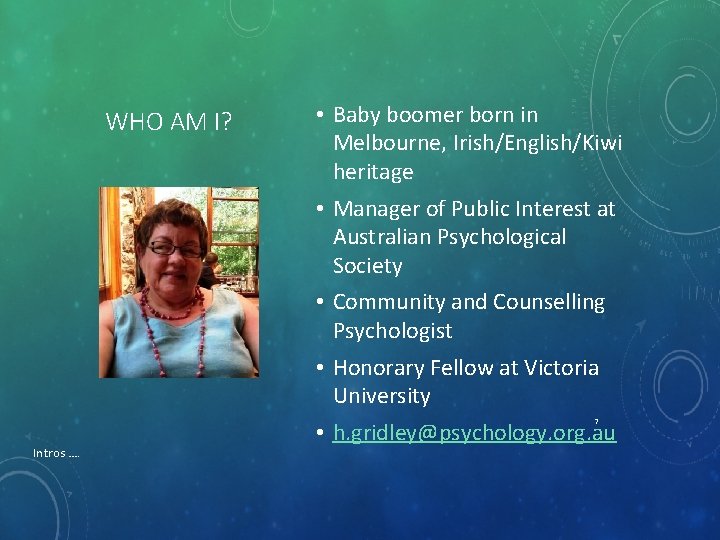
WHO AM I? • Baby boomer born in Melbourne, Irish/English/Kiwi heritage • Manager of Public Interest at Australian Psychological Society • Community and Counselling Psychologist • Honorary Fellow at Victoria University • h. gridley@psychology. org. au 7 Intros ….
THE CONTRIBUTIONS OF PSYCHOLOGY TO THE BIG ISSUES OF THE 21 ST CENTURY “The science of psychology can help us to understand the ‘big issues’ facing the world today and find solutions that contribute to individual and community wellbeing. ” Professor Mike Kyrios FAPS, APS President 2014 - 2016 Social Cohesion Climate Change Community Wellbeing.
WHO ARE YOU? • Please complete Form 1 – Introductions if you have not already (first – because we’re going to come and get them) • Please then introduce yourself to your table • Who you are, what your job is, why you are here Intros ….
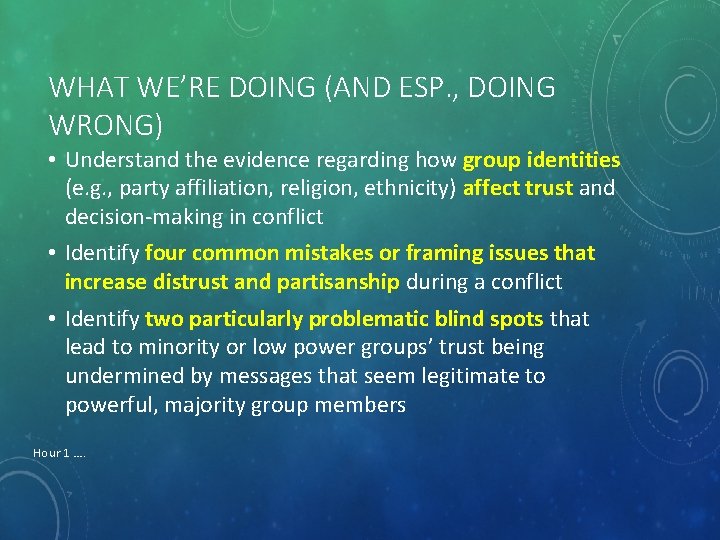
WHAT WE’RE DOING (AND ESP. , DOING WRONG) • Understand the evidence regarding how group identities (e. g. , party affiliation, religion, ethnicity) affect trust and decision-making in conflict • Identify four common mistakes or framing issues that increase distrust and partisanship during a conflict • Identify two particularly problematic blind spots that lead to minority or low power groups’ trust being undermined by messages that seem legitimate to powerful, majority group members Hour 1 ….
GROUP IDENTITIES START AND STOP TRUST SO OUTSIDERS CAN’T POLLUTE OUR MINDS Hour 1 ….
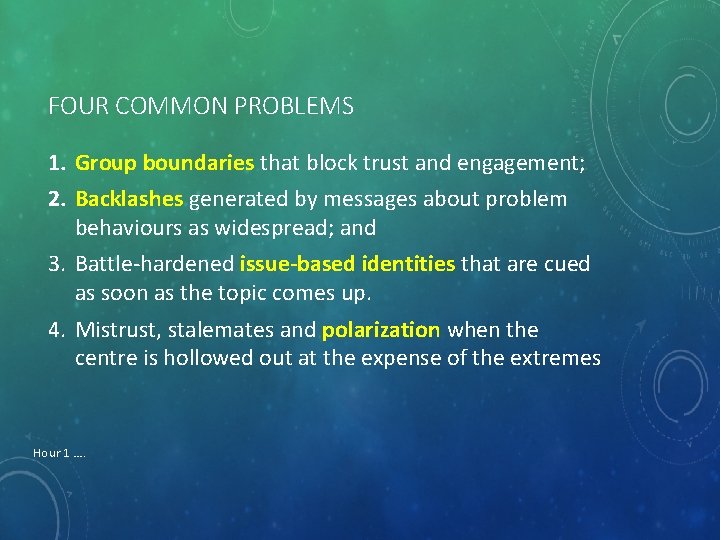
FOUR COMMON PROBLEMS 1. Group boundaries that block trust and engagement; 2. Backlashes generated by messages about problem behaviours as widespread; and 3. Battle-hardened issue-based identities that are cued as soon as the topic comes up. 4. Mistrust, stalemates and polarization when the centre is hollowed out at the expense of the extremes Hour 1 ….
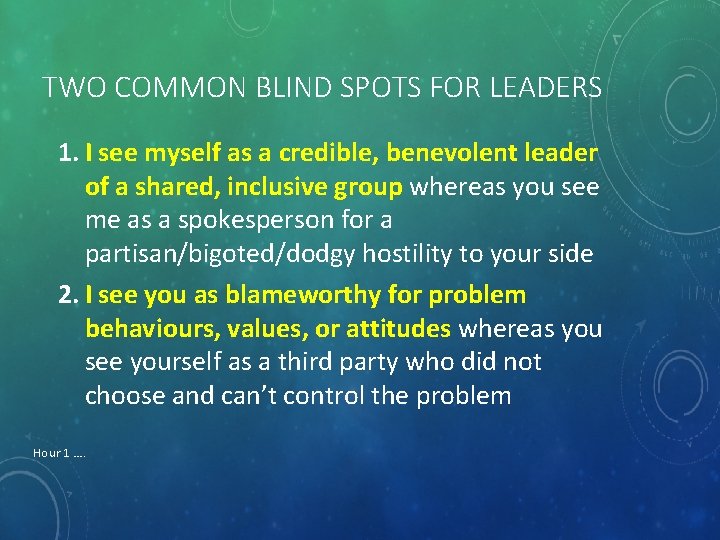
TWO COMMON BLIND SPOTS FOR LEADERS 1. I see myself as a credible, benevolent leader of a shared, inclusive group whereas you see me as a spokesperson for a partisan/bigoted/dodgy hostility to your side 2. I see you as blameworthy for problem behaviours, values, or attitudes whereas you see yourself as a third party who did not choose and can’t control the problem Hour 1 ….
TERMS I THROW AROUND A LOT • “Norms” – social rules or standards for behaviour • “Identities” – people’s sense of themselves re who they are – politicians, civil servants, LNP voters, etc. Hour 1 ….
WHY IS IT SO HARD TO TALK ABOUT RACE, RELIGION, OR POLITICS? • • • Politicians are morons …. Academics are morons …. Uncle Fred is a moron …. The public are morons …. Party x (e. g. , One Nation, The Greens) are morons …. No! Hour 1 ….
EFFECTIVE COMMUNICATION WITHIN GROUPS IS NOT THE SAME AS EFFECTIVE COMMUNICATION BETWEEN GROUPS Hour 1 ….
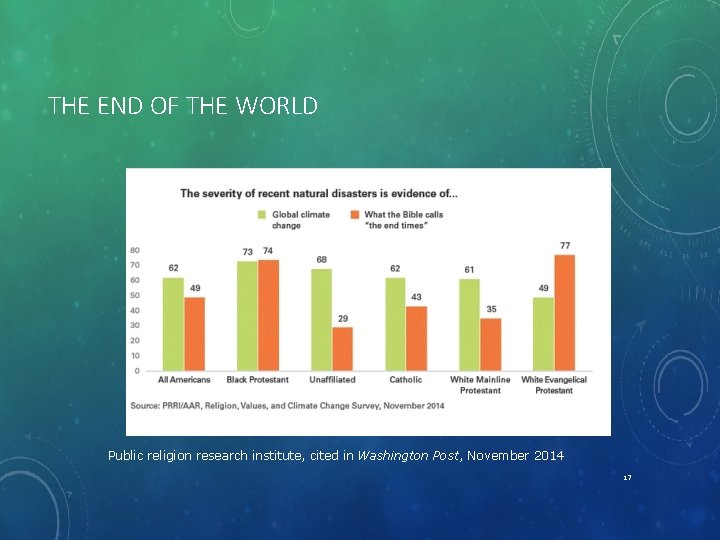
THE END OF THE WORLD Public religion research institute, cited in Washington Post, November 2014 17
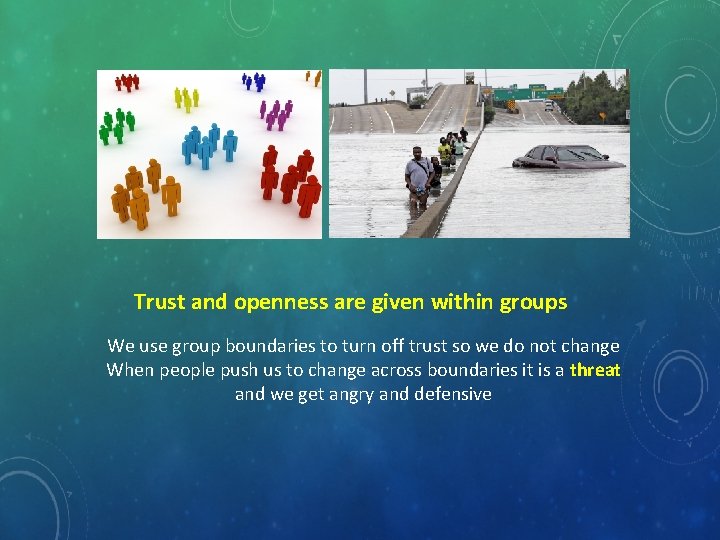
Trust and openness are given within groups We use group boundaries to turn off trust so we do not change When people push us to change across boundaries it is a threat and we get angry and defensive
2 HIGHLIGHTING NEGATIVE NORMS DOESN’T WORK • “Australians have a problem with …” • Obesity • Not using sun protection • Not saving enough for their retirement • Energy conservation • Racism • Prejudice • For ordinary punters, not only does not decrease problem behaviour, can increase it! • Works for … campaign designers.
3 BATTLE-HARDENED “OPINION GROUP” IDENTITIES • Identities don’t just attach to social groups like nations or religions • People identify with “opinion groups” of supporters or opponents • I support funding for the arts • I oppose mandatory detention for refugees • Power of identity depends on many factors • repeated activation, relevance, psychological needs • Conflict makes identities more powerful and vivid
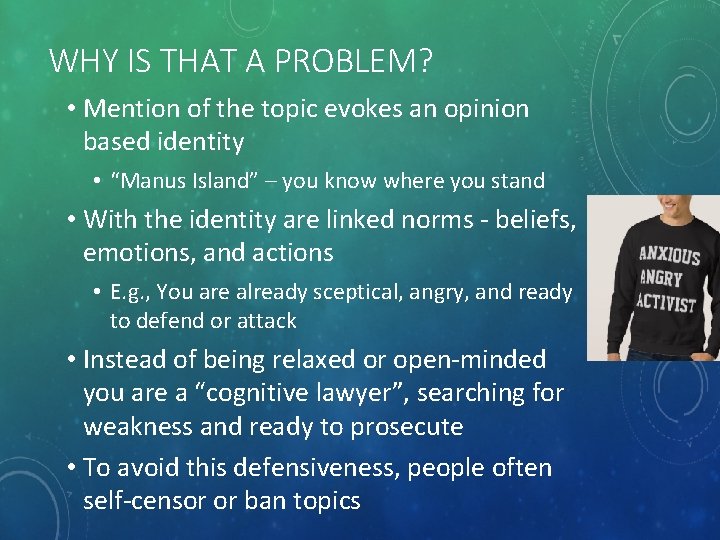
WHY IS THAT A PROBLEM? • Mention of the topic evokes an opinion based identity • “Manus Island” – you know where you stand • With the identity are linked norms - beliefs, emotions, and actions • E. g. , You are already sceptical, angry, and ready to defend or attack • Instead of being relaxed or open-minded you are a “cognitive lawyer”, searching for weakness and ready to prosecute • To avoid this defensiveness, people often self-censor or ban topics
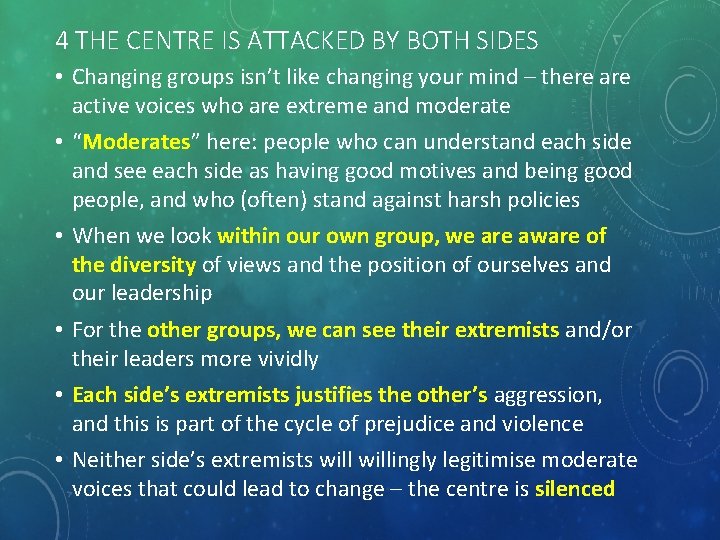
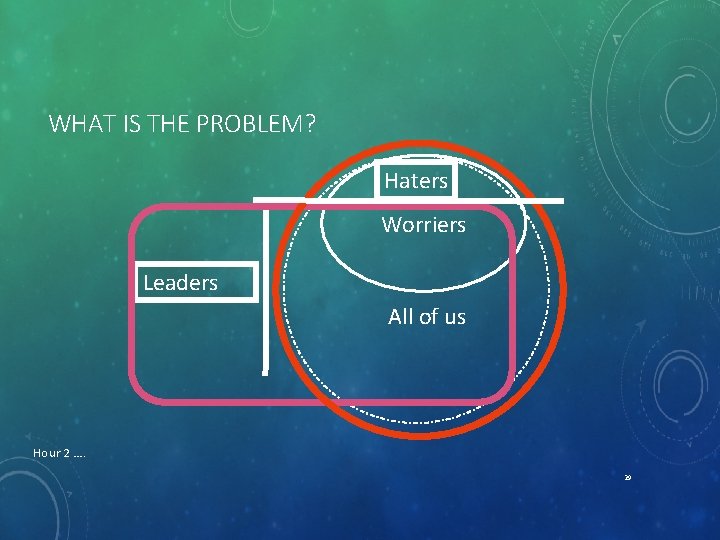
4 THE CENTRE IS ATTACKED BY BOTH SIDES • Changing groups isn’t like changing your mind – there active voices who are extreme and moderate • “Moderates” here: people who can understand each side and see each side as having good motives and being good people, and who (often) stand against harsh policies • When we look within our own group, we are aware of the diversity of views and the position of ourselves and our leadership • For the other groups, we can see their extremists and/or their leaders more vividly • Each side’s extremists justifies the other’s aggression, and this is part of the cycle of prejudice and violence • Neither side’s extremists willingly legitimise moderate voices that could lead to change – the centre is silenced
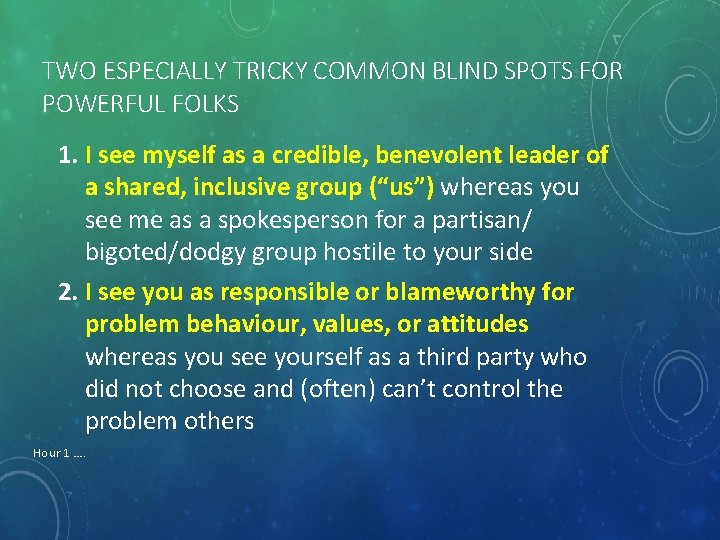
TWO ESPECIALLY TRICKY COMMON BLIND SPOTS FOR POWERFUL FOLKS 1. I see myself as a credible, benevolent leader of a shared, inclusive group (“us”) whereas you see me as a spokesperson for a partisan/ bigoted/dodgy group hostile to your side 2. I see you as responsible or blameworthy for problem behaviour, values, or attitudes whereas you see yourself as a third party who did not choose and (often) can’t control the problem others Hour 1 ….
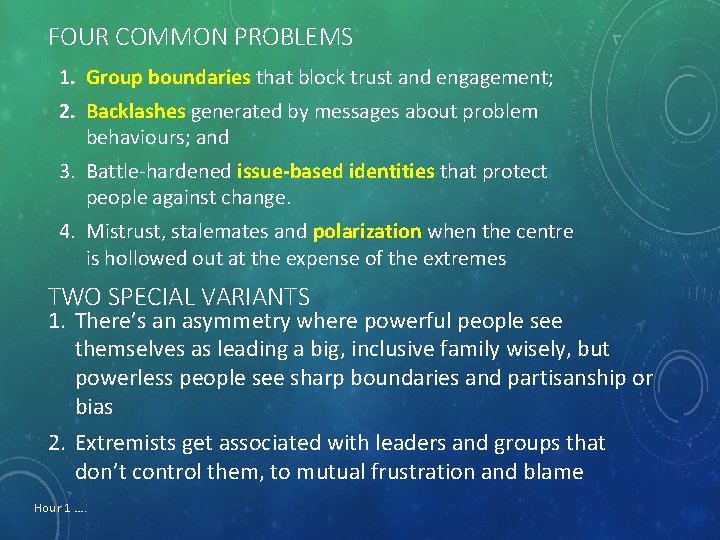
FOUR COMMON PROBLEMS 1. Group boundaries that block trust and engagement; 2. Backlashes generated by messages about problem behaviours; and 3. Battle-hardened issue-based identities that protect people against change. 4. Mistrust, stalemates and polarization when the centre is hollowed out at the expense of the extremes TWO SPECIAL VARIANTS 1. There’s an asymmetry where powerful people see themselves as leading a big, inclusive family wisely, but powerless people see sharp boundaries and partisanship or bias 2. Extremists get associated with leaders and groups that don’t control them, to mutual frustration and blame Hour 1 ….
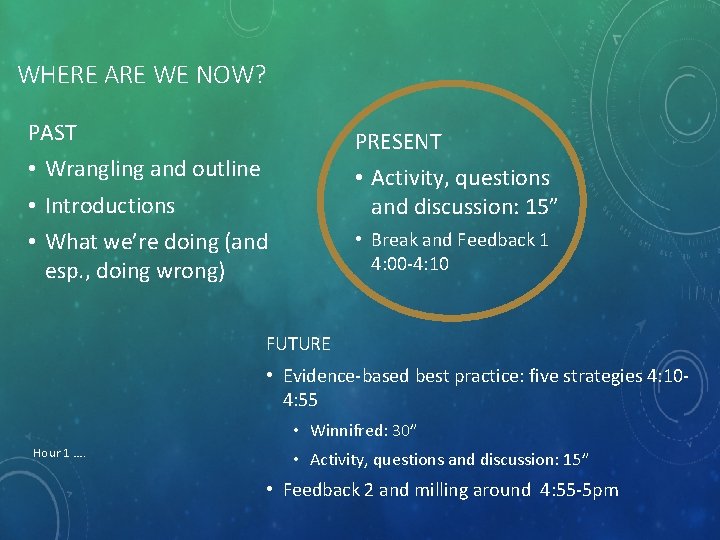
WHERE ARE WE NOW? PAST PRESENT • Wrangling and outline • Introductions • What we’re doing (and esp. , doing wrong) • Activity, questions and discussion: 15” • Break and Feedback 1 4: 00 -4: 10 FUTURE • Evidence-based best practice: five strategies 4: 104: 55 • Winnifred: 30” Hour 1 …. • Activity, questions and discussion: 15” • Feedback 2 and milling around 4: 55 -5 pm
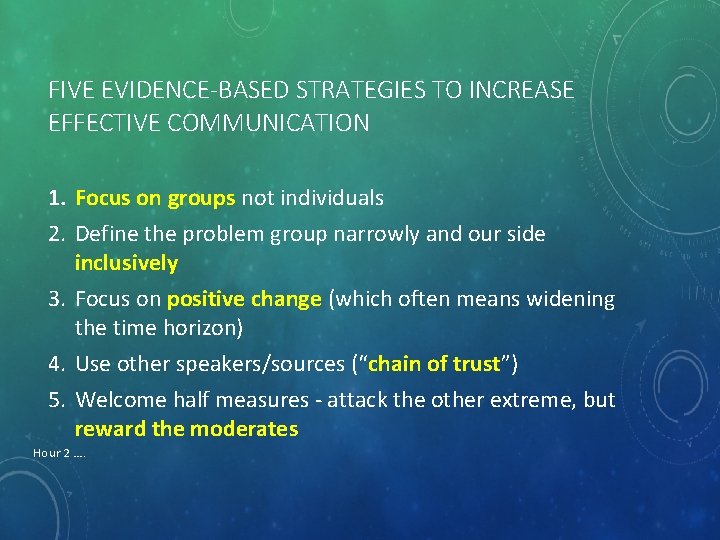
FIVE EVIDENCE-BASED STRATEGIES TO INCREASE EFFECTIVE COMMUNICATION 1. Focus on groups not individuals 2. Define the problem group narrowly and our side inclusively 3. Focus on positive change (which often means widening the time horizon) 4. Use other speakers/sources (“chain of trust”) 5. Welcome half measures - attack the other extreme, but reward the moderates Hour 2 ….
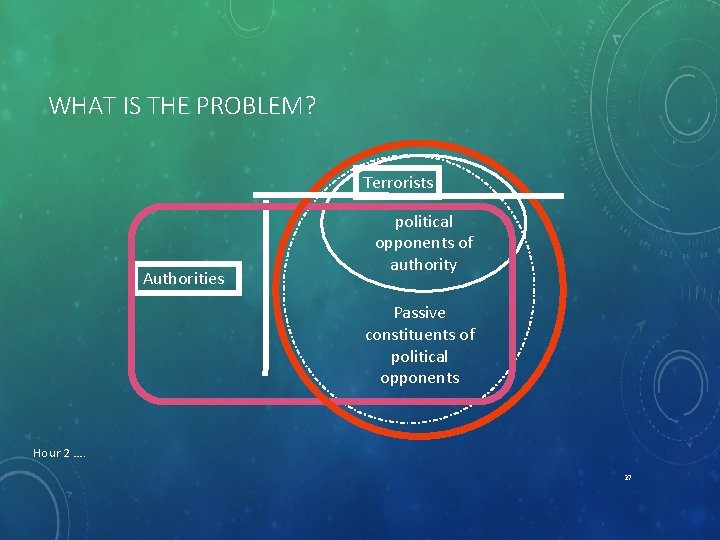
WHAT IS THE PROBLEM? Terrorists Authorities political opponents of authority Passive constituents of political opponents Hour 2 …. 27
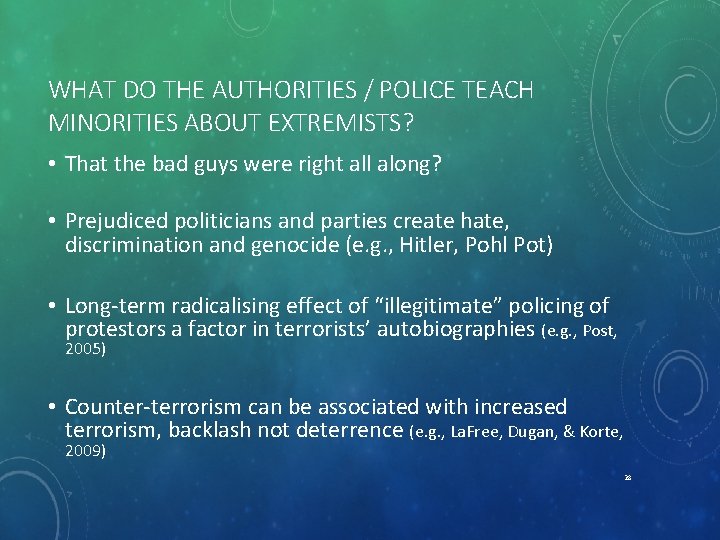
WHAT DO THE AUTHORITIES / POLICE TEACH MINORITIES ABOUT EXTREMISTS? • That the bad guys were right all along? • Prejudiced politicians and parties create hate, discrimination and genocide (e. g. , Hitler, Pohl Pot) • Long-term radicalising effect of “illegitimate” policing of protestors a factor in terrorists’ autobiographies (e. g. , Post, 2005) • Counter-terrorism can be associated with increased terrorism, backlash not deterrence (e. g. , La. Free, Dugan, & Korte, 2009) 28
WHAT IS THE PROBLEM? Haters Worriers Leaders All of us Hour 2 …. 29
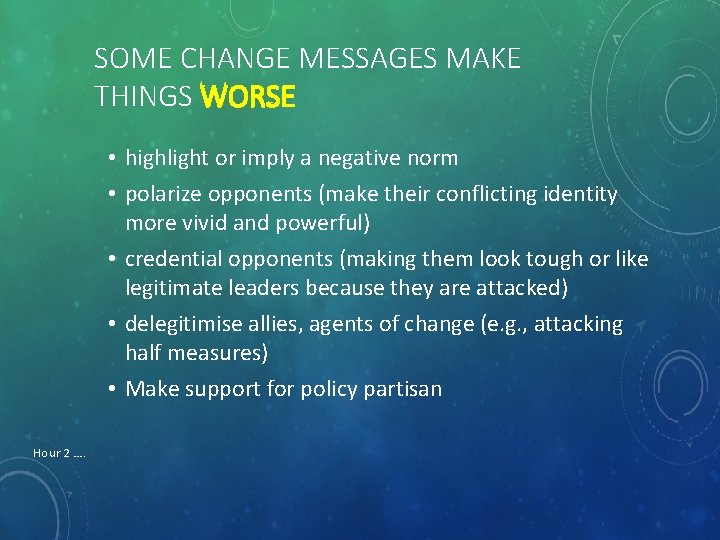
SOME CHANGE MESSAGES MAKE THINGS WORSE • highlight or imply a negative norm • polarize opponents (make their conflicting identity more vivid and powerful) • credential opponents (making them look tough or like legitimate leaders because they are attacked) • delegitimise allies, agents of change (e. g. , attacking half measures) • Make support for policy partisan Hour 2 ….
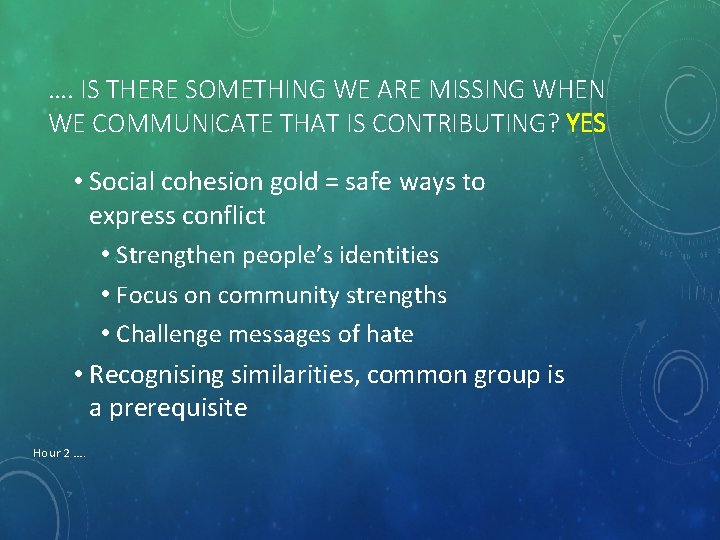
…. IS THERE SOMETHING WE ARE MISSING WHEN WE COMMUNICATE THAT IS CONTRIBUTING? YES • Social cohesion gold = safe ways to express conflict • Strengthen people’s identities • Focus on community strengths • Challenge messages of hate • Recognising similarities, common group is a prerequisite Hour 2 ….
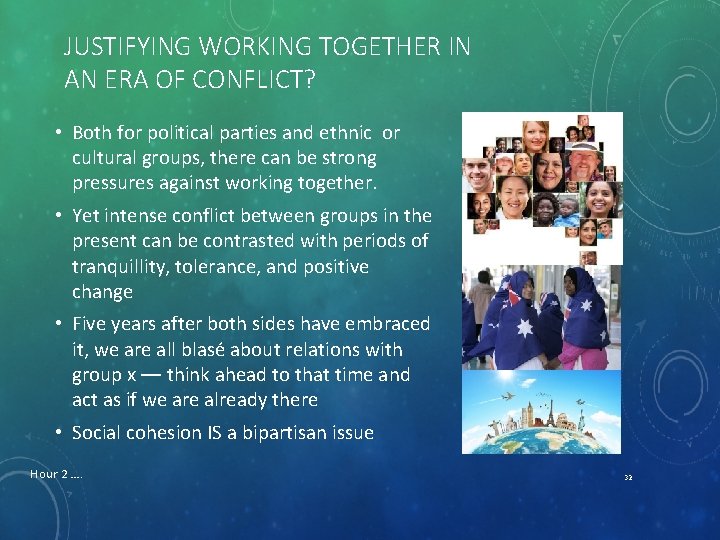
JUSTIFYING WORKING TOGETHER IN AN ERA OF CONFLICT? • Both for political parties and ethnic or cultural groups, there can be strong pressures against working together. • Yet intense conflict between groups in the present can be contrasted with periods of tranquillity, tolerance, and positive change • Five years after both sides have embraced it, we are all blasé about relations with group x –– think ahead to that time and act as if we are already there • Social cohesion IS a bipartisan issue Hour 2 …. 32
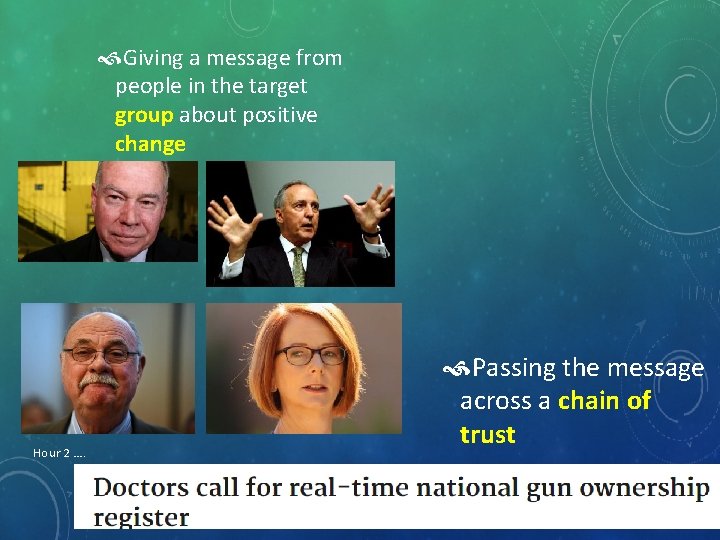
Giving a message from people in the target group about positive change Hour 2 …. Passing the message across a chain of trust
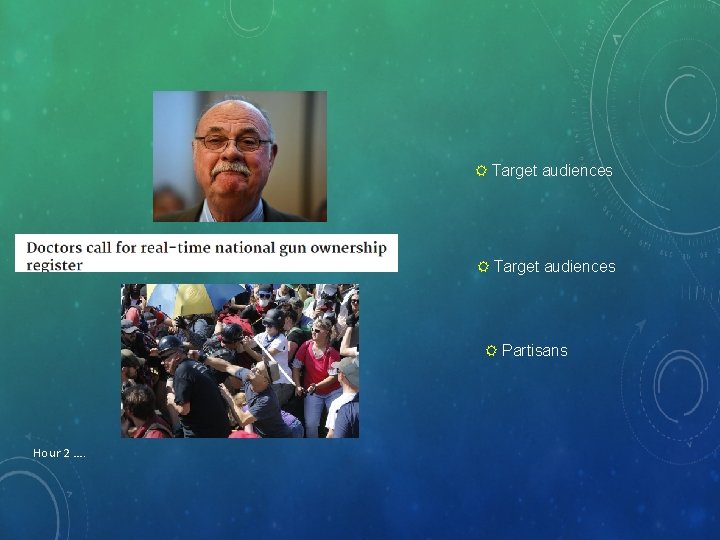
Target audiences Partisans Hour 2 ….
PURITY VS OPENNESS TO BEHAVIOUR CHANGE • Purity motives promote rejection and condemnation by leaders and group members vs inclusive welcoming • One group’s extremists justify the other’s, and in the absence of a vocal centre, a cycle of conflict is inevitable • Defeating and judging can create resentment and counter-mobilisation • Welcoming half-measures promotes change more than condemning them • Coopting is good for an issue, wedging is bad • Ultimately the other side would ideally co-own the change Hour 2 ….
FIVE EVIDENCE-BASED STRATEGIES TO INCREASE SOCIAL COHESION: COMMUNICATION IN CONFLICT 1. Focus on groups not individuals 2. Define the problem group narrowly and our side inclusively 3. Focus on positive change (which often means widening the time horizon) 4. Use other speakers/sources (“chain of trust”) 5. Welcome half measures - attack the other extreme, but reward the moderates Hour 2 ….
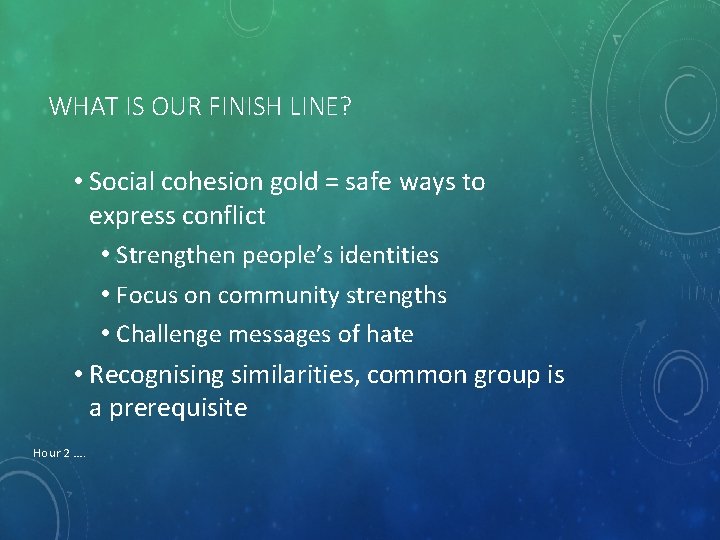
WHAT IS OUR FINISH LINE? • Social cohesion gold = safe ways to express conflict • Strengthen people’s identities • Focus on community strengths • Challenge messages of hate • Recognising similarities, common group is a prerequisite Hour 2 ….
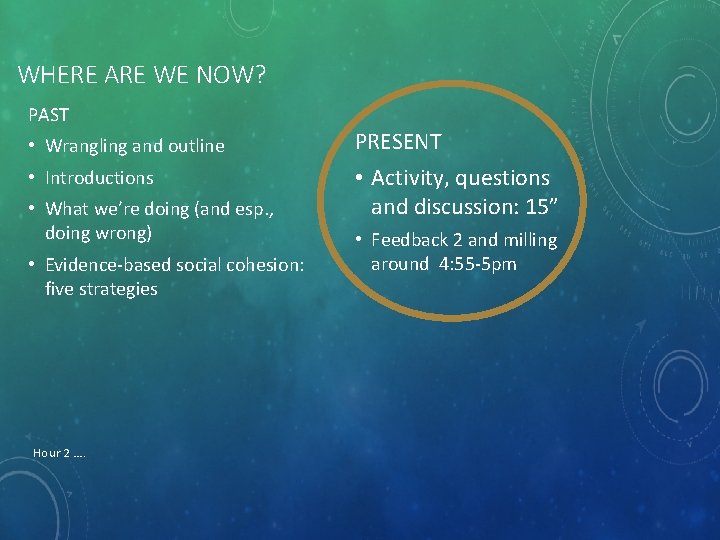
WHERE ARE WE NOW? PAST • Wrangling and outline PRESENT • Introductions • Activity, questions and discussion: 15” • What we’re doing (and esp. , doing wrong) • Evidence-based social cohesion: five strategies Hour 2 …. • Feedback 2 and milling around 4: 55 -5 pm
THANK YOU! W. LOUIS@PSY. UQ. EDU. AU H. GRIDLEY@PSYCHOLOGY. ORG. AU 39