
How to prepare compliant financial reports Robert Campbell
How to prepare compliant financial reports Robert Campbell CA, CPA, RCA, GAICD July 2019
What are compliant financial reports? • A compliant financial report : • Satisfies the legislative or regulatory or constitutional requirements for financial reporting • Identifies the applicable reporting framework • Presents a true and fair view of financial position and performance
Where are the requirements • Corporations Act 2001 • Australian Charities and Not-for-Profits Act 2012 • WA Associations Incorporation Act 2015 • The Conceptual framework for Presentation of Financial Statements underpinning Australian Accounting Standards • Australian Professional & Ethical Standard 315 Compilation Reports • The organisation’s governing documents • Constitution • Trust Deed
Corporations Act 2001 • Financial reporting required under Chapter 2 M • Public Companies • Large Proprietary companies • Australian Financial Services Licensees • A distinction between reporting and non reporting entities • RG 85 Reporting requirements for non-reporting entities Issued 1 July 2005
What is a reporting entity? • Reporting entities are described in Statement of Accounting Concepts SAC 1 – Definition of Reporting Entity • Reporting entities are all entities (including economic entities) in respect of which it is reasonable to expect the existence of users • Who are dependent on general purpose financial reports for information which will be useful to them for making and evaluating decisions about the allocation of scarce resources. • A reporting entity must produce a General Purpose Financial Report applying all relevant Accounting Standards either International or Australian
Corporations Act 2001 section 296 (compliance with accounting standards); • • • The financial report for a financial year must comply with the accounting standards • unless they are small proprietary companies or small companies limited by guarantee • These are not required to produce financial reports under the Corporations Act If 5% or more of the shareholders or members request a financial report the financial report must comply with accounting standards unless the shareholders or members specify that the financial report does not have to comply with the accounting standards
When does a small proprietary company become large? • From 1 July 2019 under the new Corporations Act Regulations, a proprietary • • • company will be considered ‘large’ for a financial year if it satisfies at least two of the following requirements: $50 million or more in consolidated revenue for the financial year of the company and the entities it controls (up from $25 million); $25 million or more in consolidated gross assets at the end of the financial year of the company and the entities it controls (up from $12. 5 million); The company and the entities it controls have 100 employees or more at the end of the financial year (up from 50).
RG 85 Reporting requirements for nonreporting entities • A non reporting entity should produce a special purpose financial report as a minimum satisfying RG 85: • Complies with the recognition and measurement requirements of the Accounting standards and the disclosure requirements of • AASB 101 ‘Presentation of Financial Statements’; • AASB 107 ‘Cash Flow Statements’; • AASB 108 ‘Accounting Policies, Changes in Accounting Estimates and Errors’; and • AASB 1048 ‘Interpretation and Application of Standards’. • Small Pty Ltd companies do not have to comply with RG 85 unless required to do so by shareholders or the governing document
APES 315 - Compilation • applying professional expertise in accounting and financial reporting to assist Those Charged with Governance in the preparation and presentation of financial information in accordance with an Applicable Financial Reporting Framework – General RDR or Special Purpose • The requirements of the Applicable Financial Reporting Framework determine the format and content of a financial report prepared in accordance with a Special Purpose Framework.
Which type of financial statement should prepared? • If you are a REPORTING ENTITY , you must submit a full General Purpose Financial Report • If not • Then a Special Purpose Financial Report • Or • A General Purpose Financial Report with Reduced Disclosures • Or • A full General Purpose Financial Report
Full General Purpose Financial Statements • Comply with all relevant Australian Accounting standards • Recognition • Measurement • Disclosure • May be over 35 pages • Must give a True & Fair view of financial position and performance.
General Purpose with Reduced Disclosures • In accordance with AASB 1053 • Disclosures are reduced • Complies with the all the recognition and measurement principles of all relevant Australian Accounting Standards • May be over 20 pages in length • Must give a True and Fair View
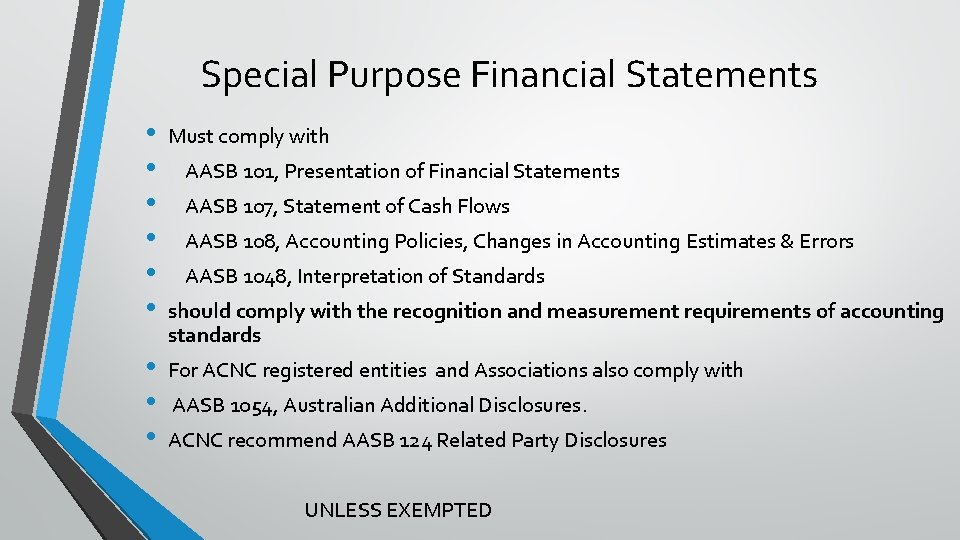
Special Purpose Financial Statements • • • Must comply with • • • For ACNC registered entities and Associations also comply with • AASB 101, Presentation of Financial Statements AASB 107, Statement of Cash Flows AASB 108, Accounting Policies, Changes in Accounting Estimates & Errors AASB 1048, Interpretation of Standards should comply with the recognition and measurement requirements of accounting standards AASB 1054, Australian Additional Disclosures. ACNC recommend AASB 124 Related Party Disclosures UNLESS EXEMPTED
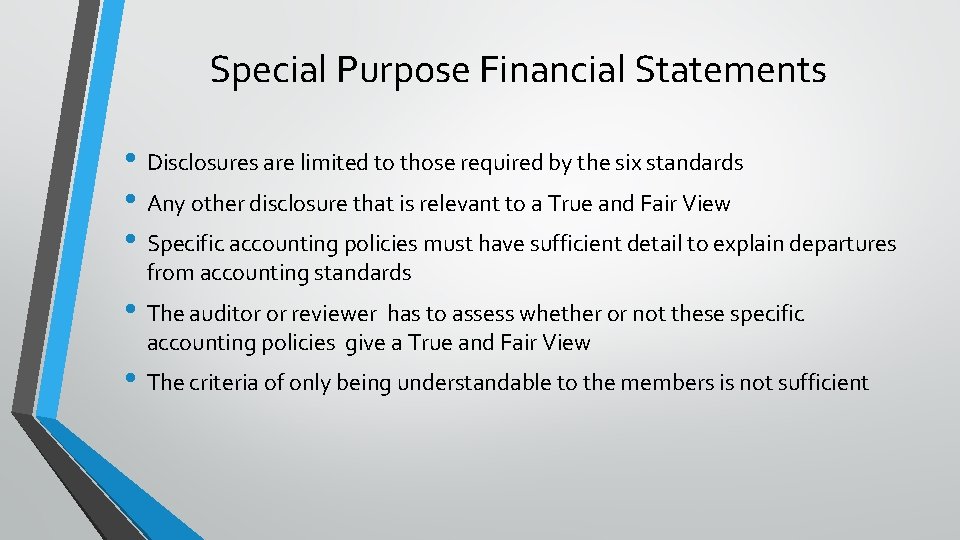
Special Purpose Financial Statements • Disclosures are limited to those required by the six standards • Any other disclosure that is relevant to a True and Fair View • Specific accounting policies must have sufficient detail to explain departures from accounting standards • The auditor or reviewer has to assess whether or not these specific accounting policies give a True and Fair View • The criteria of only being understandable to the members is not sufficient
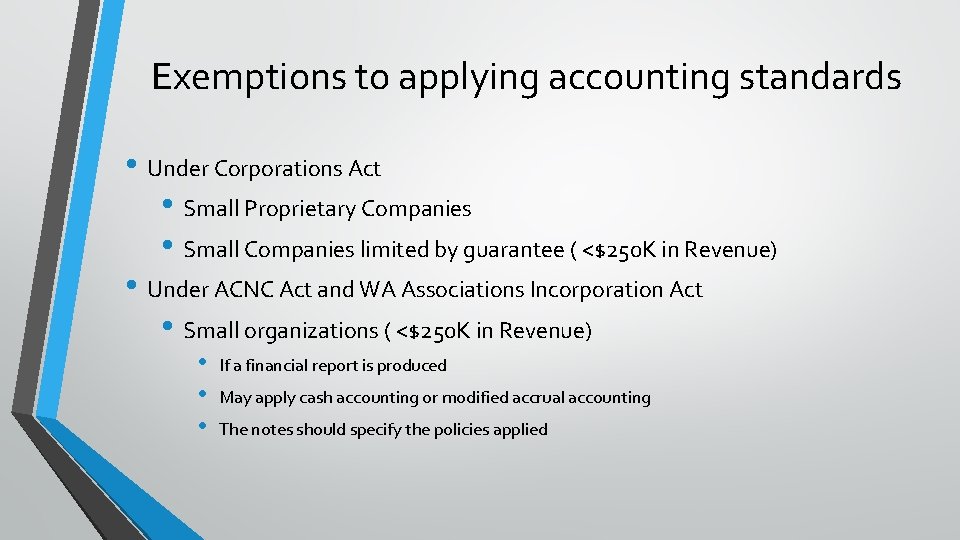
Exemptions to applying accounting standards • Under Corporations Act • Small Proprietary Companies • Small Companies limited by guarantee ( <$250 K in Revenue) • Under ACNC Act and WA Associations Incorporation Act • Small organizations ( <$250 K in Revenue) • • • If a financial report is produced May apply cash accounting or modified accrual accounting The notes should specify the policies applied
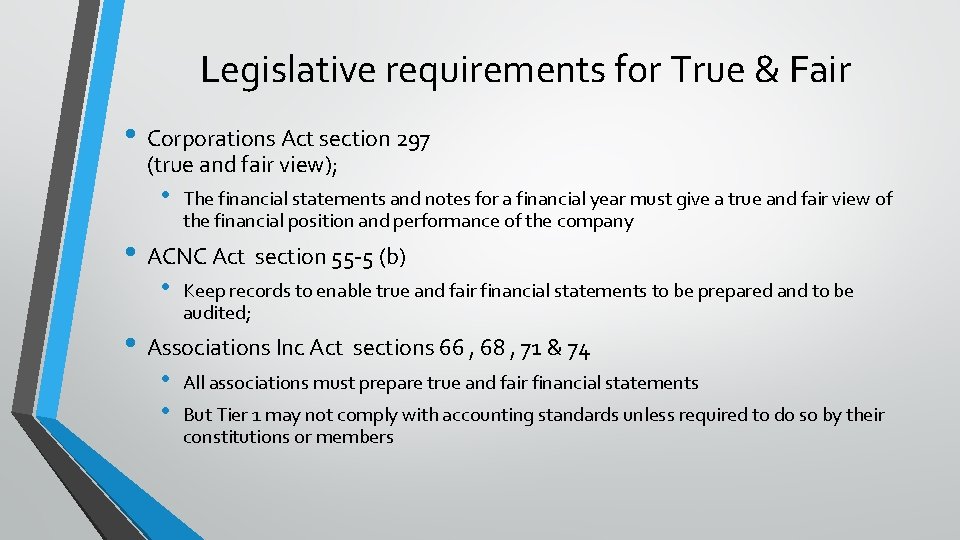
Legislative requirements for True & Fair • Corporations Act section 297 (true and fair view); • The financial statements and notes for a financial year must give a true and fair view of the financial position and performance of the company • ACNC Act section 55 -5 (b) • Keep records to enable true and fair financial statements to be prepared and to be audited; • Associations Inc Act sections 66 , 68 , 71 & 74 • • All associations must prepare true and fair financial statements But Tier 1 may not comply with accounting standards unless required to do so by their constitutions or members
What is a True & Fair View? • There is much written on the topic • The prevalent view is that at a minimum • The Financial report must comply with the recognition and measurement principles of Australian Accounting Standards • The Framework for the Preparation and Presentation of Financial Statements 2009 • AASB 101 the Presentation of Financial Statements
Examples of True & Fair Issues • Creating a Reserve for Redundancy • Then • posting redundancy expense transactions direct to the reserve instead of to the normal expenses on the Income Statement • The expenses incurred in the Financial Year have been understated because they appear in the reserve and not on the Income Statement • Thus this is NOT a True and Fair View.
Examples of True & Fair Issues • Creating a Provision for Maintenance Liability • And recording Maintenance expenses on the Income Statement • This is represents maintenance that must be completed but has not been. • The PROBLEM is that maintenance cost has not yet been incurred and no obligating event can be demonstrated • There is no liability – no legitimate expense • The surplus is this understated. • This is NOT a True and Fair View
AASB 101 Presentation of Financial Statements • Financial statements shall present fairly the financial position, financial performance and cash flows of an entity. • Fair presentation requires the faithful representation of the effects of transactions, other events and conditions in accordance with the definitions and recognition criteria for assets, liabilities, income and expenses set out in the Framework. • The application of Australian Accounting Standards, with additional disclosure when necessary, is presumed to result in financial statements that achieve a fair presentation
A complete set of financial statements comprises: • a statement of financial position as at the end of the period; • a statement of profit or loss and other comprehensive income for the period; • a statement of changes in equity for the period; • a statement of cash flows for the period; • notes, comprising significant accounting policies and other explanatory information; • comparative information in respect of the preceding period; and • a statement of financial position as at the beginning of the preceding period when an entity applies an accounting policy retrospectively or makes a retrospective restatement of items in its financial statements
Other Titles for the statements • An entity may use titles for the statements other than those used in this Standard. • For example, an entity may use the title ‘statement of comprehensive income’ instead of ‘statement of profit or loss and other comprehensive income’. • An entity may present a single statement of profit or loss and other comprehensive income, with profit or loss and other comprehensive income presented in two sections.
Accounting policies • An entity cannot rectify inappropriate accounting policies either by disclosure of the accounting policies used or by notes or explanatory material • If special purpose financial report is prepared , in extremely rare circumstances, you may depart from a relevant Accounting standard if application of the Standard is misleading and not be true and fair. • If so you mist disclose the departure from the relevant Standard and its financial effect.
Accrual basis of accounting • An entity shall prepare its financial statements, except for cash flow information, using the accrual basis of accounting. • an entity recognises items as assets, liabilities, equity, income and expenses (the elements of financial statements) when they satisfy the definitions and recognition criteria for those elements in the Framework
Materiality and aggregation • An entity shall present separately each material class of similar items. • An entity shall present separately items of a dissimilar nature or function unless they are immaterial. Offsetting • An entity shall not offset assets and liabilities or income and expenses, • unless required or permitted by an Australian Accounting Standard. Exceptions • Gains & loss on disposal of assets • expenditure related to a Provision
The statement of financial position shall include line items ( if relevant) • property, plant and equipment; • investment property; • intangible assets; • financial assets (excluding amounts shown under (e), (h) and (i)); • investments accounted for using the equity method; • biological assets within the scope of AASB 141 Agriculture; • inventories; • trade and other receivables; • cash and cash equivalents; • the total of assets classified as held for sale
The statement of financial position shall include line items ( if relevant) • trade and other payables; • provisions; • financial liabilities • liabilities and assets for current tax, if relevant • deferred tax liabilities and deferred tax assets, if relevant • non-controlling interests, presented within equity; and • issued capital (if relevant) and reserves
Current assets • An entity shall classify an asset as current when: • it expects to realise the asset, or intends to sell or consume it, in its normal operating cycle; • it holds the asset primarily for the purpose of trading; • it expects to realise the asset within twelve months after the reporting date • the asset is cash or a cash equivalent • unless the asset is restricted from being exchanged or used to settle a liability for at least twelve months after the reporting date. • An entity shall classify all other assets as non-current.
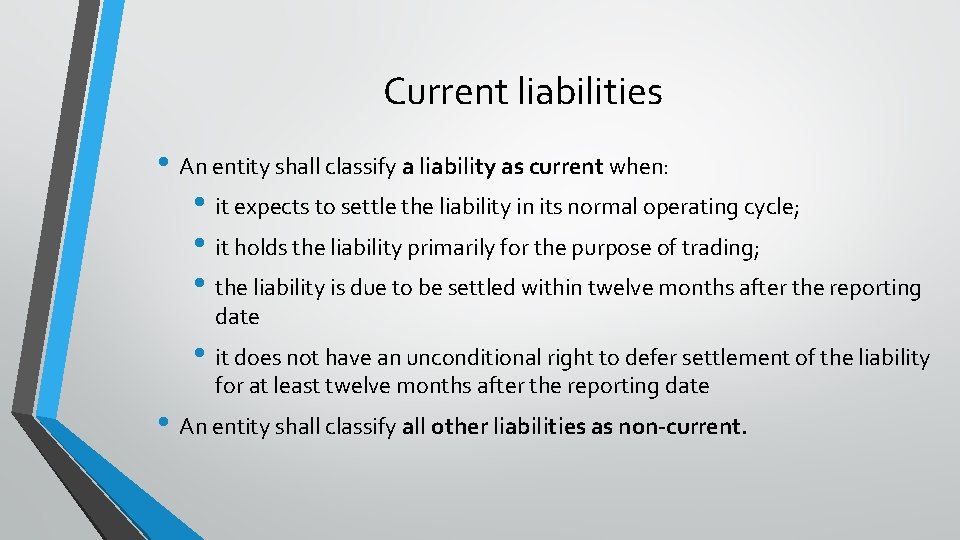
Current liabilities • An entity shall classify a liability as current when: • it expects to settle the liability in its normal operating cycle; • it holds the liability primarily for the purpose of trading; • the liability is due to be settled within twelve months after the reporting date • it does not have an unconditional right to defer settlement of the liability for at least twelve months after the reporting date • An entity shall classify all other liabilities as non-current.
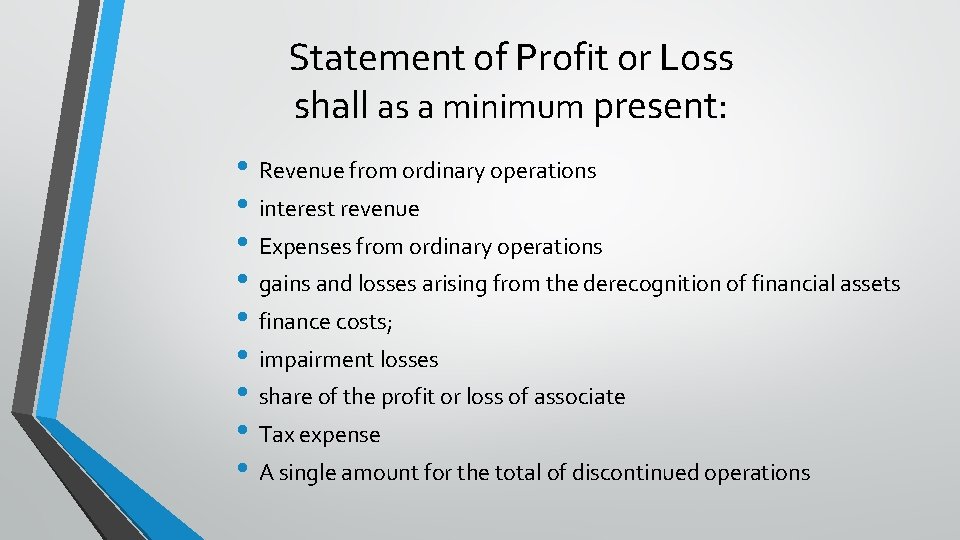
Statement of Profit or Loss shall as a minimum present: • Revenue from ordinary operations • interest revenue • Expenses from ordinary operations • gains and losses arising from the derecognition of financial assets • finance costs; • impairment losses • share of the profit or loss of associate • Tax expense • A single amount for the total of discontinued operations
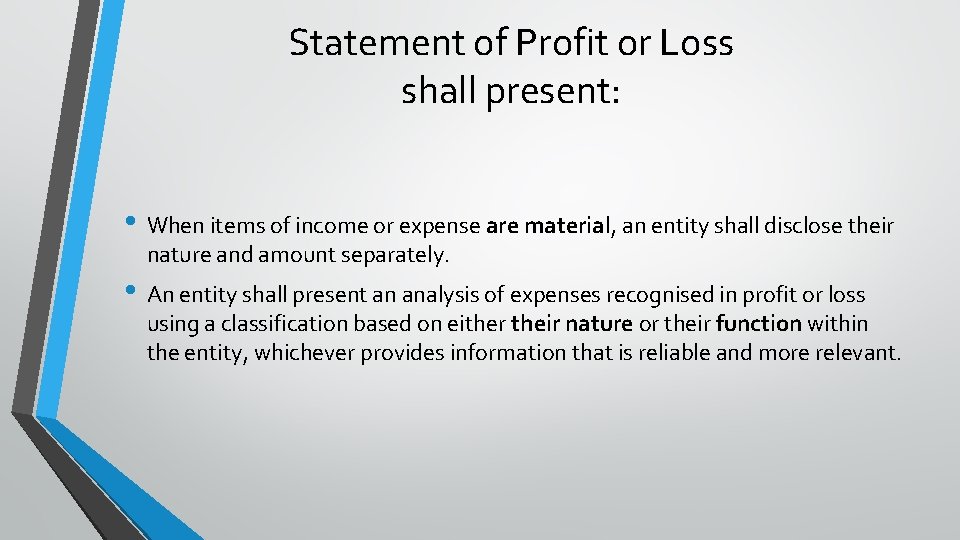
Statement of Profit or Loss shall present: • When items of income or expense are material, an entity shall disclose their nature and amount separately. • An entity shall present an analysis of expenses recognised in profit or loss using a classification based on either their nature or their function within the entity, whichever provides information that is reliable and more relevant.
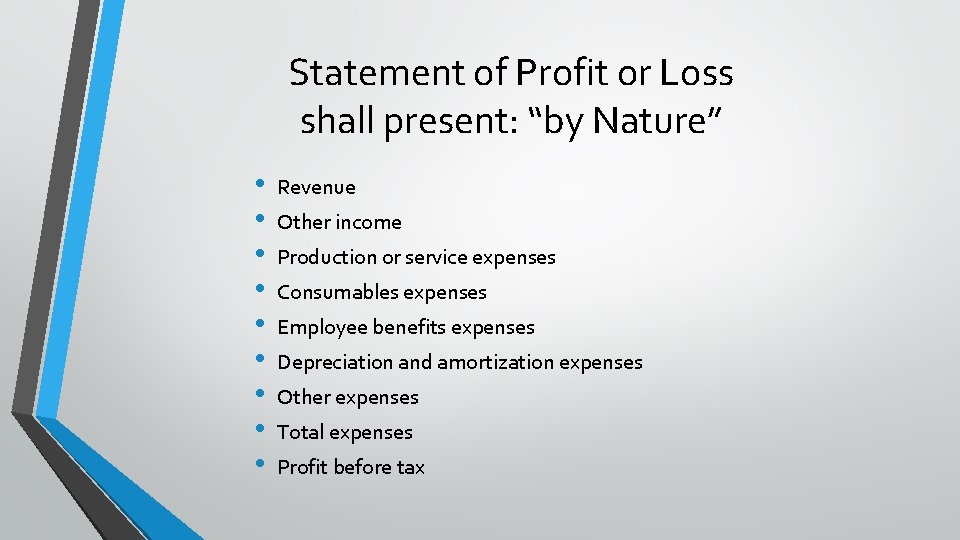
Statement of Profit or Loss shall present: “by Nature” • • • Revenue Other income Production or service expenses Consumables expenses Employee benefits expenses Depreciation and amortization expenses Other expenses Total expenses Profit before tax
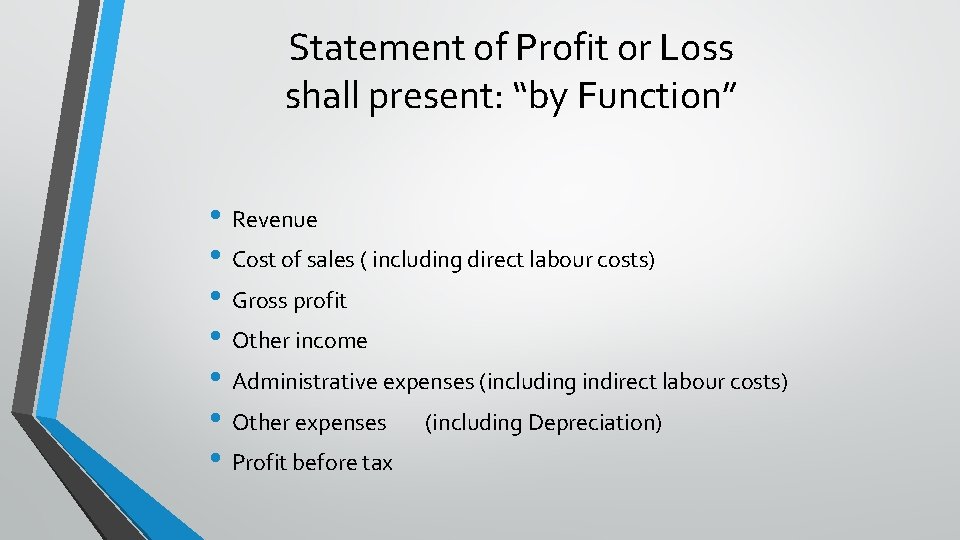
Statement of Profit or Loss shall present: “by Function” • Revenue • Cost of sales ( including direct labour costs) • Gross profit • Other income • Administrative expenses (including indirect labour costs) • Other expenses (including Depreciation) • Profit before tax
Information to be presented in the other comprehensive income • Revenues, expenses, gains and losses appear in other comprehensive income when they have not yet been realized. • For example: • Unrealized holding gains or holding losses on investments that are classified as available for sale • Revaluation of property • Foreign currency translation gains or losses
Statement of changes in equity • for each component of equity, a reconciliation between the carrying amount at the beginning and the end of the period, including retained earnings arising from : • profit or loss; • Other comprehensive income • The creation of reserves and subsequent movements • Transactions with owners such as share capital if relevant
Statement of cash flows ( AASB 107) • • Operating cash flows • • • Receipts from operations ( you may split between type of receipt) Payments to employees Payments to suppliers Investing cash flows • • Interest received( may be operating) Dividends & distributions Payments for investments (including Plant & Equipment) Proceeds from sale Financing cash flows • • • Interest paid Funds received from loans Funds paid on loans Net increase or decrease in cash
Difficult Accounting standards to consider • AASB 101 Presentation of Financial statements • No requirement to disclose the impact of new Accounting standards • But Full General Purpose and Special Purpose reports require disclosure • AASB 119 Employee Benefits • Calculating the Net present value of Long service leave entitlement • AASB 13 Fair Value Measurement • Assessing the fair value of assets in a changing environment • AASB 16 Property Plant & Equipment • The standard allows cost or revaluation • But requires depreciation on revalued assets • And assessment of impairment
Difficult Accounting standards to consider • AASB 124 • • Related party disclosures RDR allows aggregation of Key management personnel. GPFR and Special Purpose do not • AASB 138 Intangible assets • • • Recognising Goodwill on merger or acquisition Excluding internally generated Goodwill When to capitalize development costs • AASB 1004 Contributions ( relevant for 2019 FY) • when do you control funds received & when you can recognize revenue
Difficult Accounting standards to consider • AASB 1054 Australian Additional Disclosures • Require disclosure of audit fees, franking credits, reconciliation of Net operating cash flow to net profit • Not required for General Purpose RDR • AASB 1053 Application of Tiers of Australian Accounting Standards • • Who can use General purpose Reduced Disclosure Requirements Cannot be Tier 1 – for profit private sector & Government entities who have Public accountability • AASB 108 Accounting Policies, Changes in Accounting Estimates and Errors • • Change to policy may lead to a restatement of the prior two years balance sheets A not explaining the impact of the policy change
Difficult Accounting standards to consider • AASB 137 Provisions, Contingent Liabilities and Contingent Assets • • • When can you take up a provision – must be an obligating event When do you have to disclose contingent assets & liabilities Such as possible costs arising from legal actions & how much detail • AASB 102 Inventories • How do you value inventory • AASB 10 Consolidated Financial Statements • • Special Purpose do not have to apply General Purpose and RDR do have to apply when “control” of other entities is established
Cash basis • Not often applied • Typically includes • a statement of receipts and payments for the financial year; and • a reconciled statement of bank account balances as at the end of the financial year; and • a statement of assets and liabilities as at the end of the financial year; • NB difficult to determine liabilities unless accrual basis is applied • May be a statement of unpaid creditors and leave balances.
Use of templates • Beware using templates • Only in include policies and notes that relate to items in the four financial statements • For example • There should not be a policy on leases if there no leases in place.
New conceptual Framework & AASB changes • There is a movement to abolish Special Purpose reports • Except for trusts, partnerships , sole traders, and Self managed Superannuation Funds. • A new conceptual framework has been released to underpin these changes • Australia is the only country to have special purpose reports
ACNC Act Review – changes to Thresholds • • • Registered entities be required to report based on size, determined on rolling three-year revenue, with thresholds of • less than $1 million for a small entity, • AIS only required • from $1 million to less than $5 million for a medium entity • must have a review • $5 million or more for a large entity. • Must have an audit • • NO CHANGE TO SPECIAL PURPOSE REPORTING UNTIL AASB MAKES THE CHANGE FINANCIAL REPORTS submitted to ACNC MUST STILL BE TRUE AND FAIR

Questions
- Slides: 45