
How To Prepare A Team For Mock Trial




- Slides: 32
How To Prepare A Team For Mock Trial Presenters: Jean Wentz and Lourdes Morales www. crf-usa. org
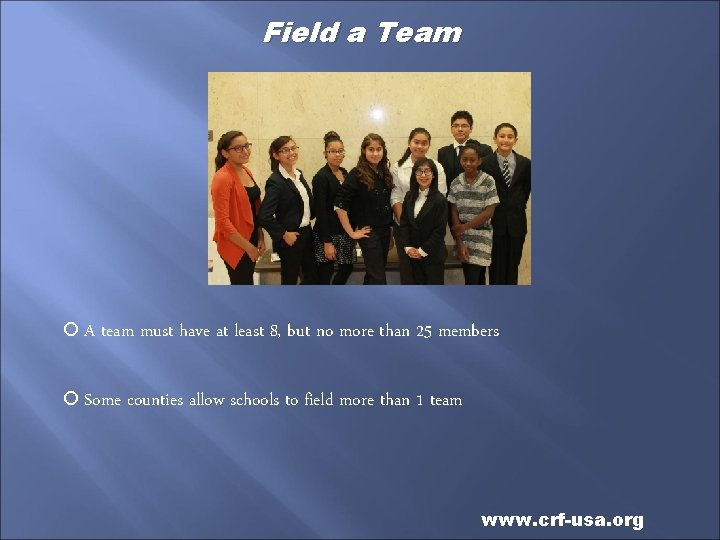
Field a Team A team must have at least 8, but no more than 25 members Some counties allow schools to field more than 1 team www. crf-usa. org
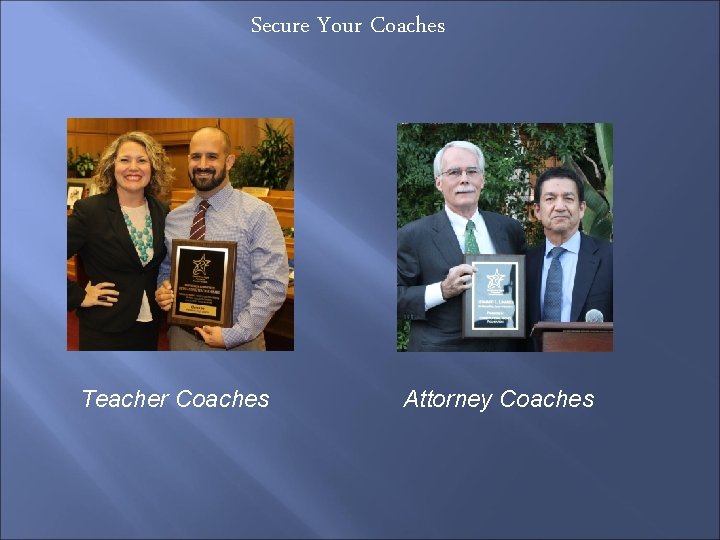
Secure Your Coaches Teacher Coaches Attorney Coaches
Read the Entire Case Packet Fact situation Charges against the Defendant Exhibits Stipulations Witness Statements The Simplified Rules of Evidence Pretrial materials Team Rulebook (separate document)
Explain Basic Legal Concepts Criminal versus Civil Trial Bench versus Jury Trial Prosecution versus Defense Lay Witness versus Expert Witness Presumption of Innocence Burden of Proof Reasonable Doubt Direct versus Circumstantial Evidence
Analyze the Case Break down Elements of each Charge Outline the evidence for and against the charge—Look for: ü Forensic evidence ü Eyewitness testimony ü Statements by the defendant ü Motive or lack of motive ü Opportunity, or lack of opportunity, to commit the crime ü Corroboration or Inconsistencies between witnesses Decide what witness will testify to this evidence Remember: The pretrial ruling may impact what evidence is available
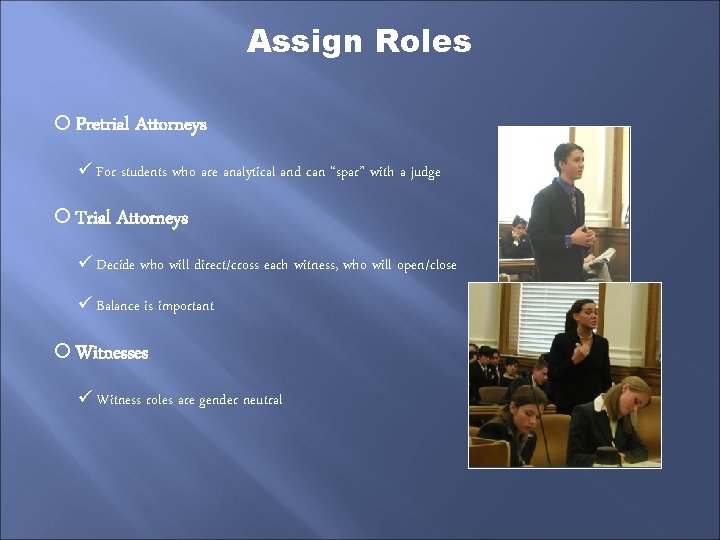
Assign Roles Pretrial Attorneys ü For students who are analytical and can “spar” with a judge Trial Attorneys ü Decide who will direct/cross each witness, who will open/close ü Balance is important Witnesses ü Witness roles are gender neutral
Assign Roles Court Clerk ü Long attention span and math skills important Bailiff ü Commanding presence Unofficial Timekeeper Suggestion: with roles (Optional) Allow other students to “shadow” those
Write Direct Examinations— Purpose and Scope Purpose is to establish facts to prove or disprove the case, explore weaknesses in your opponent’s case Scope of Directs: ü Limited to information in the witness’s statement or the fact situation/stipulations if witness would reasonably know that information • Exception: expert witnesses
Write Direct Examinations— Time Constraints § § § 14 minutes total (including re-directs) Cut “extraneous” and “objectionable” information Refer back to outline of the case to focus testimony Important: Allow sufficient time for üRe-directs üApproaching exhibits Just a Guideline: • Directs should be between 2 minutes and 4 minutes • 12 minutes for 4 directs; 1 minute for any re-directs; 1 minute buffer
Write Direct Examinations— Scoring Tips DON’T RUN OUT OF TIME! Create likeable, credible, interesting witnesses who speak slowly üOver-the-top versus “realistic” witnesses üBut remember: No accents or costumes! Avoid Objectionable Testimony: üNo leading questions üWitness should be responsive to the question asked üNo long narratives üProvide foundation for testimony üAvoid improper hearsay, opinion and character testimony
Write Cross Examinations— Purpose and Scope Purpose is to explore weaknesses in opponent’s case, test witness’s credibility and establish facts supporting the cross-examiner’s case Scope of Crosses: üCrosses must call for answers based on information in the witness’s own statement üMock trial crosses are not limited to issues raised during direct
Write Cross Examinations— Time Constraints 10 minutes total, or an average of 2 ½ minutes each üTypically, ask between 10 and 25 questions üTypically, the cross of the defendant is the longest Allow extra time for non-responsive witnesses, and for expert witnesses who have leeway to explain answers
Write Cross Examinations— Scoring Tips Use leading questions designed to get a yes or no answer Make 3 or 4 points and sit down!
Write Re-direct Examinations The purpose of redirects is to clarify or explain bad or confusing cross testimony Suggestion: Write 3 or 4 re-direct questions for possible use during the trial Remember: Redirects are limited in scope to what is raised on cross examination
Write Opening Statements: Typically 3 The to 4 minutes long opening is a short, concise statement of the case, not an argument! Use terms like— üThe evidence will show üYou will hear üYou will learn üYou will find ü____ witness will testify
Write Opening Statements— Structure Prosecution Opening Structure: üExplain what you intend to prove and how you will prove it üPresent events in an orderly sequence üSuggest motive, describe opportunity üTell your story! Defense Opening Structure: üRemember—You do not have the burden of proof! üThe purpose is to explain the weaknesses in the prosecution’s case, and why there will be reasonable doubt
Write Opening Statements— Scoring Tips Mention the name of each witness you will be calling and provide some insight (even if very brief) into what that witness will be testifying about Use a Theme. Examples: üProsecution: • This case is about a defendant who couldn’t control his anger • The defendant’s greed got the better of him • This case is about a defendant who is pretending to be insane to avoid taking responsibility for his own actions üDefense: • The case is based on witnesses who could not see, and an investigator who did not look • This case is about mistaken identity • This case is about a student who acted out of self-defense
Write Closing Arguments Typically, Unlike closings are 5 1/2 to 6 minutes long (depending on the Opening) the opening, the closing is an argument!
Prosecution Closing: üThe Prosecution has the burden of proof üWalk through the charges and explain proof • Be specific! • Explain motive and opportunity Defense Closing: üNo burden of proof! üWalk through the charges and explain reasonable doubt Be specific! If applicable, discuss other reasonable suspects
Writing Closing Arguments— Scoring Tip Be flexible! Adjust argument based on the evidence
Write Closing Rebuttals 1 minute for each The purpose is to respond to your opponent’s closing arguments Scoring Tips: üDon’t go in cold! üPractice beforehand üDon’t run out of time!
Pretrial— Getting Prepared High School Only Review fundamental concepts: üWhat is stare decisis? üWhat rulings trump others? üWhat is a holding? What is dicta? üHow is the Constitution applicable to this case? üWhat is the role of the Judge and pretrialer in the pretrial argument?
Pretrial— Getting Prepared Read the cases üImportant: Don’t go beyond the abbreviated cases üThe holdings and facts may have been changed deliberately
Pretrial— Getting Prepared Analyze the cases üFor each case, identify the holding and facts in support üDetermine which side the holding helps and hurts �If good for your side, you may want to use that case to support your argument �If bad for your side, you will need to distinguish the case based on its facts
Pretrial— Getting Prepared Write your Pretrial Argument üKeep in mind time constraints � 4 minutes for Opening � 2 minutes for Rebuttal Create Opening Argument citing 3 Start to 4 cases that support it with an introduction, state your argument, then cite case law, then conclude
Pretrial— Getting Prepared Rebuttal: üDon’t go in cold! Anticipate the main arguments on the other side üListen to what the other side says and only counter what the other side said üPractice ending rebuttal before time is called
Pretrial— Scoring Tips The key to pretrial is practice! Avoid repeating your arguments
Practices— What to Do at Team Practices 1. Understand courtroom and the order of trial 2. 3. 4. 5. 6. 7. 8. Analyze the case, develop theories and themes Write and practice directs Practice cross examinations on witnesses Review the Rules of the Competition Practice introductions Research expert opinions Monitor and review any errata issued in the case
Practices— What to Do at Trial Attorney Practices 1. 2. 3. 4. 5. 6. 7. 8. 9. Review the Rules of Evidence. Review the Witness Statements and your Direct and Cross Examinations and then: Determine what is objectionable Practice how to respond to any objections to your exams, and how to make objections to the other side’s exams. Review the Rules of the Competition Learn when to make rule violation objections Practice how to respond to rule violation objections Develop Cross examinations Learn how to Impeach Witnesses Learn how to control Witnesses Learn how to enter Exhibits Create Opening and Closing statements Draft Preliminary Matters
Practices— What to Do at Witness Practices Develop Prepare “character” for direct examination for Cross üKnow your statement! üKnow what you cannot say (what is objectionable) üRemember: Running the other team’s time is not allowed
Scrimmages Optional but can be Helpful Benefits of Scrimmaging— üIncrease understanding of mock trial competition üLearn strengths and weaknesses of your case üFun opportunity to meet other teams! Check out CRF website for list of teams