
How to Panel What is panel and how
![1. “Hello, my name is [insert name], that’s [insert code] for the judge. ”](https://slidetodoc.com/presentation_image_h2/9d2772355363e00e3ca748c2df58723e/image-6.jpg "1. “Hello, my name is [insert name], that’s [insert code] for the judge. ”")
![3. State your final opinions (ex. “I liked [insert name]’s solution, it’s productive because](https://slidetodoc.com/presentation_image_h2/9d2772355363e00e3ca748c2df58723e/image-18.jpg "3. State your final opinions (ex. “I liked [insert name]’s solution, it’s productive because")
- Slides: 21
How to Panel
What is panel and how to prepare? A group of kids that talk for 40 minutes. That’s all it really is. In order to do well in panel, you must do research on the topic provided. This research does not need to be extensive, but just enough to understand the topic (it may be beneficial to memorize a statistic or two, but it is not required).
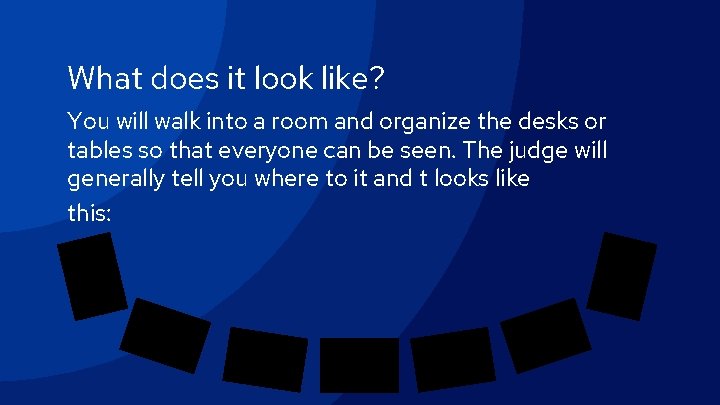
What does it look like? You will walk into a room and organize the desks or tables so that everyone can be seen. The judge will generally tell you where to it and t looks like this:
What to bring? You should bring three things to a panel round: two pieces of paper and a pencil. One piece of paper should be folded to create a name tag with your name and code written clearly on it. The other piece of paper is for your personal notes (it is wise to write your fellow panelists names on). You should also bring some sort of timer (your phone does work as long as you only use it as a timer).
Opening Statements A panel round is 40 minutes long. Give or take a few minutes, the first 5 minutes are used for openings statements. When it’s your turn, you will state the following five things:
1. “Hello, my name is [insert name], that’s [insert code] for the judge. ”
2. You state your feelings for the round (ex. “I’m really excited for this round because of abc”)
3. What you like to see in a round (ex. “I would like a calm, productive discussion” or “I would like to see some clash or else the topic gets worn out”).
4. Your feelings on the topic (ex. “I don’t know much and I’m excited to learn more” or whatever opinionated stance you have). This part can be omitted if you absolutely don’t have any opinions.
5. When you are finished speaking, you say “and with that I’ll pass the floor. ” or if you are the last speaker you say “and with that I open the floor. ”
Once the floor is open: When the floor is open, anyone can talk whenever they want. This can lead to two things. (1) Everyone yells over each other and it’s all clash. (2) No one talks at all. Very rarely will there be a middle ground.
First Circumstance The best thing to do is cut off all of the aggressors. Tell them that this is counterproductive and propose a solution to whatever the topic may be. If they continue to yell, try saying something like “[insert someone’s name] hasn’t been able to talk, what do you think, [insert name]. ” If those still don’t work after a few tries (at most two each), join in on the chaos. Although, don’t join in all the counterproductive yelling, propose solutions in an aggressive manner.
Second Circumstance This is much easier, as you have all the opportunity to speak. Here you want to propose a solution or insight, generally that will provoke others to speak. If it doesn’t, invite others to speak (this will show the judge you are a leader and deserving of winning the round).
The Perfect Third Circumstance This is the ideal panel round. All you need to do is provide helpful comments, possibly solutions, and join in on the conversation as you would a socratic seminar.
Ending the Round As you are nearing the end of the 40 minutes, around 5 minutes before it is up, you need to call for closing statements. You always start closing statements on the opposite side that you started opening statements. To close, do the following five things
1. If no one has called for them yet, you state something like “I hate to cut this discussion short but with [insert number] minutes left on the clock, I think we should start closing” or “We’re running out of time, we should do closing statements. ”
2. When it comes to your turn, you start by stating your name and code (“Once again my name is [insert name], that’s [insert code] for the judge”)
3. State your final opinions (ex. “I liked [insert name]’s solution, it’s productive because abc” or “I think that [topic solution] should be done because abc”)
4. State your feelings about the round (ex. “This was a really productive round, I liked abc” or “I thought that it could have gone better because of abc”)
5. At the end say, “Thank you for the round and with that I pass the floor. ” If you are last you say, “Thank you and with that I close the floor. ”
And that’s panel! (here is the link to the written version of these directions https: //docs. google. com/document/d/1 Ruc. F 9 Y_fex 6 MBs 2 Gq. Toep. ZHp. O 66 s. RXYc. HGRjoc 4 u. Lds/edit? usp=sharing )