
How to Multiply integers matrices and polynomials Slides

![Fast Matrix Multiplication To multiply two n-by-n matrices A and B: [Strassen 1969] Divide:](https://slidetodoc.com/presentation_image_h2/12a03941b51fa61c5c9f62c42d2ca8e4/image-19.jpg "Fast Matrix Multiplication To multiply two n-by-n matrices A and B: [Strassen 1969] Divide:")
![Fast Matrix Multiplication: Theory Best known. O(n 2. 376) [Coppersmith-Winograd, 1987] Conjecture. O(n 2+](https://slidetodoc.com/presentation_image_h2/12a03941b51fa61c5c9f62c42d2ca8e4/image-22.jpg "Fast Matrix Multiplication: Theory Best known. O(n 2. 376) [Coppersmith-Winograd, 1987] Conjecture. O(n 2+")
![Fourier Analysis Fourier theorem. [Fourier, Dirichlet, Riemann] Any periodic function can be expressed as](https://slidetodoc.com/presentation_image_h2/12a03941b51fa61c5c9f62c42d2ca8e4/image-24.jpg "Fourier Analysis Fourier theorem. [Fourier, Dirichlet, Riemann] Any periodic function can be expressed as")
![Time Domain vs. Frequency Domain Signal. [touch tone button 1] Time domain. sound pressure](https://slidetodoc.com/presentation_image_h2/12a03941b51fa61c5c9f62c42d2ca8e4/image-26.jpg "Time Domain vs. Frequency Domain Signal. [touch tone button 1] Time domain. sound pressure")
![Time Domain vs. Frequency Domain Signal. [recording, 8192 samples per second] Magnitude of discrete](https://slidetodoc.com/presentation_image_h2/12a03941b51fa61c5c9f62c42d2ca8e4/image-27.jpg "Time Domain vs. Frequency Domain Signal. [recording, 8192 samples per second] Magnitude of discrete")
![Polynomials: Coefficient Representation Polynomial. [coefficient representation] Add. O(n) arithmetic operations. Evaluate. O(n) using Horner's](https://slidetodoc.com/presentation_image_h2/12a03941b51fa61c5c9f62c42d2ca8e4/image-31.jpg "Polynomials: Coefficient Representation Polynomial. [coefficient representation] Add. O(n) arithmetic operations. Evaluate. O(n) using Horner's")
![Polynomials: Point-Value Representation Fundamental theorem of algebra. [Gauss, Ph. D thesis] A degree n](https://slidetodoc.com/presentation_image_h2/12a03941b51fa61c5c9f62c42d2ca8e4/image-33.jpg "Polynomials: Point-Value Representation Fundamental theorem of algebra. [Gauss, Ph. D thesis] A degree n")
![Polynomials: Point-Value Representation Polynomial. [point-value representation] Add. O(n) arithmetic operations. Multiply (convolve). O(n), but](https://slidetodoc.com/presentation_image_h2/12a03941b51fa61c5c9f62c42d2ca8e4/image-34.jpg "Polynomials: Point-Value Representation Polynomial. [point-value representation] Add. O(n) arithmetic operations. Multiply (convolve). O(n), but")
![FFT in Practice Fastest Fourier transform in the West. [Frigo and Johnson] Optimized C](https://slidetodoc.com/presentation_image_h2/12a03941b51fa61c5c9f62c42d2ca8e4/image-54.jpg "FFT in Practice Fastest Fourier transform in the West. [Frigo and Johnson] Optimized C")

- Slides: 63
How to Multiply integers, matrices, and polynomials Slides by Kevin Wayne. Copyright © 2005 Pearson-Addison Wesley. All rights reserved. 1
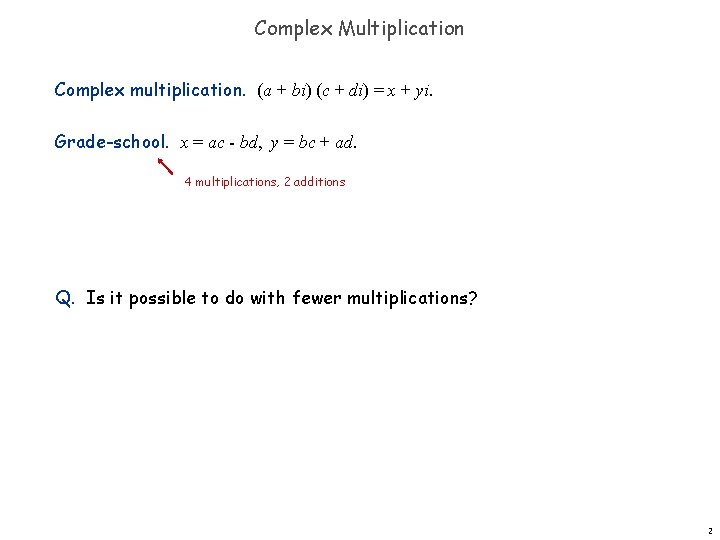
Complex Multiplication Complex multiplication. (a + bi) (c + di) = x + yi. Grade-school. x = ac - bd, y = bc + ad. 4 multiplications, 2 additions Q. Is it possible to do with fewer multiplications? 2
Complex Multiplication Complex multiplication. (a + bi) (c + di) = x + yi. Grade-school. x = ac - bd, y = bc + ad. 4 multiplications, 2 additions Q. Is it possible to do with fewer multiplications? A. Yes. [Gauss] x = ac - bd, y = (a + b) (c + d) - ac - bd. 3 multiplications, 5 additions Remark. Improvement if no hardware multiply. 3
5. 5 Integer Multiplication
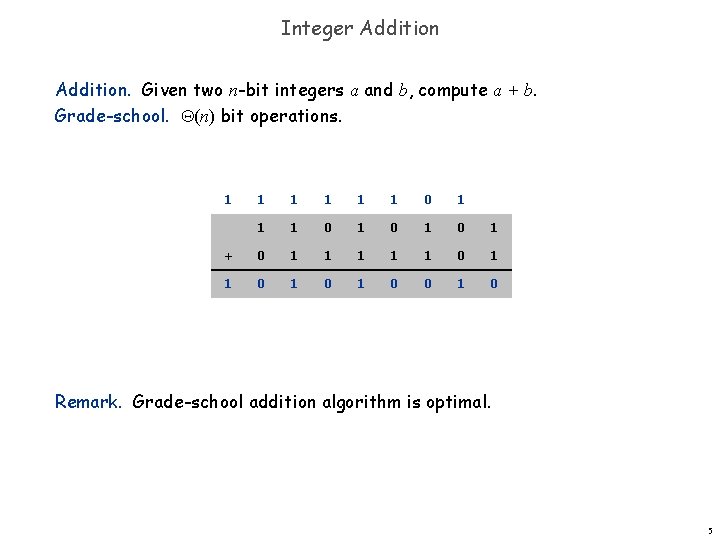
Integer Addition. Given two n-bit integers a and b, compute a + b. Grade-school. (n) bit operations. 1 1 1 0 1 0 1 + 0 1 1 1 0 1 0 1 0 Remark. Grade-school addition algorithm is optimal. 5
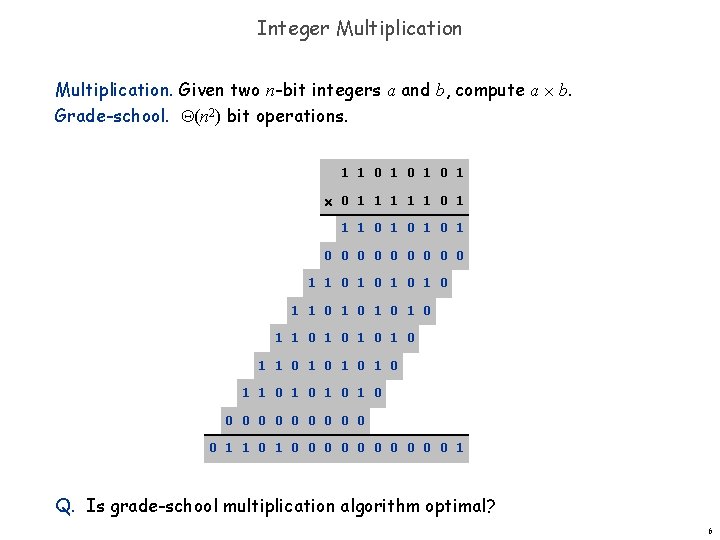
Integer Multiplication. Given two n-bit integers a and b, compute a b. Grade-school. (n 2) bit operations. 1 1 0 1 0 1 1 1 0 1 0 0 0 0 0 1 1 0 1 0 1 0 1 0 1 1 0 1 0 0 0 0 0 0 1 Q. Is grade-school multiplication algorithm optimal? 6
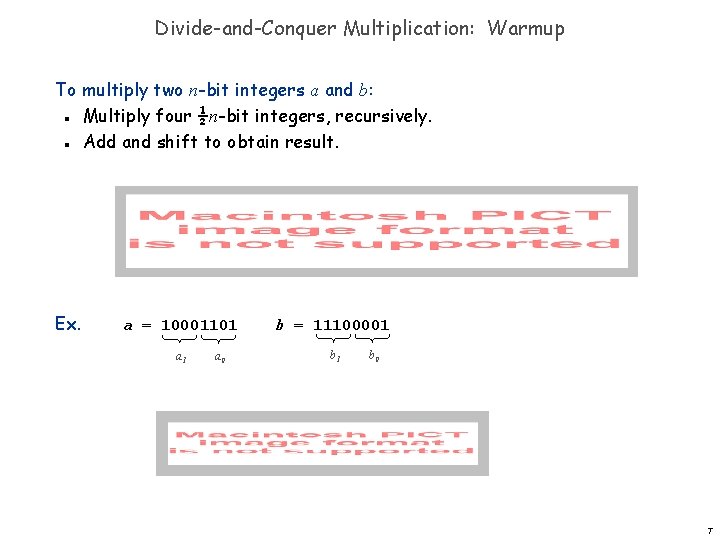
Divide-and-Conquer Multiplication: Warmup To multiply two n-bit integers a and b: Multiply four ½n-bit integers, recursively. Add and shift to obtain result. Ex. a = 10001101 b = 11100001 a 1 b 1 a 0 b 0 7
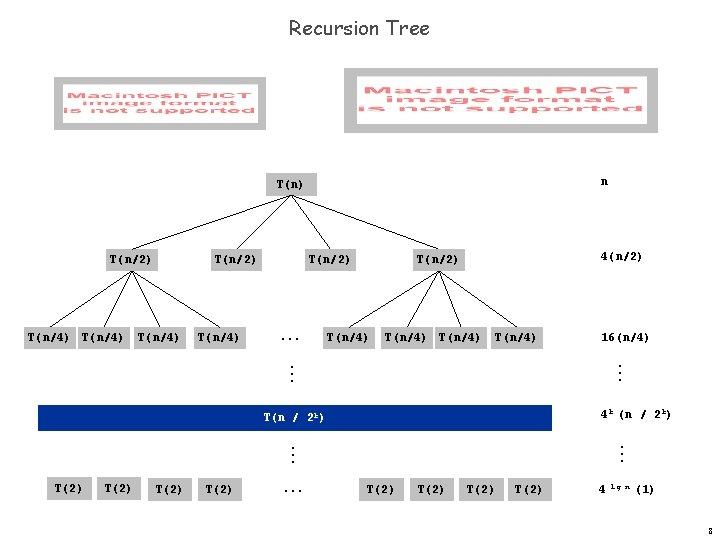
Recursion Tree n T(n) T(n/2) T(n/4) T(n/2) . . . 4(n/2) T(n/4) T(n/4) 16(n/4). . . 4 k (n / 2 k) T(n / 2 k) . . . T(2) 4 lg n (1) 8
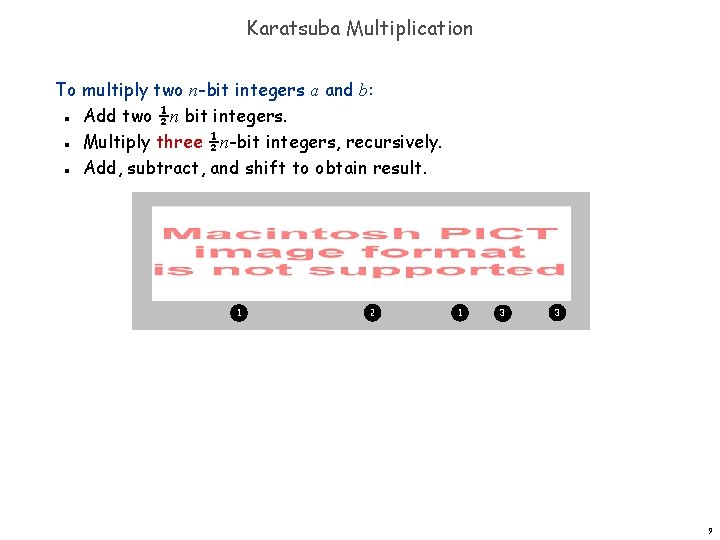
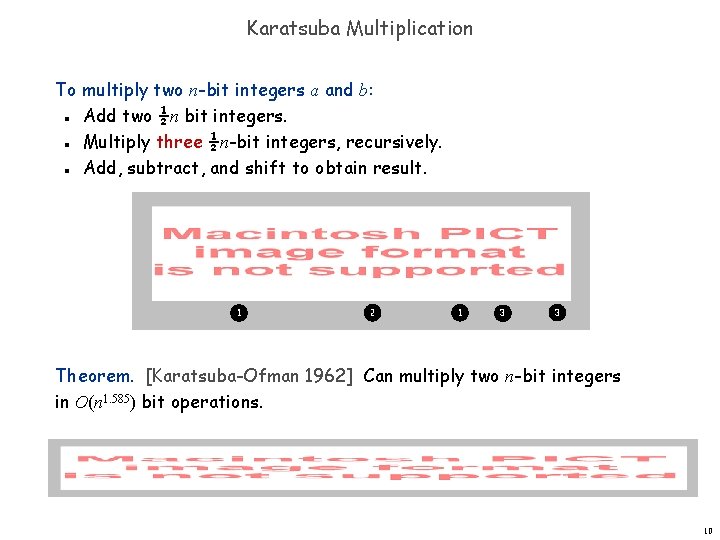
Karatsuba Multiplication To multiply two n-bit integers a and b: Add two ½n bit integers. Multiply three ½n-bit integers, recursively. Add, subtract, and shift to obtain result. 1 2 1 3 3 9
Karatsuba Multiplication To multiply two n-bit integers a and b: Add two ½n bit integers. Multiply three ½n-bit integers, recursively. Add, subtract, and shift to obtain result. 1 2 1 3 3 Theorem. [Karatsuba-Ofman 1962] Can multiply two n-bit integers in O(n 1. 585) bit operations. 10
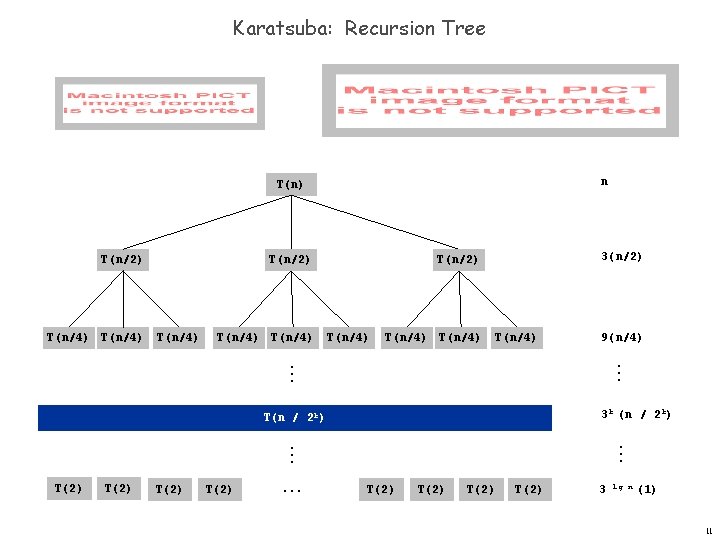
Karatsuba: Recursion Tree n T(n) T(n/2) T(n/4) T(n/4) 3(n/2) T(n/4) T(n/4) 9(n/4). . . 3 k (n / 2 k) T(n / 2 k) . . . T(2) 3 lg n (1) 11
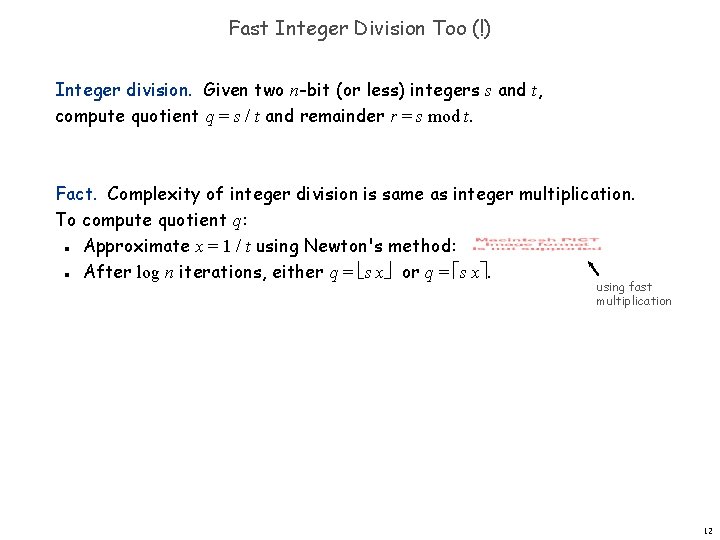
Fast Integer Division Too (!) Integer division. Given two n-bit (or less) integers s and t, compute quotient q = s / t and remainder r = s mod t. Fact. Complexity of integer division is same as integer multiplication. To compute quotient q: Approximate x = 1 / t using Newton's method: After log n iterations, either q = s x or q = s x. using fast multiplication 12
Matrix Multiplication
Dot Product Dot product. Given two length n vectors a and b, compute c = a b. Grade-school. (n) arithmetic operations. Remark. Grade-school dot product algorithm is optimal. 14
Matrix Multiplication Matrix multiplication. Given two n-by-n matrices A and B, compute C = AB. Grade-school. (n 3) arithmetic operations. Q. Is grade-school matrix multiplication algorithm optimal? 15
Block Matrix Multiplication C 11 A 12 B 11 16
Matrix Multiplication: Warmup To multiply two n-by-n matrices A and B: Divide: partition A and B into ½n-by-½n blocks. Conquer: multiply 8 pairs of ½n-by-½n matrices, recursively. Combine: add appropriate products using 4 matrix additions. 17
Fast Matrix Multiplication Key idea. multiply 2 -by-2 blocks with only 7 multiplications. 18 = 8 + 10 additions and subtractions. 18
Fast Matrix Multiplication To multiply two n-by-n matrices A and B: [Strassen 1969] Divide: partition A and B into ½n-by-½n blocks. Compute: 14 ½n-by-½n matrices via 10 matrix additions. Conquer: multiply 7 pairs of ½n-by-½n matrices, recursively. Combine: 7 products into 4 terms using 8 matrix additions. Analysis. Assume n is a power of 2. T(n) = # arithmetic operations. 19
Fast Matrix Multiplication: Practice Implementation issues. Sparsity. Caching effects. Numerical stability. Odd matrix dimensions. Crossover to classical algorithm around n = 128. Common misperception. “Strassen is only a theoretical curiosity. ” Apple reports 8 x speedup on G 4 Velocity Engine when n 2, 500. Range of instances where it's useful is a subject of controversy. Remark. Can "Strassenize" Ax = b, determinant, eigenvalues, SVD, …. 20
Fast Matrix Multiplication: Theory Q. Multiply two 2 -by-2 matrices with 7 scalar multiplications? A. Yes! [Strassen 1969] Q. Multiply two 2 -by-2 matrices with 6 scalar multiplications? A. Impossible. [Hopcroft and Kerr 1971] Q. Two 3 -by-3 matrices with 21 scalar multiplications? A. Also impossible. Begun, the decimal wars have. [Pan, Bini et al, Schönhage, …] Two 20 -by-20 matrices with 4, 460 scalar multiplications. Two 48 -by-48 matrices with 47, 217 scalar multiplications. A year later. December, 1979. January, 1980. 21
Fast Matrix Multiplication: Theory Best known. O(n 2. 376) [Coppersmith-Winograd, 1987] Conjecture. O(n 2+ ) for any > 0. Caveat. Theoretical improvements to Strassen are progressively less practical. 22
5. 6 Convolution and FFT
Fourier Analysis Fourier theorem. [Fourier, Dirichlet, Riemann] Any periodic function can be expressed as the sum of a series of sinusoids. sufficiently smooth t N = 100 15 10 24
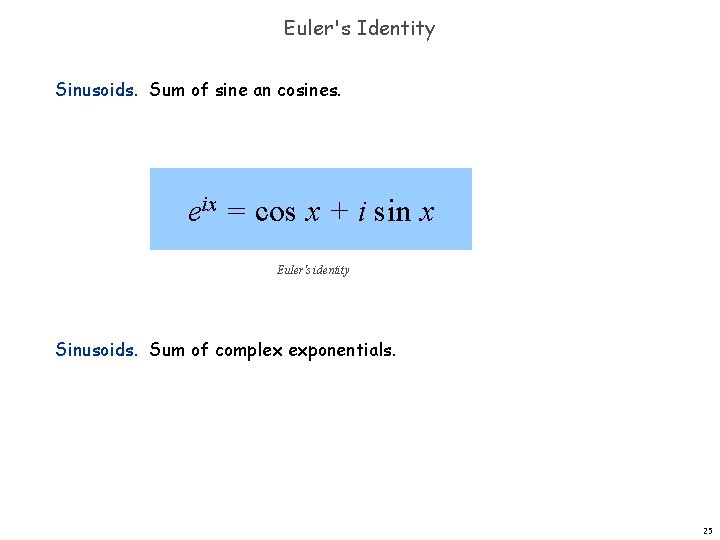
Euler's Identity Sinusoids. Sum of sine an cosines. eix = cos x + i sin x Euler's identity Sinusoids. Sum of complex exponentials. 25
Time Domain vs. Frequency Domain Signal. [touch tone button 1] Time domain. sound pressure time (seconds) Frequency domain. 0. 5 amplitude frequency (Hz) Reference: Cleve Moler, Numerical Computing with MATLAB 26
Time Domain vs. Frequency Domain Signal. [recording, 8192 samples per second] Magnitude of discrete Fourier transform. Reference: Cleve Moler, Numerical Computing with MATLAB 27
Fast Fourier Transform FFT. Fast way to convert between time-domain and frequency-domain. Alternate viewpoint. Fast way to multiply and evaluate polynomials. we take this approach If you speed up any nontrivial algorithm by a factor of a million or so the world will beat a path towards finding useful applications for it. -Numerical Recipes 28
Fast Fourier Transform: Applications. Optics, acoustics, quantum physics, telecommunications, radar, control systems, signal processing, speech recognition, data compression, image processing, seismology, mass spectrometry… Digital media. [DVD, JPEG, MP 3, H. 264] Medical diagnostics. [MRI, CT, PET scans, ultrasound] Numerical solutions to Poisson's equation. Shor's quantum factoring algorithm. … The FFT is one of the truly great computational developments of [the 20 th] century. It has changed the face of science and engineering so much that it is not an exaggeration to say that life as we know it would be very different without the FFT. -Charles van Loan 29
Fast Fourier Transform: Brief History Gauss (1805, 1866). Analyzed periodic motion of asteroid Ceres. Runge-König (1924). Laid theoretical groundwork. Danielson-Lanczos (1942). Efficient algorithm, x-ray crystallography. Cooley-Tukey (1965). Monitoring nuclear tests in Soviet Union and tracking submarines. Rediscovered and popularized FFT. Importance not fully realized until advent of digital computers. 30
Polynomials: Coefficient Representation Polynomial. [coefficient representation] Add. O(n) arithmetic operations. Evaluate. O(n) using Horner's method. Multiply (convolve). O(n 2) using brute force. 31
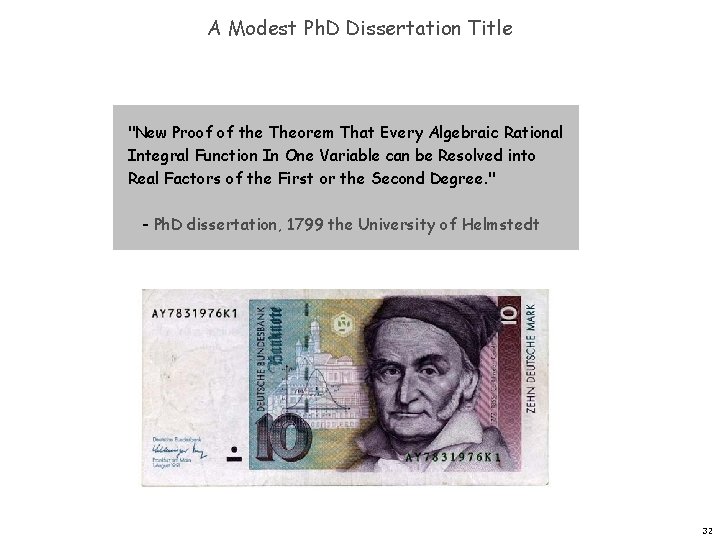
A Modest Ph. D Dissertation Title "New Proof of the Theorem That Every Algebraic Rational Integral Function In One Variable can be Resolved into Real Factors of the First or the Second Degree. " - Ph. D dissertation, 1799 the University of Helmstedt 32
Polynomials: Point-Value Representation Fundamental theorem of algebra. [Gauss, Ph. D thesis] A degree n polynomial with complex coefficients has exactly n complex roots. Corollary. A degree n-1 polynomial A(x) is uniquely specified by its evaluation at n distinct values of x. y yj = A(xj ) xj x 33
Polynomials: Point-Value Representation Polynomial. [point-value representation] Add. O(n) arithmetic operations. Multiply (convolve). O(n), but need 2 n-1 points. Evaluate. O(n 2) using Lagrange's formula. 34
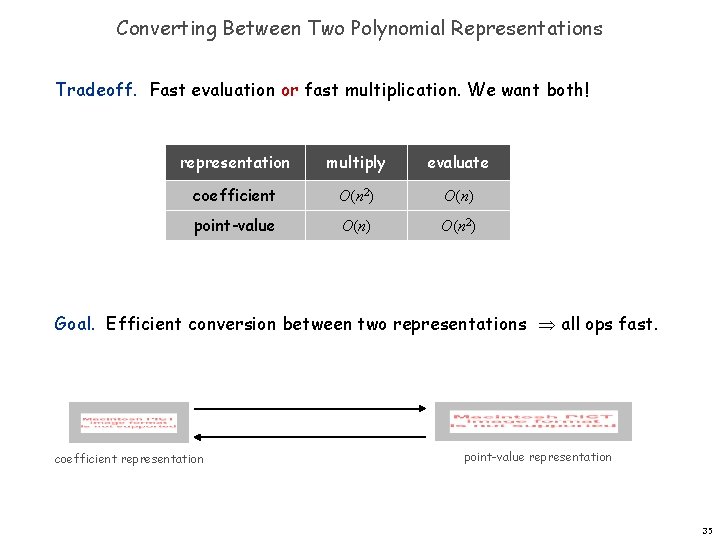
Converting Between Two Polynomial Representations Tradeoff. Fast evaluation or fast multiplication. We want both! representation multiply evaluate coefficient O(n 2) O(n) point-value O(n) O(n 2) Goal. Efficient conversion between two representations all ops fast. coefficient representation point-value representation 35
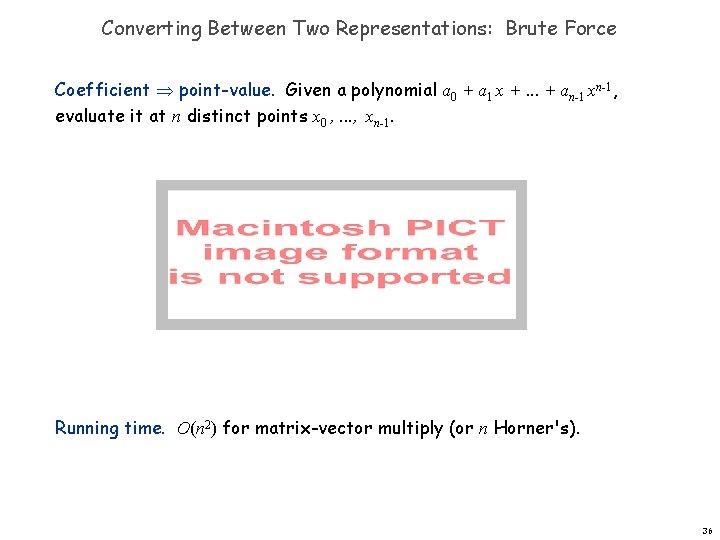
Converting Between Two Representations: Brute Force Coefficient point-value. Given a polynomial a 0 + a 1 x +. . . + an-1 xn-1, evaluate it at n distinct points x 0 , . . . , xn-1. Running time. O(n 2) for matrix-vector multiply (or n Horner's). 36
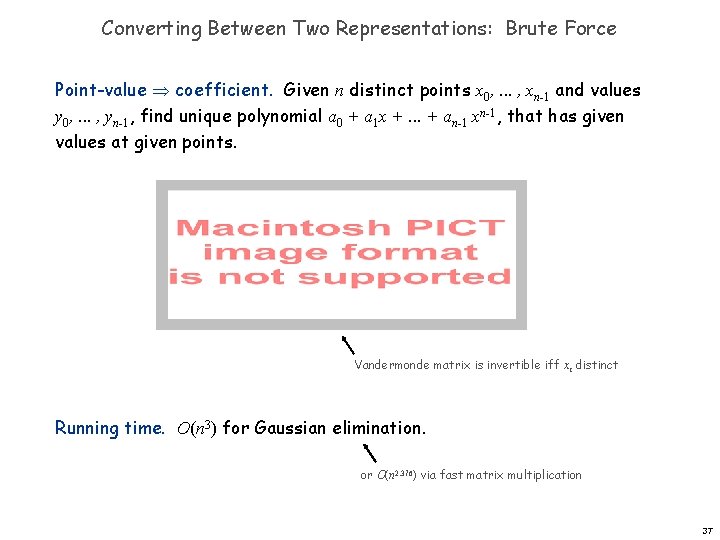
Converting Between Two Representations: Brute Force Point-value coefficient. Given n distinct points x 0, . . . , xn-1 and values y 0, . . . , yn-1, find unique polynomial a 0 + a 1 x +. . . + an-1 xn-1, that has given values at given points. Vandermonde matrix is invertible iff xi distinct Running time. O(n 3) for Gaussian elimination. or O(n 2. 376) via fast matrix multiplication 37
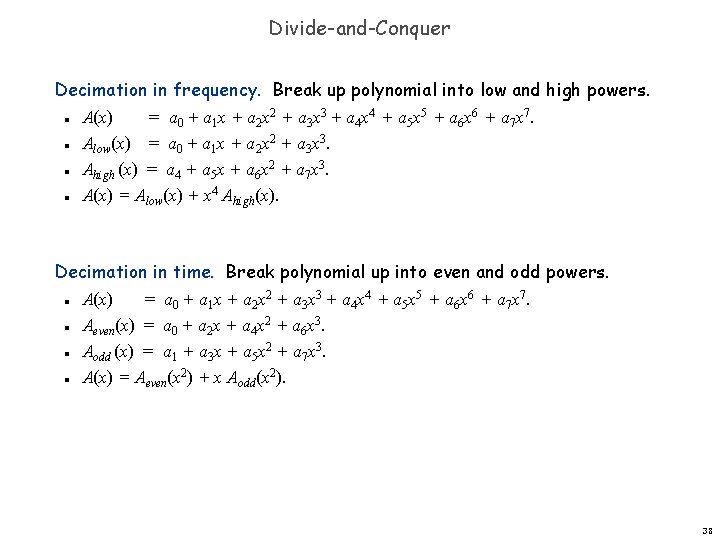
Divide-and-Conquer Decimation in frequency. Break up polynomial into low and high powers. A(x) = a 0 + a 1 x + a 2 x 2 + a 3 x 3 + a 4 x 4 + a 5 x 5 + a 6 x 6 + a 7 x 7. Alow(x) = a 0 + a 1 x + a 2 x 2 + a 3 x 3. Ahigh (x) = a 4 + a 5 x + a 6 x 2 + a 7 x 3. A(x) = Alow(x) + x 4 Ahigh(x). Decimation in time. Break polynomial up into even and odd powers. A(x) = a 0 + a 1 x + a 2 x 2 + a 3 x 3 + a 4 x 4 + a 5 x 5 + a 6 x 6 + a 7 x 7. Aeven(x) = a 0 + a 2 x + a 4 x 2 + a 6 x 3. Aodd (x) = a 1 + a 3 x + a 5 x 2 + a 7 x 3. A(x) = Aeven(x 2) + x Aodd(x 2). 38
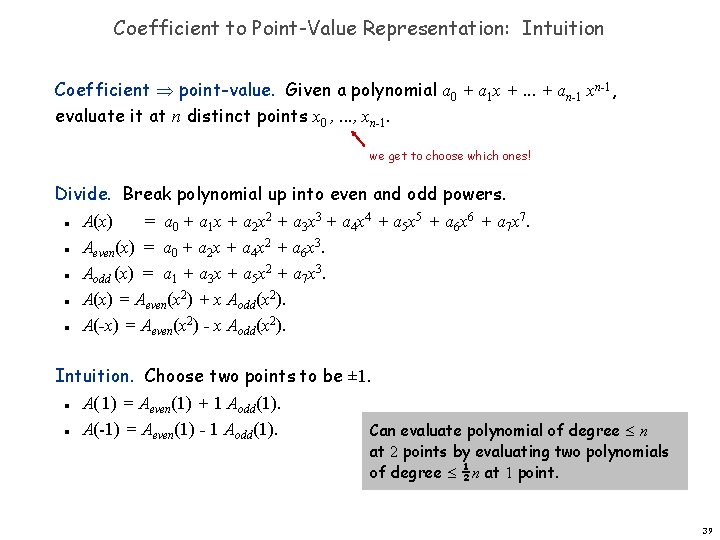
Coefficient to Point-Value Representation: Intuition Coefficient point-value. Given a polynomial a 0 + a 1 x +. . . + an-1 xn-1, evaluate it at n distinct points x 0 , . . . , xn-1. we get to choose which ones! Divide. Break polynomial up into even and odd powers. A(x) = a 0 + a 1 x + a 2 x 2 + a 3 x 3 + a 4 x 4 + a 5 x 5 + a 6 x 6 + a 7 x 7. Aeven(x) = a 0 + a 2 x + a 4 x 2 + a 6 x 3. Aodd (x) = a 1 + a 3 x + a 5 x 2 + a 7 x 3. A(x) = Aeven(x 2) + x Aodd(x 2). A(-x) = Aeven(x 2) - x Aodd(x 2). Intuition. Choose two points to be ± 1. A( 1) = Aeven(1) + 1 Aodd(1). A(-1) = Aeven(1) - 1 Aodd(1). Can evaluate polynomial of degree n at 2 points by evaluating two polynomials of degree ½n at 1 point. 39
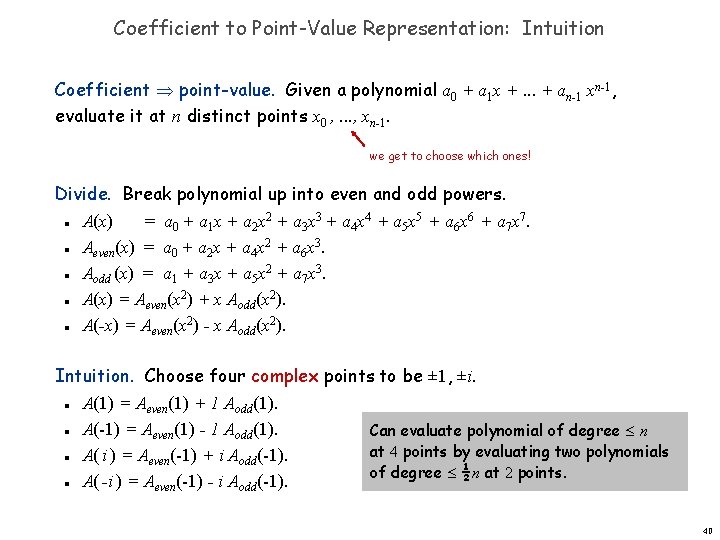
Coefficient to Point-Value Representation: Intuition Coefficient point-value. Given a polynomial a 0 + a 1 x +. . . + an-1 xn-1, evaluate it at n distinct points x 0 , . . . , xn-1. we get to choose which ones! Divide. Break polynomial up into even and odd powers. A(x) = a 0 + a 1 x + a 2 x 2 + a 3 x 3 + a 4 x 4 + a 5 x 5 + a 6 x 6 + a 7 x 7. Aeven(x) = a 0 + a 2 x + a 4 x 2 + a 6 x 3. Aodd (x) = a 1 + a 3 x + a 5 x 2 + a 7 x 3. A(x) = Aeven(x 2) + x Aodd(x 2). A(-x) = Aeven(x 2) - x Aodd(x 2). Intuition. Choose four complex points to be ± 1, ±i. A(1) = Aeven(1) + 1 Aodd(1). A(-1) = Aeven(1) - 1 Aodd(1). Can evaluate polynomial of degree n at 4 points by evaluating two polynomials A( i ) = Aeven(-1) + i Aodd(-1). of degree ½n at 2 points. A( -i ) = Aeven(-1) - i Aodd(-1). 40
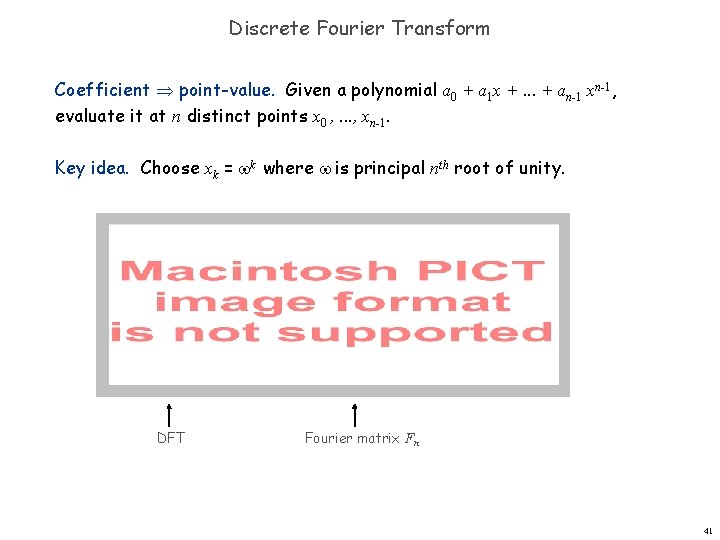
Discrete Fourier Transform Coefficient point-value. Given a polynomial a 0 + a 1 x +. . . + an-1 xn-1, evaluate it at n distinct points x 0 , . . . , xn-1. Key idea. Choose xk = k where is principal nth root of unity. DFT Fourier matrix Fn 41
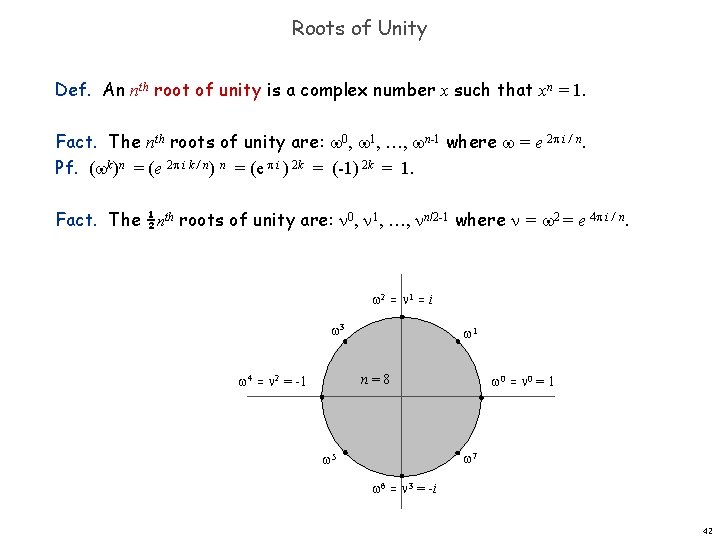
Roots of Unity Def. An nth root of unity is a complex number x such that xn = 1. Fact. The nth roots of unity are: 0, 1, …, n-1 where = e 2 i / n. Pf. ( k)n = (e 2 i k / n) n = (e i ) 2 k = (-1) 2 k = 1. Fact. The ½nth roots of unity are: 0, 1, …, n/2 -1 where = 2 = e 4 i / n. 2 = 1 = i 3 4 = 2 = -1 1 0 = 1 n=8 7 5 6 = 3 = -i 42
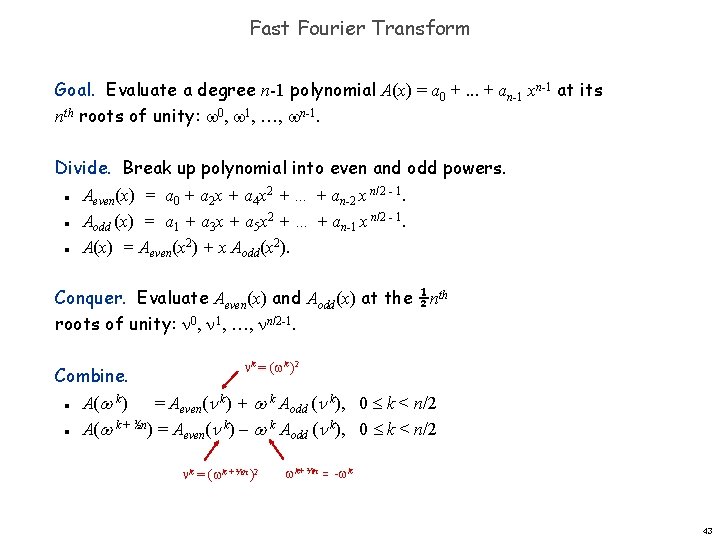
Fast Fourier Transform Goal. Evaluate a degree n-1 polynomial A(x) = a 0 +. . . + an-1 xn-1 at its nth roots of unity: 0, 1, …, n-1. Divide. Break up polynomial into even and odd powers. Aeven(x) = a 0 + a 2 x + a 4 x 2 + … + an-2 x n/2 - 1. Aodd (x) = a 1 + a 3 x + a 5 x 2 + … + an-1 x n/2 - 1. A(x) = Aeven(x 2) + x Aodd(x 2). Conquer. Evaluate Aeven(x) and Aodd(x) at the ½nth roots of unity: 0, 1, …, n/2 -1. k = ( k )2 Combine. A( k) = Aeven( k) + k Aodd ( k), 0 k < n/2 A( k+ ½n) = Aeven( k) – k Aodd ( k), 0 k < n/2 k = ( k + ½n )2 k+ ½n = - k 43
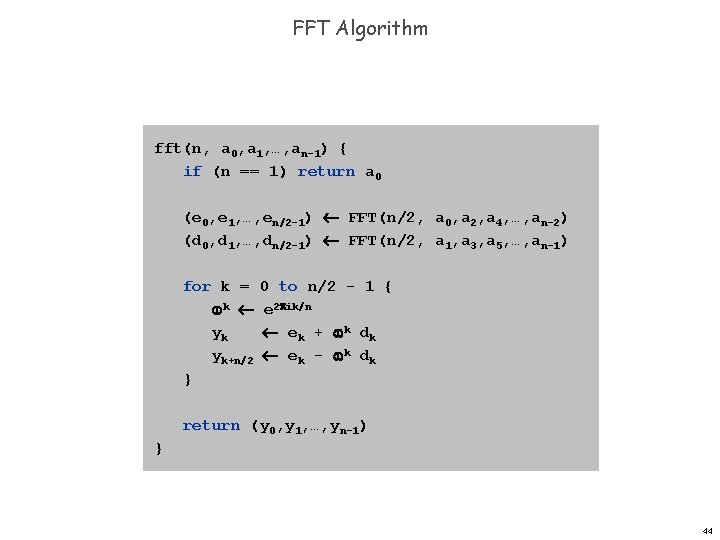
FFT Algorithm fft(n, a 0, a 1, …, an-1) { if (n == 1) return a 0 (e 0, e 1, …, en/2 -1) FFT(n/2, a 0, a 2, a 4, …, an-2) (d 0, d 1, …, dn/2 -1) FFT(n/2, a 1, a 3, a 5, …, an-1) for k = k yk+n/2 } 0 to n/2 - 1 { e 2 ik/n e k + k d k e k - k d k return (y 0, y 1, …, yn-1) } 44
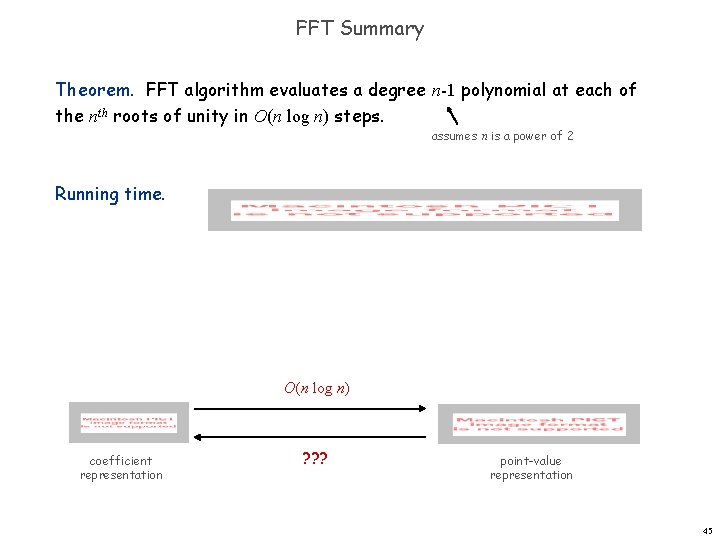
FFT Summary Theorem. FFT algorithm evaluates a degree n-1 polynomial at each of the nth roots of unity in O(n log n) steps. assumes n is a power of 2 Running time. O(n log n) coefficient representation ? ? ? point-value representation 45
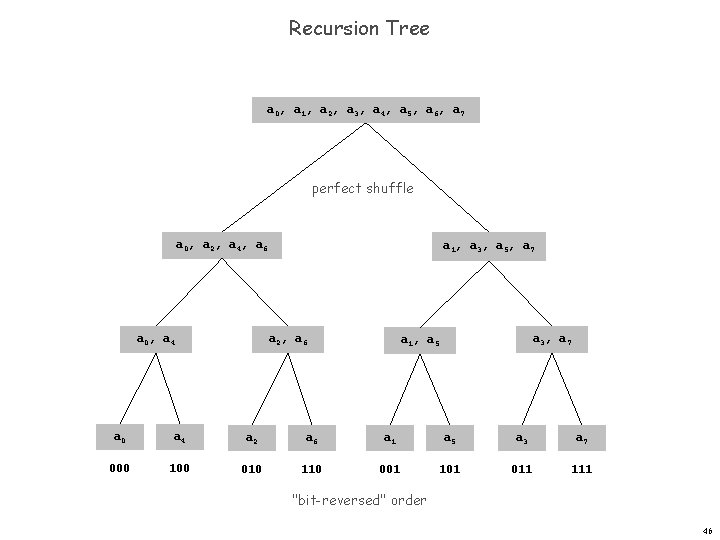
Recursion Tree a 0, a 1, a 2, a 3, a 4, a 5, a 6, a 7 perfect shuffle a 0, a 2, a 4, a 6 a 0, a 4 a 1, a 3, a 5, a 7 a 2, a 6 a 3, a 7 a 1, a 5 a 0 a 4 a 2 a 6 a 1 a 5 a 3 a 7 000 100 010 110 001 101 011 111 "bit-reversed" order 46
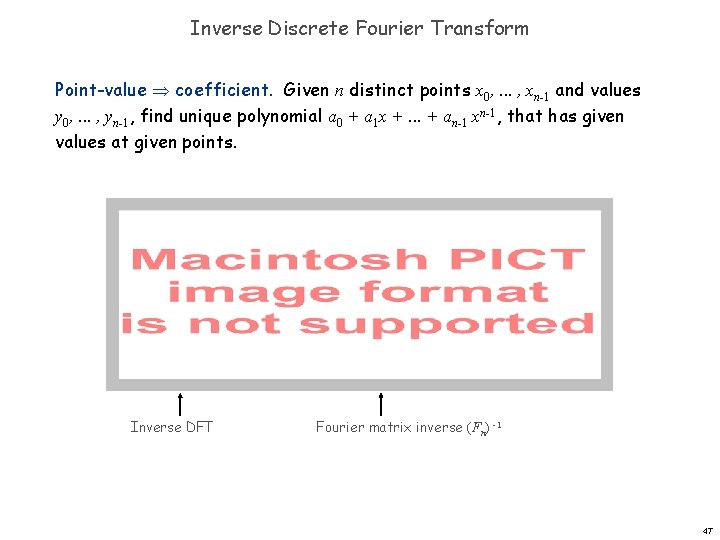
Inverse Discrete Fourier Transform Point-value coefficient. Given n distinct points x 0, . . . , xn-1 and values y 0, . . . , yn-1, find unique polynomial a 0 + a 1 x +. . . + an-1 xn-1, that has given values at given points. Inverse DFT Fourier matrix inverse (Fn) -1 47
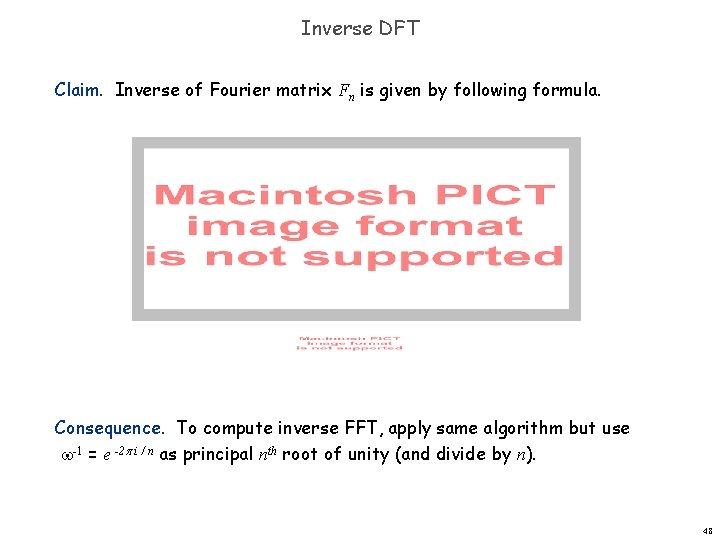
Inverse DFT Claim. Inverse of Fourier matrix Fn is given by following formula. Consequence. To compute inverse FFT, apply same algorithm but use -1 = e -2 i / n as principal nth root of unity (and divide by n). 48
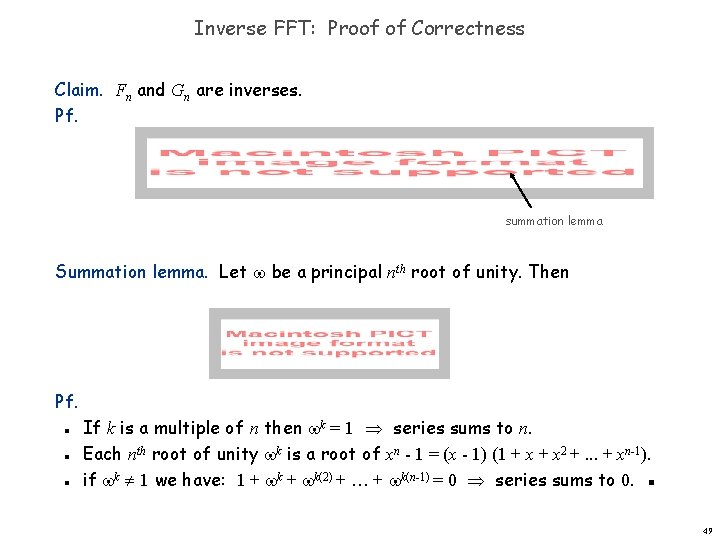
Inverse FFT: Proof of Correctness Claim. Fn and Gn are inverses. Pf. summation lemma Summation lemma. Let be a principal nth root of unity. Then Pf. If k is a multiple of n then k = 1 series sums to n. Each nth root of unity k is a root of xn - 1 = (x - 1) (1 + x 2 +. . . + xn-1). if k 1 we have: 1 + k(2) + … + k(n-1) = 0 series sums to 0. ▪ 49
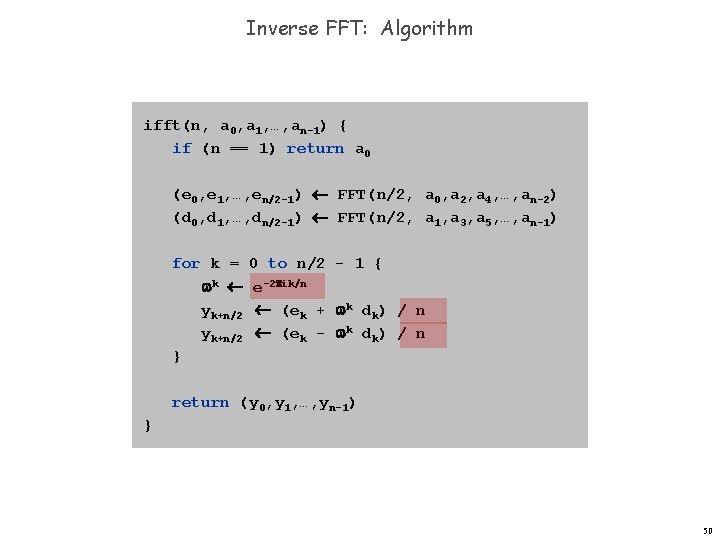
Inverse FFT: Algorithm ifft(n, a 0, a 1, …, an-1) { if (n == 1) return a 0 (e 0, e 1, …, en/2 -1) FFT(n/2, a 0, a 2, a 4, …, an-2) (d 0, d 1, …, dn/2 -1) FFT(n/2, a 1, a 3, a 5, …, an-1) for k = k yk+n/2 } 0 to n/2 - 1 { e-2 ik/n (ek + k dk) / n (ek - k dk) / n return (y 0, y 1, …, yn-1) } 50
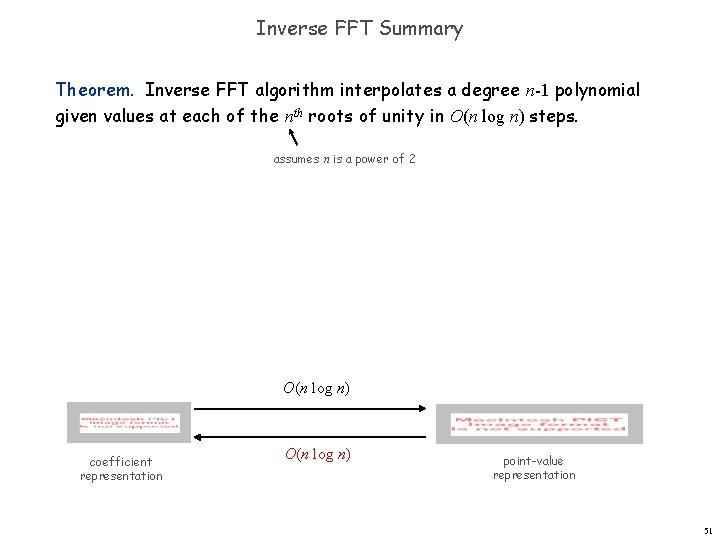
Inverse FFT Summary Theorem. Inverse FFT algorithm interpolates a degree n-1 polynomial given values at each of the nth roots of unity in O(n log n) steps. assumes n is a power of 2 O(n log n) coefficient representation O(n log n) point-value representation 51
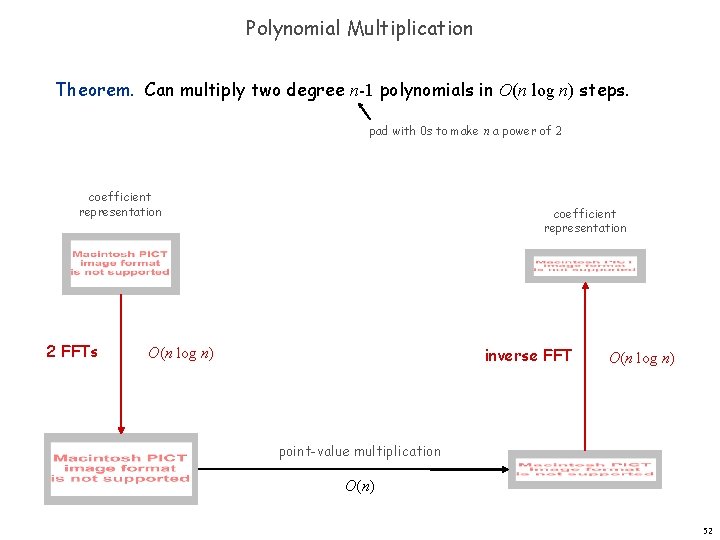
Polynomial Multiplication Theorem. Can multiply two degree n-1 polynomials in O(n log n) steps. pad with 0 s to make n a power of 2 coefficient representation 2 FFTs coefficient representation inverse FFT O(n log n) point-value multiplication O(n) 52
FFT in Practice ? 53
FFT in Practice Fastest Fourier transform in the West. [Frigo and Johnson] Optimized C library. Features: DFT, DCT, real, complex, any size, any dimension. Won 1999 Wilkinson Prize for Numerical Software. Portable, competitive with vendor-tuned code. Implementation details. Instead of executing predetermined algorithm, it evaluates your hardware and uses a special-purpose compiler to generate an optimized algorithm catered to "shape" of the problem. Core algorithm is nonrecursive version of Cooley-Tukey. O(n log n), even for prime sizes. Reference: http: //www. fftw. org 54
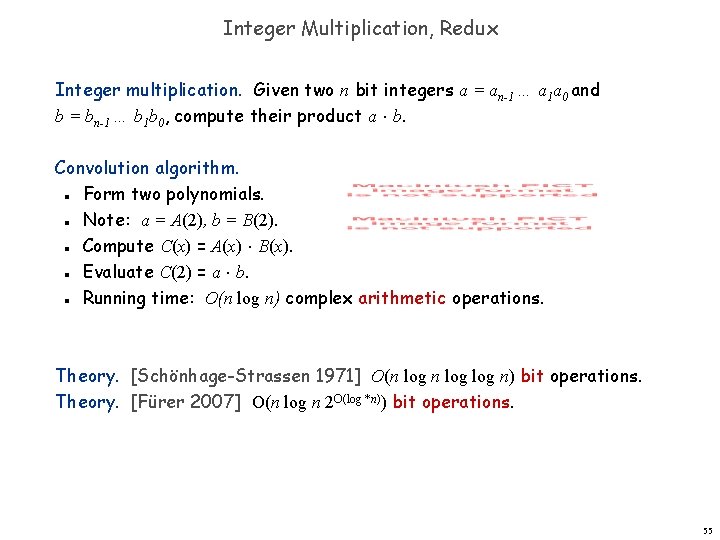
Integer Multiplication, Redux Integer multiplication. Given two n bit integers a = an-1 … a 1 a 0 and b = bn-1 … b 1 b 0, compute their product a b. Convolution algorithm. Form two polynomials. Note: a = A(2), b = B(2). Compute C(x) = A(x) B(x). Evaluate C(2) = a b. Running time: O(n log n) complex arithmetic operations. Theory. [Schönhage-Strassen 1971] O(n log log n) bit operations. Theory. [Fürer 2007] O(n log n 2 O(log *n)) bit operations. 55
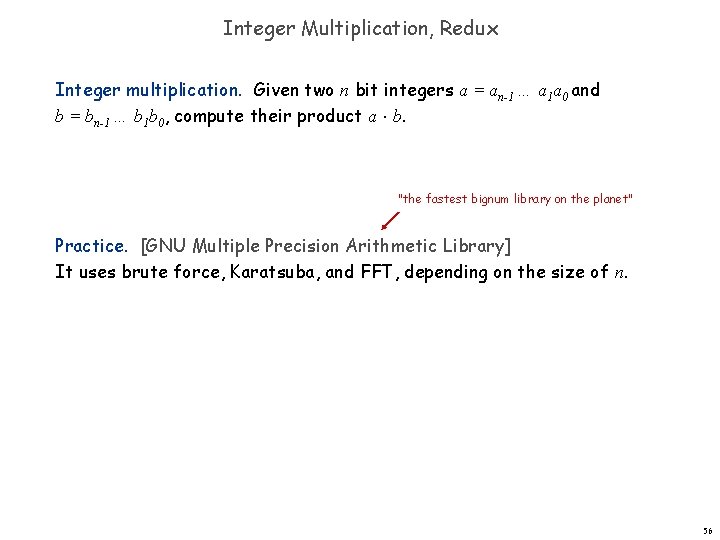
Integer Multiplication, Redux Integer multiplication. Given two n bit integers a = an-1 … a 1 a 0 and b = bn-1 … b 1 b 0, compute their product a b. "the fastest bignum library on the planet" Practice. [GNU Multiple Precision Arithmetic Library] It uses brute force, Karatsuba, and FFT, depending on the size of n. 56
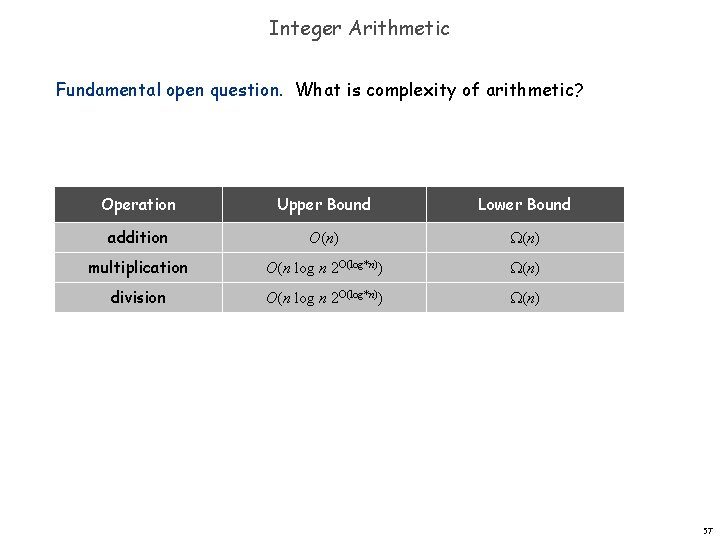
Integer Arithmetic Fundamental open question. What is complexity of arithmetic? Operation Upper Bound Lower Bound addition O(n) multiplication O(n log n 2 O(log*n)) (n) division O(n log n 2 O(log*n)) (n) 57
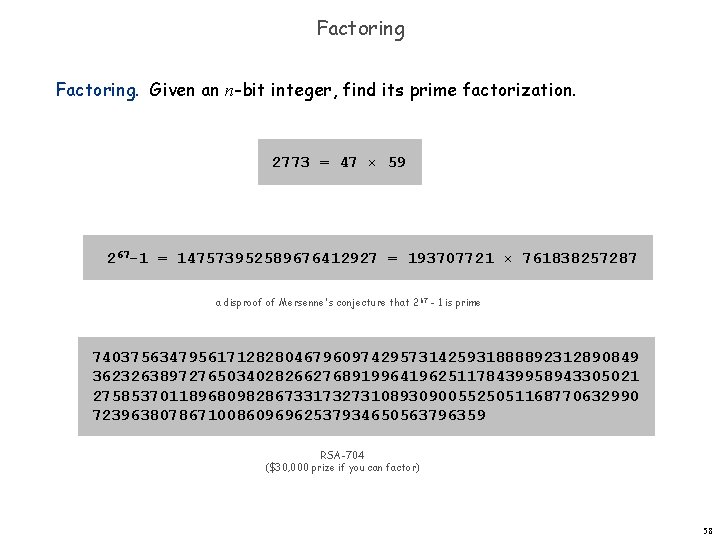
Factoring. Given an n-bit integer, find its prime factorization. 2773 = 47 × 59 267 -1 = 147573952589676412927 = 193707721 × 761838257287 a disproof of Mersenne's conjecture that 267 - 1 is prime 740375634795617128280467960974295731425931888892312890849 362326389727650340282662768919964196251178439958943305021 275853701189680982867331732731089309005525051168770632990 72396380786710086096962537934650563796359 RSA-704 ($30, 000 prize if you can factor) 58
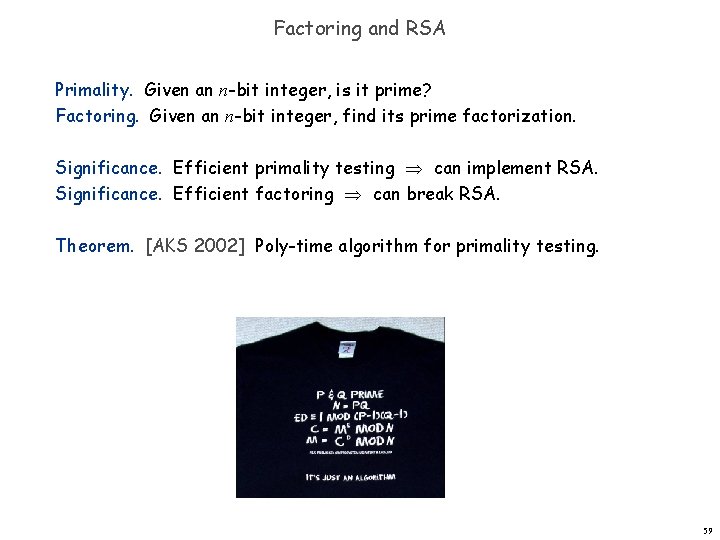
Factoring and RSA Primality. Given an n-bit integer, is it prime? Factoring. Given an n-bit integer, find its prime factorization. Significance. Efficient primality testing can implement RSA. Significance. Efficient factoring can break RSA. Theorem. [AKS 2002] Poly-time algorithm for primality testing. 59
Shor's Algorithm Shor's algorithm. Can factor an n-bit integer in O(n 3) time on a quantum computer. algorithm uses quantum QFT ! Ramification. At least one of the following is wrong: RSA is secure. Textbook quantum mechanics. Extending Church-Turing thesis. 60
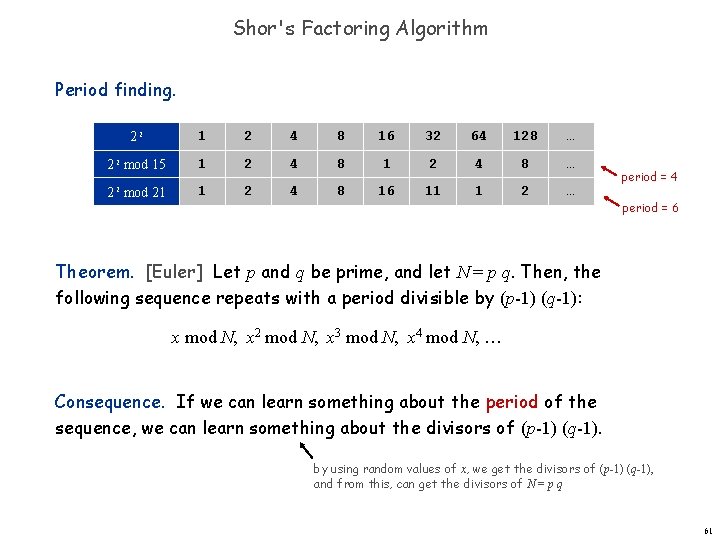
Shor's Factoring Algorithm Period finding. 2 i 1 2 4 8 16 32 64 128 … 2 i mod 15 1 2 4 8 … 2 mod 21 1 2 4 8 16 11 1 2 … i period = 4 period = 6 Theorem. [Euler] Let p and q be prime, and let N = p q. Then, the following sequence repeats with a period divisible by (p-1) (q-1): x mod N, x 2 mod N, x 3 mod N, x 4 mod N, … Consequence. If we can learn something about the period of the sequence, we can learn something about the divisors of (p-1) (q-1). by using random values of x, we get the divisors of (p-1) (q-1), and from this, can get the divisors of N = p q 61
Extra Slides
Fourier Matrix Decomposition 63