
How to Motivate Machines to Learn and Help




- Slides: 25
How to Motivate Machines to Learn and Help Humans in Making Water Decisions? Janusz Starzyk School of Electrical Engineering and Computer Science, Ohio University, USA www. ent. ohiou. edu/~starzyk EE 141
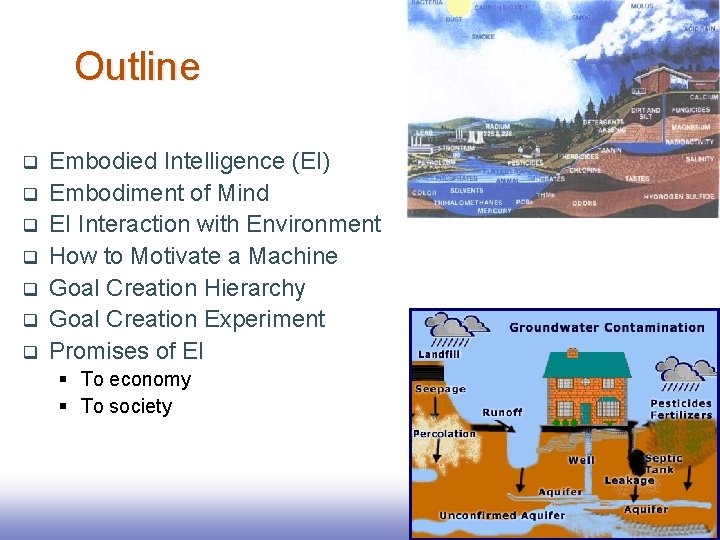
Outline q q q q Embodied Intelligence (EI) Embodiment of Mind EI Interaction with Environment How to Motivate a Machine Goal Creation Hierarchy Goal Creation Experiment Promises of EI § To economy § To society EE 141
Intelligence AI’s holy grail From Pattie Maes MIT Media Lab q “…Perhaps the last frontier of science – its ultimate challenge- is to understand the biological basis of consciousness and the mental process by which we perceive, act, learn and remember. . ” from Principles of Neural Science by E. R. Kandel et al. § E. R. Kandel won Nobel Price in 2000 for his work on physiological basis of memory storage in neurons. q “…The question of intelligence is the last great terrestrial frontier of science. . . ” from Jeff Hawkins On Intelligence. § Jeff Hawkins founded the Redwood Neuroscience Institute devoted to brain research EE 141
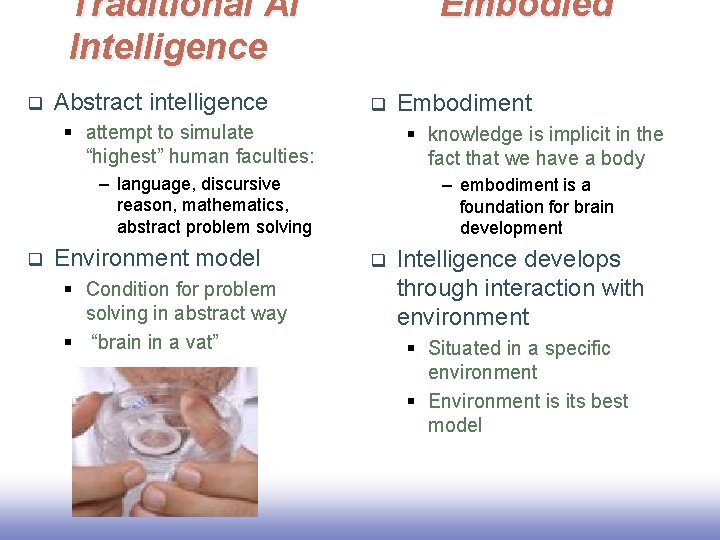
Traditional AI Intelligence q Abstract intelligence Embodied q § attempt to simulate “highest” human faculties: § knowledge is implicit in the fact that we have a body – language, discursive reason, mathematics, abstract problem solving q Environment model § Condition for problem solving in abstract way § “brain in a vat” EE 141 Embodiment – embodiment is a foundation for brain development q Intelligence develops through interaction with environment § Situated in a specific environment § Environment is its best model
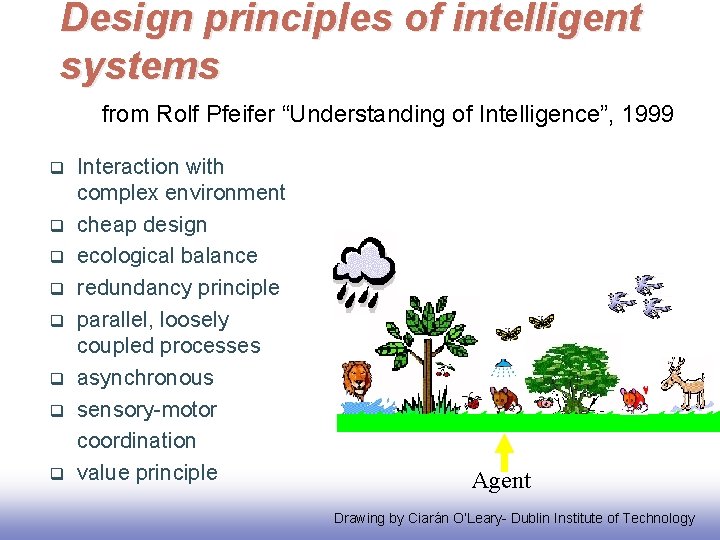
Design principles of intelligent systems from Rolf Pfeifer “Understanding of Intelligence”, 1999 q q q q EE 141 Interaction with complex environment cheap design ecological balance redundancy principle parallel, loosely coupled processes asynchronous sensory-motor coordination value principle Agent Drawing by Ciarán O’Leary- Dublin Institute of Technology
Embodied Intelligence Definition § Embodied Intelligence (EI) is a mechanism that learns how to survive in a hostile environment – Mechanism: biological, mechanical or virtual agent with embodied sensors and actuators – EI acts on environment and perceives its actions – Environment hostility is persistent and stimulates EI to act – Hostility: direct aggression, pain, scarce resources, etc – EI learns so it must have associative self-organizing memory – Knowledge is acquired by EI EE 141
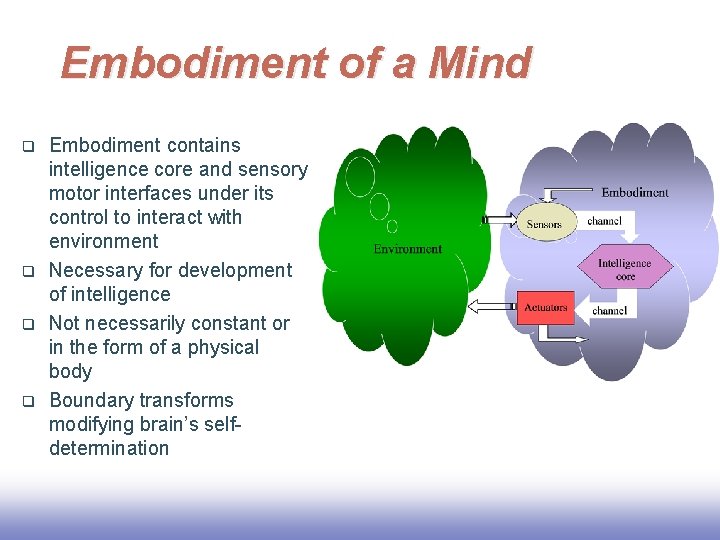
Embodiment of a Mind q q Embodiment contains intelligence core and sensory motor interfaces under its control to interact with environment Necessary for development of intelligence Not necessarily constant or in the form of a physical body Boundary transforms modifying brain’s selfdetermination EE 141
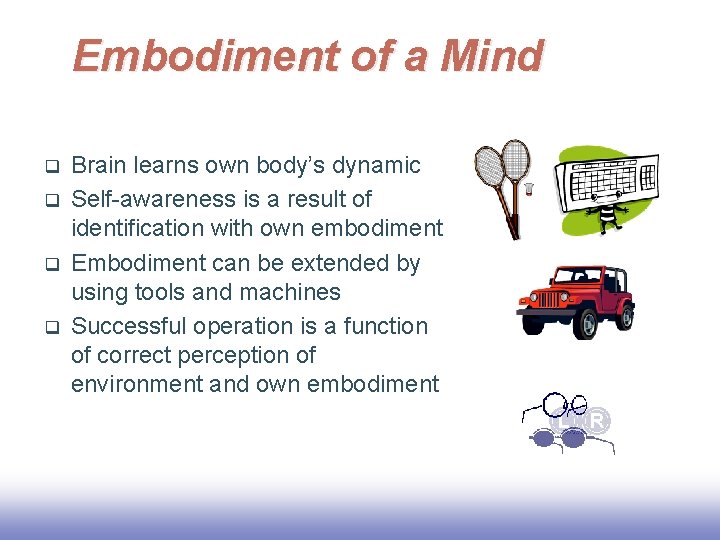
Embodiment of a Mind q q Brain learns own body’s dynamic Self-awareness is a result of identification with own embodiment Embodiment can be extended by using tools and machines Successful operation is a function of correct perception of environment and own embodiment EE 141
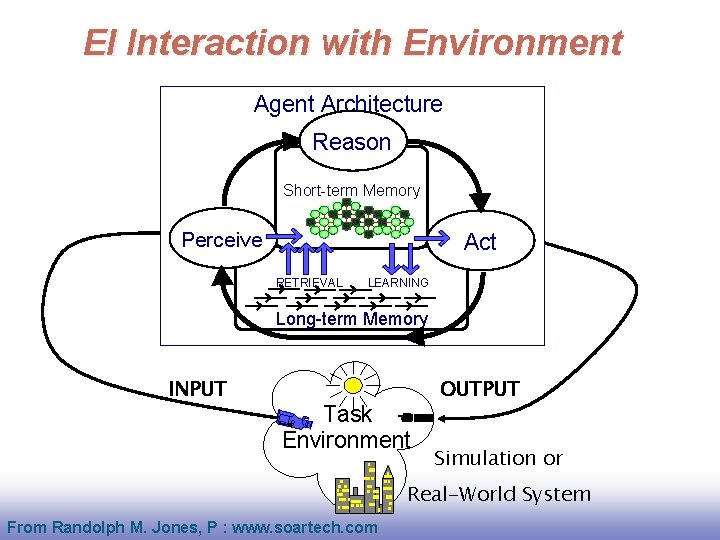
EI Interaction with Environment Agent Architecture Reason Short-term Memory Perceive Act RETRIEVAL LEARNING Long-term Memory INPUT Task Environment OUTPUT Simulation or Real-World System EE 141 From Randolph M. Jones, P : www. soartech. com
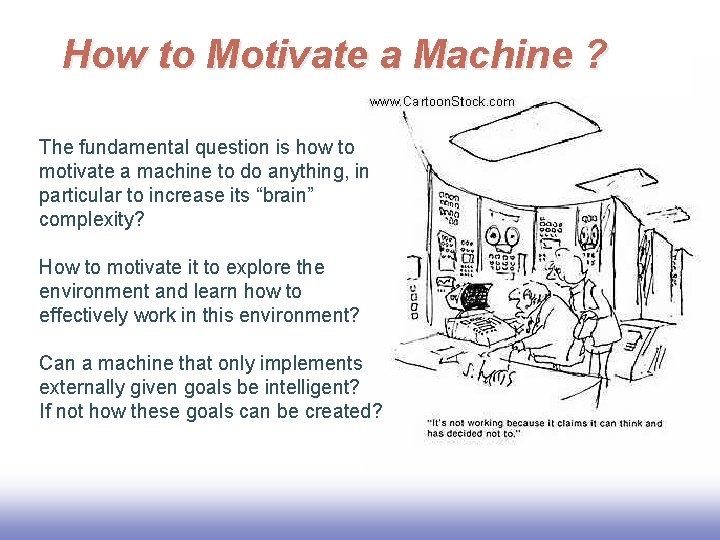
How to Motivate a Machine ? The fundamental question is how to motivate a machine to do anything, in particular to increase its “brain” complexity? How to motivate it to explore the environment and learn how to effectively work in this environment? Can a machine that only implements externally given goals be intelligent? If not how these goals can be created? EE 141
How to Motivate a Machine ? q I suggest that hostility of environment motivates us. § It is the pain that moves us. § Our intelligence that tries to minimize this pain motivates our actions, learning and development q We need both the environment hostility and the mechanism that learns how to reduce inflicted by the environment pain q I propose based on the pain mechanism that motivates the machine to act, learn and develop. §So the pain is good. §Without the pain there will be no intelligence. §Without the pain there will be no motivation to develop. EE 141
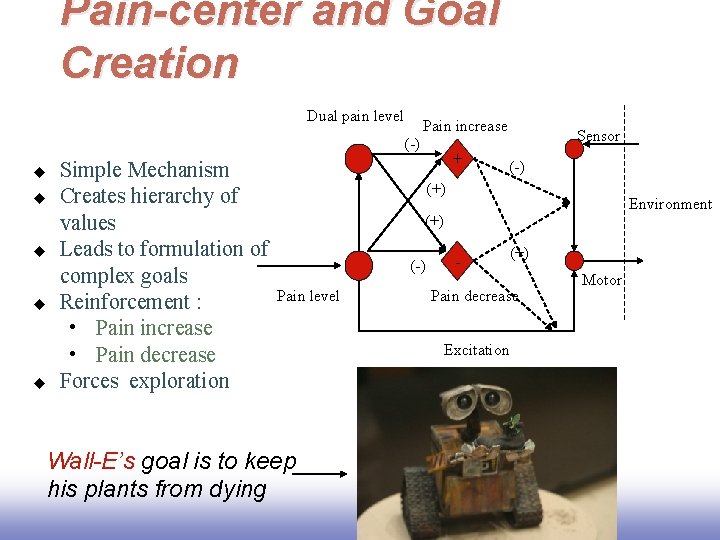
Pain-center and Goal Creation Dual pain level (-) u u u Simple Mechanism Creates hierarchy of values Leads to formulation of complex goals Reinforcement : • Pain increase • Pain decrease Forces exploration + Sensor (-) (+) Environment (+) (-) Pain level Wall-E’s goal is to keep his plants from dying EE 141 Pain increase - (+) Pain decrease Excitation Motor
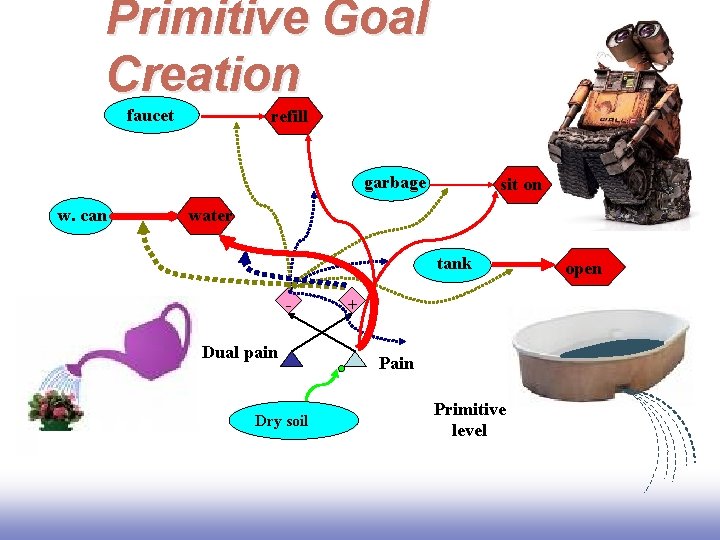
Primitive Goal Creation faucet refill garbage w. can sit on water tank Dual pain Dry soil EE 141 + Pain Primitive level open
Abstract Goal Creation q The goal is to reduce the primitive pain level q Abstract goals are created to reduce abstract pains in order to satisfy the primitive goals q Abstract pain center Sensory pathway Motor pathway (perception, sense) (action, reaction) faucet “water can” – sensory input to abstract pain w. can center Activation Stimulation Inhibition Reinforcement Echo Need Expectation EE 141 open - Dry soil + Abstract pain water Dual pain Level II Level I + Pain Primitive Level
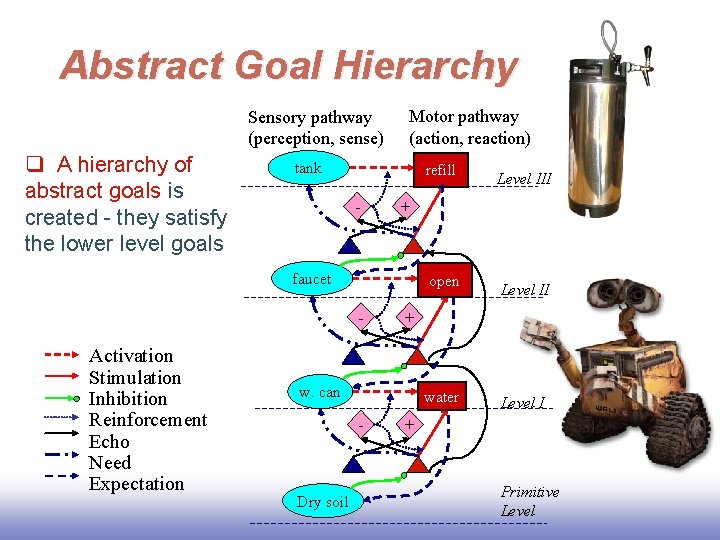
Abstract Goal Hierarchy Sensory pathway (perception, sense) q A hierarchy of abstract goals is created - they satisfy the lower level goals Motor pathway (action, reaction) tank refill - + faucet open - Activation Stimulation Inhibition Reinforcement Echo Need Expectation EE 141 Dry soil Level II + w. can water - Level III Level I + Primitive Level
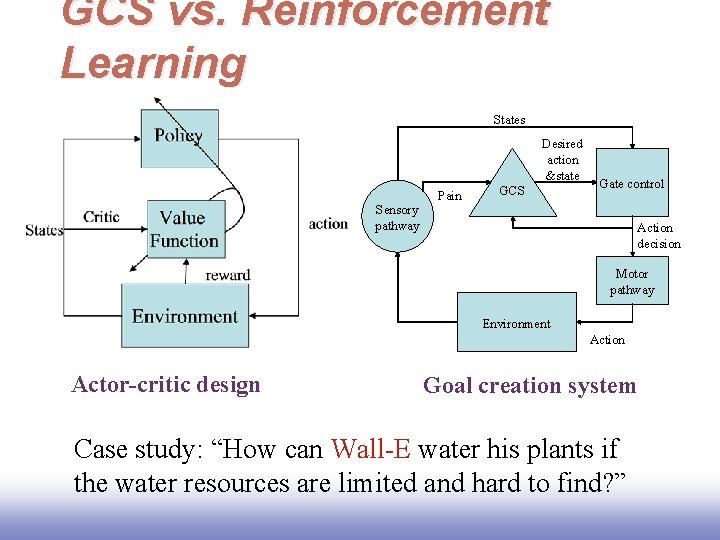
GCS vs. Reinforcement Learning States Desired action &state Sensory pathway Pain GCS Gate control Action decision Motor pathway Environment Action Actor-critic design Goal creation system Case study: “How can Wall-E water his plants if the water resources are limited and hard to find? ” EE 141
Goal Creation Experiment SENSORY MOTOR INCREASES DECREASES 1 water can water the plant moisture water in can 8 faucet open water in can water in tank 15 tank refill water in tank reservoir water 22 pipe open reservoir water lake water 29 rain fall lake water - PAIR # Sensory-motor pairs and their effect on the environment EE 141
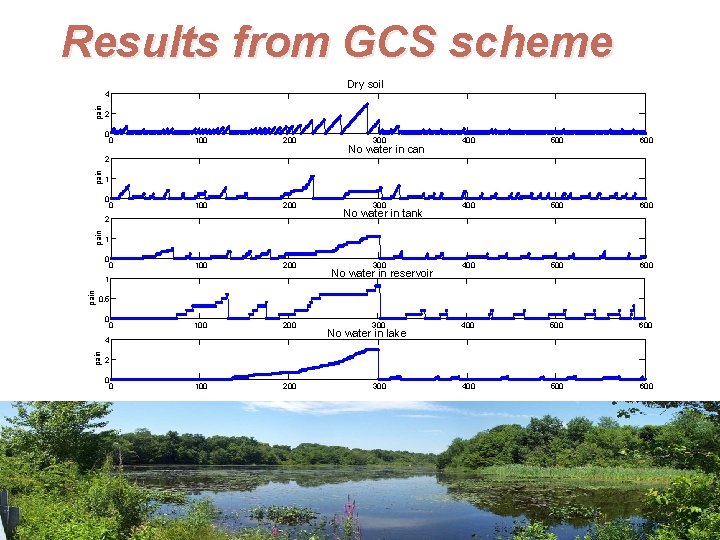
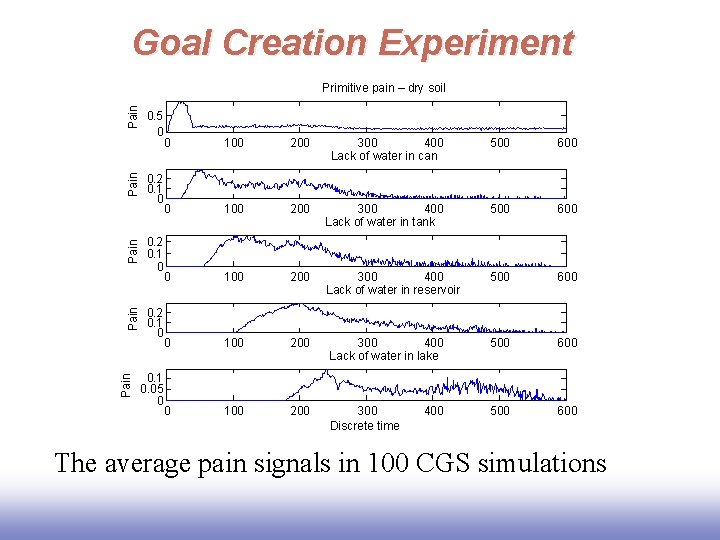
Results from GCS scheme Dry soil pain 4 2 0 0 100 200 100 200 pain 2 500 600 300 400 500 600 No water in tank 1 0 0 1 pain 400 1 0 0 No water in reservoir 0. 5 0 0 pain 4 No water in lake 2 0 0 EE 141 300 No water in can
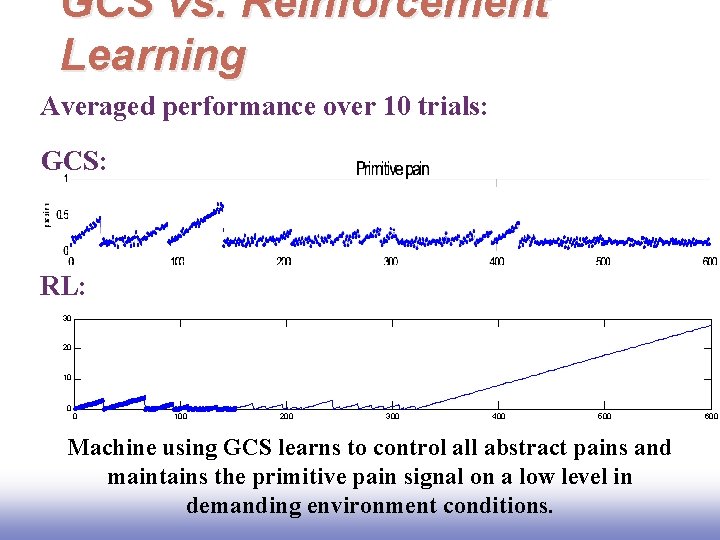
GCS vs. Reinforcement Learning Averaged performance over 10 trials: GCS: RL: 30 20 10 0 0 100 200 300 400 500 Machine using GCS learns to control all abstract pains and maintains the primitive pain signal on a low level in demanding environment conditions. EE 141 600
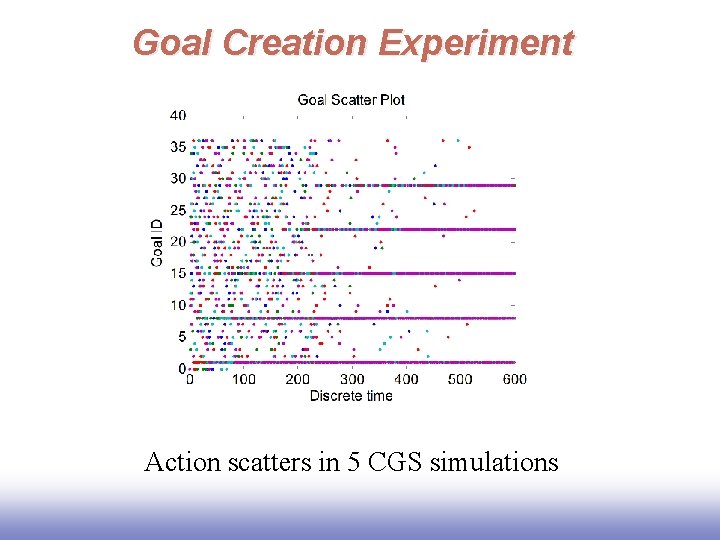
Goal Creation Experiment Action scatters in 5 CGS simulations EE 141
Goal Creation Experiment Pain Pain Primitive pain – dry soil 0. 5 0 0. 2 0. 1 0. 05 0 0 100 200 300 400 Lack of water in can 500 600 0 100 200 300 400 Lack of water in tank 500 600 0 100 200 300 400 Lack of water in reservoir 500 600 0 100 200 300 400 Lack of water in lake 500 600 0 100 200 300 Discrete time 500 600 400 The average pain signals in 100 CGS simulations EE 141
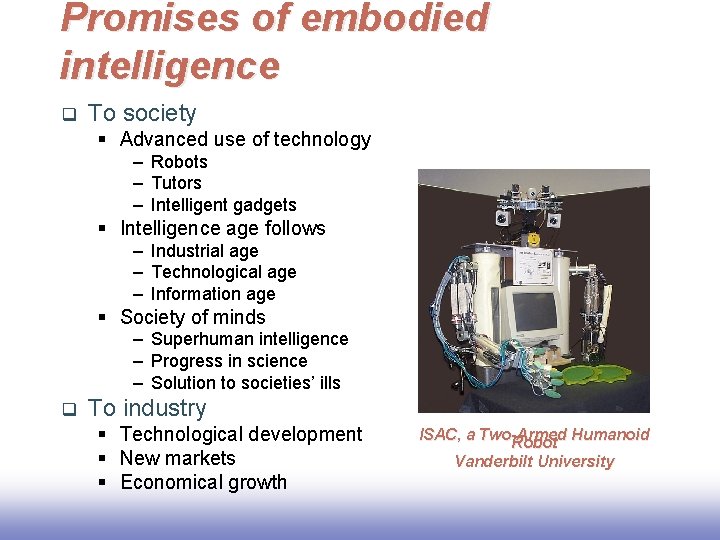
Promises of embodied intelligence q To society § Advanced use of technology – Robots – Tutors – Intelligent gadgets § Intelligence age follows – Industrial age – Technological age – Information age § Society of minds – Superhuman intelligence – Progress in science – Solution to societies’ ills q To industry § Technological development § New markets § Economical growth EE 141 ISAC, a Two-Armed Robot Humanoid Vanderbilt University
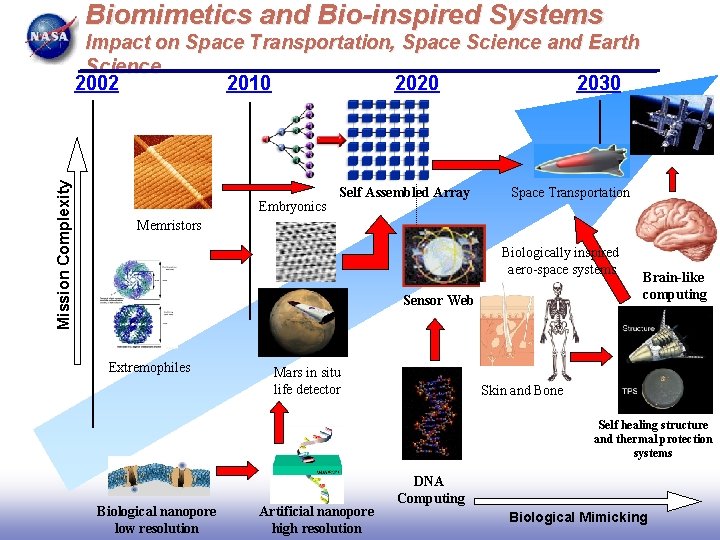
Biomimetics and Bio-inspired Systems Mission Complexity Impact on Space Transportation, Space Science and Earth Science 2002 2010 2020 2030 Embryonics Self Assembled Array Space Transportation Memristors Biologically inspired aero-space systems Sensor Web Extremophiles Mars in situ life detector Brain-like computing Skin and Bone Self healing structure and thermal protection systems EE 141 Biological nanopore low resolution Artificial nanopore high resolution DNA Computing Biological Mimicking
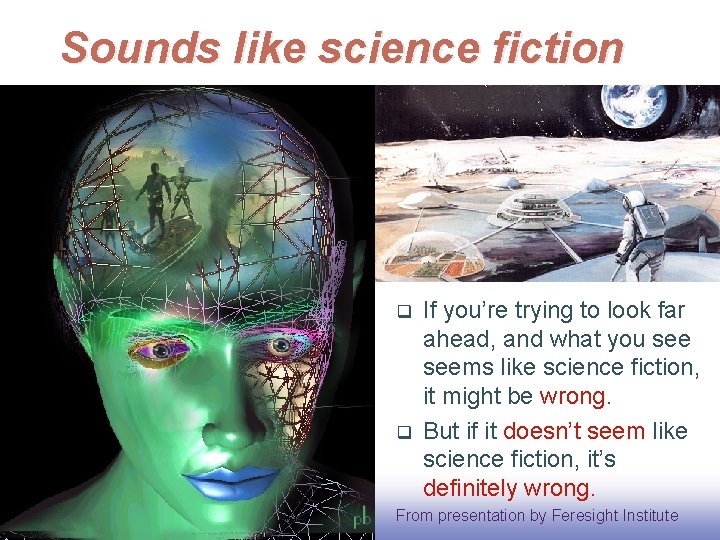
Sounds like science fiction q q EE 141 If you’re trying to look far ahead, and what you seems like science fiction, it might be wrong. But if it doesn’t seem like science fiction, it’s definitely wrong. From presentation by Feresight Institute
Questions? EE 141