
How to measure spatial abilities in visually impaired
How to measure spatial abilities in visually impaired people? Frank J. J. M. Steyvers ICTTP 2012
Issue › Applied research: often no problem › Relation with fundamental research is missing • Many spatial ability test are visual • Useless for Visually Impaired Persons (VIPs)
Tests suitable for VIPs › Performance tests (“self” constructed) • Zoo-test • Lego-test › Referenced with • Corsi block test • Money road map test • Santa Barbara Sense of Direction Test • Kozlowski & Bryant scale • GIT: puzzle, calculations, word matrices
Method › 48 normally sighted, matched with VIPs from previous research › Counterbalanced execution of the various tests › Calculation of correlations
Zoo-test › Description of • plan of a zoo (survey condition) • route through a zoo (route condition) › 20 questions about relation between items both in survey- and in route-condition ways › Repeated twice › Performance: # questions correct
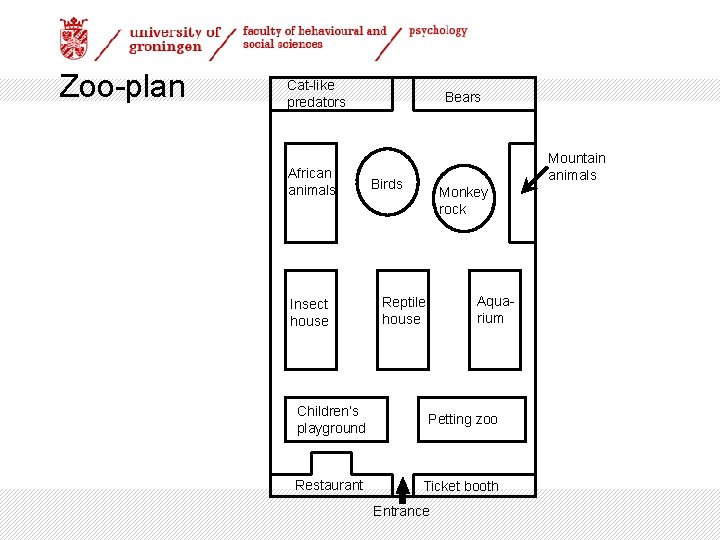
Zoo-plan Cat-like predators African animals Insect house Bears Mountain animals Birds Monkey rock Aquarium Reptile house Children’s playground Petting zoo Restaurant Ticket booth Entrance
Lego-test › Feel construction of 3 “towers” on a base plate for 10 s › Copy from memory with loose bricks › Performance: • completion time • accuracy on four dimensions (location, orientation, height, and brick type) › Use: both hands, preferred hand, non-preferred hand, both hands + vision › Three trials each
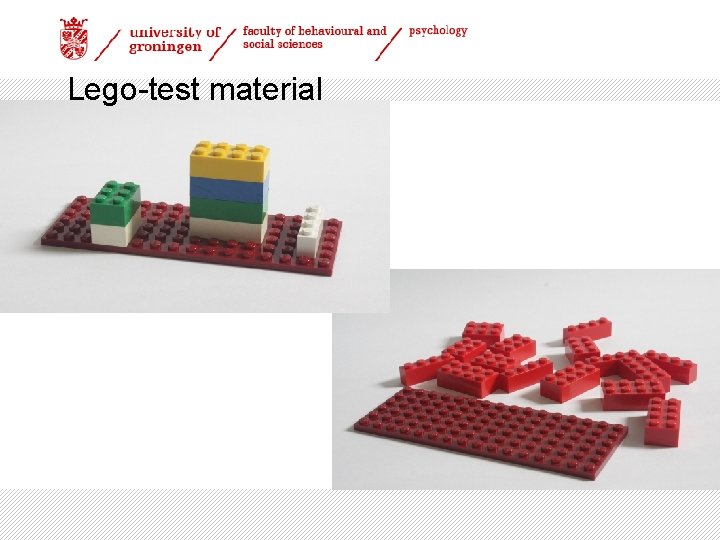
Lego-test material
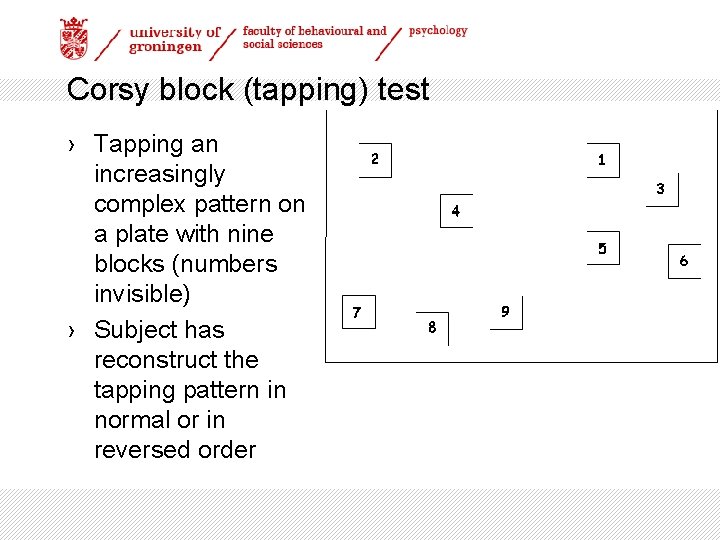
Corsy block (tapping) test › Tapping an increasingly complex pattern on a plate with nine blocks (numbers invisible) › Subject has reconstruct the tapping pattern in normal or in reversed order
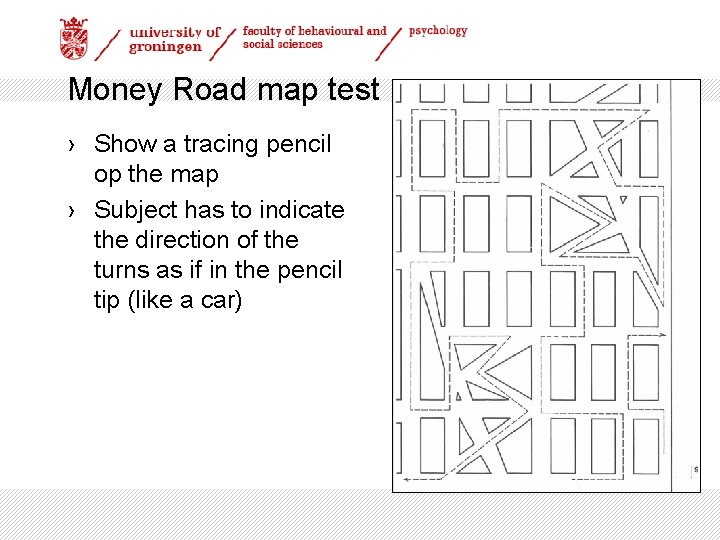
Money Road map test › Show a tracing pencil op the map › Subject has to indicate the direction of the turns as if in the pencil tip (like a car)
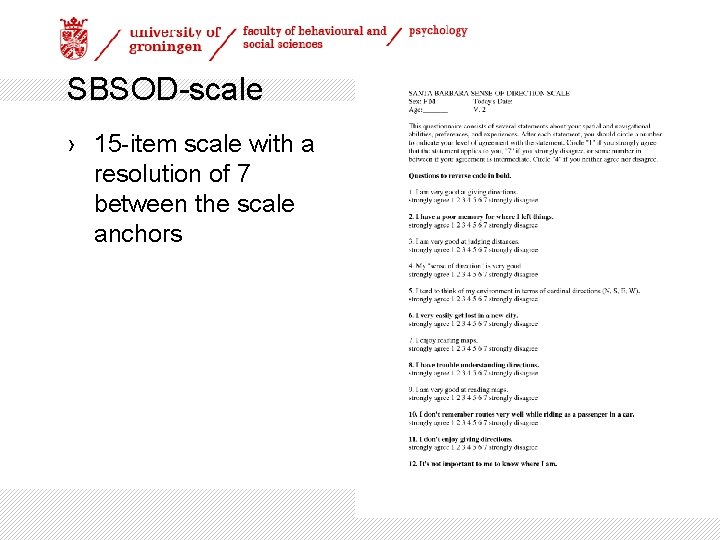
SBSOD-scale › 15 -item scale with a resolution of 7 between the scale anchors
Kozlowski & Bryant scale › One-item scale: “How good is your sense of direction? ” › Originally with a resolution of 9 between the scale anchors › For this study added as a 16 th item to the SBSODscale with a resolution of 7 between scale anchors
Groninger Intelligence Test (GIT) › Calculations: solving 40 additions of three numbers asap, e. g. , 13 34 25 + › Puzzles: select from a set of forms those necessary to complete a more complex figure (compare with tangram, only the figures and forms are drawings) › Word matrices: complete analogies (mc), e. g. , high – low big – … 1) strong; 2) heavy; 3) deep; 4) firm; 5) small
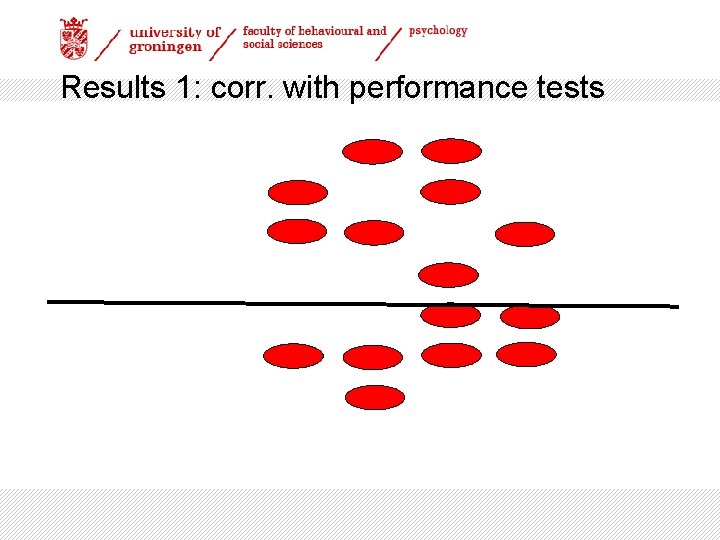
Results 1: corr. with performance tests
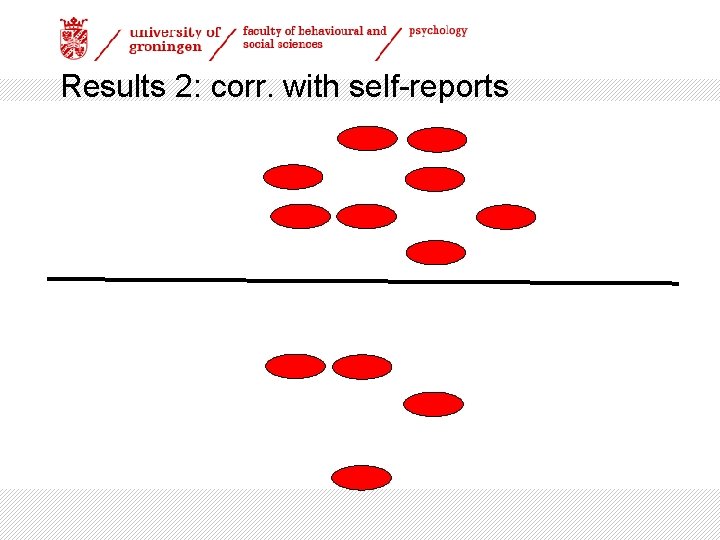
Results 2: corr. with self-reports
Discussion 1 › No clear picture › Performance tests: • corr. between ZOO and Lego-details • corr. between ZOO and Corsi Longest • corr. between ZOO and Money errors • corr. between Lego and Corsi #correct • corr. between Lego and Corsi Longest › Self-reports: • no correlations with questionnairs • … (cont)
Discussion 2 › GIT subtests: • corr. between ZOO and GIT puzzle • corr. between ZOO and GIT complete • corr. between Lego details and GIT calculations › Other (older) results: • No corr. with Big-5 • No corr. with Working Memory size (number lists) • No corr. with spatial mental rotation test • No corr. with field-dependency tests • No corr. with handedness, or gender
Conclusion › Some spatial results with performance tests › The search continues… › Any questions? › This presentation is based on the Ba-theses of Willem Takens, Sophie Snoek, Tessa Drent, Tijo Knol, Remco Paulusma, Gerdine Douma, Pauline van Dijk and Marlot Schuurman, all supervised by the author

Thank you for your attention
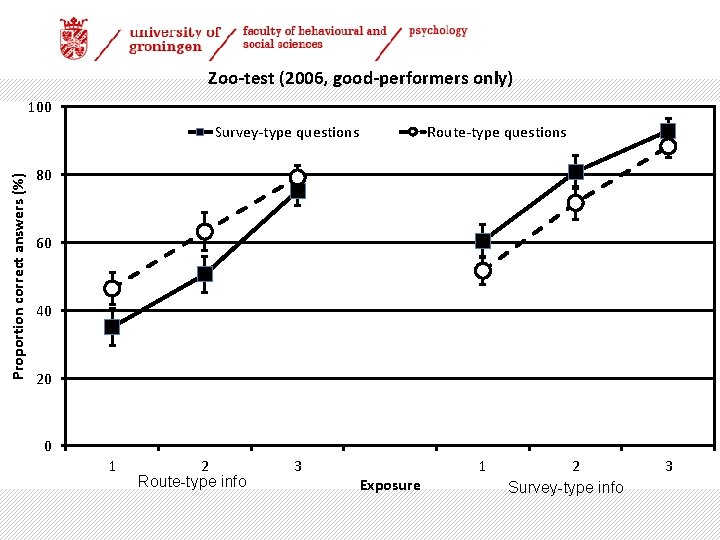
Zoo-test (2006, good-performers only) 100 Proportion correct answers (%) Survey-type questions Route-type questions 80 60 40 20 0 1 2 Route-type info 3 Exposure 1 2 Survey-type info 3
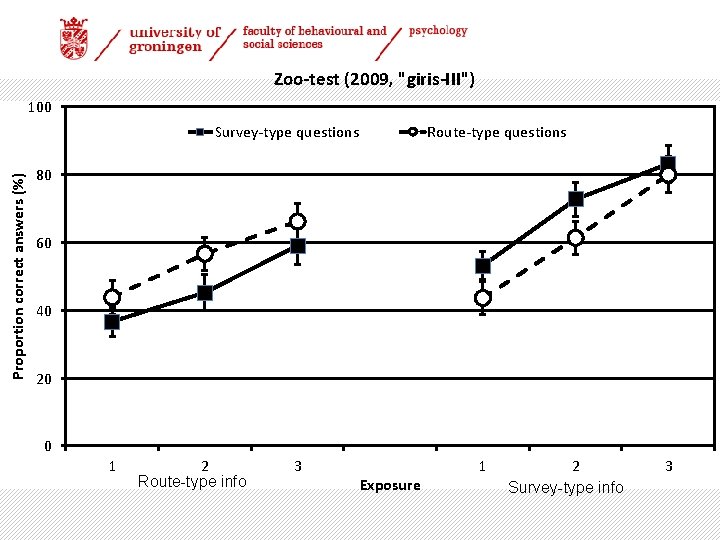
Zoo-test (2009, "giris-III") 100 Proportion correct answers (%) Survey-type questions Route-type questions 80 60 40 20 0 1 2 Route-type info 3 Exposure 1 2 Survey-type info 3
- Slides: 21