
How To Measure Fall Rates and Fall Prevention



- Slides: 48
How To Measure Fall Rates and Fall Prevention Practices ADD Hospital Name Here Module 5
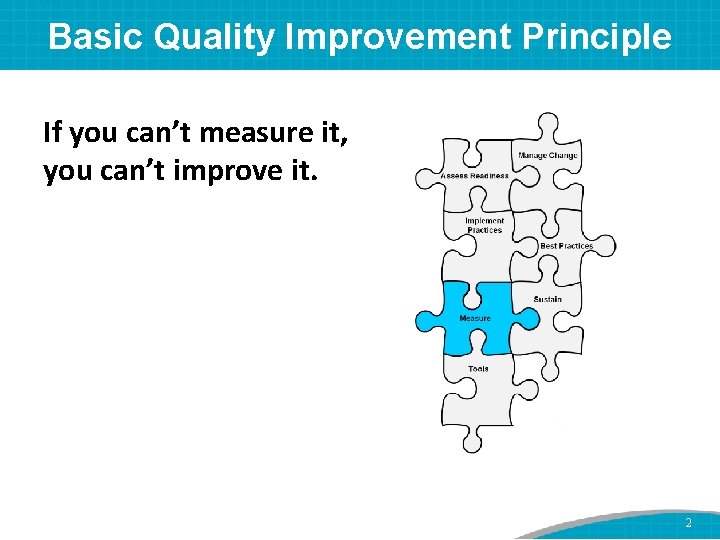
Basic Quality Improvement Principle If you can’t measure it, you can’t improve it. 2
Basic Quality Improvement Principles • Fall rates and fall prevention practices must be tracked. • By tracking performance, you will know whether care is improving, staying the same, or getting worse in response to efforts to change practice. • Continued monitoring will help you see if your improvement gains are being sustained. 3
Module 5 Goals • The Implementation Team will agree on and develop a plan for: – Measuring falls and fall-related injury rates. – Measuring fall prevention practices. – Communicating trends in fall and fall-related injury rates to key stakeholders. 4
2012 NDNQI Definition of a Fall A patient fall is an unplanned descent to the floor without injury to the patient. Include falls that result when a patient lands on a surface where you wouldn’t expect to find a patient. NDNQI–National Database of Nursing Quality Indicators 5
NDNQI Definition • All unassisted and assisted falls are to be included whether they result from physiological reasons (fainting) or environmental reasons (slippery floor). Page 70 6
Practice Insight Assisted Falls 7
How Will This Hospital Define a Fall? • Develop a uniform definition and share it throughout the hospital. • Make sure it is coupled with a culture of trust to encourage reporting fall incidents. • Will you use NDNQI’s definition to measure and monitor falls? 8
NDNQI Repeat Fall Definition • A repeat fall is more than one fall in a given month by the same patient after admission to the unit. • Do you agree to use this definition? 9
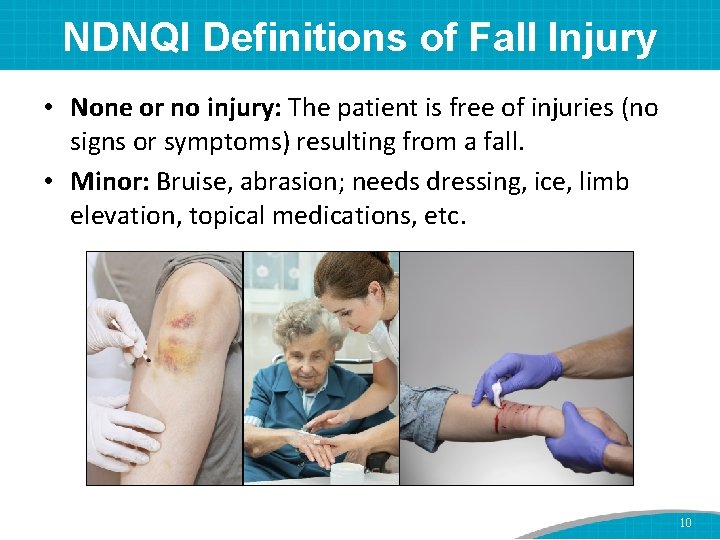
NDNQI Definitions of Fall Injury • None or no injury: The patient is free of injuries (no signs or symptoms) resulting from a fall. • Minor: Bruise, abrasion; needs dressing, ice, limb elevation, topical medications, etc. 10
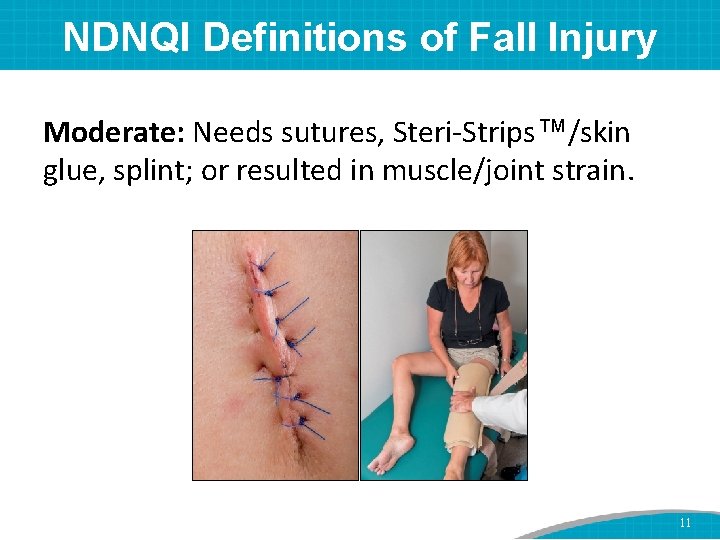
NDNQI Definitions of Fall Injury Moderate: Needs sutures, Steri-Strips™/skin glue, splint; or resulted in muscle/joint strain. 11
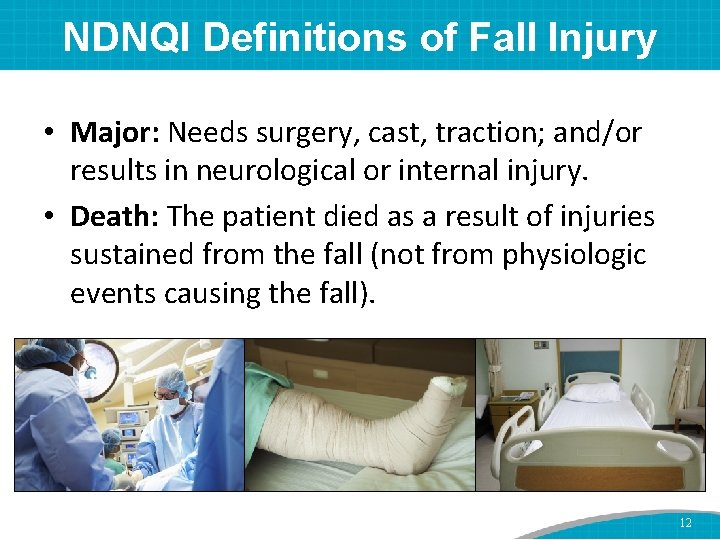
NDNQI Definitions of Fall Injury • Major: Needs surgery, cast, traction; and/or results in neurological or internal injury. • Death: The patient died as a result of injuries sustained from the fall (not from physiologic events causing the fall). 12
NDNQI Definitions of Fall Injury • None: No injury • Minor: Resulted in bruise, abrasion; needs dressing, ice, limb elevation, topical medications, etc. • Moderate: Needs suturing, splinting; or caused muscle/joint strain • Major: Needs surgery, cast, traction; results in neurological or internal injury • Death Do you agree to use these definitions? What other definitions of fall injury would be appropriate for this hospital? 13
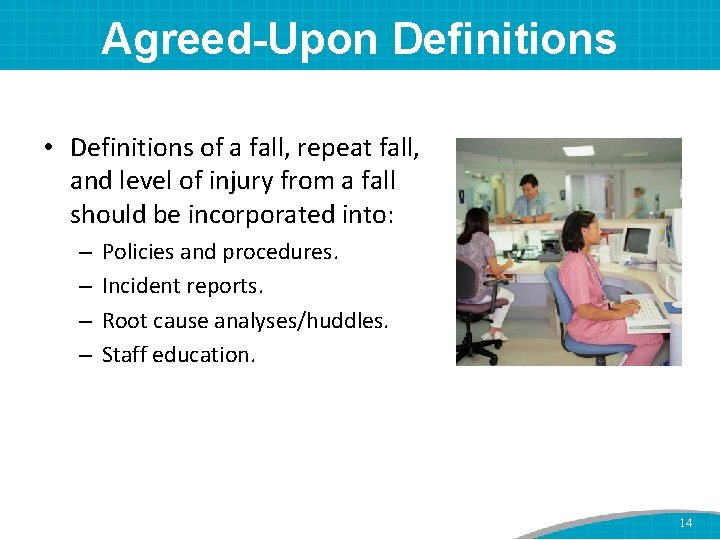
Agreed-Upon Definitions • Definitions of a fall, repeat fall, and level of injury from a fall should be incorporated into: – – Policies and procedures. Incident reports. Root cause analyses/huddles. Staff education. 14
MEASURING FALL RATES 15
Measurement Recommendations • Measure falls over time within a unit to see if care is improving. • Calculate falls as a rate (the rate of falls per 1, 000 occupied bed days). – This measure considers if the unit census is running high or low. • Use this measurement approach consistently throughout the hospital. 16
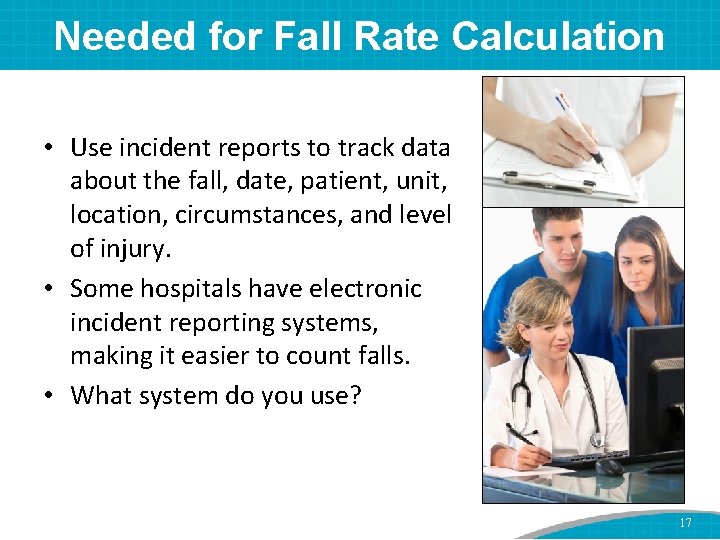
Needed for Fall Rate Calculation • Use incident reports to track data about the fall, date, patient, unit, location, circumstances, and level of injury. • Some hospitals have electronic incident reporting systems, making it easier to count falls. • What system do you use? 17
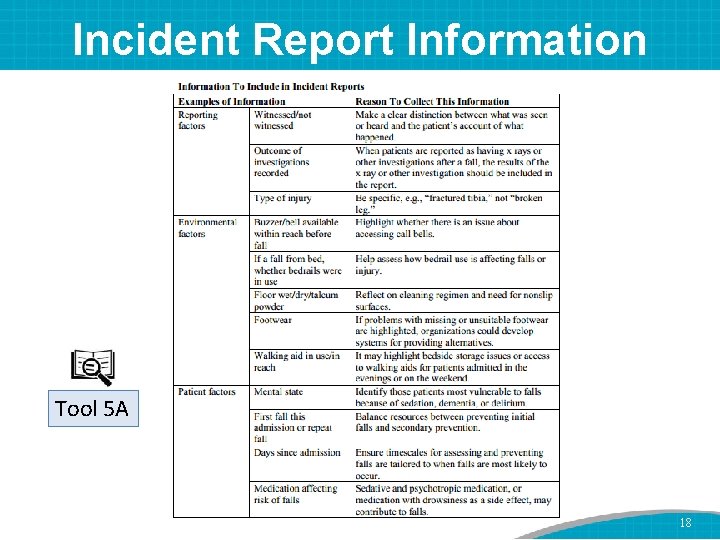
Incident Report Information Tool 5 A 18
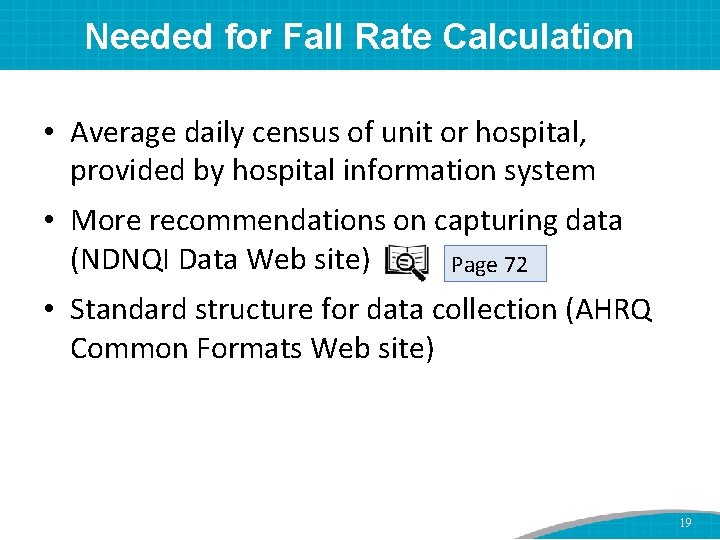
Needed for Fall Rate Calculation • Average daily census of unit or hospital, provided by hospital information system • More recommendations on capturing data (NDNQI Data Web site) Page 72 • Standard structure for data collection (AHRQ Common Formats Web site) 19
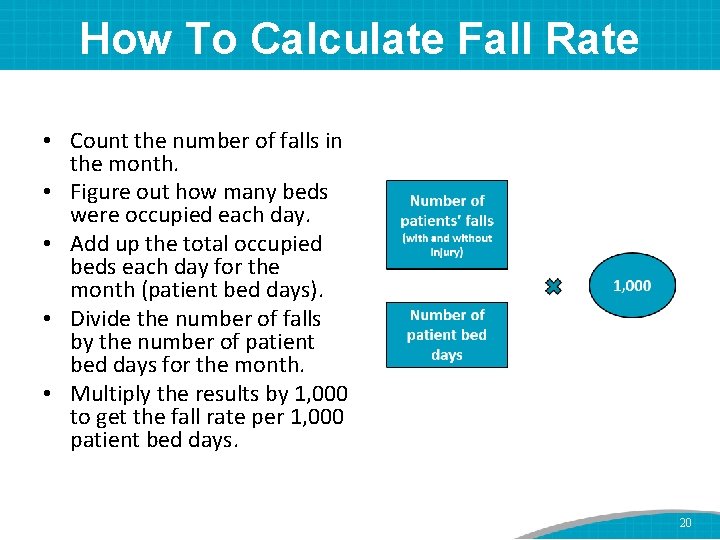
How To Calculate Fall Rate • Count the number of falls in the month. • Figure out how many beds were occupied each day. • Add up the total occupied beds each day for the month (patient bed days). • Divide the number of falls by the number of patient bed days for the month. • Multiply the results by 1, 000 to get the fall rate per 1, 000 patient bed days. 20
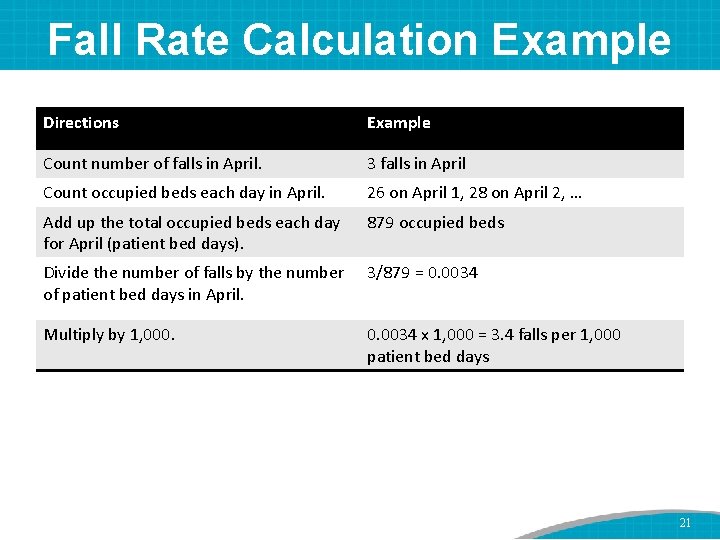
Fall Rate Calculation Example Directions Example Count number of falls in April. 3 falls in April Count occupied beds each day in April. 26 on April 1, 28 on April 2, … Add up the total occupied beds each day for April (patient bed days). 879 occupied beds Divide the number of falls by the number of patient bed days in April. 3/879 = 0. 0034 Multiply by 1, 000. 0. 0034 x 1, 000 = 3. 4 falls per 1, 000 patient bed days 21
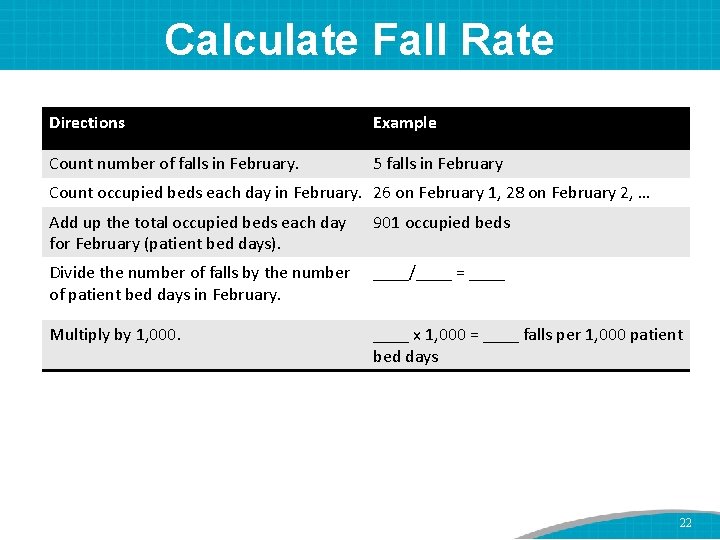
Calculate Fall Rate Directions Example Count number of falls in February. 5 falls in February Count occupied beds each day in February. 26 on February 1, 28 on February 2, … Add up the total occupied beds each day for February (patient bed days). 901 occupied beds Divide the number of falls by the number of patient bed days in February. ____/____ = ____ Multiply by 1, 000. ____ x 1, 000 = ____ falls per 1, 000 patient bed days 22
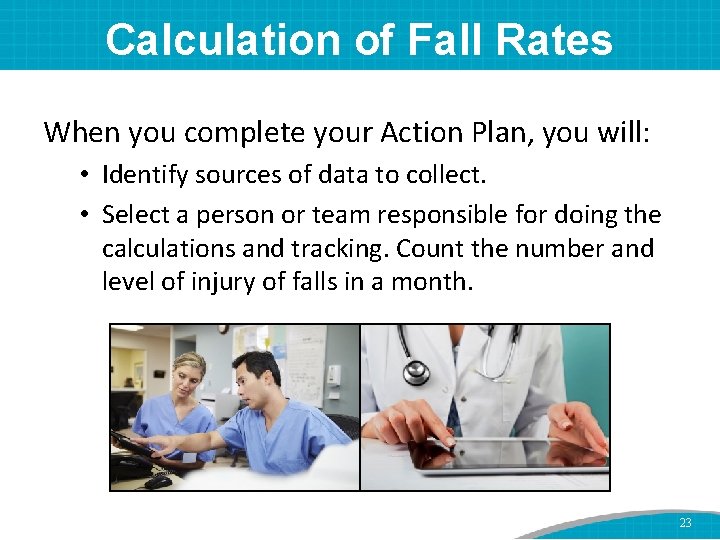
Calculation of Fall Rates When you complete your Action Plan, you will: • Identify sources of data to collect. • Select a person or team responsible for doing the calculations and tracking. Count the number and level of injury of falls in a month. 23
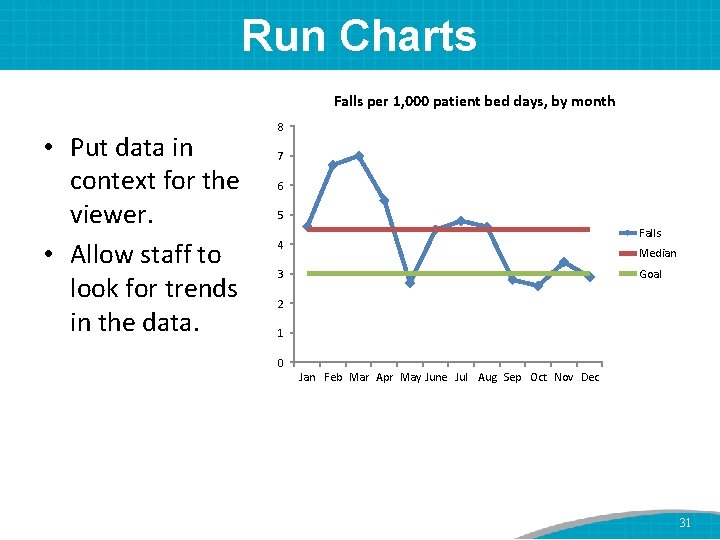
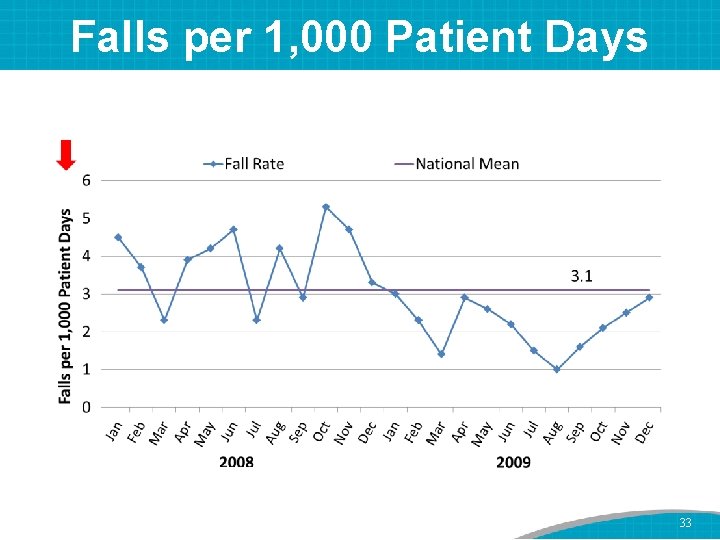
Use of Data • Examine the rates for trends over time. – Graph data in a run chart to visually examine. – Are rates getting better or worse? – Can you relate changes in rates to changes in practice? – Rates are probably quite different by patient unit. – Focus on trends over time. There will be fluctuations. Don’t overreact. 24
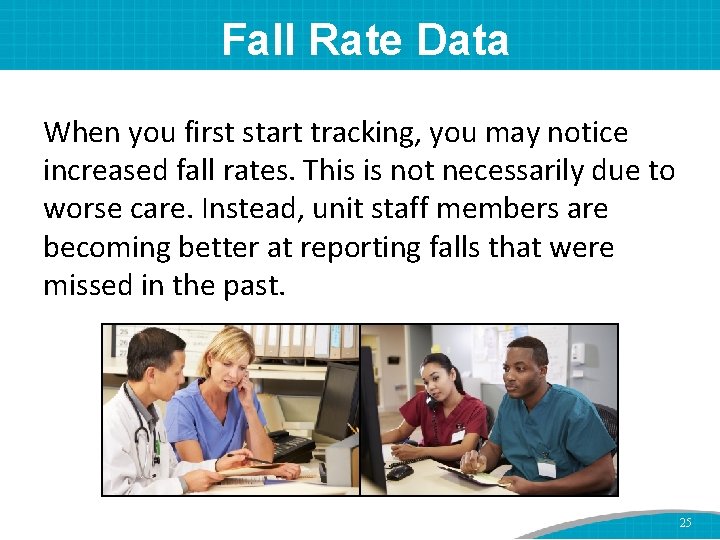
Fall Rate Data When you first start tracking, you may notice increased fall rates. This is not necessarily due to worse care. Instead, unit staff members are becoming better at reporting falls that were missed in the past. 25
Use of Data • Find ways to disseminate the information to key stakeholders and unit staff. – Post monthly rates where all staff can see how the unit is doing. – Send reports to leadership. 26
Examining Data • Study your post-fall huddle data in detail to understand what leads to each fall. • Determine whether falls are irregular events, or whethere is a pattern in the types of falls (e. g. , related to toileting). Page 76 27
Benchmarks for Comparison? • Currently, no national benchmarks exist for comparing fall rates. – It’s difficult to compare patients across hospitals because some patients are more likely to fall. – Focus on improvement over time in your hospital. • There a number of ongoing initiatives to determine fall rates using a standardized Page 77 method. • Monitor current literature on fall rates for benchmarking. 28
Practice Insight Benchmarking 29
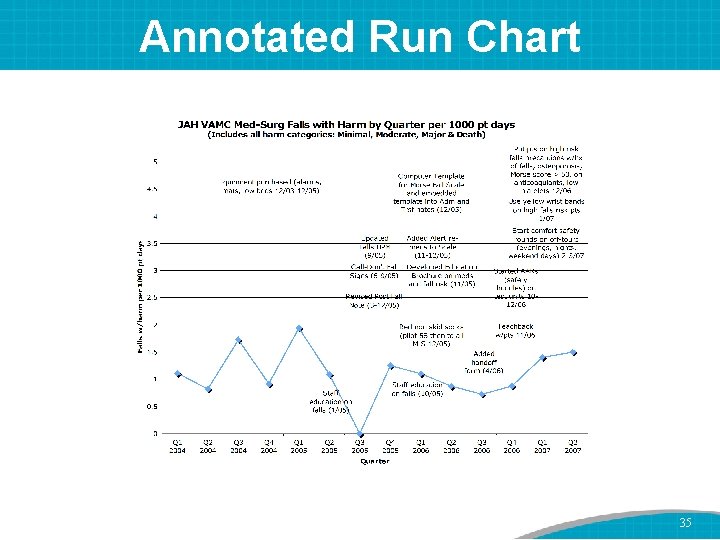
Displaying Data/Storytelling • Run charts • Control charts • Annotation (show your interventions) 30
Run Charts Falls per 1, 000 patient bed days, by month • Put data in context for the viewer. • Allow staff to look for trends in the data. 8 7 6 5 Falls 4 Median Goal 3 2 1 0 Jan Feb Mar Apr May June Jul Aug Sep Oct Nov Dec 31
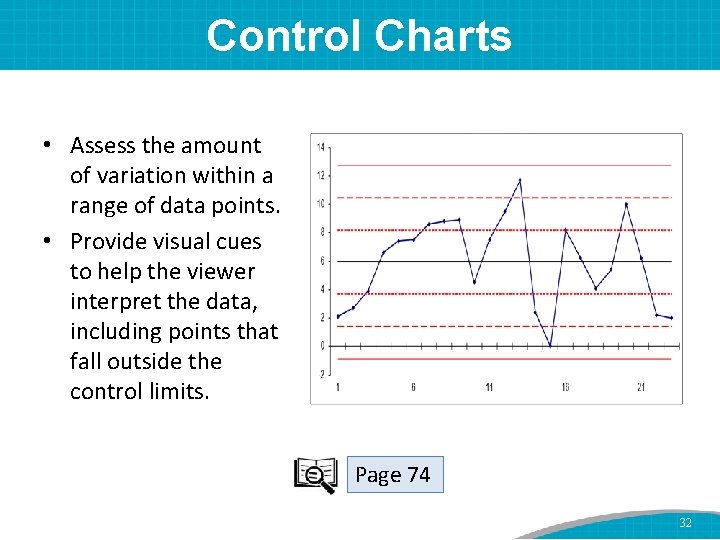
Control Charts • Assess the amount of variation within a range of data points. • Provide visual cues to help the viewer interpret the data, including points that fall outside the control limits. Page 74 32
Falls per 1, 000 Patient Days 33
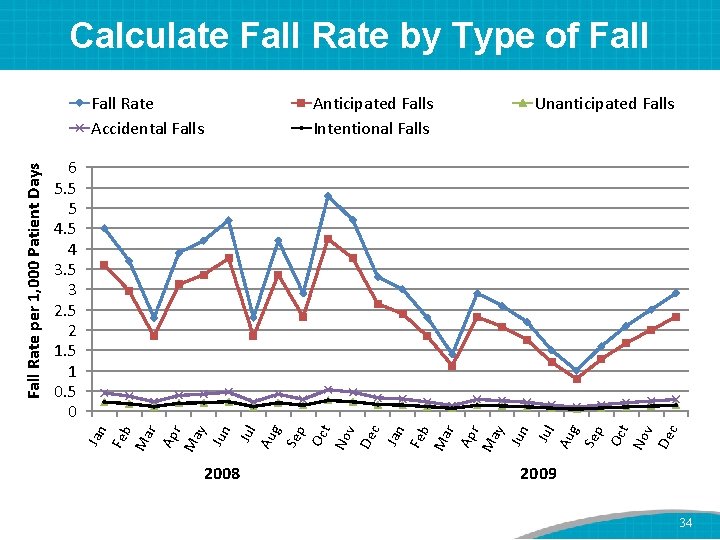
Calculate Fall Rate by Type of Fall Anticipated Falls Intentional Falls Unanticipated Falls 2008 Jul Au g Sep Oc t No v De c Jan Feb Ma r Ap r Ma y Jun 6 5. 5 5 4 3. 5 3 2. 5 2 1. 5 1 0. 5 0 Jan Feb Ma r Ap r Ma y Jun Fall Rate per 1, 000 Patient Days Fall Rate Accidental Falls 2009 34
Annotated Run Chart 35
Painting the Picture With Data • Is your program improving? • Are your patients safer? 36
MEASURING FALL PREVENTION PRACTICES 37
Measuring Fall Prevention Practices • Measuring fall rates tells you how your facility is performing. • Measuring fall prevention practices may tell you how to improve care. – If the fall rate is high, what specific areas should you focus on? – Are key practices to reduce falls being done consistently? 38
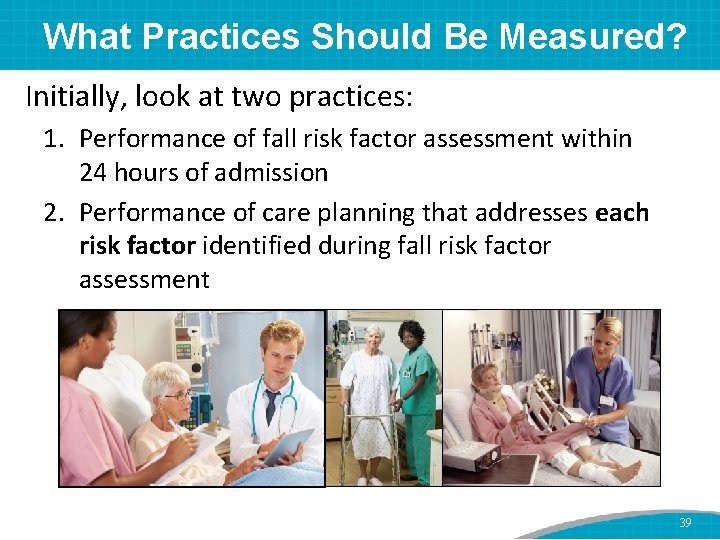
What Practices Should Be Measured? Initially, look at two practices: 1. Performance of fall risk factor assessment within 24 hours of admission 2. Performance of care planning that addresses each risk factor identified during fall risk factor assessment 39
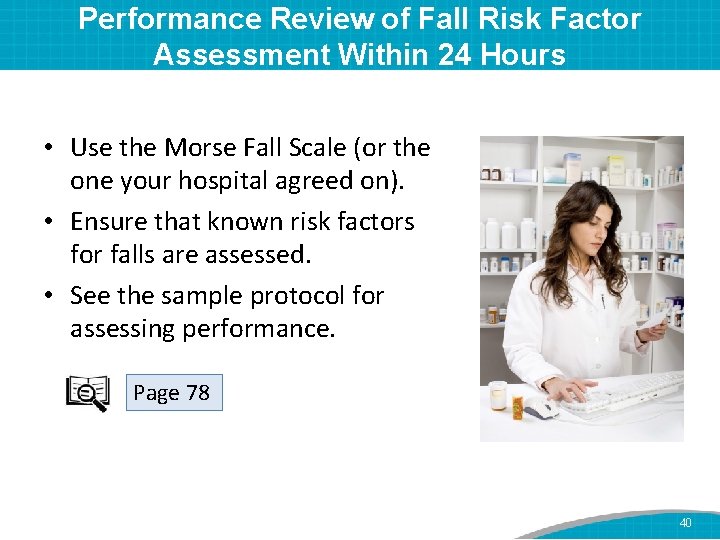
Performance Review of Fall Risk Factor Assessment Within 24 Hours • Use the Morse Fall Scale (or the one your hospital agreed on). • Ensure that known risk factors for falls are assessed. • See the sample protocol for assessing performance. Page 78 40
Care Planning Assessment • All risk factors identified on the fall risk factor assessment need to be addressed in the care plans. • Next, act on the care plans. – Critical thinking by staff – Tailored approach to each patient, based on the patient’s risk factors • Ensure that care plans address all areas of risk. 41
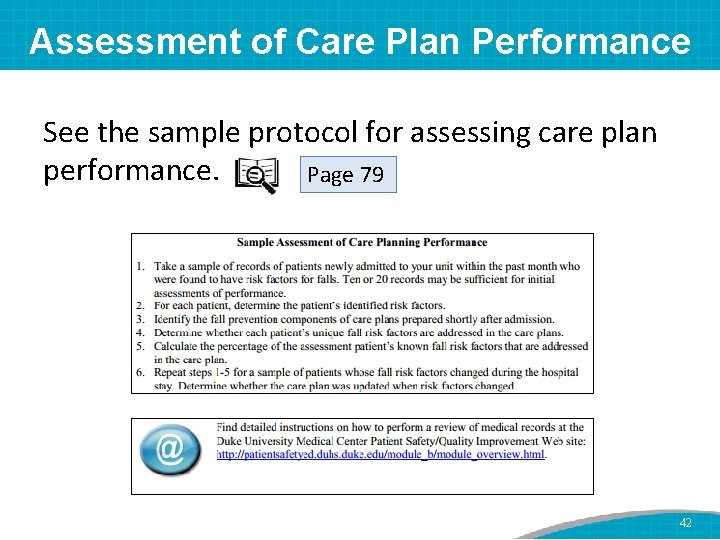
Assessment of Care Plan Performance See the sample protocol for assessing care plan performance. Page 79 42
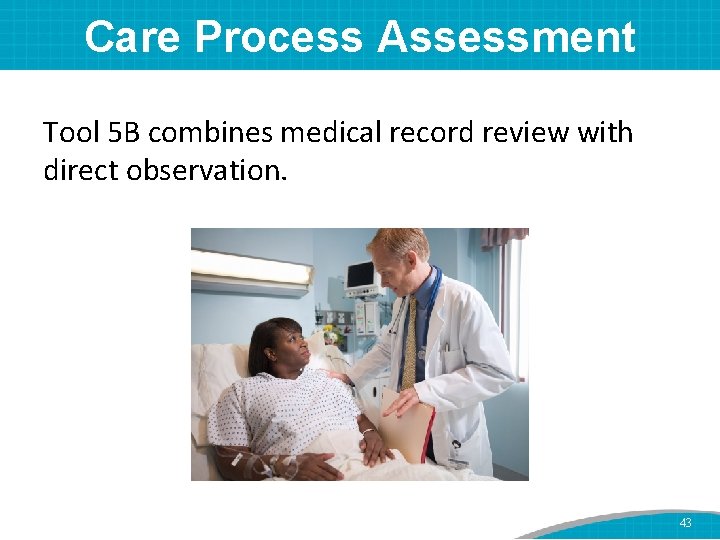
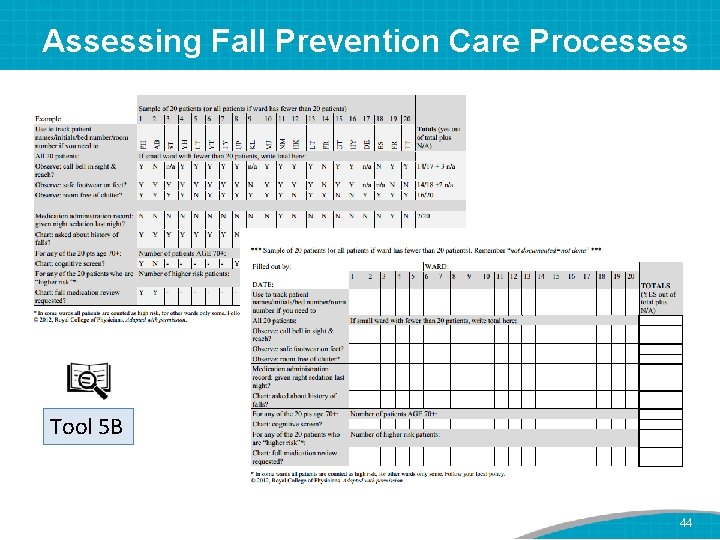
Care Process Assessment Tool 5 B combines medical record review with direct observation. 43
Assessing Fall Prevention Care Processes Tool 5 B 44
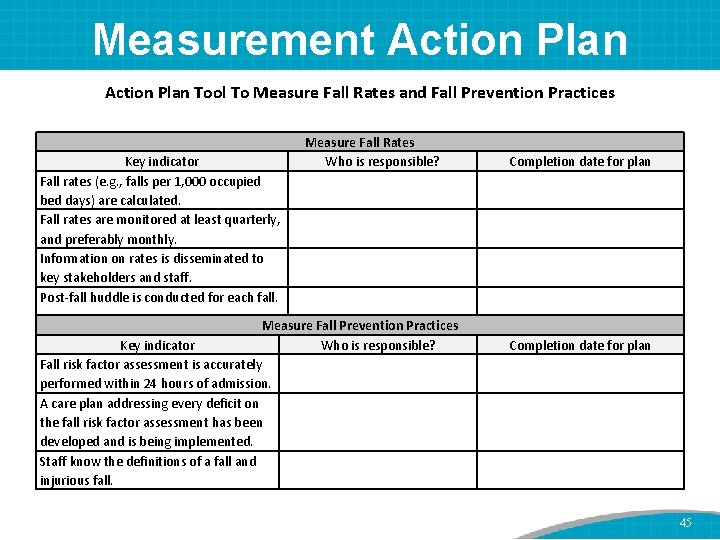
Measurement Action Plan Tool To Measure Fall Rates and Fall Prevention Practices Key indicator Fall rates (e. g. , falls per 1, 000 occupied bed days) are calculated. Fall rates are monitored at least quarterly, and preferably monthly. Information on rates is disseminated to key stakeholders and staff. Post-fall huddle is conducted for each fall. Measure Fall Rates Who is responsible? Measure Fall Prevention Practices Key indicator Who is responsible? Fall risk factor assessment is accurately performed within 24 hours of admission. A care plan addressing every deficit on the fall risk factor assessment has been developed and is being implemented. Staff know the definitions of a fall and injurious fall. Completion date for plan 45
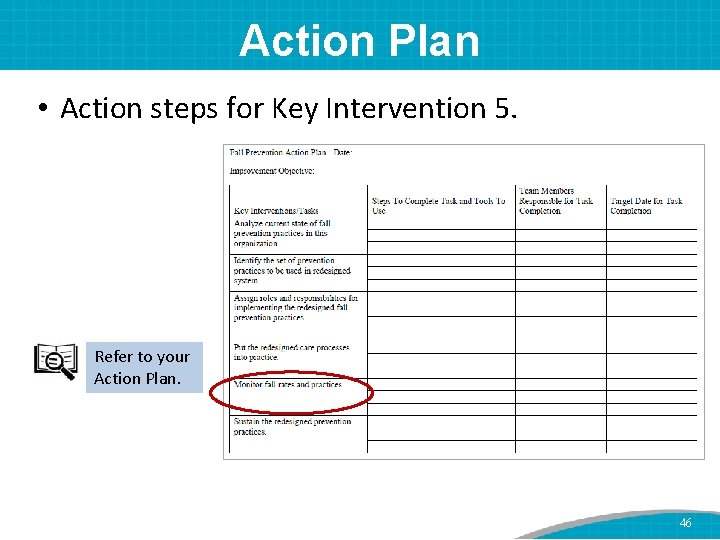
Action Plan • Action steps for Key Intervention 5. Refer to your Action Plan. 46
Summary • In this module, we discussed the following: – This hospital’s definition of a fall – How to measure fall and fall-related injury rates – How to measure fall prevention practices – How to communicate the trends in fall and fallrelated injury rates to key stakeholders 47
Next Steps • Over the next several weeks, we will meet weekly to refine your Action Plan for the Fall Prevention Program. • Thank you for being a part of this Team to make this hospital safer for patients. 48