
How to make this work You have to
- Slides: 18
How to make this work… • You have to follow the instructions on the powerpoint completely. There are moments when you will feel like a total div. I suggest you don’t do this in public. However, this honestly isn’t Woody trying to make you look like a moron, it is based on genuine scientific research about how to get information into the long term memory
Instruction one • Until the next instruction slide you have to read out loud every word on the slides. • Take it slowly and make sure you are concentrating on what you are reading.
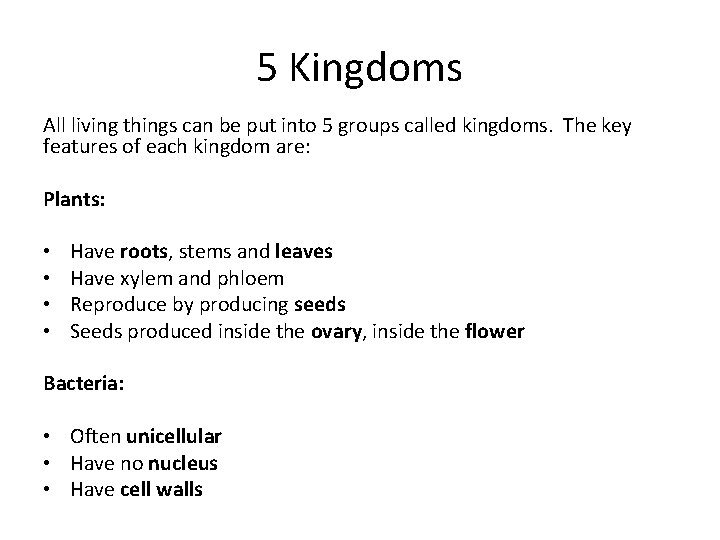
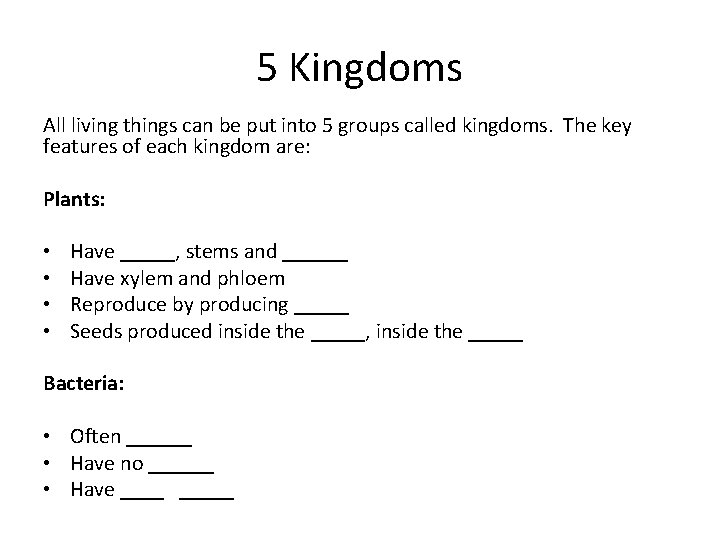
5 Kingdoms All living things can be put into 5 groups called kingdoms. The key features of each kingdom are: Plants: • Have roots, stems and leaves • Have xylem and phloem • Reproduce by producing seeds • Seeds produced inside the ovary, inside the flower Bacteria: • Often unicellular • Have no nucleus • Have cell walls
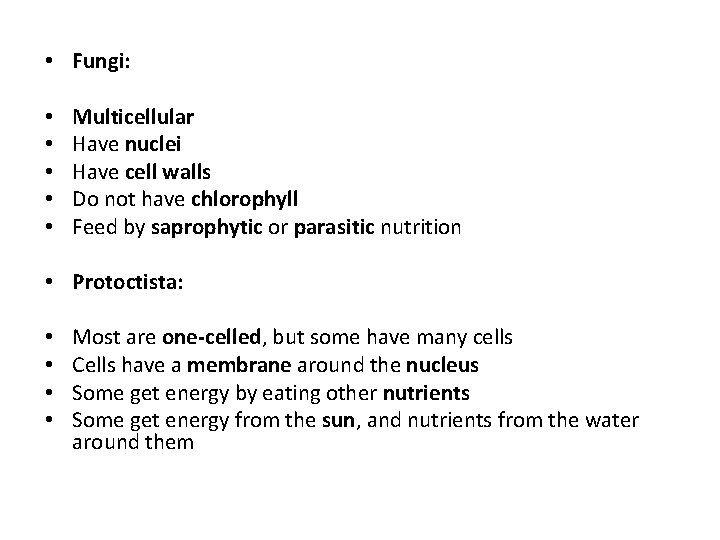
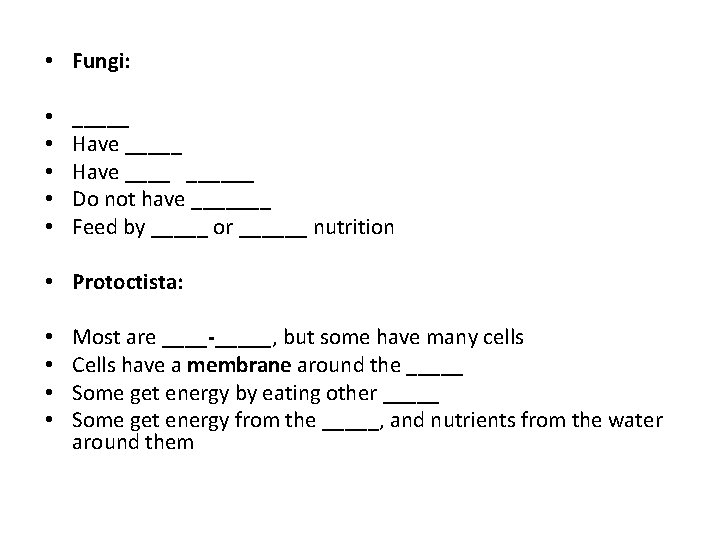
• Fungi: • • • • Multicellular Have nuclei Have cell walls Do not have chlorophyll Feed by saprophytic or parasitic nutrition • • Most are one-celled, but some have many cells Cells have a membrane around the nucleus Some get energy by eating other nutrients Some get energy from the sun, and nutrients from the water around them Protoctista:
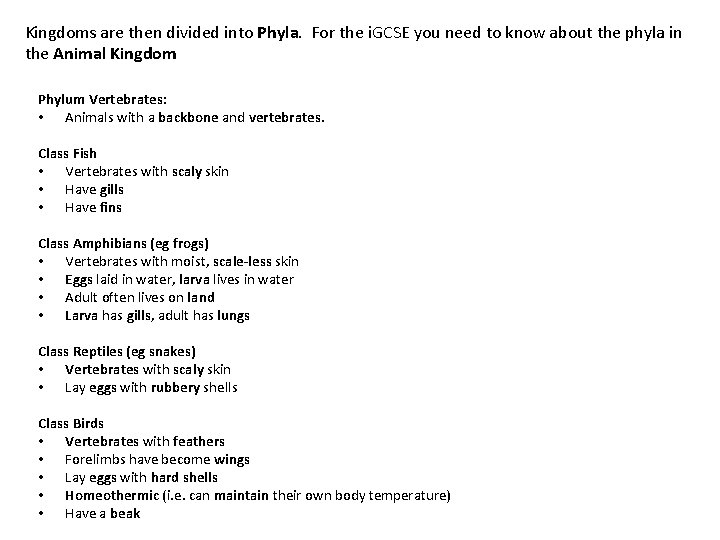
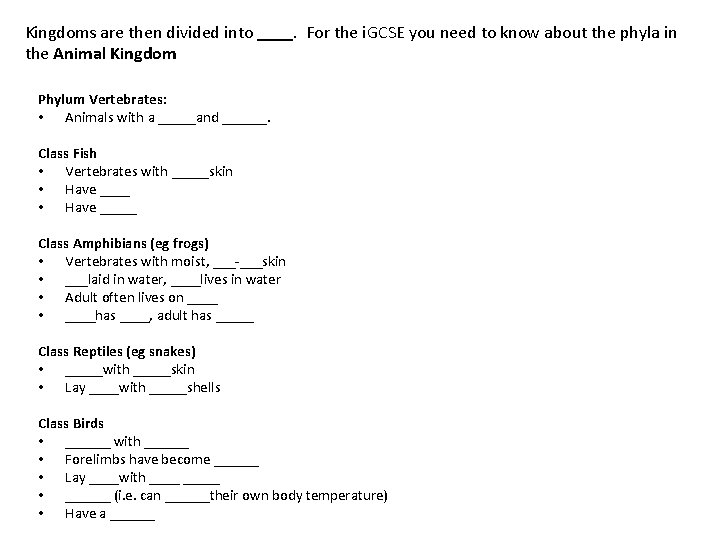
Kingdoms are then divided into Phyla. For the i. GCSE you need to know about the phyla in the Animal Kingdom Phylum Vertebrates: • Animals with a backbone and vertebrates. Class Fish • Vertebrates with scaly skin • Have gills • Have fins Class Amphibians (eg frogs) • Vertebrates with moist, scale-less skin • Eggs laid in water, larva lives in water • Adult often lives on land • Larva has gills, adult has lungs Class Reptiles (eg snakes) • Vertebrates with scaly skin • Lay eggs with rubbery shells Class Birds • Vertebrates with feathers • Forelimbs have become wings • Lay eggs with hard shells • Homeothermic (i. e. can maintain their own body temperature) • Have a beak
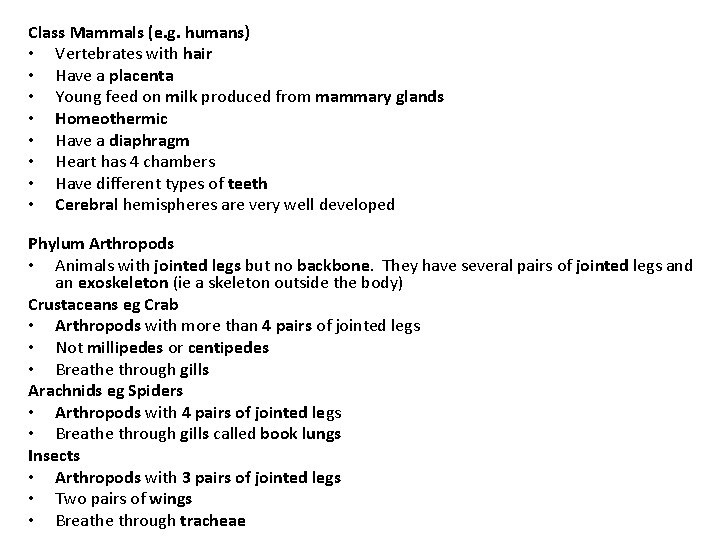
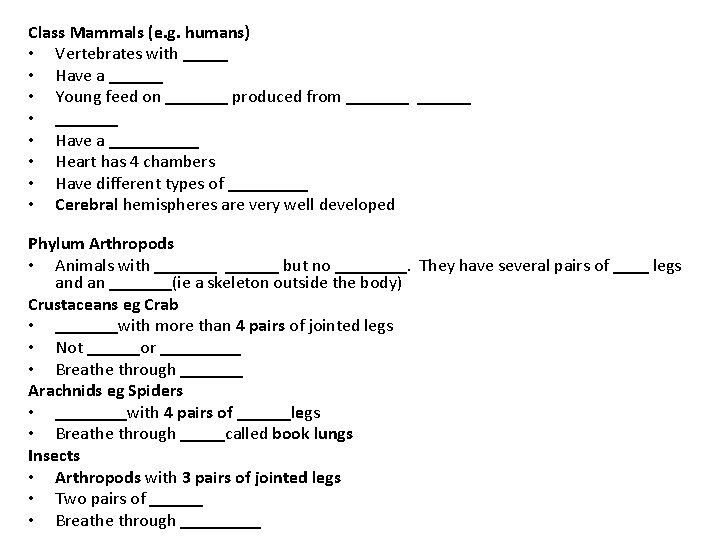
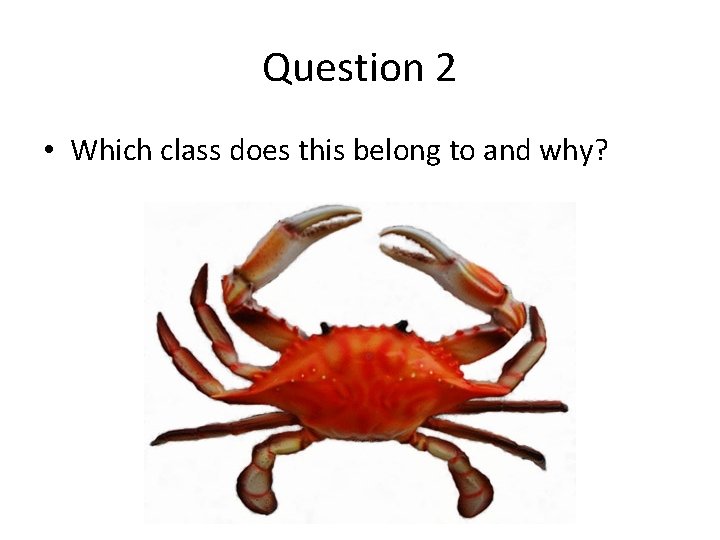
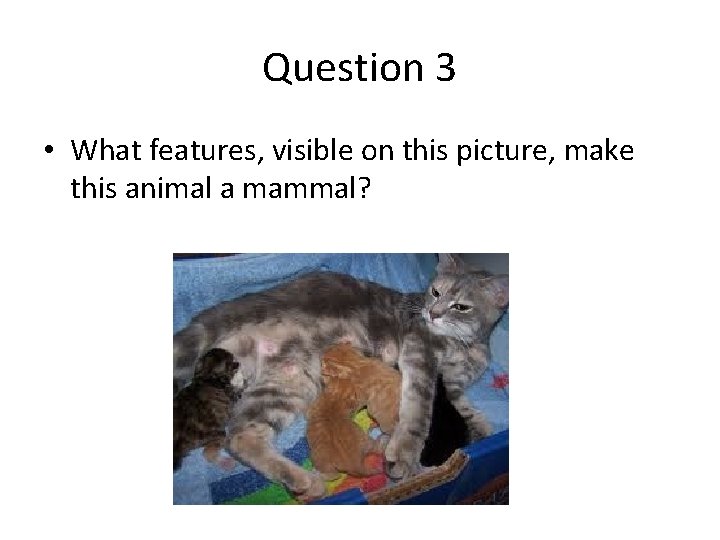
Class Mammals (e. g. humans) • Vertebrates with hair • Have a placenta • Young feed on milk produced from mammary glands • Homeothermic • Have a diaphragm • Heart has 4 chambers • Have different types of teeth • Cerebral hemispheres are very well developed Phylum Arthropods • Animals with jointed legs but no backbone. They have several pairs of jointed legs and an exoskeleton (ie a skeleton outside the body) Crustaceans eg Crab • Arthropods with more than 4 pairs of jointed legs • Not millipedes or centipedes • Breathe through gills Arachnids eg Spiders • Arthropods with 4 pairs of jointed legs • Breathe through gills called book lungs Insects • Arthropods with 3 pairs of jointed legs • Two pairs of wings • Breathe through tracheae
Instruction 2 • Stand up • Yes, get up – I mean it… • Now – jump up and down, run around, tap your head and rub your belly. • Do something active for 5 minutes. It would be perfect if you could throw or kick a ball about
Now… • You will see the same slides again but this time words have been taken out. You need to read the slides out loud again, this time inserting the missing word. • Keep going until the next instruction slide.
5 Kingdoms All living things can be put into 5 groups called kingdoms. The key features of each kingdom are: Plants: • Have _____, stems and ______ • Have xylem and phloem • Reproduce by producing _____ • Seeds produced inside the _____, inside the _____ Bacteria: • Often ______ • Have no ______ • Have _____
• Fungi: • • • • _____ Have ______ Do not have _______ Feed by _____ or ______ nutrition • • Most are ____-_____, but some have many cells Cells have a membrane around the _____ Some get energy by eating other _____ Some get energy from the _____, and nutrients from the water around them Protoctista:
Kingdoms are then divided into ____. For the i. GCSE you need to know about the phyla in the Animal Kingdom Phylum Vertebrates: • Animals with a _____and ______. Class Fish • Vertebrates with _____skin • Have _____ Class Amphibians (eg frogs) • Vertebrates with moist, ___-___skin • ___laid in water, ____lives in water • Adult often lives on ____ • ____has ____, adult has _____ Class Reptiles (eg snakes) • _____with _____skin • Lay ____with _____shells Class Birds • ______ with ______ • Forelimbs have become ______ • Lay ____with _____ • ______ (i. e. can ______their own body temperature) • Have a ______
Class Mammals (e. g. humans) • Vertebrates with _____ • Have a ______ • Young feed on _______ produced from _______ • Have a _____ • Heart has 4 chambers • Have different types of _____ • Cerebral hemispheres are very well developed Phylum Arthropods • Animals with _______ but no ____. They have several pairs of ____ legs and an _______(ie a skeleton outside the body) Crustaceans eg Crab • _______with more than 4 pairs of jointed legs • Not ______or _____ • Breathe through _______ Arachnids eg Spiders • ____with 4 pairs of ______legs • Breathe through _____called book lungs Insects • Arthropods with 3 pairs of jointed legs • Two pairs of ______ • Breathe through _____
Instruction 3 • Stand up • Yes, get up – I mean it… • Now – jump up and down, run around, tap your head and rub your belly. • Do something active for 5 minutes. It would be perfect if you could throw or kick a ball about
And now… • You are going to answer some questions to test your new found knowledge. • Each slide has a question – have a go at it. • This should be straightforward now
Question 1 • What are the defining characteristics of organisms in the: a) b) c) d) Plant Fungi Protist Prokaryote Kingdoms?
Question 2 • Which class does this belong to and why?
Question 3 • What features, visible on this picture, make this animal a mammal?
And finally • Take another 5 minute activity break – seriously, throwing a ball is ideal – it uses a different parts of your brain and makes it function more efficiently as it is using both hemispheres. • Anyway – then, sit down with your text book and make sure you have flashcards or notes covering this. They love asking MCQ questions on it