
HOW TO MAKE A GREAT TALK by Dina
HOW TO MAKE A GREAT TALK by Dina F. Mandoli Designed for the MCB Graduate Program at University of Washington Modified for ASPB
HOW TO VIEW THIS PRESENTATION • Hi! Please view this presentation in edit mode so that I can narrate to you via the notes feature in the panel directly below the slide image. When there is an animation that I would like you to look at, I will direct you to go into slide show mode. Dina Mandoli

DESIGNING A GREAT TALK I. TYPES OF TALKS II. STRUCTURAL FEATURES A. MECHANICS B. TONE AND FLOW
DESIGNING A GREAT TALK I. TYPES OF TALKS II. STRUCTURAL FEATURES A. MECHANICS B. TONE AND FLOW
DESIGNING A GREAT TALK I. TYPES OF TALKS • Formal • Informal • Spontaneous • 12 minute • 45 minute • Job…. arghhhh!!

TYPES OF TALKS • Formal - practice timing! • Informal - no rambling allowed… • Spontaneous - important, overlooked • 12 minute - has one punch line • 45 minute - has 1 or 2 themes • Job - practice, practice
DESIGNING A GREAT TALK I. TYPES OF TALKS II. STRUCTURAL FEATURES A. MECHANICS B. TONE AND FLOW
DESIGNING A GREAT TALK II. STRUCTURAL FEATURES A. MECHANICS – – – Audience rapport Organization Flow of ideas Crystallizing ideas Style B. TONE & FLOW – – Adapting to the circumstance Personal appearance Audience rapport Pace of the talk

DESIGNING A GREAT TALK II. STRUCTURAL FEATURES A. MECHANICS – – – Audience rapport Organization Flow of ideas Crystallizing ideas Style B. TONE & FLOW – – Adapting to the circumstance Personal appearance Audience rapport Pace of the talk
AUDIENCE RAPPORT Say “hi”. Earn their trust. Keep their trust. Say “bye”.
ORGANIZATION Introduction…Rationale…Results…Summary • Share your organization; • sub-summary slides mark sections, define logic, crystallize ideas; • transitions…; • have a clear ending…”Thank you…”
ORGANIZATIONAL AIDS Facts about people: • Their thoughts stray during a 45 minute talk. • They need repetition both to remember things… • …and to crystallize & integrate new information. • They need to trust a speaker to learn.
FLOW OF IDEAS Make what you want the audience to know OBVIOUS from the start of the talk - tell them the punch line first. Remind the audience of where you have been, where you are going and why often enough that they follow your train of thought. Remember to…
WHY CRYSTALLIZE IDEAS? • Cements concepts and integrates data. • Gives the chance for folks who drifted off or were drawing a cartoon to catch up. • Relieves stress of folks who “didn’t get it”. • Allows folks with different learning styles or from different backgrounds to “see” where you are going.
CRYSTALLIZING IDEAS You know the work better than anyone! Simple slides help the audience: • Hypothesis “If…then, …”; • logic “We reasoned that…”; • titles that are informative; • sub-summary; • overall summary.
STYLE… Depends on your comfort zone & personality. Jokes… Sunsets… Backgrounds… Font… Colors… Show and tell… Bullets… Transitions… Movies… Animation. Depends on the audience you are addressing.
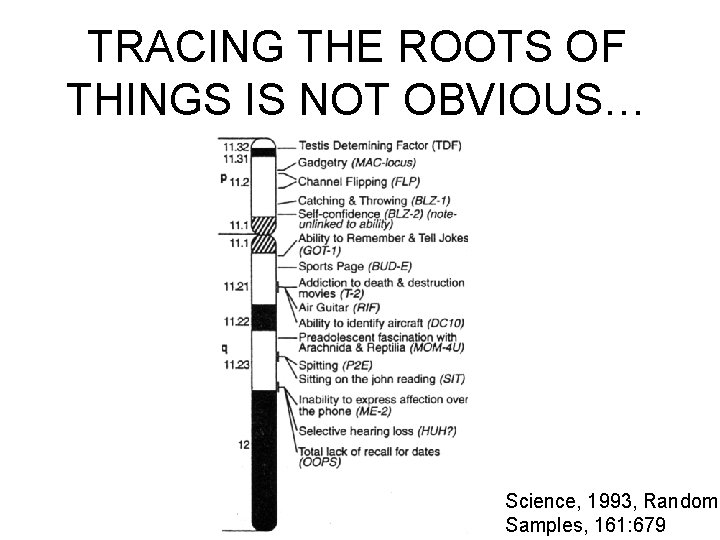
TRACING THE ROOTS OF THINGS IS NOT OBVIOUS… Science, 1993, Random Samples, 161: 679
DESIGNING A GREAT TALK II. STRUCTURAL FEATURES A. MECHANICS – – – Audience rapport Organization Flow of ideas Crystallizing ideas Style B. TONE & FLOW – – Adapting to the circumstance Personal appearance Audience rapport Pace of the talk
KNOW YOUR AUDIENCE, KNOW YOUR ROOM, KNOW YOUR TIMING, KNOW YOURSELF. Kindergarteners versus adults Big versus little Short versus long Reminders & transitions
GETTING THE ATTENTION OF THE AUDIENCE • Please guess the amount of time that you have to get the attention of your audience and what you should wear for a talk. • Now, please go into slide show mode to see some answers. Do take the time to look at the URLs. They are amusing if nothing else…
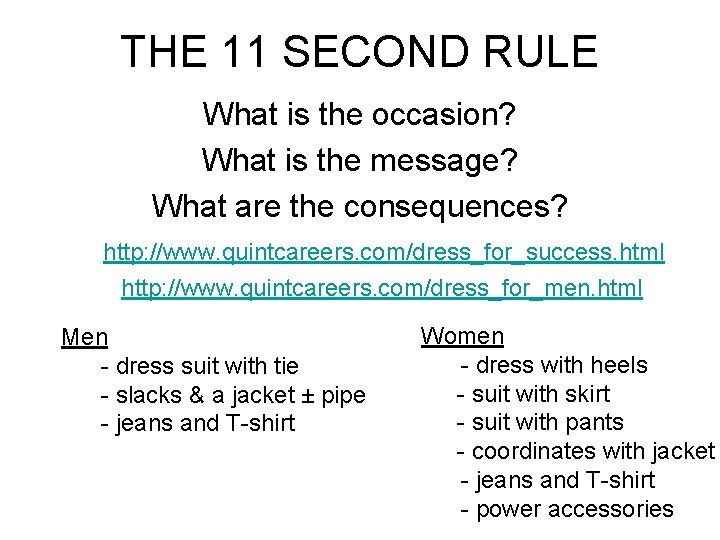
THE 11 SECOND RULE What is the occasion? What is the message? What are the consequences? http: //www. quintcareers. com/dress_for_success. html http: //www. quintcareers. com/dress_for_men. html Men - dress suit with tie - slacks & a jacket ± pipe - jeans and T-shirt Women - dress with heels - suit with skirt - suit with pants - coordinates with jacket - jeans and T-shirt - power accessories
Please exit slide show mode now.
THE 11 SECOND RULE What is the occasion? What is the message? What are the consequences? http: //www. quintcareers. com/dress_for_success. html http: //www. quintcareers. com/dress_for_men. html Men - dress suit with tie - slacks & a jacket ± pipe - jeans and T-shirt Women - dress with heels - suit with skirt - suit with pants - coordinates with jacket - jeans and T-shirt - power accessories
WHY SHOULD I CARE? Be enthusiastic Be present (“Puzzled? …”) Be interactive (violate borders)
AUDIENCE RAPPORT Interact at many levels: • • • Establish rapport with body language; keep it with a loud, clear voice… ; … and open body language; keep eye contact with audience, give them space to think; match the depth/breadth of the information to their needs.
THE RELATIVE VALUE OF WAYS OF COMMUNICATING What is the relative impact of your body language, your tone and your words? On the next slide you will see the answers so get your guesses in mind and then go to slide show mode. Again, do take the time to look at the URLs.
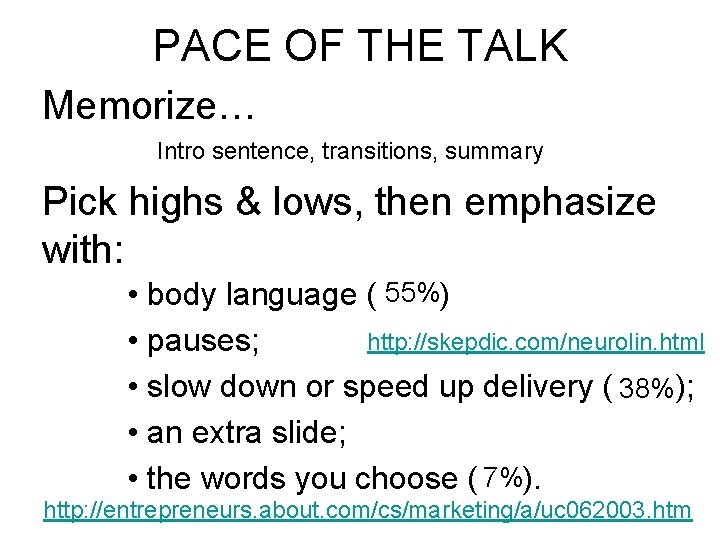
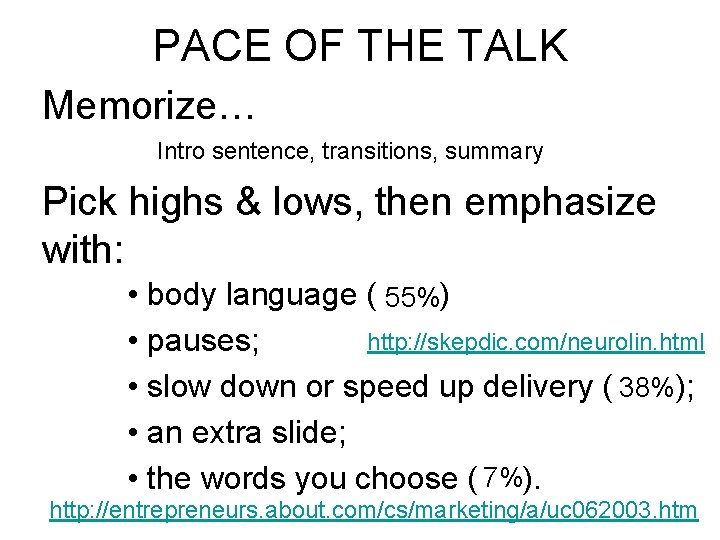
PACE OF THE TALK Memorize… Intro sentence, transitions, summary Pick highs & lows, then emphasize with: • body language ( 55%) http: //skepdic. com/neurolin. html • pauses; • slow down or speed up delivery ( 38%); • an extra slide; • the words you choose ( 7%). http: //entrepreneurs. about. com/cs/marketing/a/uc 062003. htm
Please exit slide show mode.
PACE OF THE TALK Memorize… Intro sentence, transitions, summary Pick highs & lows, then emphasize with: • body language ( 55%) http: //skepdic. com/neurolin. html • pauses; • slow down or speed up delivery ( 38%); • an extra slide; • the words you choose ( 7%). http: //entrepreneurs. about. com/cs/marketing/a/uc 062003. htm
AND ONE LAST THING… Mind your manners! In words … (“Tommy, …”) In tone… (matching the context) In physical displays! (gender based interactions and self-stroking)
POWER asym. METRIES Mirroring level of interaction (emails…) Always err on the side of politeness Avoid fawning Avoid self-erasure Avoid sliding into another mode near the end of the interaction.
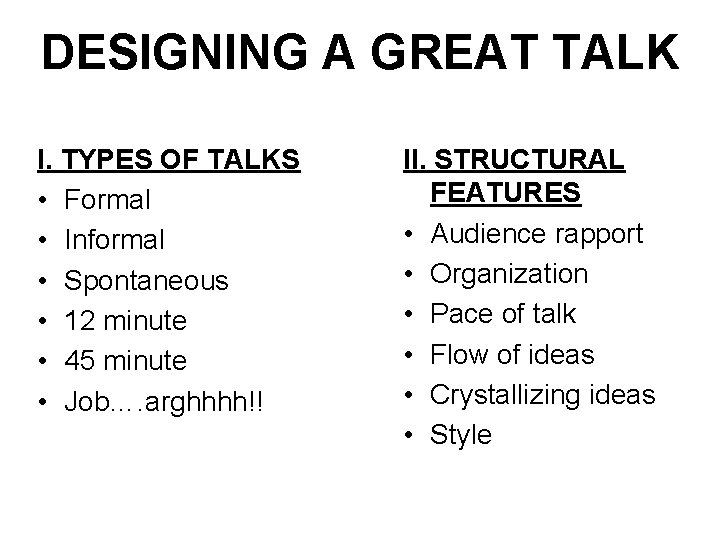
DESIGNING A GREAT TALK I. TYPES OF TALKS • Formal • Informal • Spontaneous • 12 minute • 45 minute • Job…. arghhhh!! II. STRUCTURAL FEATURES • Audience rapport • Organization • Pace of talk • Flow of ideas • Crystallizing ideas • Style
- Slides: 32