
How to Interpret Scripture Lesson 7 for May

- Slides: 16
How to Interpret Scripture Lesson 7 for May 16, 2020
Memory Verse
God let His Word to be persecuted for some time in the past (Revelation 11). However, in the End Time–our time–, God has let the Bible to be read by 95% of the Earth’s population. Bible Societies have been essential for the translation and distribution of the Scriptures. We can read the Bible in our mother tongue, but we should understand some basic concepts about its original language and context, so we can understand its message better. Understanding Words Repetition Context Authorship
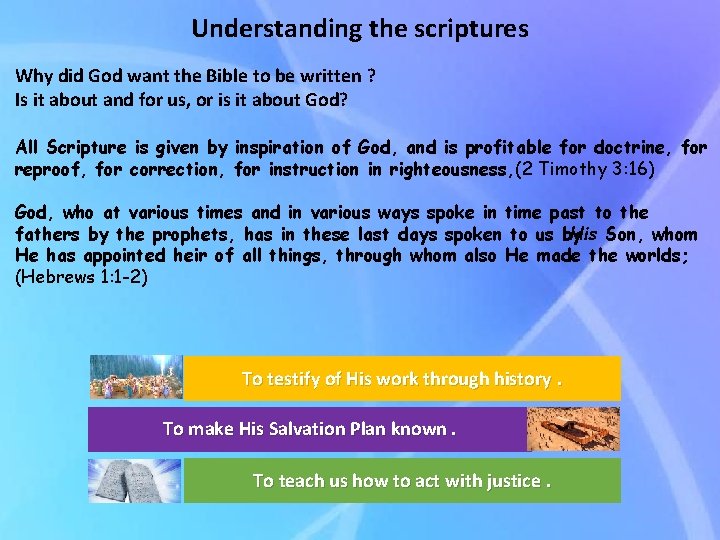
Understanding the scriptures Why did God want the Bible to be written ? Is it about and for us, or is it about God? All Scripture is given by inspiration of God, and is profitable for doctrine, for reproof, for correction, for instruction in righteousness, (2 Timothy 3: 16) God, who at various times and in various ways spoke in time past to the fathers by the prophets, has in these last days spoken to us by His Son, whom He has appointed heir of all things, through whom also He made the worlds; (Hebrews 1: 1 -2) To testify of His work through history. To make His Salvation Plan known. To teach us how to act with justice.
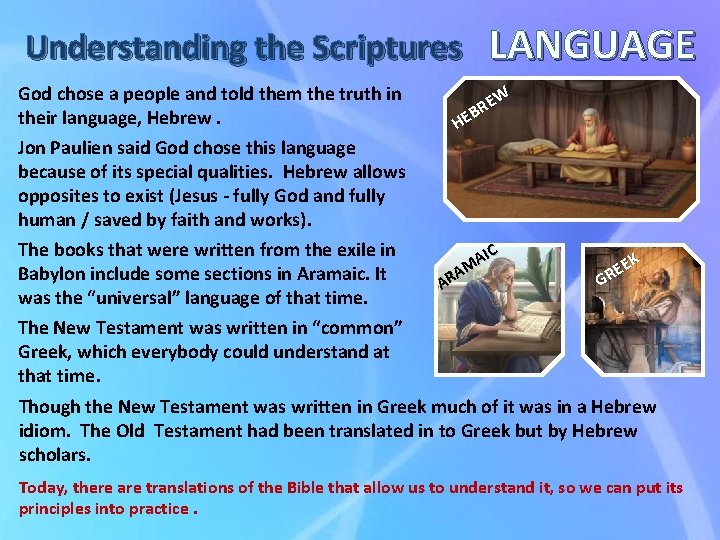
Understanding the Scriptures God chose a people and told them the truth in their language, Hebrew. Jon Paulien said God chose this language because of its special qualities. Hebrew allows opposites to exist (Jesus - fully God and fully human / saved by faith and works). The books that were written from the exile in Babylon include some sections in Aramaic. It was the “universal” language of that time. The New Testament was written in “common” Greek, which everybody could understand at that time. LANGUAGE EW R B HE IC A AM R A EK E GR Though the New Testament was written in Greek much of it was in a Hebrew idiom. The Old Testament had been translated in to Greek but by Hebrew scholars. Today, there are translations of the Bible that allow us to understand it, so we can put its principles into practice.
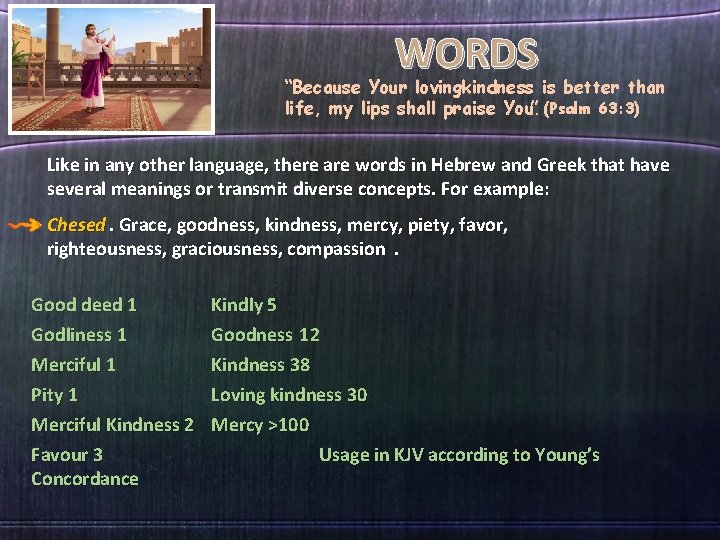
WORDS “Because Your lovingkindness is better than life, my lips shall praise You. ” (Psalm 63: 3) Like in any other language, there are words in Hebrew and Greek that have several meanings or transmit diverse concepts. For example: Chesed. Grace, goodness, kindness, mercy, piety, favor, righteousness, graciousness, compassion. Good deed 1 Godliness 1 Merciful 1 Pity 1 Merciful Kindness 2 Favour 3 Concordance Kindly 5 Goodness 12 Kindness 38 Loving kindness 30 Mercy >100 Usage in KJV according to Young’s
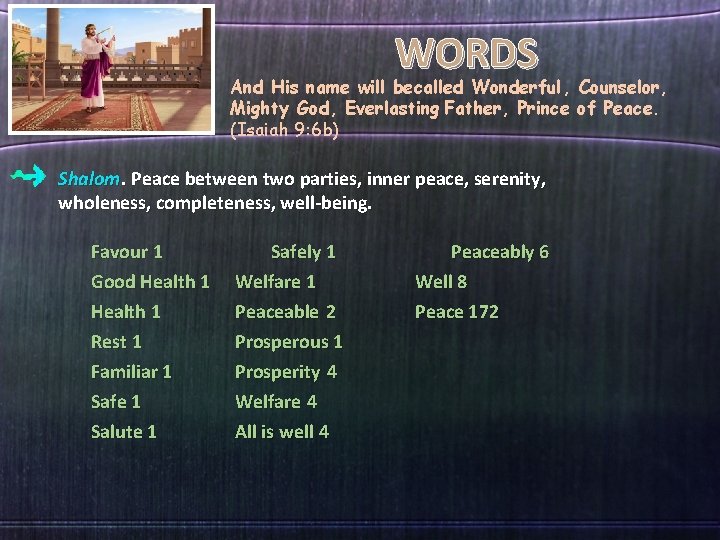
WORDS And His name will becalled Wonderful , Counselor, Mighty God, Everlasting Father, Prince of Peace. (Isaiah 9: 6 b) Shalom. Peace between two parties, inner peace, serenity, wholeness, completeness, well-being. Favour 1 Good Health 1 Rest 1 Familiar 1 Safe 1 Salute 1 Safely 1 Welfare 1 Peaceable 2 Prosperous 1 Prosperity 4 Welfare 4 All is well 4 Peaceably 6 Well 8 Peace 172
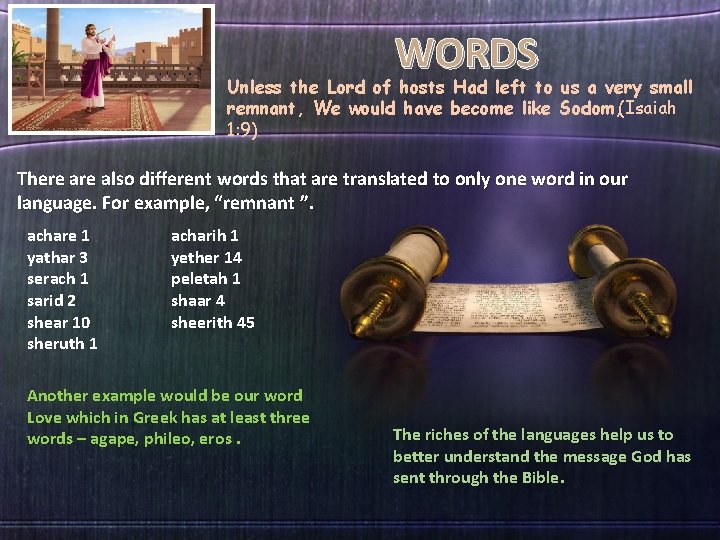
WORDS Unless the Lord of hosts Had left to us a very small remnant, We would have become like Sodom, (Isaiah 1: 9) There also different words that are translated to only one word in our language. For example, “remnant ”. achare 1 yathar 3 serach 1 sarid 2 shear 10 sheruth 1 acharih 1 yether 14 peletah 1 shaar 4 sheerith 45 Another example would be our word Love which in Greek has at least three words – agape, phileo, eros. The riches of the languages help us to better understand the message God has sent through the Bible.
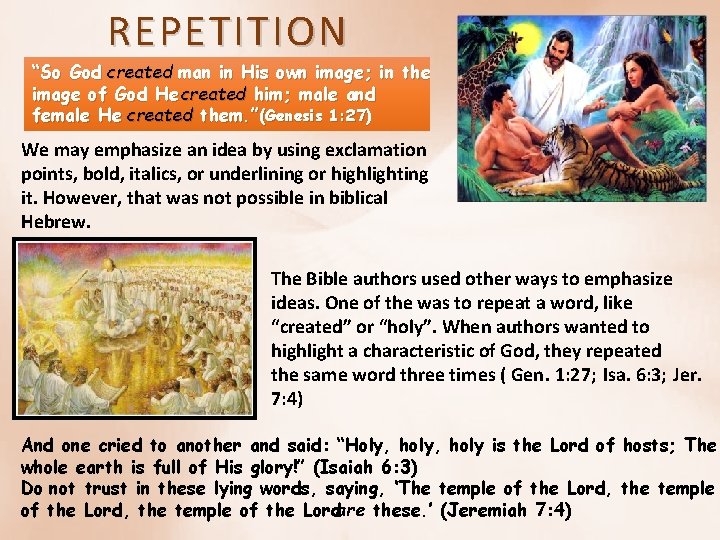
REPETITION “So God created man in His own image; in the image of God He created him; male and female He created them. ” (Genesis 1: 27) We may emphasize an idea by using exclamation points, bold, italics, or underlining or highlighting it. However, that was not possible in biblical Hebrew. The Bible authors used other ways to emphasize ideas. One of the was to repeat a word, like “created” or “holy”. When authors wanted to highlight a characteristic of God, they repeated the same word three times ( Gen. 1: 27; Isa. 6: 3; Jer. 7: 4) And one cried to another and said: “Holy, holy is the Lord of hosts; The whole earth is full of His glory!” (Isaiah 6: 3) Do not trust in these lying words, saying, ‘The temple of the Lord, the temple of the Lordare these. ’ (Jeremiah 7: 4)
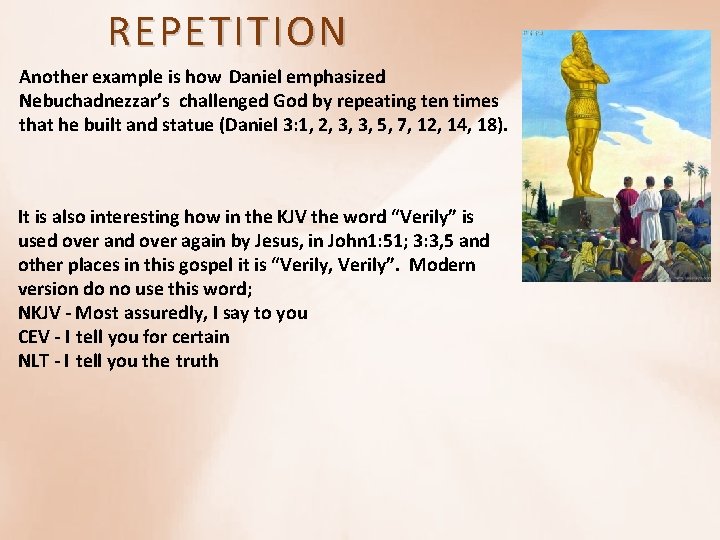
REPETITION Another example is how Daniel emphasized Nebuchadnezzar’s challenged God by repeating ten times that he built and statue (Daniel 3: 1, 2, 3, 3, 5, 7, 12, 14, 18). It is also interesting how in the KJV the word “Verily” is used over and over again by Jesus, in John 1: 51; 3: 3, 5 and other places in this gospel it is “Verily, Verily”. Modern version do no use this word; NKJV - Most assuredly, I say to you CEV - I tell you for certain NLT - I tell you the truth
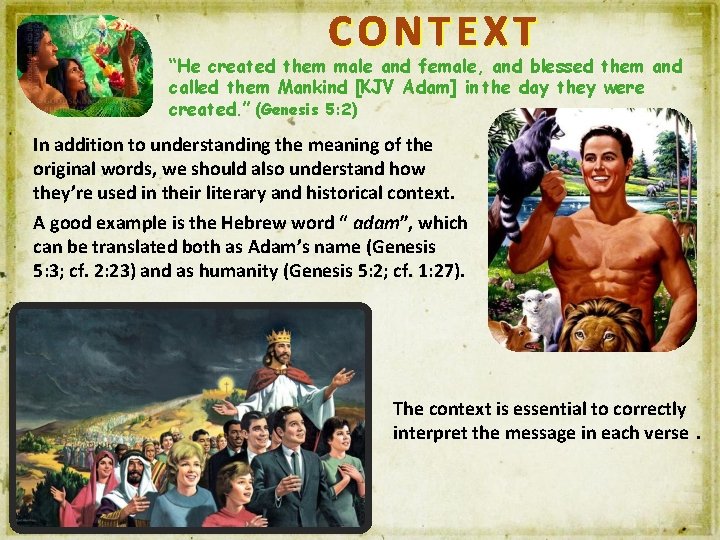
CONTEXT “He created them male and female, and blessed them and called them Mankind [KJV Adam] in the day they were created. ” (Genesis 5: 2) In addition to understanding the meaning of the original words, we should also understand how they’re used in their literary and historical context. A good example is the Hebrew word “ adam”, which can be translated both as Adam’s name (Genesis 5: 3; cf. 2: 23) and as humanity (Genesis 5: 2; cf. 1: 27). The context is essential to correctly interpret the message in each verse.
AUTHORSHIP “The words of Amos, who was among the sheepbreeders of Tekoa, which he saw concerning Israel in the days of Uzziah king of Judah, and in the days of Jeroboam the son of Joash, king of Israel, two years before the earthquake. ” (Amos 1: 1) We can better understand the message of the Bible if we know about who wrote each book and the author’s writing style. We know who wrote many of the books of the Bible, and even the date when it was written (Amos is a good example). However, this information is only available through the Judeo-Christian tradition in other cases. In some cases, the historical context is especially important. For example, we may not understand the book of Exodus completely if we have not read Genesis first. In addition, the Bible contains poetic, historical, prophetic, and epistolary books. Each style should be read and interpreted in a different way. SEVERAL AUTHORS SEVERAL AGES SEVERAL STYLES
Some other general comments about Understanding the Scriptures “The less you know about the Bible the more likely you are to say you understand it” Jan Paulien. “It isn’t hard to have strong convictions on any topic as long as you are willing to ignore some of the evidence. ” Many times when God was clear to the people at the time it is unclear to us because we have a different world views. For what great nation is there that has Godso near to it. . . Only take heed to yourself, and diligently keep yourself, lest you forget the things your eyes have seen, and lest they depart from your heart all the days of your life. And teach them to your children and your grandchildren. (Deuteronomy 4: 7, 9)
“Written in different ages, by men who differed widely in rank and occupation, and in mental and spiritual endowments, the books of the Bible present a wide contrast in style, as well as a diversity in the nature of the subjects unfolded. Different forms of expression are employed by different writers; often the same truth is more strikingly presented by one than by another. [various writers present] different aspect of the truth in each, but a perfect harmony through all. And the truths thus revealed unite to form a perfect whole, adapted to meet the wants of men in all the circumstances and experiences of life. ” E. G. W. (The Great Controversy, Introduction , p. vi)
The End These slides have been adapted from those prepared by Sergio Fustero and Eunice Laveda, members of the Seventh-Day Adventist Church in Spain. The originals can be found at https: //www. fustero. es/index_en. php