
How to integrate dynamic risk assessment into mental





- Slides: 56
How to integrate dynamic risk assessment into mental health treatment and drug counseling
About me: �LCSW: Mental Health 1986 -1999 �U. S. Probation March 1999 to 4/30/19 �Cal State L. A. , School of Social Work, Lecturer, 2006 to now �“To teach is to learn”, Japanese proverb
Mental Health & Criminal Justice
About you? � Drug counselors? � Mental health clinicians?
RNR? On a 1 -5 scale: � 1= Never heard of it � 2 = I’ve heard of it � 3 = I have had some training but need help knowing how to integrate it into my daily work with clients � 4 = I have had some training; I’m ready to integrate into my practice, but I don’t have the agency support I need, i. e. , ongoing training, coaching & supervision � 5 = I should be doing the training instead of this guy
Plan for today � In one hour, from big picture, EBP/RNR to work some practical examples together
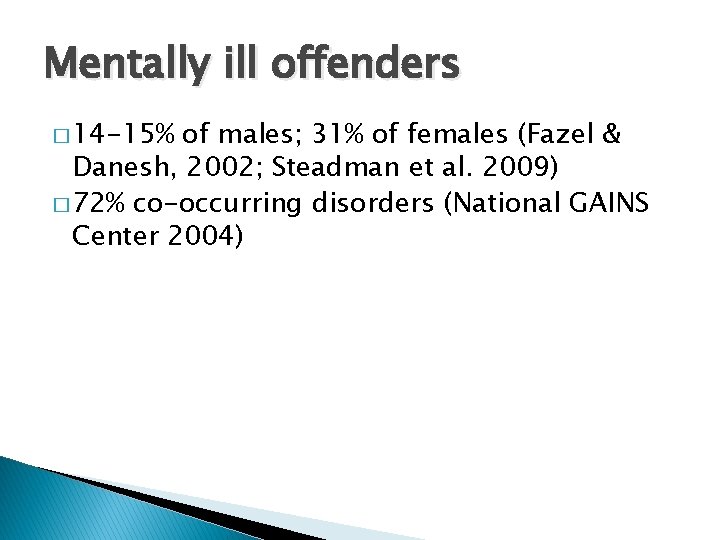
Mentally ill offenders � 14 -15% of males; 31% of females (Fazel & Danesh, 2002; Steadman et al. 2009) � 72% co-occurring disorders (National GAINS Center 2004)
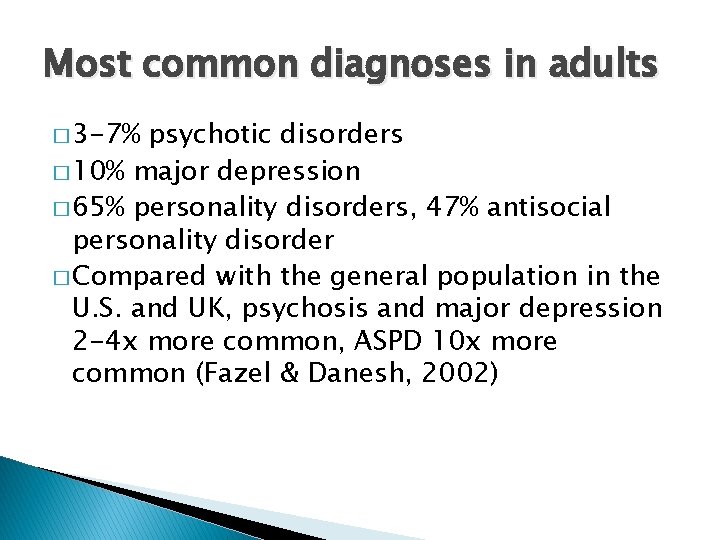
Most common diagnoses in adults � 3 -7% psychotic disorders � 10% major depression � 65% personality disorders, 47% antisocial personality disorder � Compared with the general population in the U. S. and UK, psychosis and major depression 2 -4 x more common, ASPD 10 x more common (Fazel & Danesh, 2002)
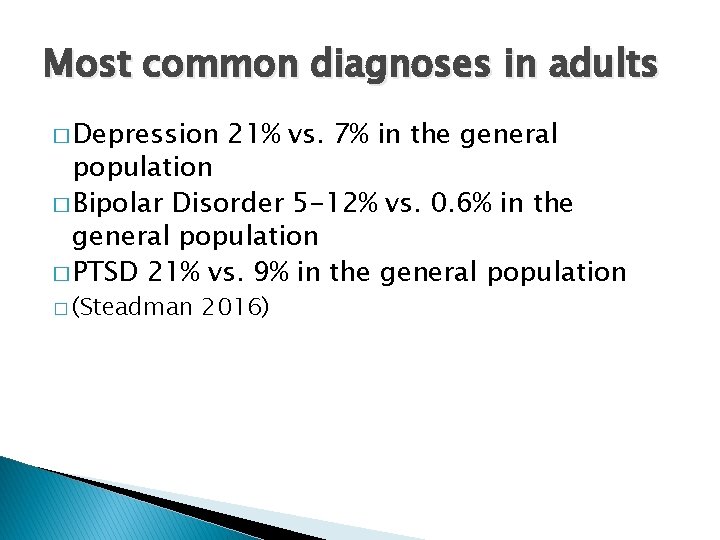
Most common diagnoses in adults � Depression 21% vs. 7% in the general population � Bipolar Disorder 5 -12% vs. 0. 6% in the general population � PTSD 21% vs. 9% in the general population � (Steadman 2016)
Personality Disorders � Who are the other 18%? � Anecdotally, mostly narcissistic, borderline, schizoid, schizotypal, paranoid
� One study - Offenders included federal inmates, parolees (Georgia), child molesters � Antisocials: 33 -49% � Neurotic: 13 -18% � Dependent: 16 -29% � Situational: 17 -25% ◦ (Listwan et al. 2004)
Other diagnostic considerations � Gambling Disorder – 25 -30% (Petrey et al. 2005; 5 -73% (Williams et al. 2005) ◦ Credit to Tim Fong, MD, UCLA � www. problemgambling. ca. gov
What is evidence-based practice (EBP)? �“…simply … the use of research findings as a primary source of knowledge for practice” (Trotter, 2006)
� National Institute of Corrections (NIC) ◦ Best practices = based on collective professional experience, not scientifically tested ◦ “What works” = general outcomes ◦ EBP = definable, measureable outcomes of practical realities, e. g. , recidivism
Washington State Institute for Public Policy (WSIPP) � Evidence-based: tested in heterogeneous or intended populations; multiple randomized and/or statistically-controlled evaluations or one large multiple-site randomized and/or statistically controlled evaluation; weight of systematic review demonstrates sustained improvements; can be implemented with a set of procedures for successful replication; cost-beneficial
� Washington State Institute for Public Policy (WSIPP) continued � Research-based: tested with one randomized and/or statistically-controlled evaluation demonstrating sustained desirable outcomes; or weight of evidence from a systematic review supports sustained outcomes
Substance Abuse and Mental Health Services Administration (SAMHSA) National Registry of Evidence-based Programs and Practices (NREPP) � ◦ http: //nrepp. samhsa. gov/01_landing. aspx ◦ Evidence-based practice: “A practice that is based on rigorous research that has demonstrated effectiveness in achieving the outcomes that it is designed to achieve. ” ◦ Promising: “Outcomes based on an evidence base which produced sufficient evidence of a favorable effect. ” ◦ Ineffective or Inconclusive
� � � Office of Justice Programs (OJP), National Institute of Justice (NIJ) http: //www. crimesolutions. gov/ Effective: “Programs have strong evidence to indicate they achieve their intended outcomes when implemented with fidelity. ” Promising: “Programs have some evidence to indicate their intended outcomes. ” No Effects
How do we really know? �Excited over data? �“There are 3 kinds of lies: lies, damned lies, and statistics” (Benjamin Disraeli) �Best we have. �RNR works - reduces recidivism 2550% = win-win: truly “ex”offenders, their families, and prevention of real victims!
Symptom reduction alone does not decrease recidivism � � � 1 in 10 direct connection between mental illness and crime At most, there is a 4 – 12% incidence of individuals committing crimes while in the midst of severe mental health symptoms Of these, 2/3 also commit crimes independent of symptoms
Symptom reduction alone does not decrease recidivism � Risk factors the same across mentally ill & non-mentally ill offenders (or higher for mentally ill offenders) (Peterson et al. 2014; Bonta et al. 2014; Morgan et al. 2010; Skeem et al. 2009; Bonta et al. 1998; Gendreau 1996)
Case example: the 1 in 10 � 35 yo female. Single, divorced. Has 2 latencyage sons. Diagnosed with Bipolar Disorder. Non-compliant with treatment. She is camping in a national park with her boyfriend when she believes he is Satan and attempts to kill him by stabbing him in the back with a large knife. He survives. She has no prior criminal history. No significant alcohol/drug use. She is found NGRI in federal court. After being confined to a federal medical center for about 4 years, she is conditionally released.
� Success: After about 5 years of supervision in the community, she is compliant with mental health treatment, including a mood stabilizer; she is raising her 2 boys on her own with the help of her mother (who cared for them when she was incarcerated), and she is attending nursing school. Her conditional release is terminated.
Severe, chronic mental illness – not our focus population for today � This is a client with severe mental illness who was psychotic at the time of the assault. She had no prior history of violence or behavioral issues. This is NOT the population we are focused on today. � Post-script: She later completes nursing school and is employed at a major hospital.
Traditional mental health treatment vs. forensic treatment �Criminal justice money for mental health treatment, the focus is on public safety �Symptom reduction alone does not reduce recidivism �Focus on high need, high risk �On mild to moderate need and low risk, if criminal justice is paying for it, then we expect brief, goal targeted interventions (Clement et al. 2011)
Q&A - discussion
The evidence-based practice model in correctional treatment is the RNR model
The Risk-Need-Responsivity (RNR) Model (Andrews & Bonta 2010) �How to think about it (theory) and how to do it (practical implementation)
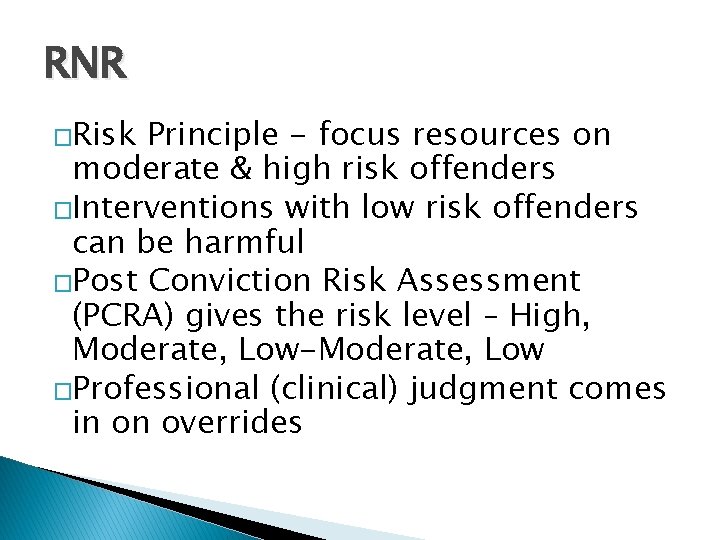
RNR �Risk Principle - focus resources on moderate & high risk offenders �Interventions with low risk offenders can be harmful �Post Conviction Risk Assessment (PCRA) gives the risk level – High, Moderate, Low-Moderate, Low �Professional (clinical) judgment comes in on overrides
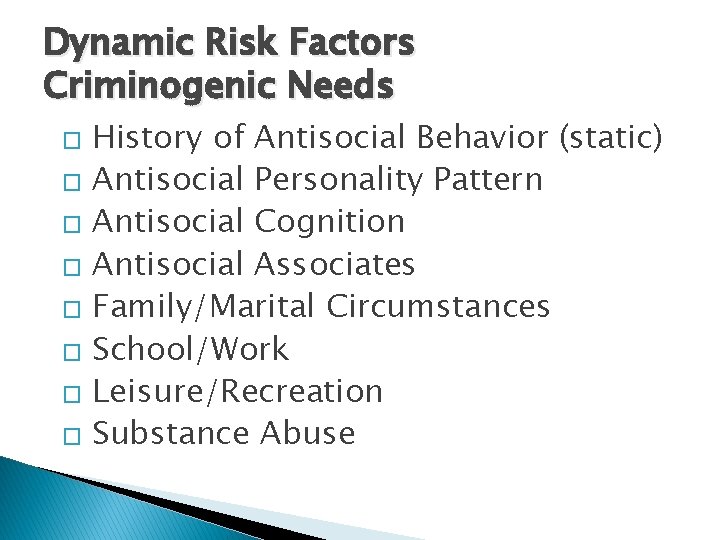
RNR �Need Principle - target criminogenic needs/dynamic risk factors
Dynamic Risk Factors Criminogenic Needs History of Antisocial Behavior (static) � Antisocial Personality Pattern � Antisocial Cognition � Antisocial Associates � Family/Marital Circumstances � School/Work � Leisure/Recreation � Substance Abuse �
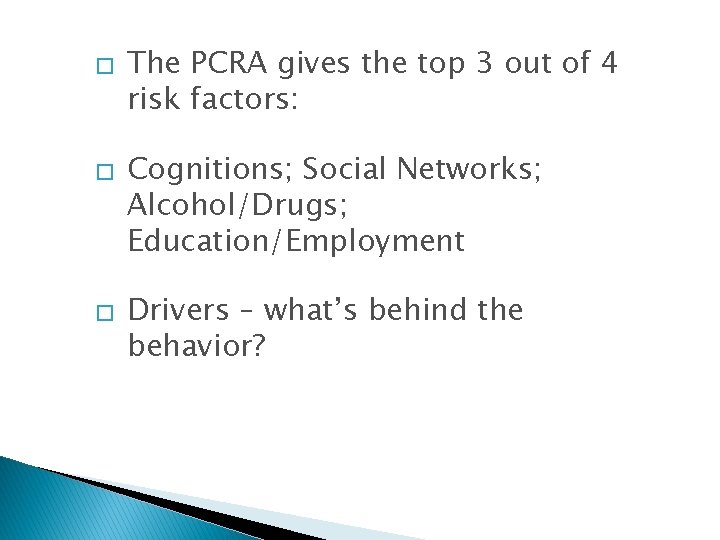
� � � The PCRA gives the top 3 out of 4 risk factors: Cognitions; Social Networks; Alcohol/Drugs; Education/Employment Drivers – what’s behind the behavior?
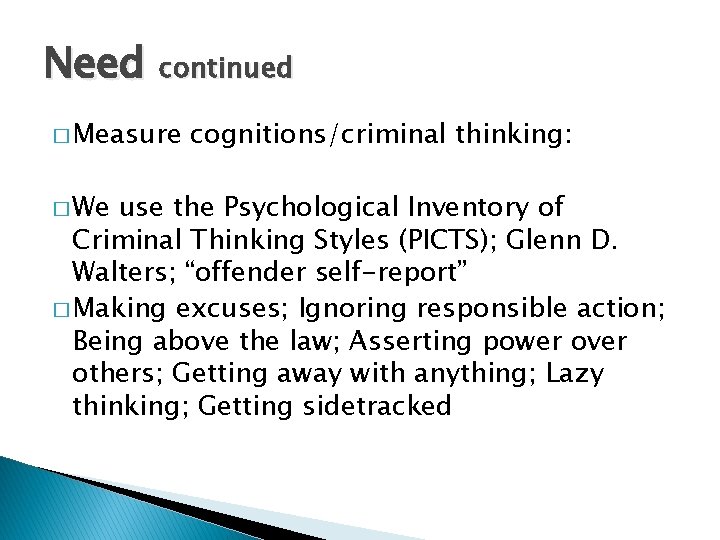
Need continued � Measure � We cognitions/criminal thinking: use the Psychological Inventory of Criminal Thinking Styles (PICTS); Glenn D. Walters; “offender self-report” � Making excuses; Ignoring responsible action; Being above the law; Asserting power over others; Getting away with anything; Lazy thinking; Getting sidetracked
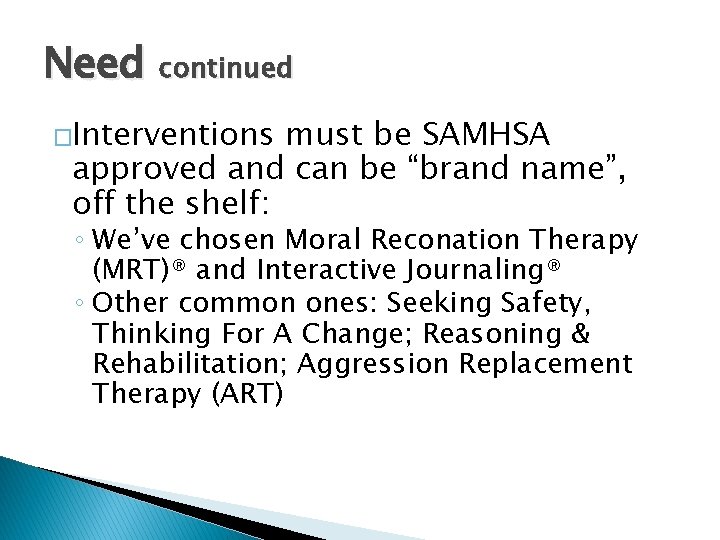
Need continued �Interventions must be SAMHSA approved and can be “brand name”, off the shelf: ◦ We’ve chosen Moral Reconation Therapy (MRT)® and Interactive Journaling® ◦ Other common ones: Seeking Safety, Thinking For A Change; Reasoning & Rehabilitation; Aggression Replacement Therapy (ART)
RNR �Responsivity Principle ◦ General responsivity - use CBT; based on cognitive-behavioral & social learning theory ◦ Specific responsivity - offender characteristics; not direct risk factors but potential obstacles to delivery of interventions that will decrease risk;
Specific responsivity factors �Transportation; trauma history; homeless; mental illness; language; gender; culture; motivation; learning style; literacy; child care; medical problems �Consider that “resistance” may be a responsivity factor – motivation �This is where strengths based fits into the model
“I have this guy …” Vignette #1 � 30 yo male. Single, gang affiliated. Multiple convictions since age 14 including drug possession/sales, assault and armed robbery. 1 strike. Current charge felon in possession of a firearm. Has served 6 years in prison, released on supervision 2 weeks ago. History of methamphetamine, cocaine and alcohol dependence from age 13. Diagnosed with PTSD and Major Depression. Client is homeless, estranged from his biological family, no employment history and no high school diploma or GED.
Evidence Based Practices in Mental Health � The Relationship � Illness Management & Recovery ◦ May include medication � Assertive Community Treatment � Integrated Co-Occurring Disorders Treatment ◦ May include Medication Assisted Treatment (MAT) for addiction recovery � Trauma Interventions � Supported housing and supported employment
Using the RNR model, what more information do you need?
�Risk level – Low, Moderate, High?
Dynamic Risk Factors ◦ Extensive criminal history starting before age 15 = Antisocial personality pattern = Cognitions ◦ Single, gang-affiliated, estranged from family = Social Networks ◦ No HS diploma nor GED & no employment history = Education/Employment ◦ Meth, cocaine, alcohol dependence = Substance Abuse ◦ Leisure/recreation activities?
�Responsivity factors: ◦ Mental illness – Major Depression and PTSD – unknown trauma history ◦ Homelessness ◦ Transportation ◦ More? Literacy? Motivation? Learning style?
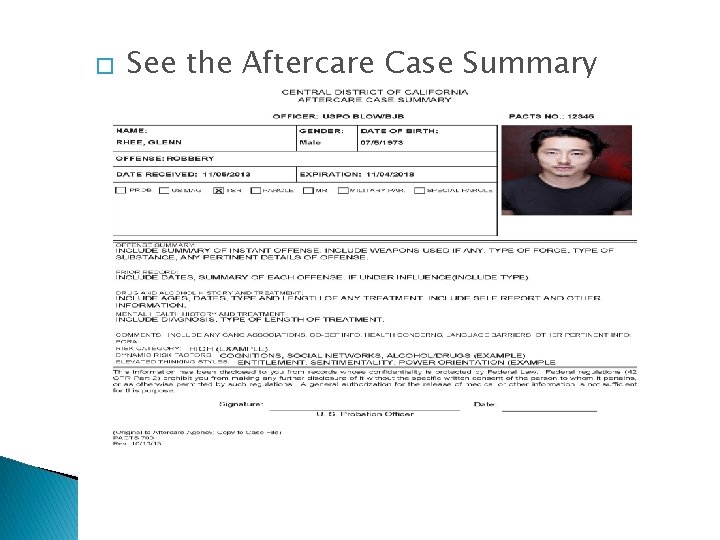
� See the Aftercare Case Summary
This changes the treatment plan … �In addition to traditional mental health treatment - cognitive behavioral, social learning, and motivational interviewing approaches to address dynamic risk factors
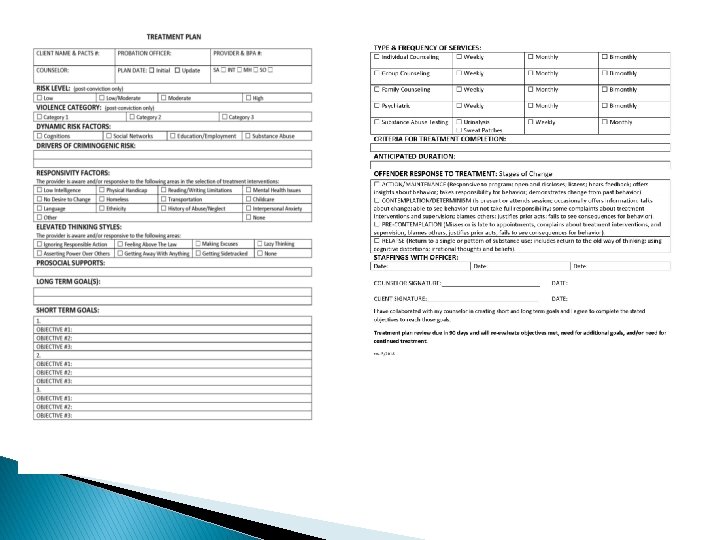
� � See the Treatment Plan Overlap, mental health and risk reduction: ◦ Distorted thinking ◦ Social supports
vignette 2 • Don is a 50 year old male court-ordered to psychotherapy. He says that although he does not think he has any problems that he needs counseling for, he will come to therapy because he does not want to go back to prison. Don has a lengthy criminal history starting with multiple car thefts and burglaries as an adolescent. As an adult, he has been convicted of crimes ranging in seriousness from driving with a suspended license to attempted rape. He has been convicted of multiple forgeries, credit card fraud violations and drug possession. He also has multiple arrests forgery that he was not convicted of. At age 25, he was less than honorably discharged from the Army. He has an 11 th grade education and has been unable to keep jobs between his incarcerations. He has a history of methamphetamine addiction. He has no medical problems. He says he is through with his criminal lifestyle because he is too old to go to prison again, but he shows no remorse for his actions. He was recently released after 5 years in prison. He is currently living with his elderly father and he has a girlfriend, but he has no other friends. He is currently unemployed. He denies any symptoms of depression, anxiety, or psychosis.
vignette 2 – what more information do you need? � From � Risk RNR perspective: level is High � Top 3 dynamic risk factors are Cognitions, Social Networks, Substance Abuse � Responsivity factor – motivation?
Discussion of treatment plan for Don � Clinically or diagnostically: ◦ No clinical mental health disorder present (old Axis I) ◦ Severe Methamphetamine Use Disorder ◦ Antisocial Personality Disorder
vignette 3 • John is a 28 year old male referred to therapy by his probation officer. He was just released from prison after 5 years for credit card fraud and threats. He submitted fraudulent credit card applications. When he did not hear back from the credit card company in a timely way (unknown to him, the company had flagged the applications and was investigating), he called the company, said he was with Bin Laden and would send anthrax. He has an 11 th grade education and is chronically unemployed. He lives at home with his mother. He has a history of gang association, but is currently isolative. He told his mother that he dropped out of high school because of a conspiracy between his teachers to force him out of school. He has a history of marijuana use, but denies use since incarceration. Upon interview, he tells therapist that the FBI has him under surveillance. He believes he is receiving secret messages from the television, and he hears voices in his room calling his name. He has a history of truancy and theft starting as a young adolescent and continuing into his young adulthood before this offense. His risk level is Moderate. Top 3 dynamic risk factors are Social Networks, Education/Employment, and Substance Abuse.
Discussion of treatment plan for John • Schizophrenia Cannabis Use Disorder Antisocial Personality Disorder • Responsivity factors: trauma? motivation? transportation? • •
Q&A - discussion
In conclusion: The challenge of the dual role �Control and help – probation �Recovery and public safety - therapist
In conclusion: “Correctional Quackery” � Quackery = common sense or tradition over scientific evidence � Unscientific services -- no change or can increase antisocial behavior (Flores et al. 2005)
My encouragement and challenge for you… �Don’t practice correctional quackery �A personal action plan… tell the person next to you, one change, today or tomorrow?
My contact info � Thomas_granucci@cacp. uscourts. gov � 213 -894 -5576