
How to improve your memory Mnemonic Devices Chapter
- Slides: 27
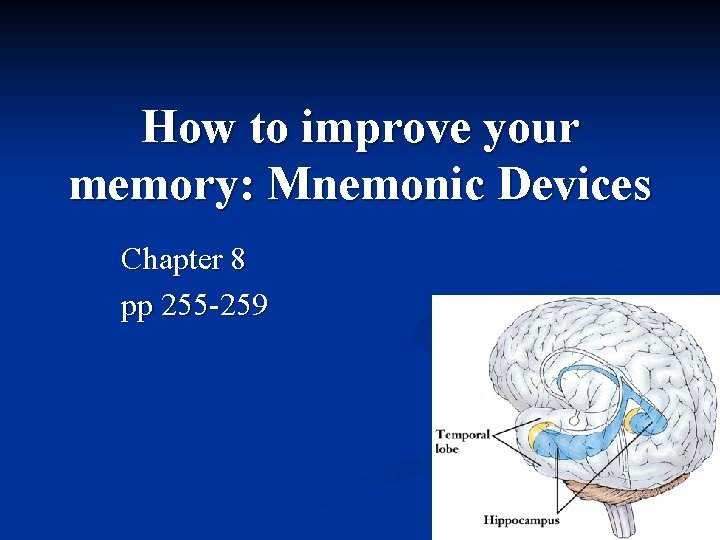
How to improve your memory: Mnemonic Devices Chapter 8 pp 255 -259
Why do we need MEMORY? n Memory is the diary that we all carry about with us. ~Oscar Wilde Memory is the primary and fundamental power, without which there could be no other intellectual operation. ~Samuel Johnson n What if you couldn’t create new memories? n n Amnesia patient: Clive Wearing How do you use your memory everyday? “National Memory Championship” – “Memoriad” n http: //usamemorychampionship. com/ n http: //www. youtube. com/watch? v=6 vs. YCSm. Bc. M 0&feature=related
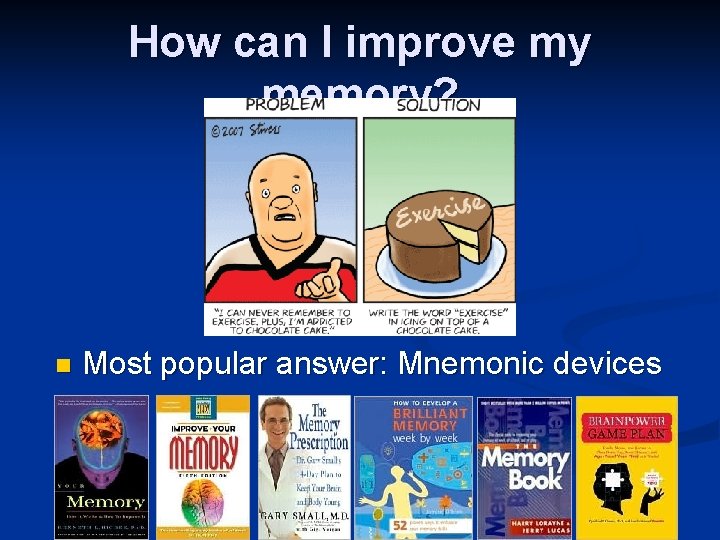
How can I improve my memory? n Most popular answer: Mnemonic devices
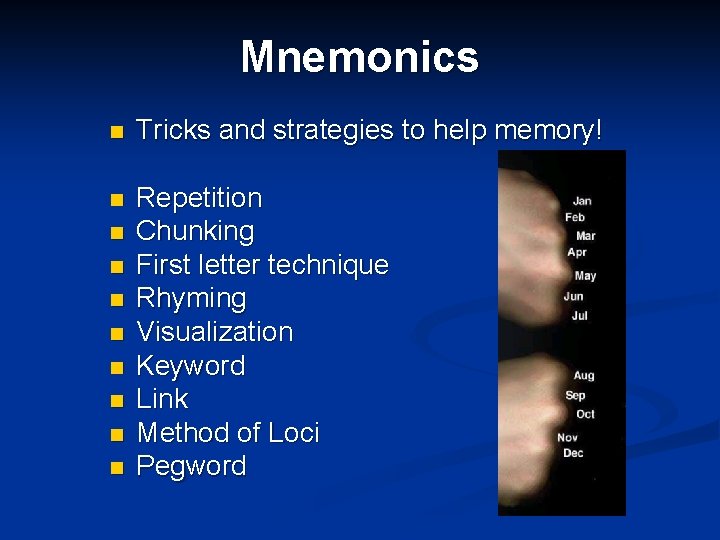
Mnemonics n Tricks and strategies to help memory! n Repetition Chunking First letter technique Rhyming Visualization Keyword Link Method of Loci Pegword n n n n
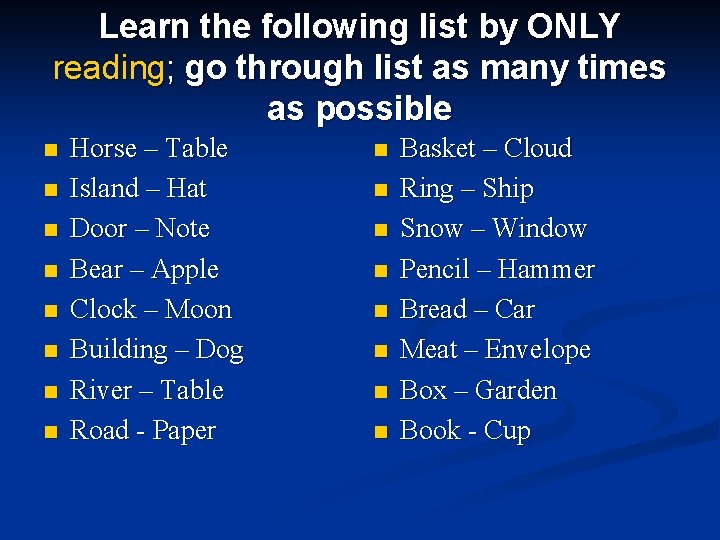
Learn the following list by ONLY reading; go through list as many times as possible n n n n Horse – Table Island – Hat Door – Note Bear – Apple Clock – Moon Building – Dog River – Table Road - Paper n n n n Basket – Cloud Ring – Ship Snow – Window Pencil – Hammer Bread – Car Meat – Envelope Box – Garden Book - Cup
Recall as many as possible n n n n Horse – Island – Door – Bear – Clock – Building – River – Road - n n n n Basket – Ring – Snow – Pencil – Bread – Meat – Box – Book –
Answers n n n n Horse – Table Island – Hat Door – Note Bear – Apple Clock – Moon Building – Dog River – Table Road - Paper n n n n Basket – Cloud Ring – Ship Snow – Window Pencil – Hammer Bread – Car Meat – Envelope Box – Garden Book - Cup
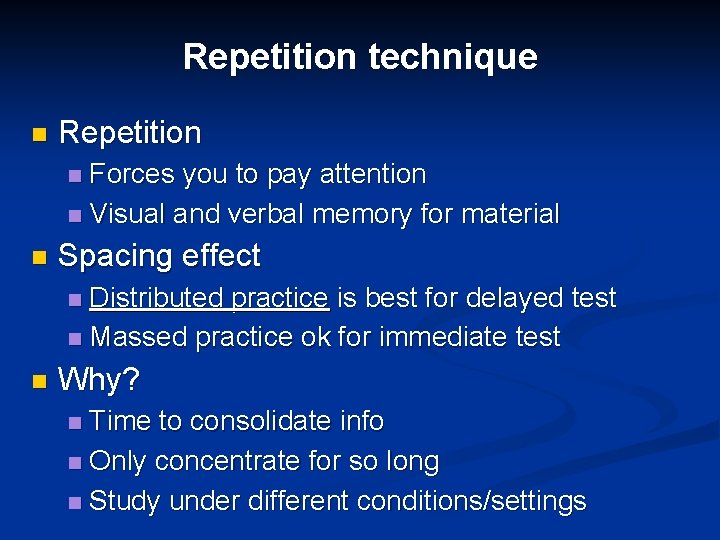
Repetition technique n Repetition Forces you to pay attention n Visual and verbal memory for material n n Spacing effect Distributed practice is best for delayed test n Massed practice ok for immediate test n n Why? Time to consolidate info n Only concentrate for so long n Study under different conditions/settings n
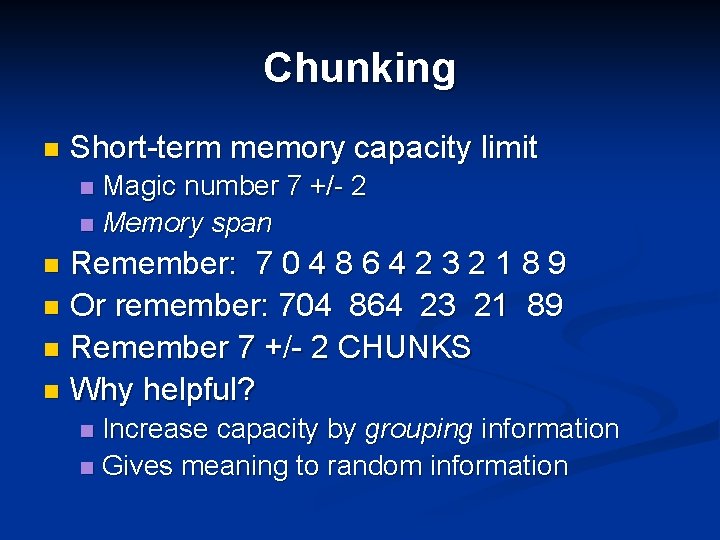
Chunking n Short-term memory capacity limit Magic number 7 +/- 2 n Memory span n Remember: 7 0 4 8 6 4 2 3 2 1 8 9 n Or remember: 704 864 23 21 89 n Remember 7 +/- 2 CHUNKS n Why helpful? n Increase capacity by grouping information n Gives meaning to random information n
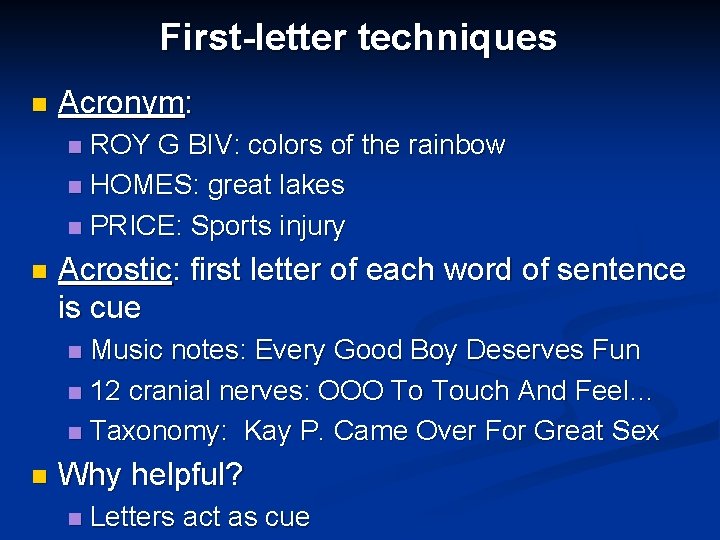
First-letter techniques n Acronym: ROY G BIV: colors of the rainbow n HOMES: great lakes n PRICE: Sports injury n n Acrostic: first letter of each word of sentence is cue Music notes: Every Good Boy Deserves Fun n 12 cranial nerves: OOO To Touch And Feel… n Taxonomy: Kay P. Came Over For Great Sex n n Why helpful? n Letters act as cue
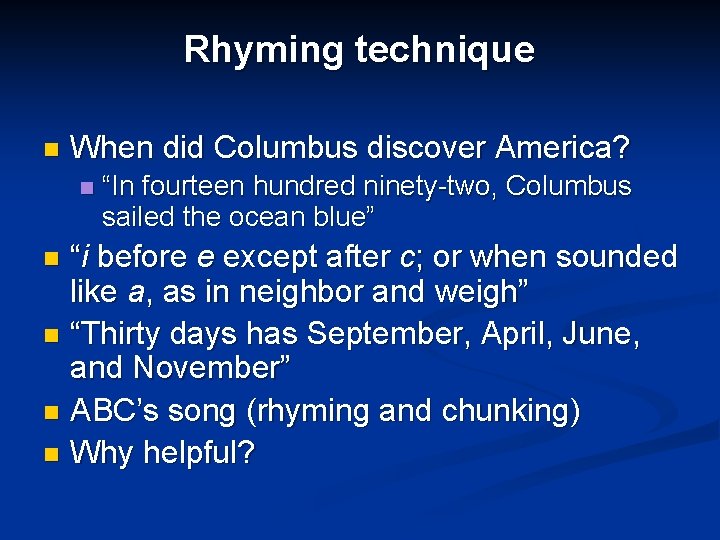
Rhyming technique n When did Columbus discover America? n “In fourteen hundred ninety-two, Columbus sailed the ocean blue” “i before e except after c; or when sounded like a, as in neighbor and weigh” n “Thirty days has September, April, June, and November” n ABC’s song (rhyming and chunking) n Why helpful? n
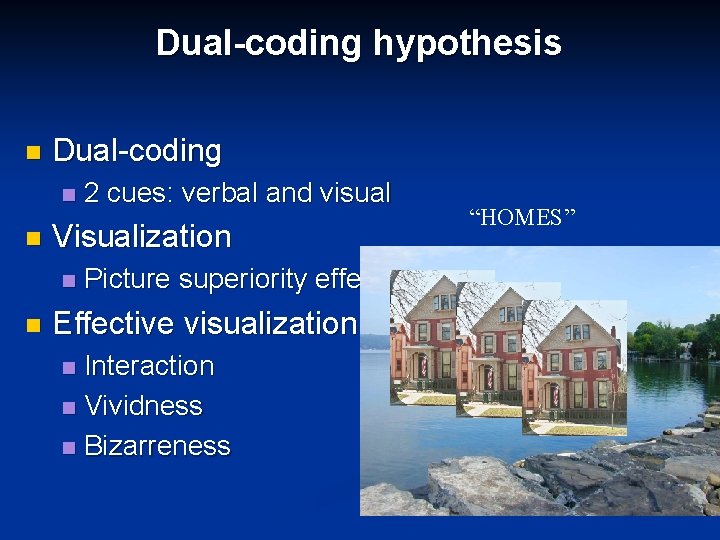
Dual-coding hypothesis n Dual-coding n n Visualization n n 2 cues: verbal and visual Picture superiority effect Effective visualization Interaction n Vividness n Bizarreness n “HOMES”
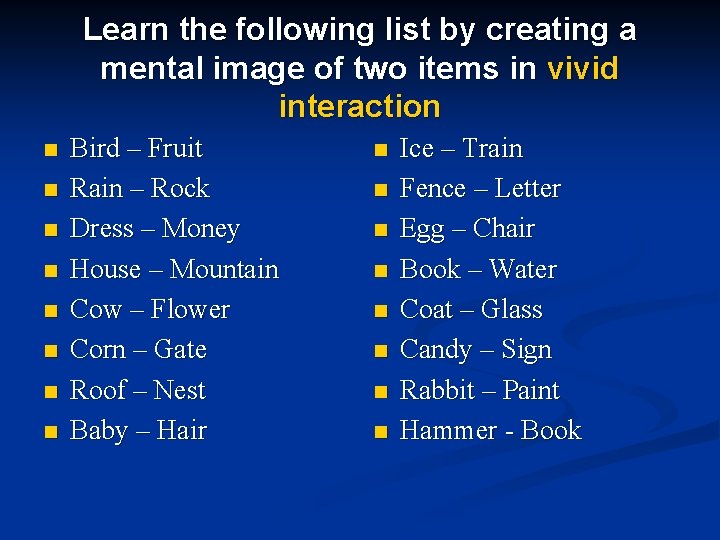
Learn the following list by creating a mental image of two items in vivid interaction n n n n Bird – Fruit Rain – Rock Dress – Money House – Mountain Cow – Flower Corn – Gate Roof – Nest Baby – Hair n n n n Ice – Train Fence – Letter Egg – Chair Book – Water Coat – Glass Candy – Sign Rabbit – Paint Hammer - Book
Recall n n n n Bird – Rain – Dress – House – Cow – Corn – Roof – Baby – n n n n Ice – Fence – Egg – Book – Coat – Candy – Rabbit – Hammer -
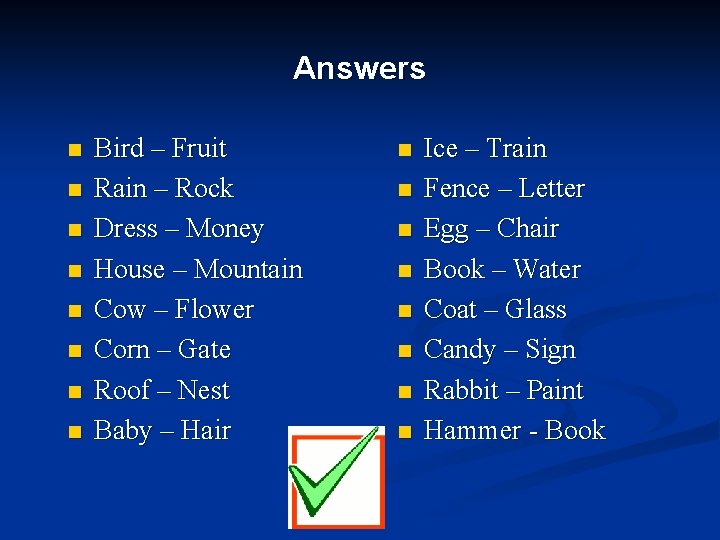
Answers n n n n Bird – Fruit Rain – Rock Dress – Money House – Mountain Cow – Flower Corn – Gate Roof – Nest Baby – Hair n n n n Ice – Train Fence – Letter Egg – Chair Book – Water Coat – Glass Candy – Sign Rabbit – Paint Hammer - Book
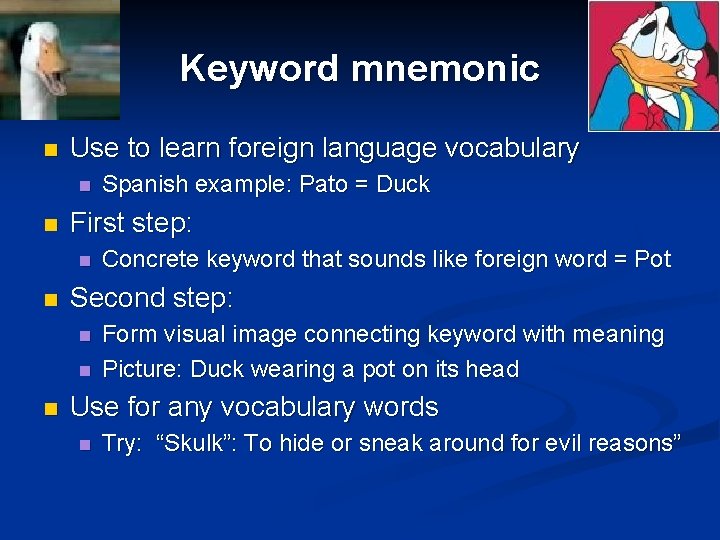
Keyword mnemonic n Use to learn foreign language vocabulary n n First step: n n Concrete keyword that sounds like foreign word = Pot Second step: n n n Spanish example: Pato = Duck Form visual image connecting keyword with meaning Picture: Duck wearing a pot on its head Use for any vocabulary words n Try: “Skulk”: To hide or sneak around for evil reasons”
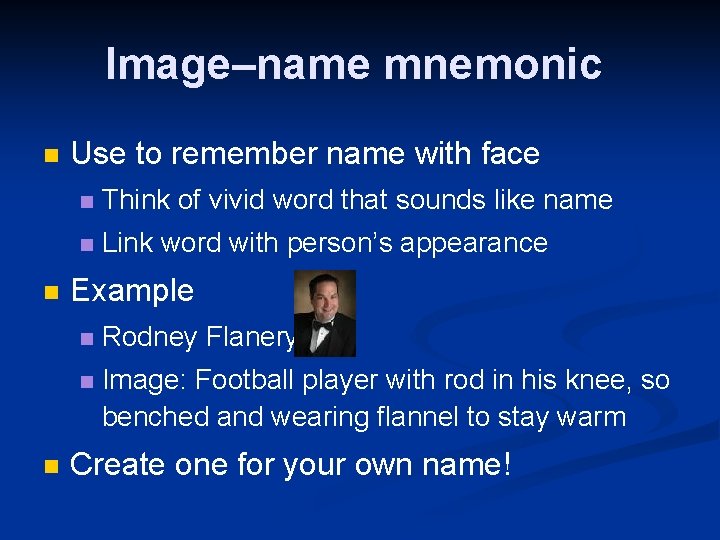
Image–name mnemonic n n n Use to remember name with face n Think of vivid word that sounds like name n Link word with person’s appearance Example n Rodney Flanery n Image: Football player with rod in his knee, so benched and wearing flannel to stay warm Create one for your own name!
Link mnemonic n Chaining or Link system n n Narrative technique n n n First: form visual image for each item Second: associate image with next image Important to SEE associations Form a story using items you want to remember Appropriate for serial learning Problem: if forget one item then next items may be inaccessible too
Method of Loci n “In the first place” 1. Memorize familiar locations in natural order n 2. Create visual image of word with each location n 3. Recall: take a “mental walk” n
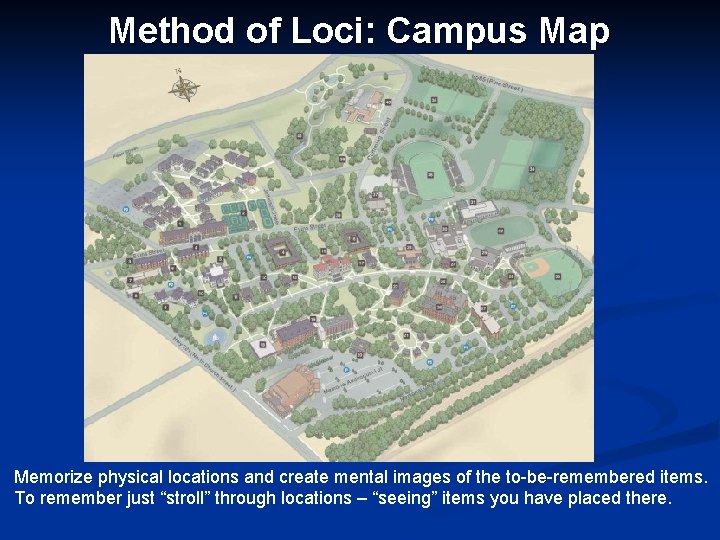
Method of Loci: Campus Map Memorize physical locations and create mental images of the to-be-remembered items. To remember just “stroll” through locations – “seeing” items you have placed there.
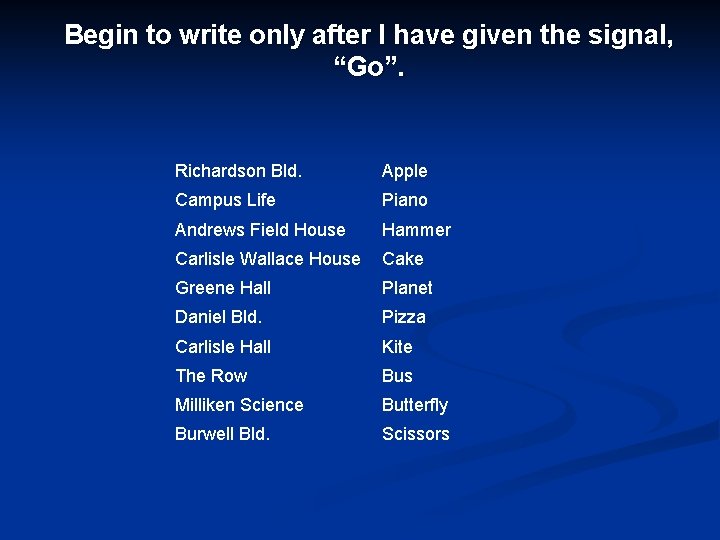
Begin to write only after I have given the signal, “Go”. Richardson Bld. Apple Campus Life Piano Andrews Field House Hammer Carlisle Wallace House Cake Greene Hall Planet Daniel Bld. Pizza Carlisle Hall Kite The Row Bus Milliken Science Butterfly Burwell Bld. Scissors
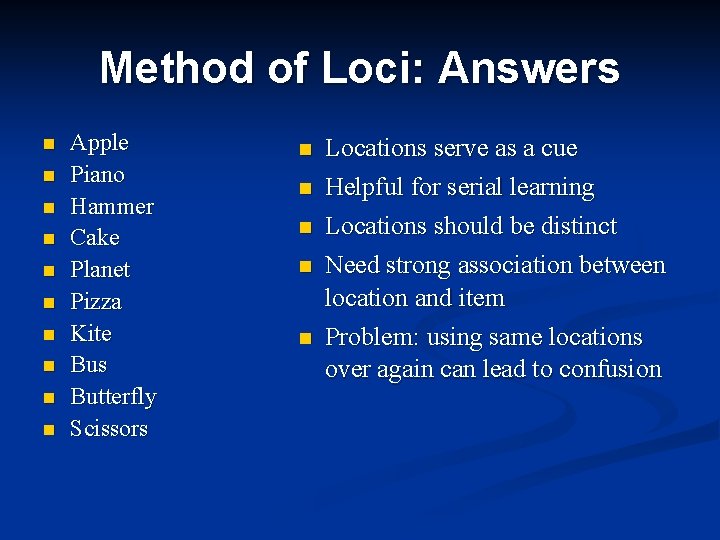
Method of Loci: Answers n n n n n Apple Piano Hammer Cake Planet Pizza Kite Bus Butterfly Scissors n n n Locations serve as a cue Helpful for serial learning Locations should be distinct Need strong association between location and item Problem: using same locations over again can lead to confusion
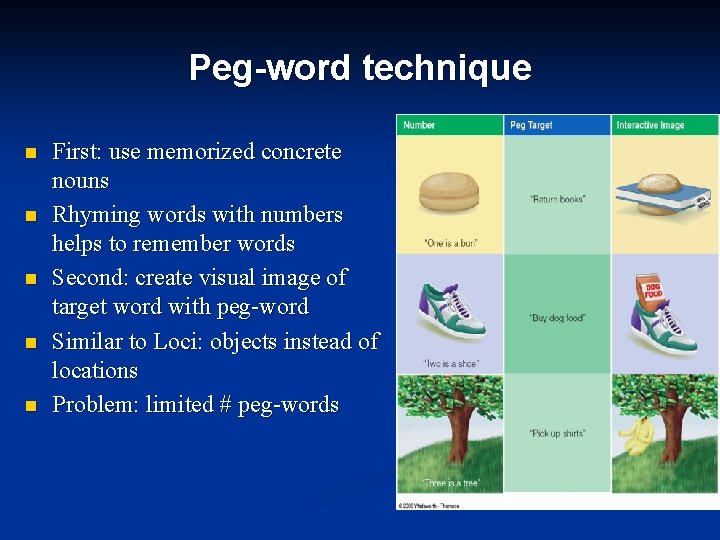
Peg-word technique n n n First: use memorized concrete nouns Rhyming words with numbers helps to remember words Second: create visual image of target word with peg-word Similar to Loci: objects instead of locations Problem: limited # peg-words
Think: n What tricks and strategies do you use to memorize information? n You go to a party and meet lots of new people. You would like to be able to remember their face and name. How do you do it?
n Why do these techniques work to improve memory? What do they share in common? n Which of these techniques could you realistically use to help you study for exams? Why wouldn’t you use some of them? n
Why mnemonic devices work n Attention n n Repetition Structured retrieval cues Dual-coding cues n n n “chunks” Elaboration n n Verbal and visual representations Visual imagery: picture superiority effect Organization n n Ensure encoding Think about meaning and make distinctive Generation n Your ideas makes it personal
Limitations of Mnemonics Time n How to deal with abstract material? n Learning vs. retention n Creative ability n Interference n Doesn’t help memory in general n n No help if you fail to use technique Does not help understanding of material n Need to practice mnemonics! n