
How to Help Your Child Prepare for Tests
- Slides: 31
How to Help Your Child Prepare for Tests and Eliminate Test Anxiety
Presented by • Jennifer Rayburn, KBS Counselor • Patricia Watson, Monroe County School Psychologist • Thanks to Ms. Pack, Ms. Harris and Ms. Allen of Hubbard Elementary School.
The Influence of Parents… • http: //www. youtube. com/watch? feat ure=player_detailpage&v=ZRapukg. N 0 Q A Positive Outcome… • http: //www. youtube. com/watch? feat ure=player_detailpage&v=5 su. Fd. Lwwl Ao
Why do we give the CRCT? The Criterion-Referenced Competency Test (CRCT) is designed to measure the degree to which students have acquired the skills and knowledge described in the Common Core Georgia Performance Standards (CCGPS).
CRCT Content Areas • • • English/Language Arts (ELA) Reading Mathematics Science Social Studies For more information, www. gadoe. org
CRCT Schedule • 1 st and 2 nd graders : Tuesday, April 22 – Friday, April 25 • 3 rd – 5 th graders : Tuesday, April 29 th – Friday, May 9 • 1 content area per day • Each content area has two sections that last approximately 70 minutes each.
CRCT Study Guide Links • http: //www. gadoe. org/Curriculum-Instruction-and -Assessment/Pages/CRCT-Study. Guides. aspx • http: //www. gadoe. org/Curriculum-Instruction-and Assessment/Documents/Grade_4_S tudy_Guide_GA 13_Final. pdf • http: //www. gadoe. org/Curriculum-Instruction-and Assessment/Documents/Grade_5_S tudy_Guide_GA 13_Final. pdf
Good Test-Taking Strategies • Keep a positive attitude and try to stay relaxed. If you start to feel nervous take a few deep breaths to relax. • Budget your time. Don't stay on a problem that you are stuck on especially when time is a factor. • Don't rush, but pace yourself.
More Testing Strategies • Read the entire question and look for keywords. • Always read the whole question carefully. • Eliminate answers that are obviously wrong. Use Process of Elimination! •
Final Test Taking Strategies • When you are finished, make sure that you have answered all the questions. Only change an answer if you misread or misinterpreted the question, because the first answer that you put is usually the correct one.
What Is Test Anxiety? • Test anxiety is when a student excessively worries about doing well on a test. This can become a major hindrance on test performance and cause extreme nervousness and memory lapses among other symptoms. Excessive worry can lower your test scores.
Signs and Symptoms… • Racing Thoughts • Difficulty Concentrating – Loss of Focus • Obsessed on others and how they are performing • Knowing the answers after the test but not while taking the test • Nausea – Headache • Fear or Irritability
The Positives of Test Stress Some degree of test stress or nervous anticipation can be positive. *It can help sharpen focus, concentration and effort. *It helps you maintain your peak performance. *It revs you up.
The Road That Leads to Anxiety
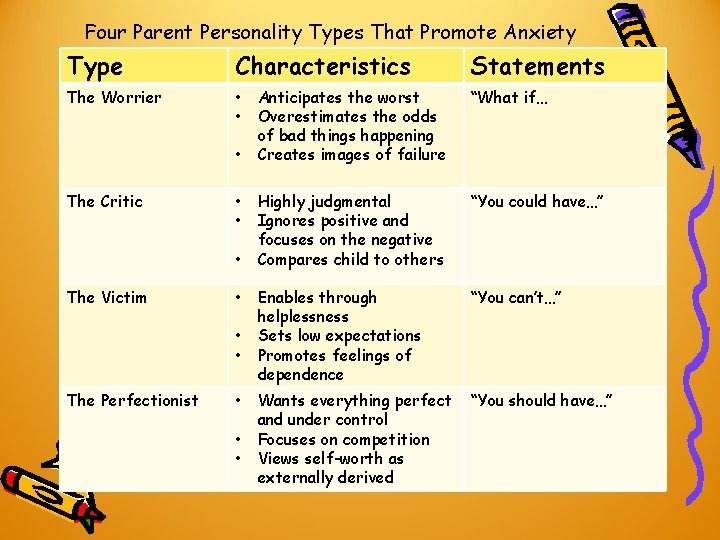
Four Parent Personality Types That Promote Anxiety Type Characteristics The Worrier • • • The Critic • • • The Victim • • • The Perfectionist • • • Statements Anticipates the worst Overestimates the odds of bad things happening Creates images of failure “What if… Highly judgmental Ignores positive and focuses on the negative Compares child to others “You could have…” Enables through helplessness Sets low expectations Promotes feelings of dependence “You can’t…” Wants everything perfect and under control Focuses on competition Views self-worth as externally derived “You should have…”
Other Causes of Anxiety • Lack of Preparation • Lack of Confidence • The anticipation of something stressful. • Focusing on the Negative
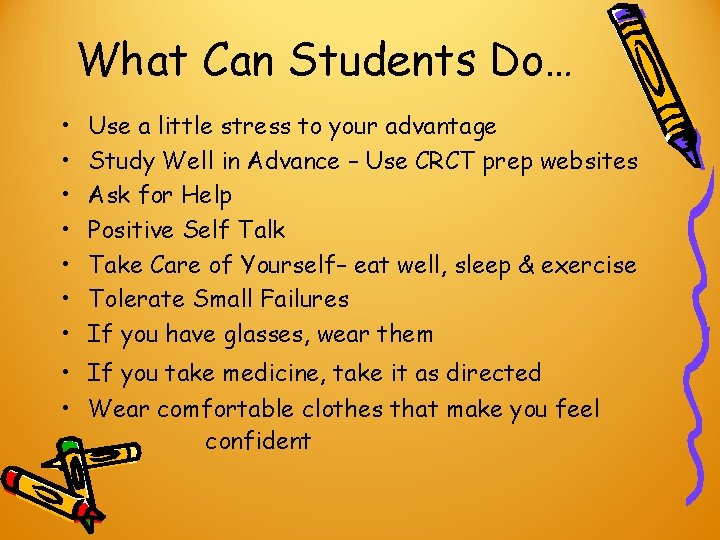
What Can Students Do… • • Use a little stress to your advantage Study Well in Advance – Use CRCT prep websites Ask for Help Positive Self Talk Take Care of Yourself– eat well, sleep & exercise Tolerate Small Failures If you have glasses, wear them • If you take medicine, take it as directed • Wear comfortable clothes that make you feel confident
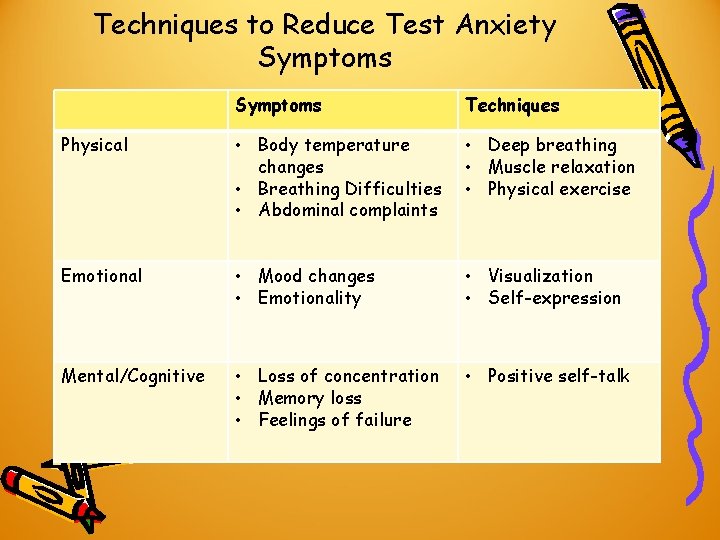
Techniques to Reduce Test Anxiety Symptoms Techniques Physical • Body temperature changes • Breathing Difficulties • Abdominal complaints • Deep breathing • Muscle relaxation • Physical exercise Emotional • Mood changes • Emotionality • Visualization • Self-expression Mental/Cognitive • Loss of concentration • Memory loss • Feelings of failure • Positive self-talk
Think Positive! You Can If You Think You Can! If you think you are beaten, you are, If you think you dare not, you don't. If you like to win, but you think you can't, It is almost certain you won't. If you think you'll lose, you're lost, For out in the world we find, Success begins with a person’s will. It's all in the state of mind. If you think you are outclassed, you are, You have to think high to rise, You have to be sure of yourself before You can ever win a prize. Life's battles don't always go To the stronger or faster man. But sooner or later the person who wins, Is the one who thinks he can. ~ C. W. Longenecker ~
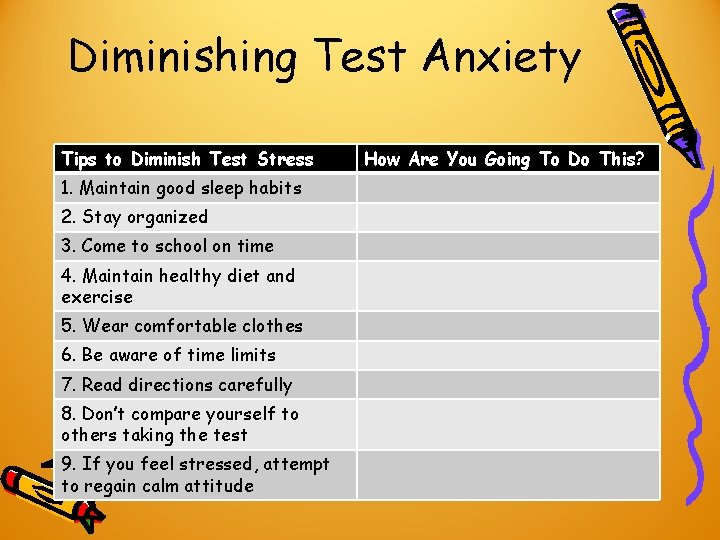
Diminishing Test Anxiety Tips to Diminish Test Stress 1. Maintain good sleep habits 2. Stay organized 3. Come to school on time 4. Maintain healthy diet and exercise 5. Wear comfortable clothes 6. Be aware of time limits 7. Read directions carefully 8. Don’t compare yourself to others taking the test 9. If you feel stressed, attempt to regain calm attitude How Are You Going To Do This?
What Parents Can Do to Diminish Test Anxiety • Constructive self-talk • Avoid negative self-talk and irrational talk. Silently shout “Stop!” or “Stop thinking about that!” • Replace negative self-talk with positive talk. •
Example of Positive Self. Talk • Example: “I am no good at math, so why should I try? ” to “I’ve worked hard, and I will try my best. ” • Example: “No matter what I do, I cannot pass this test. ” To “I have studied and worked hard this year, I will do my best and pass this test. ”
Parents Can Teach Relaxation • Relaxation Training • Release Muscle Tension: Feet flat on the floor. • Grab sides of chair/desk with hands. • Push down with feet and pull up with hands for 5 seconds. • Release/relax for 5 to 10 seconds. Repeat this 2 to 3 times.
Relaxation with Visualization • Visualize a Calming Scene: Close and cover eyes with palm of hand (do not press down on eyes; cup around eye. Think of real/imaginary scene (lake, ocean, woods). • Visualize the scene as if you were there. • Visualize the scene for 1 to 2 minutes.
Deep Breathing • Deep Breathing: Sit straight up in a chair using good posture. • Slowly inhale through the nose. • Feel your lungs filling from lower section to upper part of the lungs. • Slowly breathe out through your mouth.
Long-Term Relaxation • Long-Term Relaxation: teach and practice cue-controlled relaxation. • Choose a phrase to repeat such as “I am relaxed. ” “I can get through this. ” “Tests don’t scare me. ” • Practice using this phrase during testing or stressful situations.
Thinking Positive • Remember something that makes you feel really good. (Example: your pet, a hug from your mom, a fun day at the park). • Concentrate on how you felt at that time. • Hold on to that feeling. Pretend you are holding it in your heart. • Hold on to that feeling for 10 to 20 seconds. • Practice this just before the test.
Changing “What if? ” Thoughts • Changing the “What if? ” Questions: Rewrite negative “what if” thoughts. Example: “What if I fail? , Run out of time? Can’t remember? ” can be turned into “What if I remember more than I expected to remember? ” “What if I feel calmer than I think I can? ” Practice turning negative into positive.
Parent Activity Letter to your child: Write a letter to be given to your child the first day of the CRCT. Notecard –A-Day: Write an encouraging word on an index card to be given to your child each morning of the CRCT. http: //www. youtube. com/watch? v=o. FMjbs 3 hoi. U Putting the CRCT in perspective, “This Test Does Not Define You. ”
Questions
Suggested Reading for Your Child • Stress Can Really Get on Your Nerves by Trevor Romain • I Can Do It Too! By Karen Baicker • Don’t Pop Your Cork on Mondays!: The Children’s Anti. Stress Book by Adolph Moser • Johnny Can-Do: A Disabled Boy’s Courage by Sean Byerley • Mind Over Basketball: Coach Yourself to Handle Stress by Jane Weierbach • Those Can-Do Pigs by David Mc. Phail • Something Might Happen by Helen Lester • The Worrywarts by Pam Edwards