
How to give effective professional and academic presentations
- Slides: 45
How to give effective professional and academic presentations Eleni Tsiartsioni MPhil Trinity College Dublin, Ireland Ph. D Candidate Aristotle University of Thessaloniki Thursday 22 May 2008 University of Macedonia, Department of Technology Management, Naousa Eleni Tsiartsioni
Structure of this presentation 1. 2. 3. 4. 5. Preparing the presentation Performing the presentation Giving feedback Observation of presentations Workshop Eleni Tsiartsioni 2
A. PREPARING THE PRESENTATION ‘In all things success depends on previous preparation, and without such preparation there is sure to be failure’ Eleni Tsiartsioni 3
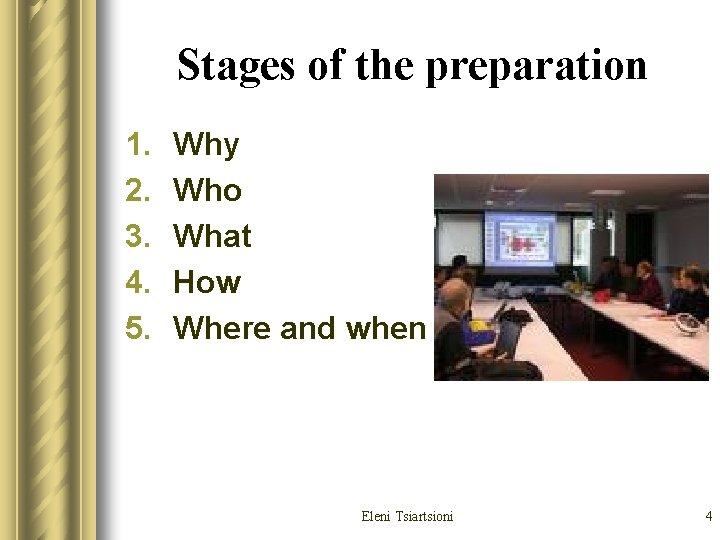
Stages of the preparation 1. 2. 3. 4. 5. Why Who What How Where and when Eleni Tsiartsioni 4
Why? The General Purpose l. To inform l. To persuade Eleni Tsiartsioni 5
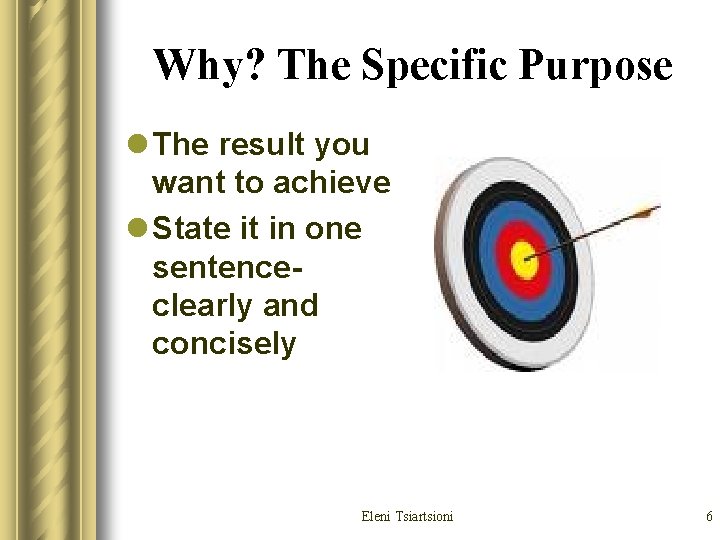
Why? The Specific Purpose l The result you want to achieve l State it in one sentenceclearly and concisely Eleni Tsiartsioni 6
Examples of purposes… l To inform the audience about the benefits of using a particular system l To tell the audience about new procedures l To persuade the audience to support a project l To persuade the audience to use our services l To ‘sell’ our company to the audience Eleni Tsiartsioni 7
Who? Complete an audience profile: l l Who are they? How many? Why are they coming? What do they know about the subject? l Why are they interested in the subject? l What is their relationship to you? Eleni Tsiartsioni 8
What? ‘Three things matter in a speech; who says it, how it is said and what is said- and of the three, the last matters least’. John Morley Eleni Tsiartsioni 9
What? Presentation outline Good Organisation: l. Helps you remember l. Helps them understand l. Helps you to keep the point l. Helps you to reduce nervousness Eleni Tsiartsioni 10
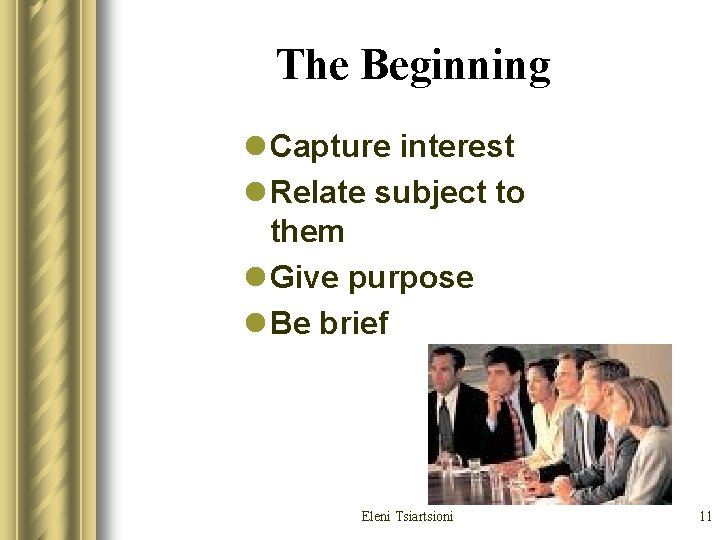
The Beginning l Capture interest l Relate subject to them l Give purpose l Be brief Eleni Tsiartsioni 11
The Middle l. Have 3 or 4 main points (they will not remember more than 4 points!) l. Take 80% of the time l. Have signposts and summaries Eleni Tsiartsioni 12
The Ending l. Summarise the main points l. Relate conclusion to them l. Don’t present new ideas l. Be interesting l. Be brief Eleni Tsiartsioni 13
How? 1. Key words 2. Rehearsal Eleni Tsiartsioni 14
How? Keywords l. Use index cards l. Print in big capitals l. Only keywords l. Number cards l. Use colour coding Eleni Tsiartsioni 15
How? Rehearsals l Rehearsal is the most important part of preparing l Run through your presentation at least twice l Check timing Eleni Tsiartsioni 16
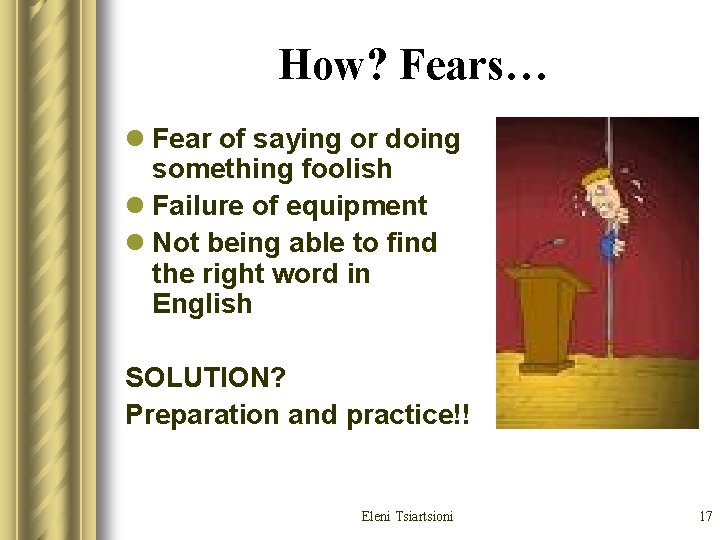
How? Fears… l Fear of saying or doing something foolish l Failure of equipment l Not being able to find the right word in English SOLUTION? Preparation and practice!! Eleni Tsiartsioni 17
Where? l. Things to take l. Things to check Eleni Tsiartsioni 18
When? The best time are: l Tuesday to Thursday… l From 10 to 12 Eleni Tsiartsioni 19
B. PERFORMING THE PRESENTATION ‘The human brain starts working the moment we are born and never stops until you stand up to speak in public’ George Jessel Eleni Tsiartsioni 20
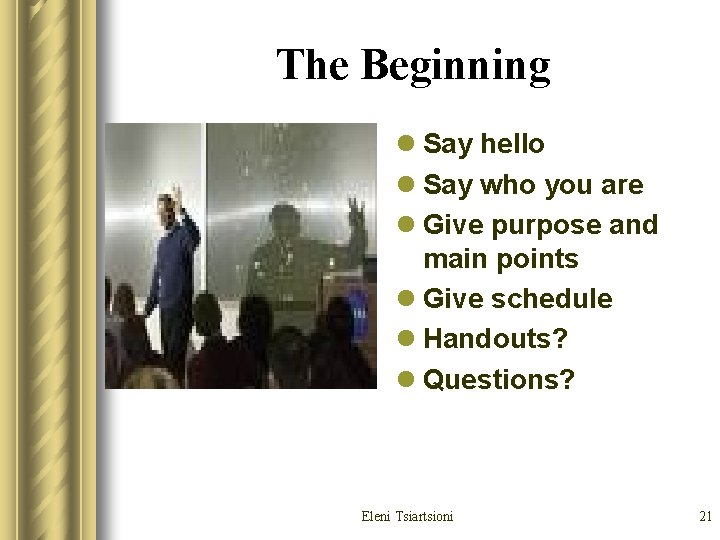
The Beginning l Say hello l Say who you are l Give purpose and main points l Give schedule l Handouts? l Questions? Eleni Tsiartsioni 21
Making it interesting l. Visual aids l. Quote l. Surprising fact l. Story/ anecdote l. Question Eleni Tsiartsioni 22
Language ‘The person who uses a lot of big words is not trying to inform you; he is trying to impress you’ O. Miller Eleni Tsiartsioni 23
Language: the don’ts l. Avoid jargon l. Avoid complex phrases l. Avoid being too formal l. Avoid long sentences Eleni Tsiartsioni 24
Language: the dos l Use everyday language l Use concrete words l Use rhetorical questions (i. e. ‘What should we do? ’ –pause ‘How much would it cost? ’ –pause) l Use dramatic structures (i. e. We have a revolutionary product What we have is a revolutionary product) Eleni Tsiartsioni 25
Signposting l. Signpost l. Summarise l. Use check-up questions Eleni Tsiartsioni 26
Making it interesting l. Stories/ anecdotes l. Explain by analogy l. Involve them: • Ask questions • Pause and reply Eleni Tsiartsioni 27
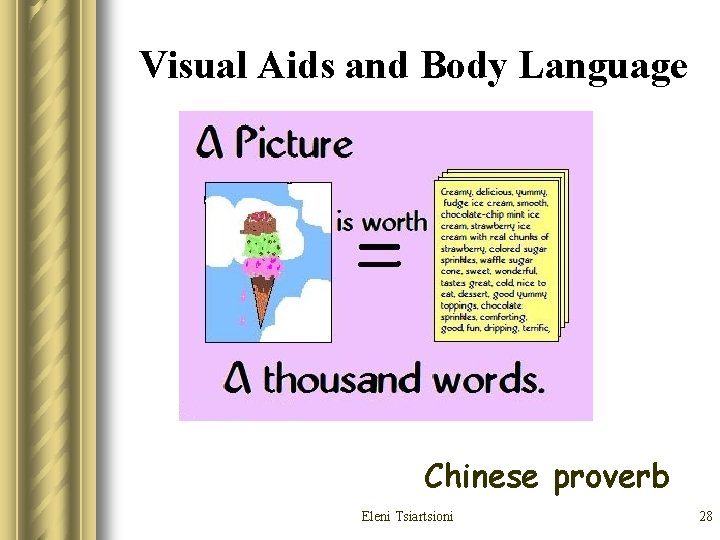
Visual Aids and Body Language Chinese proverb Eleni Tsiartsioni 28
Visual Aids and Body Language Which is the most important? Content? Tone of voice? Body language? Eleni Tsiartsioni 29
Flip Chart and Whiteboard l. Big and bold l. Use colours l. Face audience when you talk and write l. Flip over/ wipe off when finished Eleni Tsiartsioni 30
Overhead Projector l. Use a mask to show one point at a time l. Use a pen or pointer on the machine l. Switch it off so they focus on you Eleni Tsiartsioni 31
Making Transparencies l Use software or write with special pens l Max. 8 lines l Use keywords l Use pictures l Use colours Eleni Tsiartsioni 32
Body language: the dos l Move hands and arms l Move around the room (? ) l Move towards audience l Move your eyes around the audience l Moving is normal Eleni Tsiartsioni 33
Body language: the don’ts l. Don’t point at anyone l. Don’t rock backwards and forwards l. Don’t stand rooted to the spot l. Don’t leave your hands by your sides l. Don’t avoid eye contact Eleni Tsiartsioni 34
Voice: Voice and Pronunciation l. Project your voice: aim for the back l. Emphasise importance • Say some words louder • Repeat important words Eleni Tsiartsioni 35
Making it interesting l. Go faster to excite l. Go slower to show importance l. Pause often and look round audience l. Give emphasis with voice and body Eleni Tsiartsioni 36
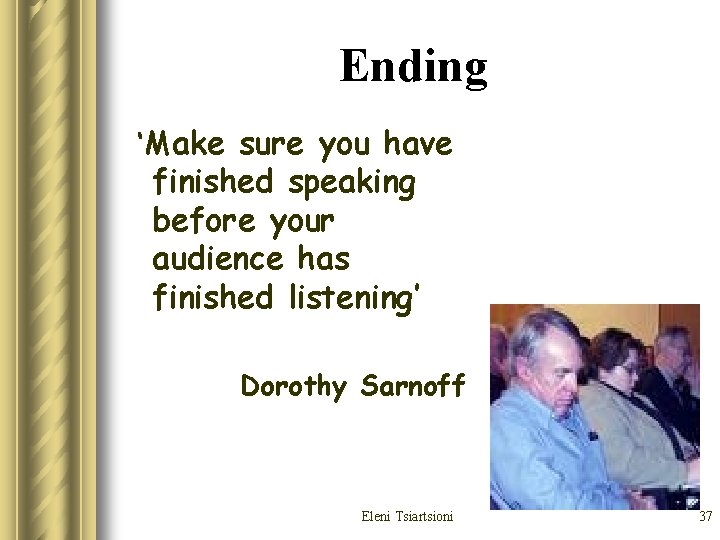
Ending ‘Make sure you have finished speaking before your audience has finished listening’ Dorothy Sarnoff Eleni Tsiartsioni 37
The ending: Communication techniques l. Finish on time l. Cut out, but not summing up or conclusion Eleni Tsiartsioni 38
The Ending l. Sum up l. Conclude l. Handouts? l. Any questions? l. Close Eleni Tsiartsioni 39
Questions What is a question? The only real question is a request for further information Other questions are: -requests for the spotlight -attacks or traps Eleni Tsiartsioni 40
‘Real’ Questions l. Paraphrase for audience l. If real question, answer it briefly l. Answer audience, not just the questioner l. If you don’t know the answer, say so Eleni Tsiartsioni 41
Feedback Grid: Giving feedback l. Stress the good points l. Use constructive criticism l. Give feedback to the presenter by using you, not he or she Eleni Tsiartsioni 42
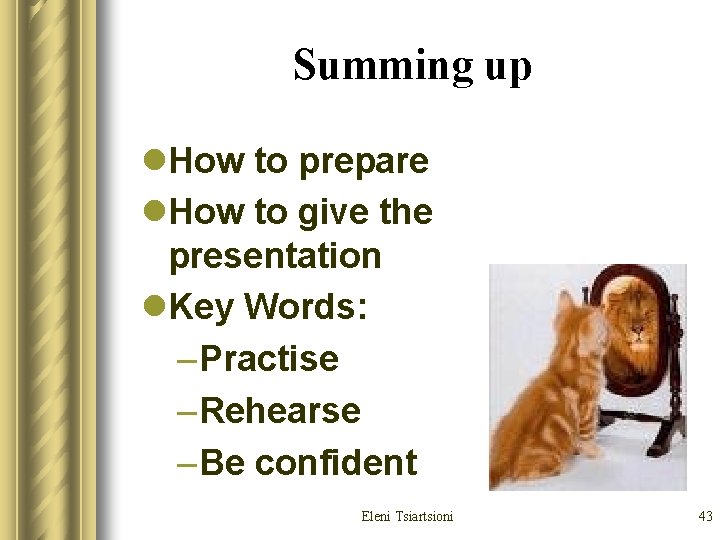
Summing up l. How to prepare l. How to give the presentation l. Key Words: – Practise – Rehearse – Be confident Eleni Tsiartsioni 43
Thank you! Eleni Tsiartsioni 44
Any Questions? ? ? Eleni Tsiartsioni 45