
How to Give and Use Running Records Tammy
- Slides: 18
How to Give and Use Running Records Tammy Hatfield tammy. hatfield@borgerisd. net
Today you will learn… n n n What is a Running Record How to score a running record Cueing System: Meaning, Structure, Visual cues How to analyze miscues Using running records to plan instruction Prompts to help students become strategic readers
Readers Integrate Meaning, Structure, and Visual Cues n Reading is an interactive process in which the reader uses information in the text (visual), and applies his/her knowledge of the world (meaning), and knowledge of the language (structure), to help determine author’s intended message.
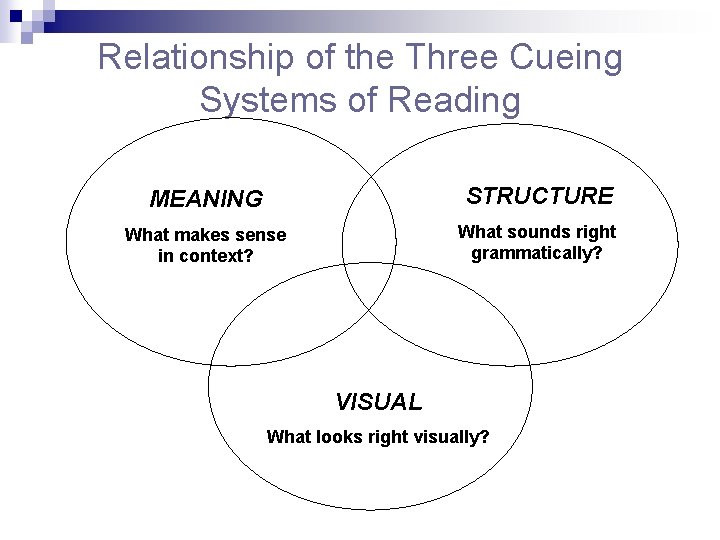
Relationship of the Three Cueing Systems of Reading MEANING STRUCTURE What makes sense in context? What sounds right grammatically? VISUAL What looks right visually?
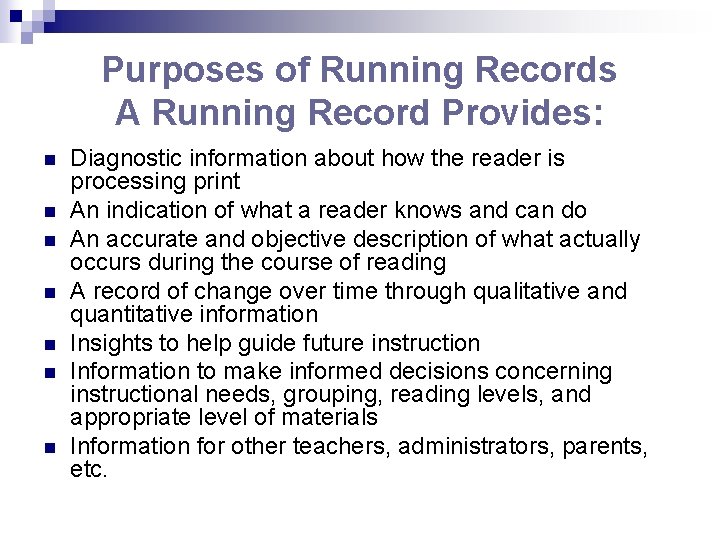
Purposes of Running Records A Running Record Provides: n n n n Diagnostic information about how the reader is processing print An indication of what a reader knows and can do An accurate and objective description of what actually occurs during the course of reading A record of change over time through qualitative and quantitative information Insights to help guide future instruction Information to make informed decisions concerning instructional needs, grouping, reading levels, and appropriate level of materials Information for other teachers, administrators, parents, etc.
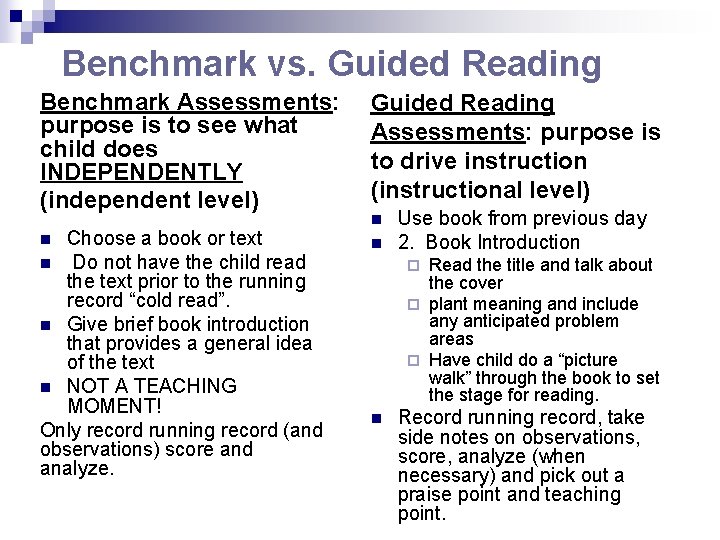
Benchmark vs. Guided Reading Benchmark Assessments: purpose is to see what child does INDEPENDENTLY (independent level) Choose a book or text n Do not have the child read the text prior to the running record “cold read”. n Give brief book introduction that provides a general idea of the text n NOT A TEACHING MOMENT! Only record running record (and observations) score and analyze. n Guided Reading Assessments: purpose is to drive instruction (instructional level) n n Use book from previous day 2. Book Introduction Read the title and talk about the cover ¨ plant meaning and include any anticipated problem areas ¨ Have child do a “picture walk” through the book to set the stage for reading. ¨ n Record running record, take side notes on observations, score, analyze (when necessary) and pick out a praise point and teaching point.
Running Record Codes/Scoring Guidelines n Look at handout
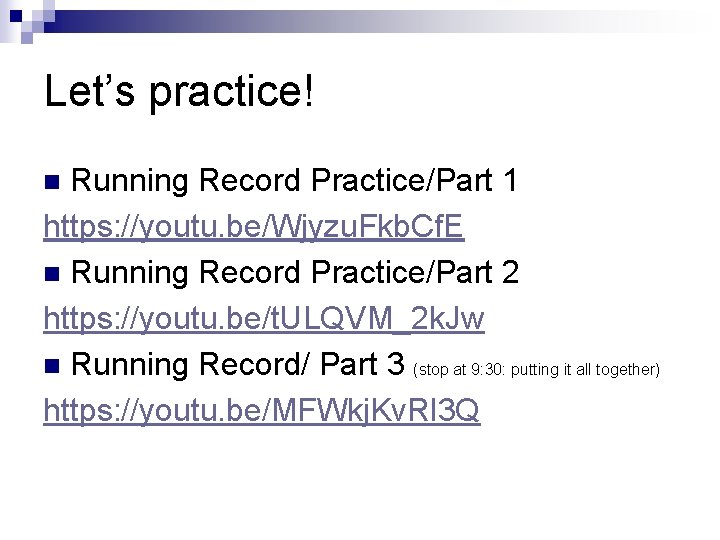
Let’s practice! Running Record Practice/Part 1 https: //youtu. be/Wjyzu. Fkb. Cf. E n Running Record Practice/Part 2 https: //youtu. be/t. ULQVM_2 k. Jw n Running Record/ Part 3 (stop at 9: 30: putting it all together) https: //youtu. be/MFWkj. Kv. Rl 3 Q n
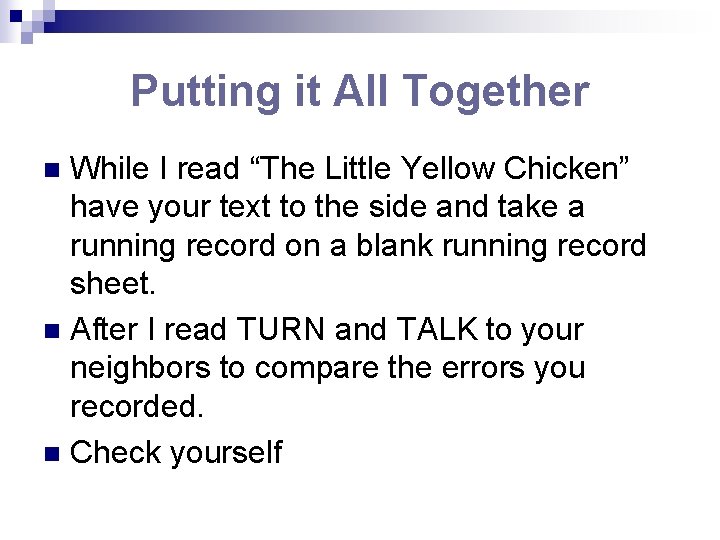
Putting it All Together While I read “The Little Yellow Chicken” have your text to the side and take a running record on a blank running record sheet. n After I read TURN and TALK to your neighbors to compare the errors you recorded. n Check yourself n
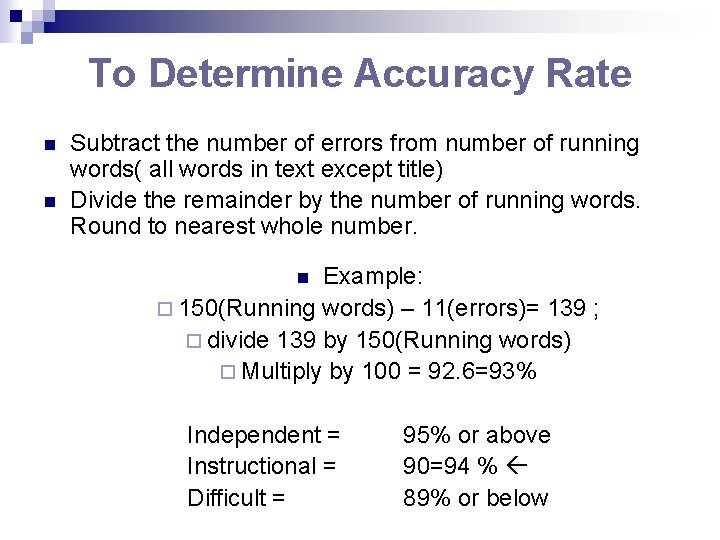
To Determine Accuracy Rate n n Subtract the number of errors from number of running words( all words in text except title) Divide the remainder by the number of running words. Round to nearest whole number. Example: ¨ 150(Running words) – 11(errors)= 139 ; ¨ divide 139 by 150(Running words) ¨ Multiply by 100 = 92. 6=93% n Independent = Instructional = Difficult = 95% or above 90=94 % 89% or below
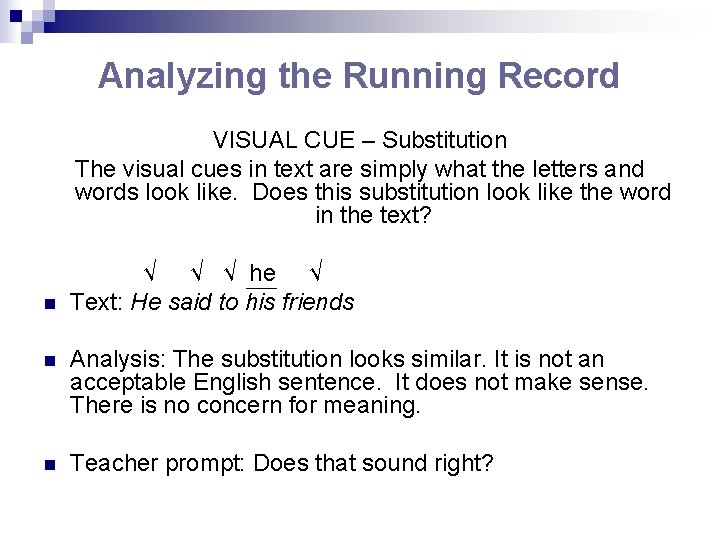
Analyzing the Running Record VISUAL CUE – Substitution The visual cues in text are simply what the letters and words look like. Does this substitution look like the word in the text? n √ √ √ he √ Text: He said to his friends n Analysis: The substitution looks similar. It is not an acceptable English sentence. It does not make sense. There is no concern for meaning. n Teacher prompt: Does that sound right?
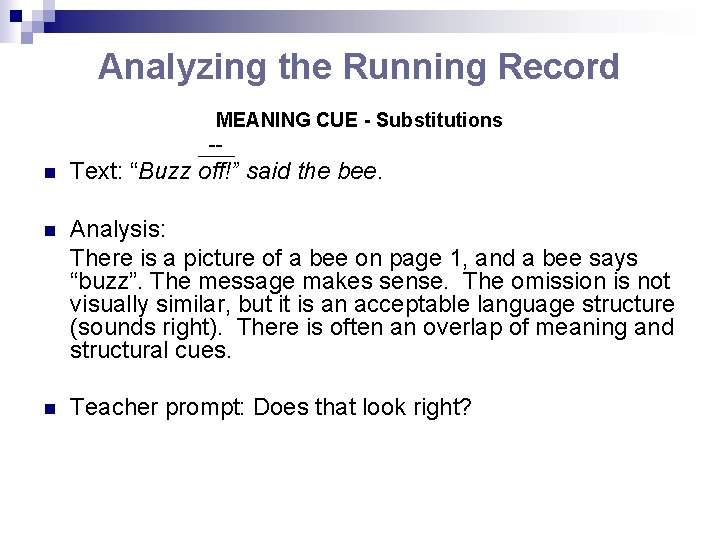
Analyzing the Running Record MEANING CUE - Substitutions -n Text: “Buzz off!” said the bee. n Analysis: There is a picture of a bee on page 1, and a bee says “buzz”. The message makes sense. The omission is not visually similar, but it is an acceptable language structure (sounds right). There is often an overlap of meaning and structural cues. n Teacher prompt: Does that look right?
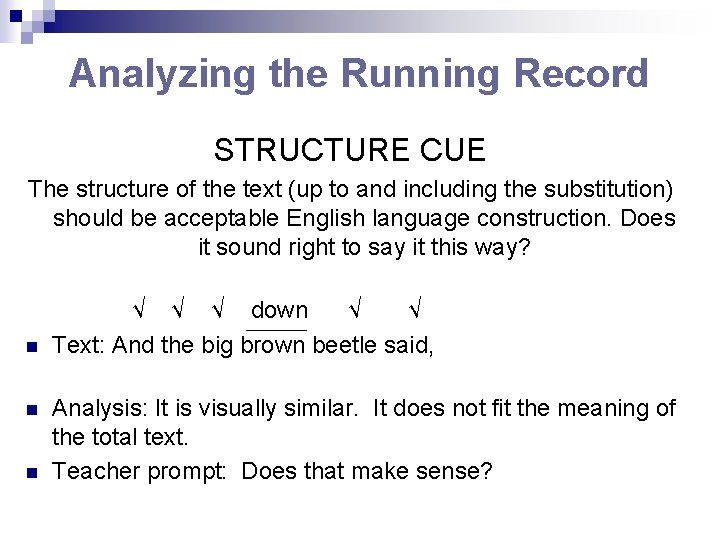
Analyzing the Running Record STRUCTURE CUE The structure of the text (up to and including the substitution) should be acceptable English language construction. Does it sound right to say it this way? n n n √ √ √ down √ √ Text: And the big brown beetle said, Analysis: It is visually similar. It does not fit the meaning of the total text. Teacher prompt: Does that make sense?
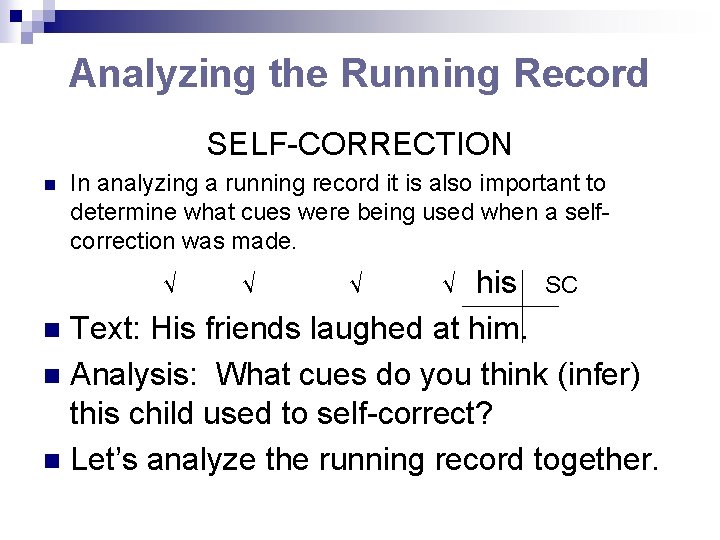
Analyzing the Running Record SELF-CORRECTION n In analyzing a running record it is also important to determine what cues were being used when a selfcorrection was made. his SC n Text: His friends laughed at him. n Analysis: What cues do you think (infer) this child used to self-correct? n Let’s analyze the running record together. √ √
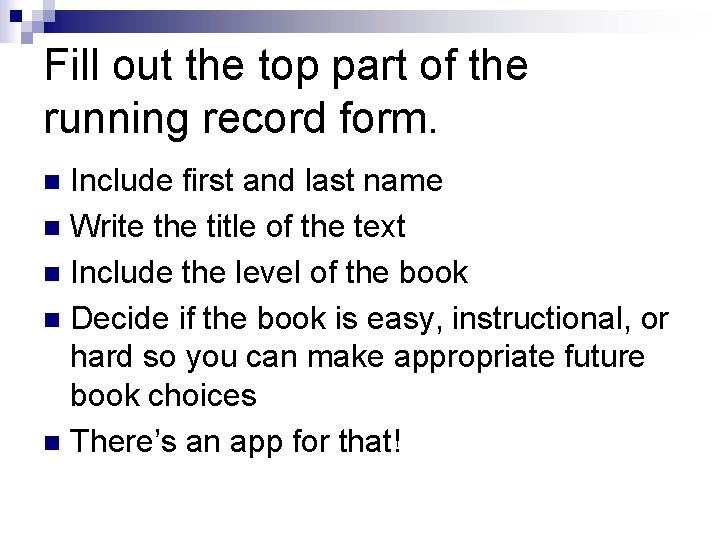
Fill out the top part of the running record form. Include first and last name n Write the title of the text n Include the level of the book n Decide if the book is easy, instructional, or hard so you can make appropriate future book choices n There’s an app for that! n
Resources For You To Use Conventions/Fluency Chart n Scoring Guidelines n Determining Reading Levels n Text Level Ladder of Progress n Blank Running Record Sheet n Guide for Observing Reading Behaviors n Teaching Prompts n
Bibliography Guided Reading: Good First Teaching for all Children, Gay Su Pinnell and Irene Fountas Observation Survey, Marie Clay Becoming Literate, Marie Clay Reading Recovery: A Guidebook for Teachers in Training, Marie Clay Classrooms That Work: They Can All Read and Write, PM Cunningham and R. Allington Early Childhood Assessment Framework, Pennsylvania Department of Education
Feel free to contact me with any questions at tammy. hatfield@borgerisd. net