
How To Give An Oral Scientific Presentation Level

- Slides: 18
How To Give An Oral Scientific Presentation Level : Basic A. John Rush, MD Professor, Duke-NUS This work is licensed under a Creative Commons Attribution-Non. Commercial-No. Derivs 3. 0 Unported License To view a copy of this license, visit [http: //creativecommons. org/licenses/by-nc-nd/3. 0/] Creation date: 27 th September 2011 Current date: 27 th September 2011 Version no: 1. 0
Disclosures (past 3 years) Since August, 2008, Dr. A. John Rush has received consulting fees from University of Michigan, Brain Resource Inc. ; consultant/speaker fees from Otsuka Pharmaceuticals; author royalties from Guilford Publications & the University of Texas Southwestern Medical Center at Dallas, & research support from the National Institute of Mental Health & Duke-National University of Singapore. * Note – Remove this slide if not applicable
Learning Objectives As a result of watching this Voice Annotated Powerpoint presentation, the learner will be able to: • Organize and prepare the slides for oral scientific presentation • Deliver a presentation
Agenda • The parameters & conditions • The message (bottom line) • The sequence (logic or chronology? ) • The slides • Disclosures, credits, references • “Entertainment” • Revise & edit • Delivery • Anxiolysis
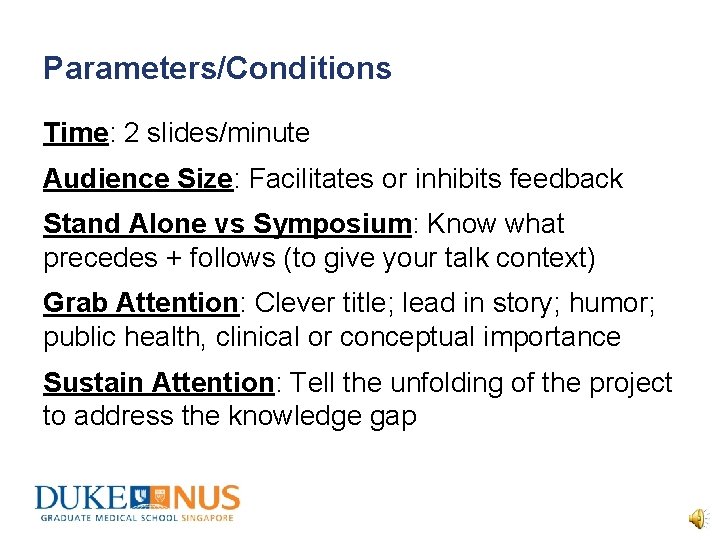
Parameters/Conditions Time: 2 slides/minute Audience Size: Facilitates or inhibits feedback Stand Alone vs Symposium: Know what precedes + follows (to give your talk context) Grab Attention: Clever title; lead in story; humor; public health, clinical or conceptual importance Sustain Attention: Tell the unfolding of the project to address the knowledge gap
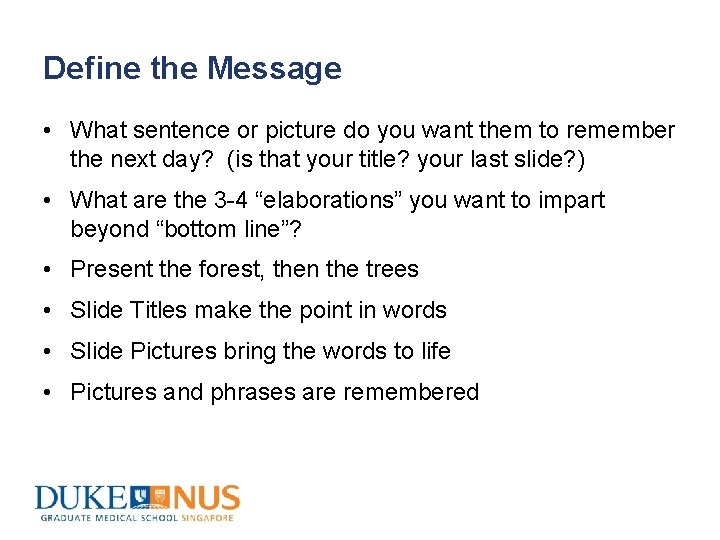
Define the Message • What sentence or picture do you want them to remember the next day? (is that your title? your last slide? ) • What are the 3 -4 “elaborations” you want to impart beyond “bottom line”? • Present the forest, then the trees • Slide Titles make the point in words • Slide Pictures bring the words to life • Pictures and phrases are remembered
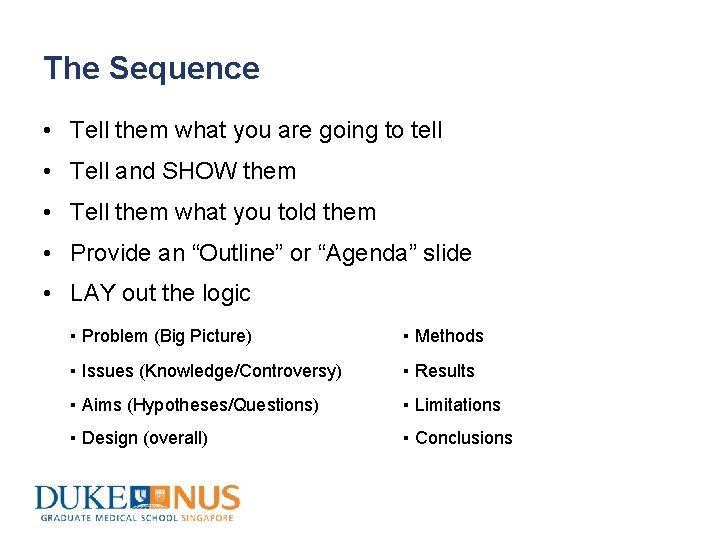
The Sequence • Tell them what you are going to tell • Tell and SHOW them • Tell them what you told them • Provide an “Outline” or “Agenda” slide • LAY out the logic ▪ Problem (Big Picture) ▪ Methods ▪ Issues (Knowledge/Controversy) ▪ Results ▪ Aims (Hypotheses/Questions) ▪ Limitations ▪ Design (overall) ▪ Conclusions
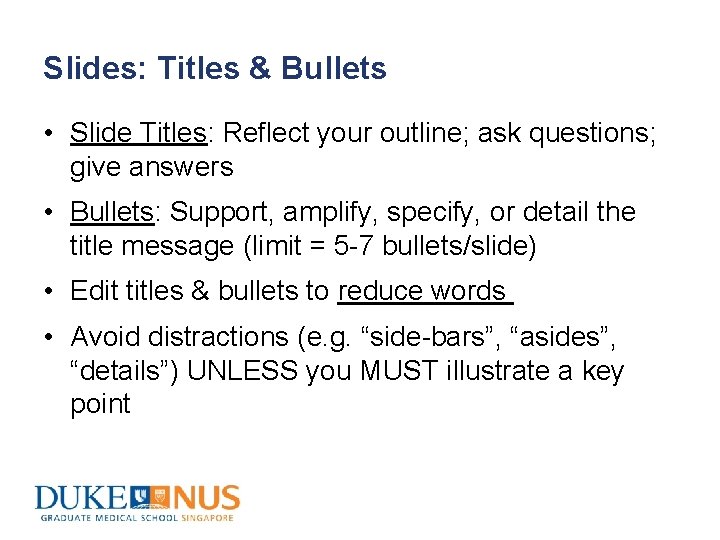
Slides: Titles & Bullets • Slide Titles: Reflect your outline; ask questions; give answers • Bullets: Support, amplify, specify, or detail the title message (limit = 5 -7 bullets/slide) • Edit titles & bullets to reduce words • Avoid distractions (e. g. “side-bars”, “asides”, “details”) UNLESS you MUST illustrate a key point
Slides: Pictures/Figures • Simplify figures • Title says what the figure, picture or table SHOWS • Tables: ONLY the key rows + columns • Bold the numbers you want them to KNOW • Statistics PLUS words in the slide • Convert statistical numbers into everyday concepts
Disclosures, Credits, References • Title Slide: Coauthors? Presented elsewhere? • Slide 2 (Disclosures): All sources, last 3+ years • References (on relevant slides) • LAST Slide: Acknowledgements • ? Website or contact for further information/followup? • Questions? FAQs?
Entertainment • Limited value in scientific talks • May break monotony • May introduce problem, highlight a method, summarize a result • Options: - Electronic - Humor - Cartoons - Stories • Selective use - Aphorisms
Revise & Edit • Check flow (order) • Delete JARGON. Use everyday language • Delete DETAILS • Use titles to MAKE the POINT or raise the question • Use a picture whenever possible • Summarize key results in 1 slide • Take away sentence: pithy? clear? • Take away picture?
Delivery - 1 • Practice, practice (+ time it) • Avoid uhs, ums, half sentences, halts, jerks, etc. • Talk as if you are telling a friend what you did • Avoid jargon • Avoid ACROs in slides and talk! • DO NOT READ SLIDES • Amplify, elaborate, illustrate, summarize slide content - (e. g. Almost half the sample failed to meet criterion) - (e. g. this slide summarizes key inclusion/exclusion criteria)
Delivery - 2 • CONSORT Charts • Give a picture for each key result • Use words to summarize relationships or stats (2 slides if needed) - (e. g. with a 35% placebo and 50% drug response, the Number Needed to Treat is 7 which means ___) • After results, what have others found? • How do you explain your results? • ALWAYS note study limitations • Conclusion: The take away sentence (with picture!)
Anxiolysis • Public speaking anxiety: – >80% have it – Skilled presenters/performers get anxious – Typically due to fear of judgment/failure • Anxiolysis: Talk to yourself – Audience is there to learn NOT judge – Failure is failure to tell them what you did – You can’t fail if the slides are good – Look at single individuals when talking – Shift gaze from Left, Center, Right, Center, etc. – Practice, practice – If Q+A, practice possible Qs+As
Summary • Communicate Key Points • Use Pictures + Words • Delete Jargon and Details • Repeat the Message • SAY What Each Slide Says/Shows • End with BOTTOM LINE • Practice, Practice
Acknowledgements • Ron Krug Ph. D • Tim Beck MD • Multiple media trainers
www. duke-nus. edu. sg Thank you