
How to Give a Good Talk Original slides
- Slides: 32
How to Give a Good Talk Original slides from Dr Sally A. Goldman and Dr. Simon Peyton Jones
Why Are We Here? • For your work to have significant impact, it is essential that you can convey results to your community • Your reputation depends on colleagues’ reaction to your talk • This skill may be crucial to getting a job or advancing in industry • Giving a good talk is a skill you can learn • I will give you guidance and tips on giving a good talk
Goals of a Talk • Meta-Goal: • • • Give your audience a intuitive feel for your idea Keep audiences’ interest (and attention) Convey technical material Communicate a key idea Convince audience to read written documentation (if exists) • Non-Goals: • Show people how smart you are • Expect audience to understand most key details of your work
Outline • Goals of a Talk • Planning Stages • Structuring Your Talk • Slide Preparation • The Do’s • The Don’ts • At the Talk • The Do’s • The Don’ts • Concluding Remarks
Planning Stages • Know your audience: • What is their background? • General, EE, Cp. E, or other? • Somewhat specialized audience • Highly specialized audience • If someone has spoken before you: • Look at paper/abstract/titles of relevant talks that proceeded yours • Prepare to use context provided
Scheduling (if you can) • If possible schedule your talk at 11: 00 • Most people are awake • Few have gone back to sleep • Bad times to schedule talk: • After lunch since the audience is more likely to be sleepy • Late afternoon since people will be running out of steam • Best to have room that will be comfortably crowded
Your audience • The audience you’d like • Thoroughly understand all the relevant theory of cartesian closed endomorphic bifunctors • Are all agog to hear about the latest developments in your work • Are fresh, alert, and ready for action • The audience you’ll get • Have heard of bifunctors, but wish they hadn’t • Have just had lunch and are ready for a doze
Structuring Your Talk • Use a top-down approach: • • Introduction (define problem, present a “carrot”, and put in context) Body (high level summary of key results) Technicalities (more depth into a key result) Conclusion (review key results and wrap up)
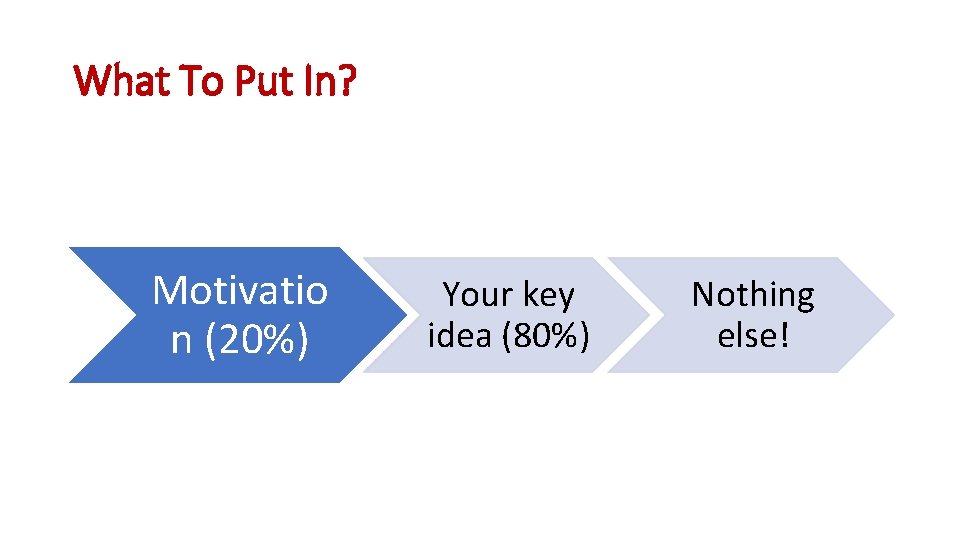
What To Put In? Motivatio n (20%) Your key idea (80%) Nothing else!
The Introduction • Define the Problem/Objective • Minimize use of terminology • Use pictures/examples/props if possible • Motivate the audience (give a “carrot”) • • • Why do I care? Why is problem important? Wy is it an interesting paper? How does it fit into larger picture? What are the applications?
The Introduction • Discuss related work • Table useful (mention authors and dates) • Succinctly state contributions of your work • Provide a road-map (outline)
Motivation • You have 2 minutes to answer these questions! • Example: • Java class files are large (brief figures), and get sent over the network. Can we use language-aware compression to shrink them? Yes, and I’m going to show you how we can do 50% better than the best generic zipping technology • Example: • Synchronization errors in concurrent programs are a nightmare to find. I’m going to show you a type system that finds many such errors at compile time.
The Body • Abstract the key results • Focus on a central, exciting concept • Explain significance of your work • Sketch methodology of key ideas • • Keep it high-level emphasizing structure Use pictures/diagrams whenever possible Provide intuition Gloss over technical details
Focus On Your Key Idea • You must identify a key idea • ”What I did this summer” is No Good. • Be specific • Don’t leave your audience to figure it out for themselves. • Be absolutely specific • Say “If you remember nothing else, remember this. ” • Organize your talk around this specific goal • Ruthlessly prune material that is irrelevant to this goal
The Technicalities • Take key result (or part of it) and go into some depth • Guide audience through difficult ideas • Give overview • State result • Review • It is this portion of your talk that typically grows when you give a 50 minute talk
Use Examples • To motivate the work • To convey the basic intuition • To illustrate The Idea in action • To show extreme cases • To highlight shortcomings
The Conclusion • Provide a coherent synopsis • Review key contributions and why they are important • Discuss open problems/future work • Tell your audience what you want them to do next • Indicate your talk is over. (For example, “Thank you. Are there any questions? ”) • Be ready to answer questions • If there are points you glossed over that you expect the audience may be interested in, you may want to prepare some slides (just in case)
Slide Preparation – Do’s • Decide what you want to say and say less! • Allow an average of 1. 5 – 2 minutes for each slide • Use Repetition • “Tell them what you’re going to tell them. Then tell them what you told them. ” • Realize that 20% of your audience at any given time is thinking about something else • Use Pictures/Diagrams whenever you can
Slide Preparation – Do’s (cont) • Use a large font (at least 20 pt) • Use color (in a meaningful way) • You need not use full sentences • Number your slides in case people want to ask you questions • Write reminders, key phrases and such on the slide notes
Slide Preparation – Do’s (cont) • Provide units on any graphs (e. g. Volts/meter) • Make graph or picture labels large enough to read – including axis marks • Use color to highlight graphs, but make lines/data readable in black and white if providing black and white handouts
Slide Preparation – Do’s (cont) • Check your spelling • PRACTICE! • • • Give a practice for your colleagues Be ready to redo all your slides Practice again Be sure that all your material projects on the screen Make sure it does not take too much time • (leave time for questions!)
Slide Preparation – Don’ts • Overload slide • Intend to use too many slides • Put some detail on the slide that you do not want to talk about • Get bogged down in details • Try to give a core dump
Slide Preparation – Don’ts (cont) • Show complex equations • Show code • Pseudocode is good • Have a slide that introduces a point that you are unsure of (unless you want to give the audience a chance to attack you)
The jelly effect • If you are anything like me, you will experience apparently severe pre -talk symptoms • Inability to breathe • Inability to stand up (legs give way) • Inability to operate brain
What to do about it • You are not a wimp. Everyone feels this way. • Deep breathing during previous talk • Script your first few sentences precisely (=> no brain required) • Move around a lot, use large gestures, wave your arms, stand on chairs • Practice!
At the Talk – Do’s • If you expect the audience to take notes provide copies of your slides (this is rarely the case in a conference or colloquium/job talk situation) • Have eccentricity (but not too extreme) • Make it fun/easy for people to remember you • Extreme eccentricity is bad for younger people
At the Talk – Do’s (cont) • Be EXCITED about your work! • Remind Don’t Assume • If you assume a standard result provide the audience with a brief reminder • TALK WITH SUFFICIENT VOLUME • Make Eye Contact • Be With the Audience • Walk toward and away from the people as well as left and right to break down implicit barrier •
At the Talk – Do’s (cont) • Point to the screen not slide • Bring props • Ask real and rhetorical questions to keep audience engaged • Use a pointer to highlight items on the display (but don’t overuse – especially with a laser pointer!) • Deflect obstructionists • Tell them you’d like to talk to them after the talk (about the interesting point made) because the point is a detail, tangential, has a long answer, you need to think about it, … • End on Time!
At the Talk – Don’ts • Talk too softly, mumble, or speak in a monotone voice, use “um”, “ah”, … • Read your slides • Focus attention on the screen – you’ll end up talking to the screen vs. the audience • Stand so that you block the projection • Mention a detail/point you don’t want to talk about • Darken the room (unless necessary to see) since it entices audience to sleep • Babble on when you have nothing to say • Over-run your time
Answering Questions • Questions are not a problem • Questions are a golden opportunity to connect with your audience • Be to the point in your answers • Do not give a history lesson • Be prepared to be interrupted during the talk • If the answer is involved, postpone the question at the end • If you have promised that you will answer questions at the end, don’t forget about them!
Concluding Remarks • Follow the guidelines provided here • Take every opportunity you can to give talks (and thus get practice and feedback) • Remember that the guidelines for structuring your talk must be adapted to each specific talk • Preparing a good talk takes time, do not expect to throw it together last minute • Practice for colleagues to get feedback • AND … you will give better talks and reap all the rewards that follow
Other Resources • How to give a great talk? • https: //www. youtube. com/watch? v=gzdad. ZQt. Qkc • How to give a great research talk? • https: //www. youtube. com/watch? v=s. T_-owj. KIb. A • Lots of other resources