
HOW TO GET PUBLISHED and How to review
HOW TO GET PUBLISHED and How to review a paper in a scientific journal Dr. Oleg B. Malyshev Associated Editor, Vacuum Original talk from Dr. Jan Willem Wijnen Executive Publisher, Elsevier
Outline • Elsevier and the publishing process • Journal organisation • Writing a quality manuscript • Preparations • Article construction • Language • Technical details • Review process • Revisions and response to reviewers • Ethical issues • Conclusions: getting accepted • Acting as a reviewer

Scientific publishing - There about 2, 000 scientific journal publishers in the world. - There are more than 25, 000 peer-reviewed scholarly journals in the world. - Together they publish about 1. 5 million articles a year. - The number of published articles increases each year by 3%. - About 10 million scientists in the world publish their work. And about 4, 000 unique authors in a year. This number also increases by ~3% each year. 3
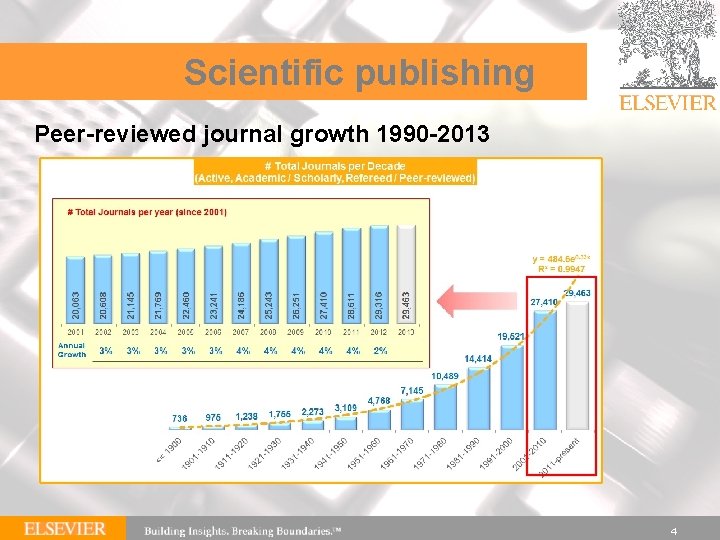
Scientific publishing Peer-reviewed journal growth 1990 -2013 4
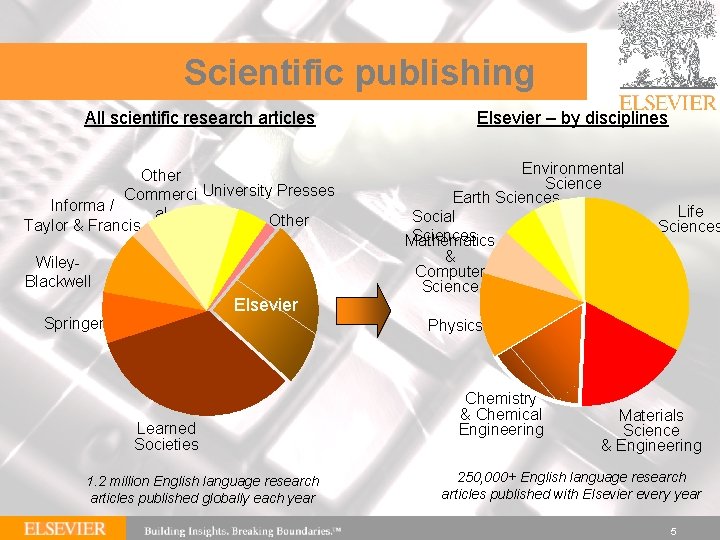
Scientific publishing All scientific research articles Other Commerci University Presses Informa / al Other Taylor & Francis Wiley. Blackwell Elsevier Springer Elsevier – by disciplines Environmental Science Earth Sciences Social Sciences Mathematics & Computer Science Life Sciences Physics Learned Societies 1. 2 million English language research articles published globally each year Chemistry & Chemical Engineering Materials Science & Engineering 250, 000+ English language research articles published with Elsevier every year 5
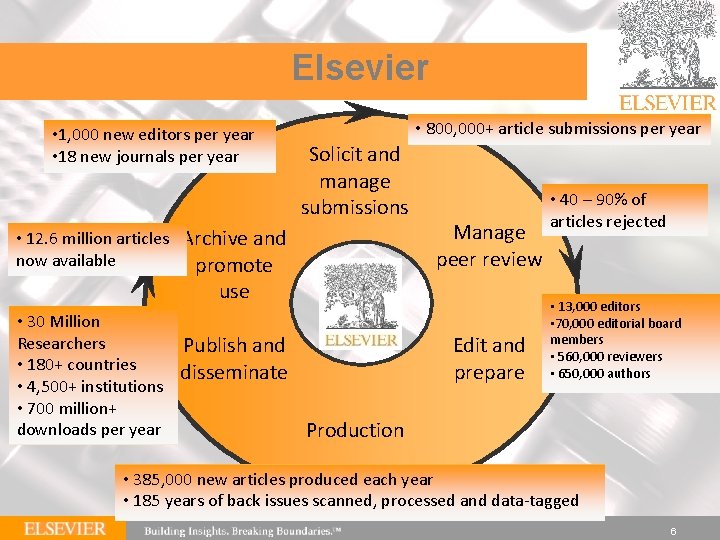
Elsevier • 1, 000 new editors per year • 18 new journals per year • 800, 000+ article submissions per year Solicit and manage submissions • 12. 6 million articles Archive and now available promote Manage peer review use • 30 Million Researchers Publish and • 180+ countries disseminate • 4, 500+ institutions • 700 million+ downloads per year Production Edit and prepare • 40 – 90% of articles rejected • 13, 000 editors • 70, 000 editorial board members • 560, 000 reviewers • 650, 000 authors • 385, 000 new articles produced each year • 185 years of back issues scanned, processed and data-tagged 6
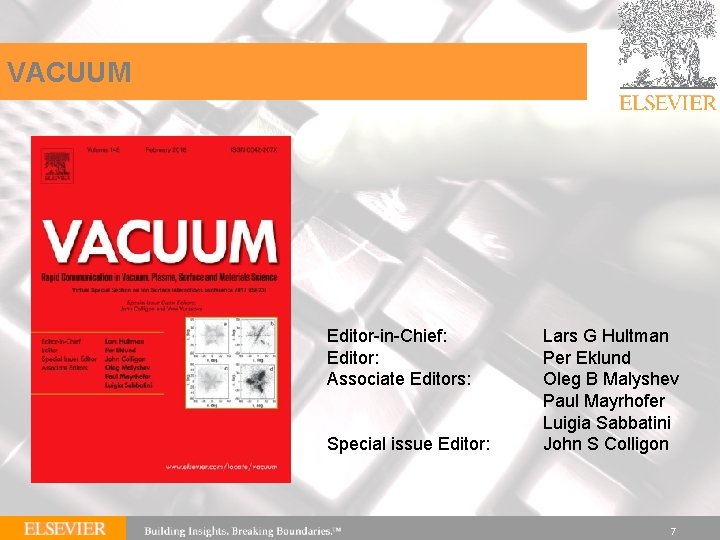
VACUUM Editor-in-Chief: Editor: Associate Editors: Special issue Editor: Lars G Hultman Per Eklund Oleg B Malyshev Paul Mayrhofer Luigia Sabbatini John S Colligon 7
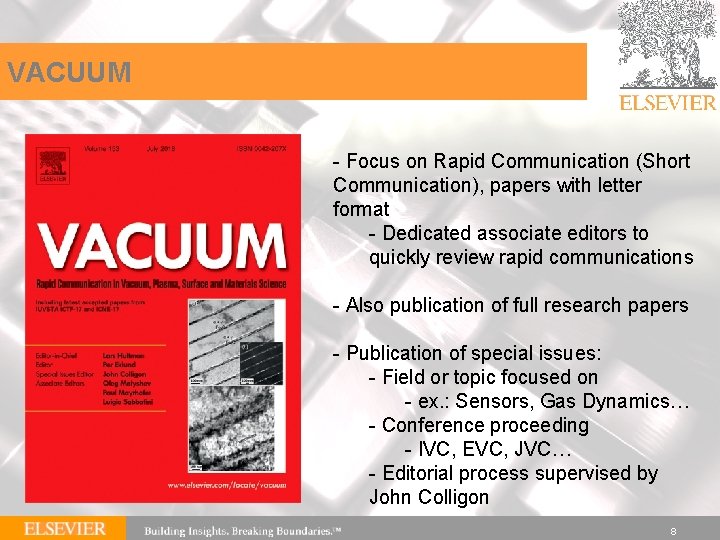
VACUUM - Focus on Rapid Communication (Short Communication), papers with letter format - Dedicated associate editors to quickly review rapid communications - Also publication of full research papers - Publication of special issues: - Field or topic focused on - ex. : Sensors, Gas Dynamics… - Conference proceeding - IVC, EVC, JVC… - Editorial process supervised by John Colligon 8
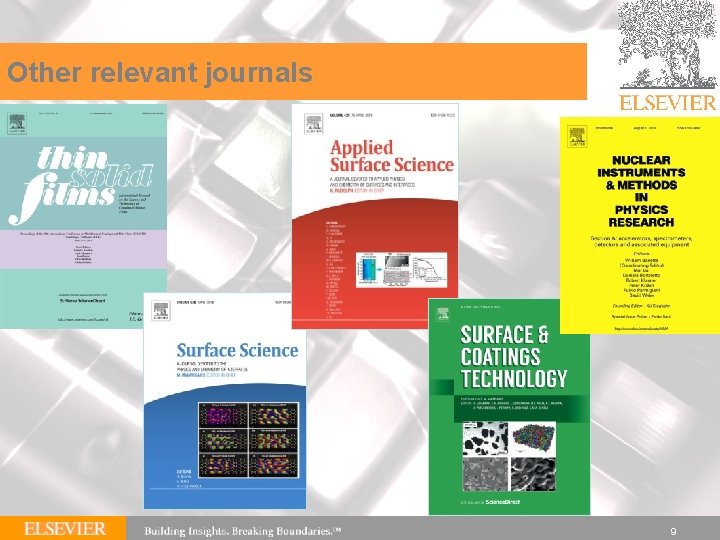
Other relevant journals 9
How is a journal organised?
Journal organisation - A journal is usually started/owned by a society or a commercial publisher. - The publisher • appoints editors, editorial board, • provides the editorial infrastructure, • arranges publication of accepted manuscripts, • provides promotion, distribution of the journal to readers and archiving
Journal organisation - The publisher appoints the editors. - The editors are responsible for the scientific quality of the papers in the journal. - They send out manuscripts to several reviewers who judge the content. Editors make a decision based on their advice. - Editors also advise on strategy and direction of the journal.
Journal organisation - The publisher and editors appoint an editorial board. Editorial board members are usually experts in a sub-field of the journal and can be consulted on journal policy. - The editorial board also advises on topics such as special issues, review papers, strategy of journal, or, key players in the field - The editorial board members are usually the active paper reviewers
Journal organisation - A journal always has an Aims&Scope, a text that describes the goal of the journal: - Subject / field - Audience (scientific, public, students…) - Type of articles (letters, full papers, review papers, . . . - Quality or coverage of field - Association with group
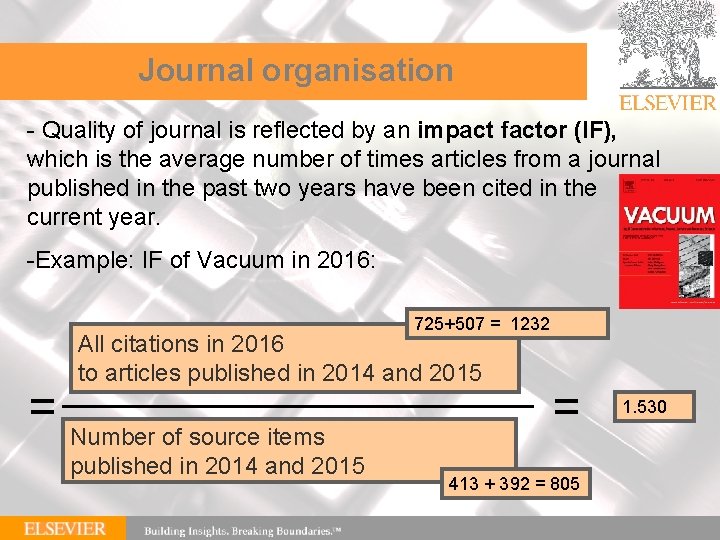
Journal organisation - Quality of journal is reflected by an impact factor (IF), which is the average number of times articles from a journal published in the past two years have been cited in the current year. -Example: IF of Vacuum in 2016: 725+507 = 1232 All citations in 2016 to articles published in 2014 and 2015 = Number of source items published in 2014 and 2015 = 413 + 392 = 805 1. 530
Journal organisation - Quality of journal is also reflected by -a 5 -year impact factor (IF), which is the average number of times articles from a journal published in the past 5 years have been cited in the current year. - VACUUM 5 -Year Impact Factor: 1. 553 - Cite. Score measures the average citations received per document published in this title. Cite. Score values are based on citation counts in a given year (e. g. 2015) to documents published in three previous calendar years (e. g. 2012 – 14), divided by the number of documents in these three previous years (e. g. 2012 – 14). - VACUUM Cite. Score: 2. 00
Writing a quality manuscript • Preparations
Preparation - Remember: - you want to get published, - but editors want original and attractive papers for their journal. - So, focus on what the reader wants to read - All editors and reviewers hate wasting time on poorly prepared manuscripts and will reject them • 40 – 90% of articles rejected!
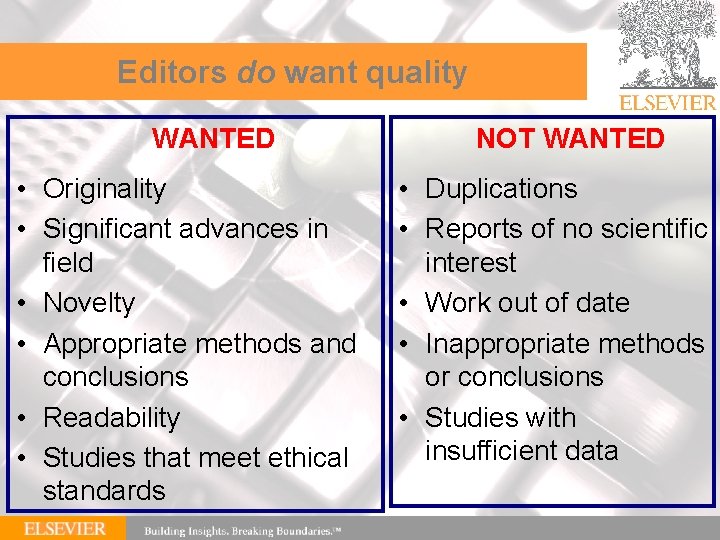
Editors do want quality WANTED • Originality • Significant advances in field • Novelty • Appropriate methods and conclusions • Readability • Studies that meet ethical standards NOT WANTED • Duplications • Reports of no scientific interest • Work out of date • Inappropriate methods or conclusions • Studies with insufficient data
Preparation Which journal? – Aims & Scope • check journal websites and recent articles – Types of articles • full paper, letter, review paper – Audience • specialists, multidisciplinary, general – Current hot topics • go through recent abstracts and conference session titles – Ask colleagues for advice
Preparation • Once you have chosen a journal: – Consult and apply the list of guidelines in the “Guide for Authors” and “Author Information Pack” – Read some of the articles to understand which type of articles the editors find acceptable. – Use the correct: • • Layout Section lengths (stick to word limits) Nomenclature, abbreviations and spelling Number’s standard Units (SI) Reference format Number and type of figures and tables Statistics
Writing a quality manuscript • Article construction
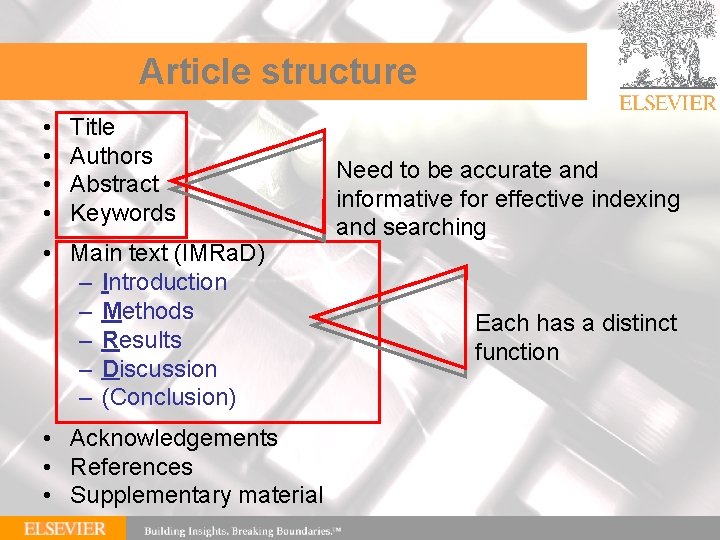
Article structure • • Title Authors Abstract Keywords • Main text (IMRa. D) – Introduction – Methods – Results – Discussion – (Conclusion) • Acknowledgements • References • Supplementary material Need to be accurate and informative for effective indexing and searching Each has a distinct function
Title, affiliation, keywords • Title: a good title should contain the fewest possible words that adequately describe the contents of a paper. The title conveys the main findings of research and is specific, concise, complete and attracts readers • Affiliations: be consistent with spelling, full versus short names, full versus short addresses • Keywords: are important for indexing: they enable your manuscript to be more easily identified and cited. Keywords should be specific. Avoid uncommon abbreviations and general terms. Check “guide-for-authors” for specific keyword policy.
Abstract • The quality of an abstract will strongly influence the editor’s decision • The abstract summarizes in 50 -300 words the problem, the method, the results and the conclusion • The abstract gives sufficient detail so the reader can decide whether or not to read the whole article • Write the abstract last so it accurately reflects the article
Introduction • Provide the necessary and balanced background information to put your work into context, but no extensive review • It should be clear from the introduction: • Why the current work was performed – aims (what you want to achieve) – significance (why) • What has been done before • What has been done and achieved in this work (in brief terms, in one sentence)
Methods • The Methods section must provide sufficient information so that a knowledgeable reader can reproduce the experiment • If methods are new, explain in detail, otherwise refer to previously published work • It should be clearly shown what parts of method are from the literature (providing references) and what are the author’s ideas, was equipment procured or made by authors • List suppliers of reagents and manufacturers of equipment, and define apparatus in familiar terms
Results • Present your findings and explain what was found • Be clear and present in logical sequence • Use tables, figures, descriptions of observations • Clearly identify significant trends • Do not give interpretations here!
Graphics Figures and tables are the most effective way to present results BUT: • Captions should be able to stand alone, such that the figures and tables are understandable without the need to read the entire manuscript • The data represented should be easy to interpret • Colour should only be used when necessary
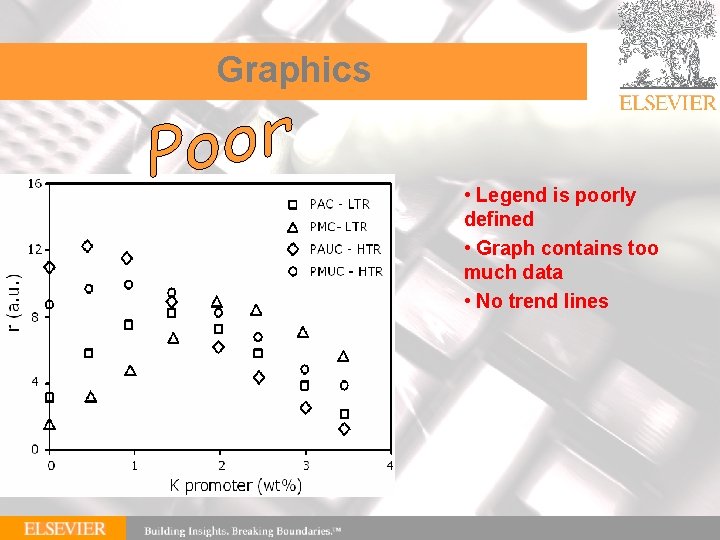
Graphics • Legend is poorly defined • Graph contains too much data • No trend lines
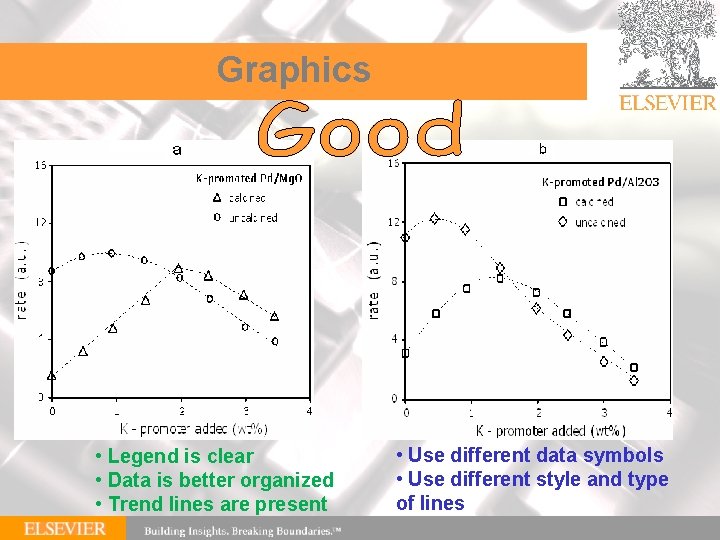
Graphics • Legend is clear • Data is better organized • Trend lines are present • Use different data symbols • Use different style and type of lines
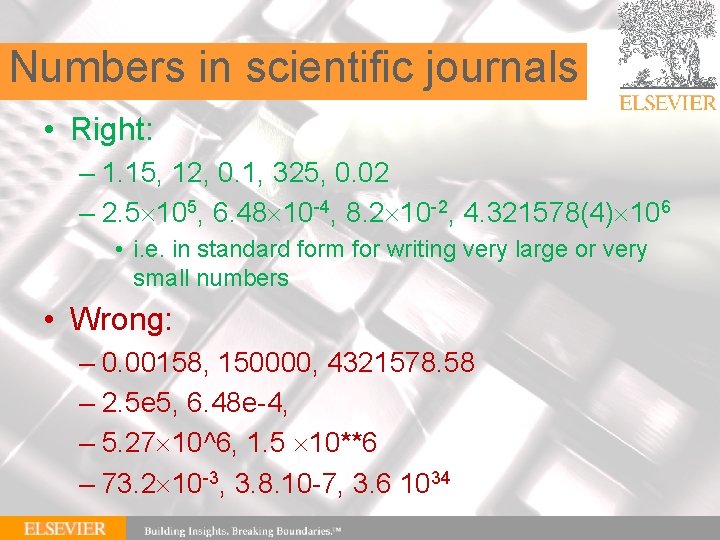
Numbers in scientific journals • Right: – 1. 15, 12, 0. 1, 325, 0. 02 – 2. 5 105, 6. 48 10 -4, 8. 2 10 -2, 4. 321578(4) 106 • i. e. in standard form for writing very large or very small numbers • Wrong: – 0. 00158, 150000, 4321578. 58 – 2. 5 e 5, 6. 48 e-4, – 5. 27 10^6, 1. 5 10**6 – 73. 2 10 -3, 3. 8. 10 -7, 3. 6 1034
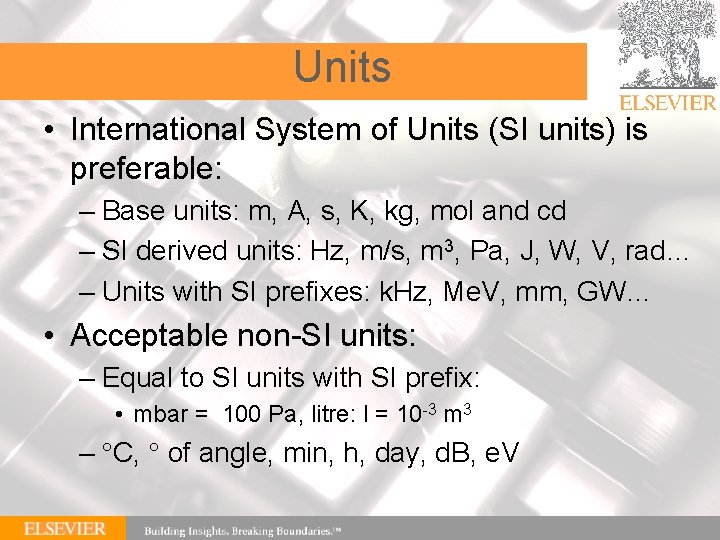
Units • International System of Units (SI units) is preferable: – Base units: m, A, s, K, kg, mol and cd – SI derived units: Hz, m/s, m 3, Pa, J, W, V, rad… – Units with SI prefixes: k. Hz, Me. V, mm, GW… • Acceptable non-SI units: – Equal to SI units with SI prefix: • mbar = 100 Pa, litre: l = 10 -3 m 3 – C, of angle, min, h, day, d. B, e. V
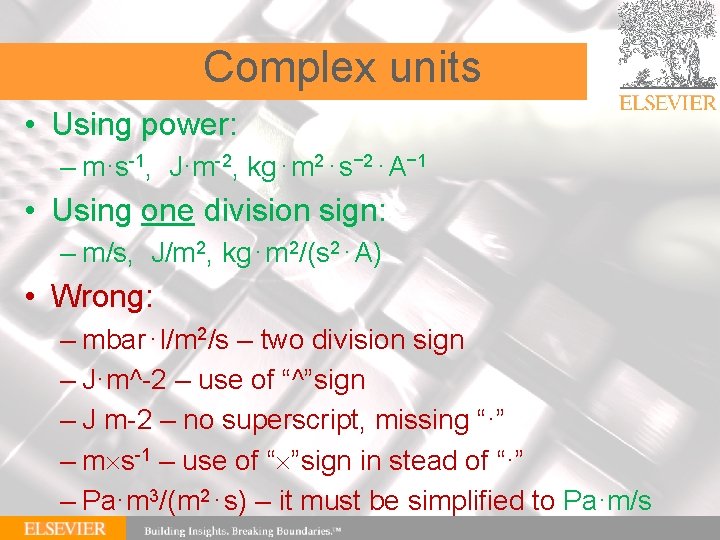
Complex units • Using power: – m·s-1, J·m-2, kg⋅m 2⋅s− 2⋅A− 1 • Using one division sign: – m/s, J/m 2, kg⋅m 2/(s 2⋅A) • Wrong: – mbar⋅l/m 2/s – two division sign – J·m^-2 – use of “^”sign – J m-2 – no superscript, missing “·” – m s-1 – use of “ ”sign in stead of “·” – Pa·m 3/(m 2⋅s) – it must be simplified to Pa·m/s
Discussion • Describe how the results relate to the study’s aims and hypotheses • Explain how the findings relate to those of other studies • Discuss all possible interpretations of your findings • Mention the limitations of the study • Employed method applicability limitations • Error analysis
Conclusions Put the results of your study into CONTEXT Describe how it represents an advance in the field Suggest future experiments BUT Avoid repetition with other sections Do not continue discussion here Avoid being overly speculative Do not over-emphasize the impact of your study
Acknowledgements Acknowledge anyone who has helped you with the study, including: • Researchers who supplied materials or reagents • Anyone who provided technical help • Funding sources • Anyone who helped with the writing or English, or offered critical comments about the content • Explain why these people are acknowledged
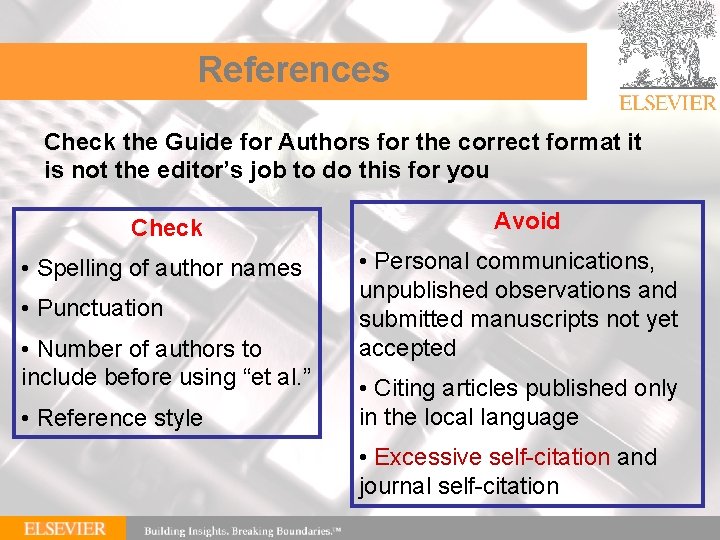
References Check the Guide for Authors for the correct format it is not the editor’s job to do this for you Check • Spelling of author names • Punctuation • Number of authors to include before using “et al. ” • Reference style Avoid • Personal communications, unpublished observations and submitted manuscripts not yet accepted • Citing articles published only in the local language • Excessive self-citation and journal self-citation
Supplementary material Information related to and supportive of the main text, but of secondary importance Includes: • Large data sets • Method validation • Additional controls • Video data Will be available online when the manuscript is published
Writing a quality manuscript • Language
Language • Journal editors and in particular reviewers may reject a manuscript simply because of frequent language mistakes. In any case they will be irritated. • Publishers do not language edit manuscripts • If English is not your mother-tongue: • Find a native-English speaker to read and correct your manuscript • Use a paid-for editing service. More information at https: //webshop. elsevier. com/languageservices/languageediting/ • DO NOT copy complete phrases from other papers, it may be considered plagiarism!
Language • Key to successful manuscript writing is to be alert to common errors: • Long sentences • Sentence construction • Incorrect tenses • Inaccurate grammar • Mixing languages • You should: • Write direct and short sentences • Remember that one idea or piece of information per sentence is sufficient • Avoid multiple statements in one sentence
Final Check before Submission • Ask colleagues to take a look and to be critical • Check that everything meets the requirements set out in the “Guide for Authors” – again! • Check that the scope of the paper is appropriate for the selected journal • If necessary, get a colleague or approved editing service to improve the language • Ensure that citations are balanced and that aims/purpose of the study, and significance of the results, are clear • Use a spell-checker
Writing a quality manuscript • Cover letter
Cover letter • This is your opportunity to convince the journal editor that they should publish your study • Keep it brief, but convey the particular importance of your manuscript to the journal • Briefly describe: • your research area and track record • the main findings of your research • the significance of your research • relevance to a journal • Suggest reviewers (at least 3), preferably from different institutes, and different countries
Review process : what happens after submission?
Review process • Different journals have different editorial processes and even different decision options. For example: • One editor, more editors, regional editors, topical editors, . . . • Number of required referees differs (usually 2 or 3). • Some journals pre-screen manuscripts (for language, competence).
Review process • Generally editors do a first check (topic, language, completeness, . . . ). They are allowed to desk-reject. • After initial check, they will send out for review, usually to a few referees. Review process takes several weeks. Many invited reviewers decline invitation, adding to review times. • Editor receives referee-reports and takes a decision based on them. • In case of doubt, they may consult another referee or review themselves. • Different journals can have different type of decisions (not all journals are open to major revisions. • Editor informs author
Review process • Reasons for rejection: • Out-of-scope • Poor language • Lacking novelty • Lacking thorough analysis • Poor science
Revisions, Responses to Reviewers and Rejection
Post-referee revision • Carefully study the reviewers’ comments, adjust your manuscript and prepare a detailed letter of response • Respond to all points; even if you disagree with a reviewer provide a scientifically solid rebuttal, do not ignore their comment • State specifically what changes you have made to address the reviewers’ comments, mentioning the page and line numbers where changes have been made • Perform additional experiments, calculations or computations, if required; these usually serve to make the final paper stronger
Accepting rejection • Don’t take it personally • Please respect reviewer’s work – they are trying to help you to make a better paper, and their work is unpaid (in most cases) • Try to understand why the paper has been rejected • Evaluate honestly – will your paper meet the journal’s requirements with the addition of more data or is another journal more appropriate? • Don’t resubmit elsewhere without significant revisions addressing the reasons for rejection and checking the new “Guide for Authors”
Ethical Issues
Unethical publishing behaviour Submitting a paper implies that you are familiar with and have accepted publishing ethics, see • “Guide for Authors” • “Author Information Pack” • https: //www. elsevier. com/about/policies/publishing-ethics Publishers can retract published papers and state in public why a paper was retracted. They may also inform the management of your Institute
Unethical publishing behaviour includes: • Multiple submissions • Submission to a journal implies that it is not under consideration for publication elsewhere (see guide for authors) • Plagiarism • Serious offence that could lead to paper rejection, academic charges and termination of employment. It will seriously affect your scientific reputation • Plagiarism is the appropriation of another person’s ideas, processes, results, or words without giving appropriate credit • Publishers are increasingly using software to detect unethical behaviour. Soon this will be done routinely
Unethical publishing behaviour • Redundant publications • An author should not submit for consideration in another journal a previously published paper. It is considered selfplagiarism. • Data fabrication and falsification • Making up data or results, and recording or reporting them • Copy from one publication and presenting as new data
Unethical publishing behaviour • Improper author contribution. (Co-)author should have: • Substantial contributions to conception and design, or acquisition of data, or analysis and interpretation of data • Drafted/revised the article for important intellectual content • Made final approval of the version to be published • Communication with co-authors • All co-authors should agree with a final manuscript before submission to a journal • Missing co-author • Check that all contributors are recognised as co-authors or in acknowledgments • You can’t include into your paper someone results, text, figures, tables, etc. without his/her permission (see plagiarism)
Conclusion: Getting Accepted
How to get accepted? Attention to detail Check and double check your work Consider the reviews English must be as good as possible Presentation is important Take your time with revision Acknowledge those who have helped you New, original and previously unpublished Critically evaluate your own manuscript Ethical rules must be obeyed – Nigel John Cook, Editor-in-Chief, Ore Geology Reviews
Highlights • Many journals are asking for submitting the paper Highlights. • The Highlights are not another Abstracts! • 3 -5 short (<85 signs, one line) statements to attract readers to your paper. • They will appear in the internet search engine together with your paper title.
Types of publications • • Regular paper. Letters / Rapid communications. Reviews. Conference proceedings (peer-reviewed selection).
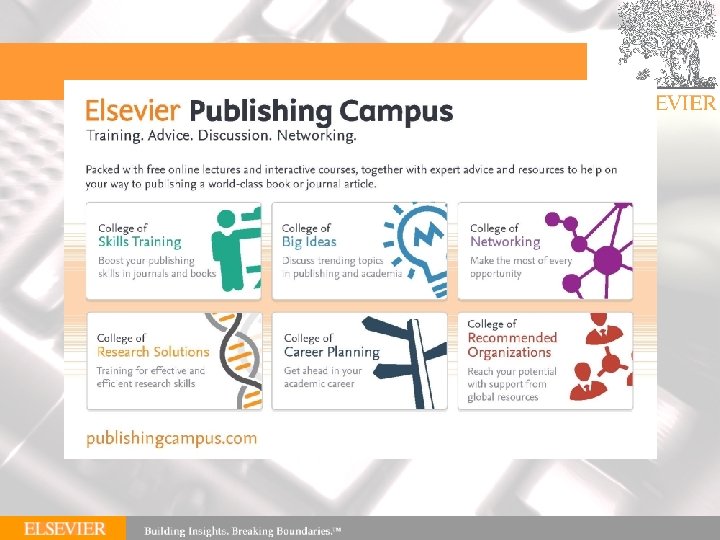
Further reading • Author Training at Research Academy: https: //researcheracademy. elsevier. com/
Non-peer-reviewed publications It is a reality in the apply science and technology fields: • University or Institute notes and preprints • Project Notes and Reports – ILC note, LHC Report, H 2020 report • TDR and CDR – DLS Green book, ILC TDR, ELI-NP CDR • Conference and workshop proceedings – IPAC, EPAC, …
Why publish? • Why publish? – You finding are not missing • Why publish in peer-reviewed journals? – Quality, visibility, accountability, recognition. • What to publish? – Difference between a report and a scientific paper
Reviewer's view How to review a manuscript: The steps of acting as a reviewer Courtesy to Dr Carina Arasa Cid Publisher Surface Science Elsevier
66 Why peer-review? Peer review is the evaluation of work by one or more people of similar competence to the producers of the work (peers) Peer-review is used to assess the quality, significance and originality of scientific research before publication. • • provide credibility improve the record of science control in scientific communication ensures that previous work is acknowledged The reviewer is a first reader of the paper • He/she provides a feedback to the author • He/she advises on how to improve the quality of the paper
| 67 Editors’ view: what makes a good reviewer? • • • Provides an objective, thorough, and comprehensive report Provides well-founded comments for authors • On content, method, analysis, conclusions, references. etc… Gives constructive criticism • Advises on how to improve the paper Provides a clear recommendation to the Editor Submits the report on time
| 68 Why do academics review? • Value from mentoring young researchers • Enjoyment in reviewing • General interest in the area • Awareness of new research and developments • • • before their peers Career development Help with own research or new ideas Association with journals and Editors
| 69 Introduction § What editor is expecting from a reviewer: • • • Is the paper effective, clear and well organised? Does it really introduce and put into perspective what follows? Suggest changes in organisation and point authors to appropriate citations if necessarily Is it worth publishing? Be as specific as possible when giving feedback • Don’t just write “the authors have done a poor job”
| 70 Assessing the methodology § § § Can a colleague reproduce the experiments and get the same outcomes? Is the description of new methodology complete and accurate? Did the authors include proper references to previously published methodology? Is the sample size large enough and was it selected in an appropriate way? Was the data collected in accordance with accepted practice? Could or should the authors have included supplementary material?
| 71 Results and discussion (I) • • • Suggest improvements in the way data is shown Comment on general logic and on justification of interpretations and conclusions Comment on the number of figures, tables, and schemes Consider the implications of the results presented A good Discussion section relates the findings back to the literature and to the aims of the research, as outlined in the Introduction. From the Discussion, you should be able to assess the contribution made by the study, and decide how far it has helped to resolve the original problem. Write concisely and precisely which changes you recommend
| 72 Results and discussion (II) • • List suggested style/grammar changes and other small changes separately Suggest additional experiments or analyses Make clear the need for changes/updates Ask yourself whether the manuscript is worth being published
| 73 Assessing the conclusions • • • The purpose of the Conclusion is to assess the implication of the results obtained, and to put these in a broader research context. Comment on importance, validity, and generality of conclusions Request toning down of unjustified claims and generalizations Request removal of redundancies and summaries The Abstract, not the Conclusion, summarises the study
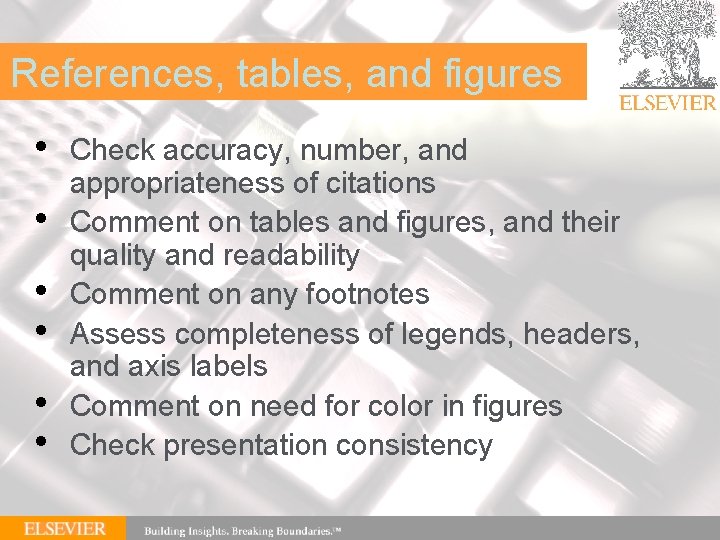
| 74 References, tables, and figures • • • Check accuracy, number, and appropriateness of citations Comment on tables and figures, and their quality and readability Comment on any footnotes Assess completeness of legends, headers, and axis labels Comment on need for color in figures Check presentation consistency
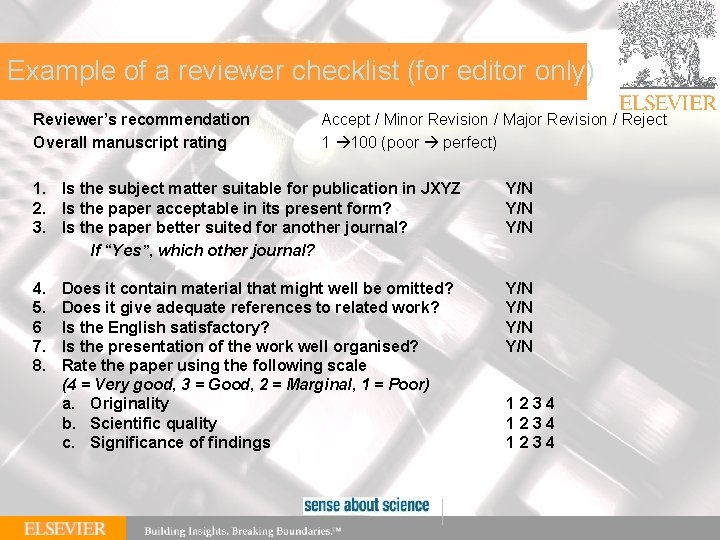
| 75 Example of a reviewer checklist (for editor only) Reviewer’s recommendation Overall manuscript rating Accept / Minor Revision / Major Revision / Reject 1 100 (poor perfect) 1. Is the subject matter suitable for publication in JXYZ 2. Is the paper acceptable in its present form? 3. Is the paper better suited for another journal? If “Yes”, which other journal? Y/N Y/N 4. 5. 6 7. 8. Y/N Y/N Does it contain material that might well be omitted? Does it give adequate references to related work? Is the English satisfactory? Is the presentation of the work well organised? Rate the paper using the following scale (4 = Very good, 3 = Good, 2 = Marginal, 1 = Poor) a. Originality b. Scientific quality c. Significance of findings 1234
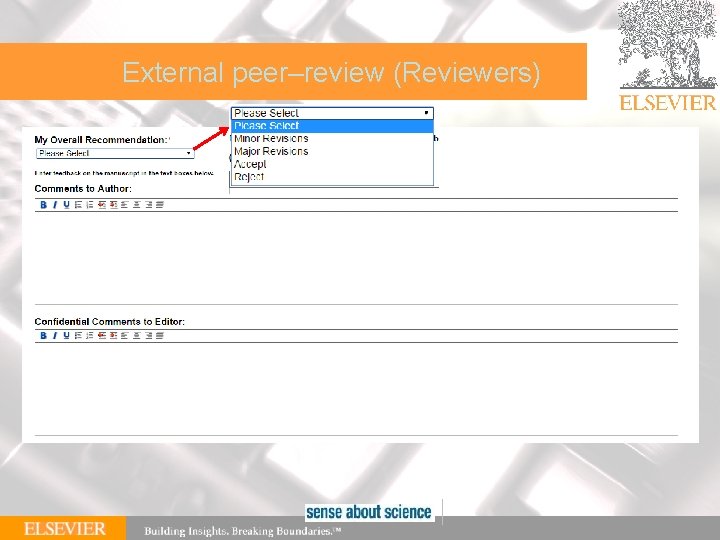
| 76 External peer–review (Reviewers)
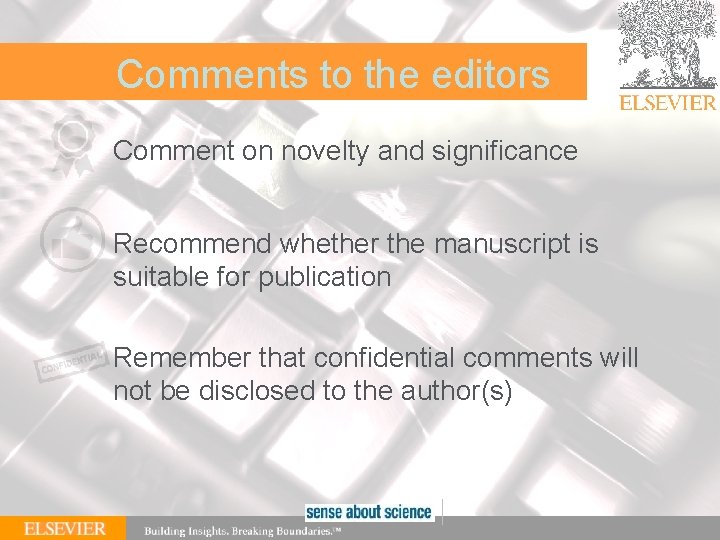
| 77 Comments to the editors Comment on novelty and significance Recommend whether the manuscript is suitable for publication Remember that confidential comments will not be disclosed to the author(s)
| 78 Comments to the authors § § § Ensure comments to the author(s) are consistent with your recommendation to the Editors Do not include recommendation to accept or reject Use neutral language and avoid direct criticism Provide specific comments on the design Comment on the presentation of data, results and discussion “When reviewing, try to remember that you are an author too and be professional and constructive in your approach. That can be hard but don’t let your inner nit-picker get the upper hand. Leave 24 hours between reading the manuscript and writing your review, to allow time for your reasonable self to rise to the fore. ” Stephen Curry, Professor of Structural Biology, Imperial College London
| 79 Further reading at publishingcampus. com elsevier. com/authors elsevier. com/reviewers elsevier. com/editors Understanding the Publishing Process with Elsevier – complete guide Publishing Ethics brochure – top reasons to publish ethically Get Published – top tips on writing, reviewing and grant writing etc. Get Noticed – new ways to promote your article and research Open access – definitions and options Career Planning Guide – download in 12 languages
| 80
Thank you Visit Elsevier Publishing Campus www. publishingcampus. com More information on journal peer review www. elsevier. com/reviewers
- Slides: 81