
How to Find Work Experience Work Experience at


- Slides: 21
How to Find Work Experience
Work Experience at Hillhead � There is no set week for work experience, you can decide to go at a time that suits you, the company you are working with and the school (not during prelim times etc) � You don’t have to do a full week can go on more than 1 work experience or do the same experience for longer than a week
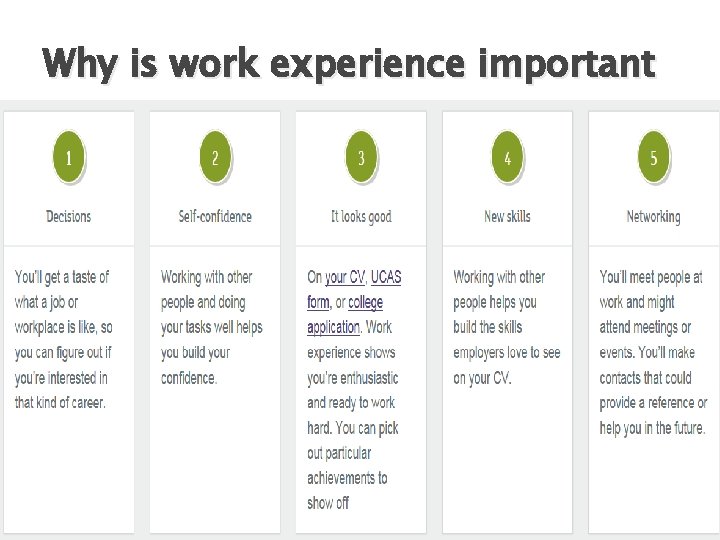
Why is work experience important
Why do I need to find my own? � The process of finding a work placement is just as important as the actual work experience � It teaches you key skills you will need when you are looking for a “real” job.
Who can help? � Lots � Mr of support is available Richardson � School Careers Advisor � Family � Teachers (Speak to one who teaches the subject area you are interested in)
Where to go? � The best thing to do is to look for work experience that’s related to the job you want to do, or in the same sector or industry as your chosen career. � Here are some examples: � If you know you want to be a chef, you could try to find a placement in a restaurant or canteen. � If you’re interested in a career in medicine, you could try to find a placement in a hospital or GP surgery. � If you like travel, you could look for a placement with a travel agent or tour company. � If you think a career in finance would suit you, you could try to get a placement in an accounts office or at a bank.
Not sure? � If you don’t know what type of career you want to pursue, log into My World of Work and complete the careers profile � https: //www. myworldofwork. co. uk/my- career-options
Now that you have some ideas! � make a list of the top 10 placements you would like � imagine the kinds of things you might do on your placement � try to be realistic � remember that you won’t be given a lot of responsibility � ask yourself if the placement is realistic for someone your age � expect to do some repetitive and easy tasks.
Step by Step Guide � Here are some steps you can follow to help you find a work placement; � Step 1 – If someone in your family works somewhere interesting, you can ask them if they’ll contact their human resources department for you. � Step 2 – Ask neighbours and family friends if their work would consider you for a work placement. � Step 3 – If you already know of an organisation that interests you, do a web search for their contact details.
Step by Step Guide � Step 4 – Find employers in your local area by looking on www. yell. com or www. thomsonlocal. com. Just type in your postcode and the kind of company you’re looking for. � Step 5 - Look on recruitment websites for the type of job you want. This will give you contact details for companies who offer these kinds of jobshttps: //www. myworldofwork. co. uk/getting-a -job
Step by Step Guide � Step 6 - Make sure you check GLOW emails regularly- Mr Richardson sends out lots of opportunities in this way. � Step 7 – Think of companies you pass by when you are on your way to school or out shopping. � Step 8 – Be willing to travel to other areas, This will give you more choice and open up other opportunities. Mr Richardson can supply you with a bus pass to help with costs
Step by Step Guide � Step 9 - Download the Workfinder App or visit the website- https: //www. workfinder. com/ � https: //www. stemexchange. co. uk/Young. Peo ple. aspx Stem Exchange is also useful if you are interested in science, technology, engineering or mathematics.
Step by Step Guide � Register for www. uptree. co to find lots of virtual work placement opportunities. � Due to COVID-19 some work places may be more reluctant to take on pupils for work experience. Universities, colleges and employers are fully aware of this. But by taking on virtual work experience you are still gaining work related skills!
Contacting the Company � If the company is small and in the local area you could drop in and speak to them. � Larger companies may require a letter and CV. You will need to ring up the company and ask who organises work experience. Some larger companies put this information on their websites. Once you have the name of the person you should speak to, you will need to phone them to introduce yourself.
Making the call � Lots of young people find it a bit scary to call an employer. Even some adults get nervous phoning companies. The more you do it, the easier it will be – you’ll soon wonder what you were worried about. Here are some tips that might help: � Think about what you want to say before you make the call. � Write it down on a piece of paper and keep it in front of you. � Have a pen and paper ready to take down any names or notes. � Take a deep breath and relax before dialling the number. � Always be polite and try to speak clearly.
Making the Call � Start by introducing yourself – give your name, say which school you go to and explain that you’re looking for work experience. � Be prepared to say why you are interested in a placement with that employer (Do your research!!) � Say what interests you about that company or the kind of work they do. � If they say yes, ask them when would be a good time to complete the placement (Remember for most companies we will need 6 weeks notice)
If at first you don’t succeed… � Keep trying other employers – don't give up. � If you’re really nervous, you could ask a parent or teacher to be with you when you make the first phone call. � Practice makes perfect!
Once you have a placement � � � Let Mr Richardson know ASAP Think about how you will get there, what time will you need to leave the house? If it is a virtual placement, where will you access it? Somewhere quite is essential! Is there a uniform or dress code? See Mr Richardson if you need any help here. Remember who your main employer contact is. You need to know who to ask for when you get there. It’s also helpful to have a phone number in case you need to get in touch if you’re running late.
Making the most of the placement � Show up on time- Employers value good time keeping � Stay � Be off your phone- It is very unprofessional friendly- Even though you may be nervous try to say hello to everyone
Making the most of the placement � Pay attention in meetings- Listening skills are something that employers always look for. Take notes and be prepared to give an answer if spoken to. � Show initiative- Ask for some tasks to get started on and when you’re finished, see if there is anything else you can help with.
Making the most of the placement � Ask questions- If you don’t understand, ask. Don’t be afraid to make a mistake. � Tidy up after yourself-Make sure you don’t leave your mess behind. � Be yourself- It's not what you know, how talented you are, or even what you do on the first day that will make it a success. It's your attitude and behaviour that an employer will remember and help you get the most from the experience.