
How to Explain the Numbers Helping Staff Parents
How to Explain the Numbers: Helping Staff, Parents, and Other Stakeholders Understand the Results of the NCSEAM Surveys for Part C and 619 Batya Elbaum, NCSEAM Pam Roush, West Virginia Part C OSEP National Early Childhood Meeting Arlington, VA, December 2007
Purpose of the session n To provide participants with strategies for explaining the measures and percentages that come from the NCSEAM rating scales addressing Indicators C 4 and B 8.
Part C Indicator #4 “Percent of families participating in Part C who report that early intervention services have helped the family a) know their rights, b) effectively communicate their children’s needs, and c) help their children develop and learn. ”
Part B Indicator #8 “Percent of parents with a child receiving special education services who report that schools facilitated parent involvement as a means of improving services and results for children with disabilities. ”
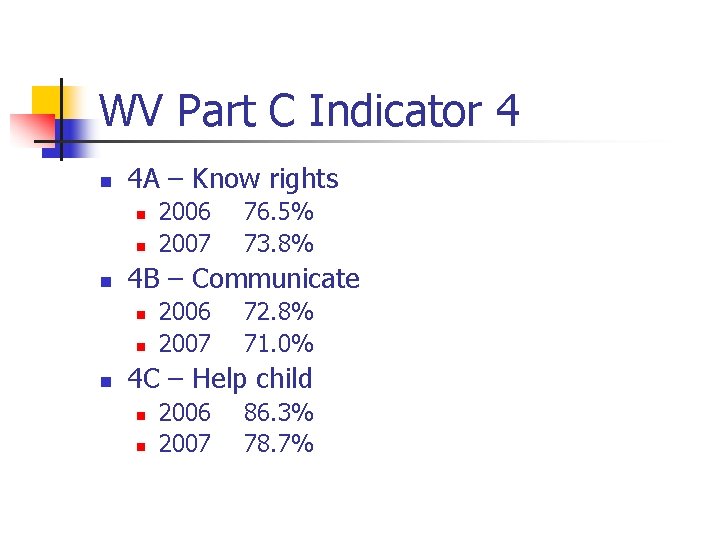
WV Part C Indicator 4 n 4 A – Know rights n n n 76. 5% 73. 8% 4 B – Communicate n n n 2006 2007 72. 8% 71. 0% 4 C – Help child n n 2006 2007 86. 3% 78. 7%

Change in measure by region
Percent on 4 A by Region in 2006 and 2007
Why use a measurement analysis?
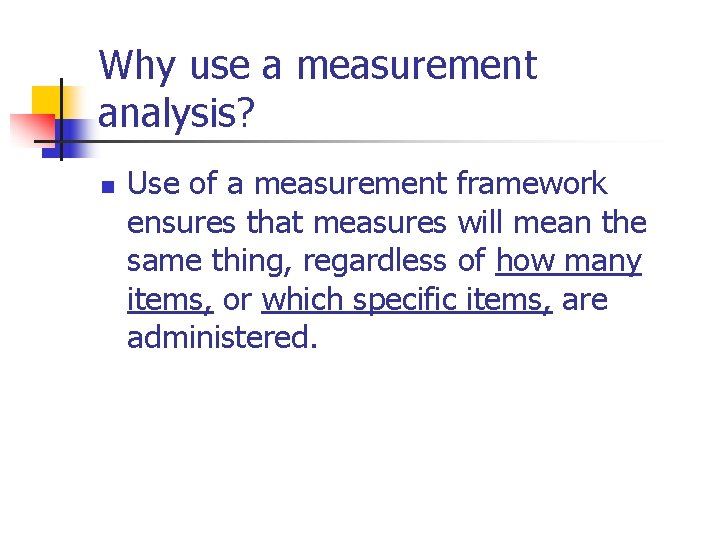
Why use a measurement analysis? n Use of a measurement framework ensures that measures will mean the same thing, regardless of how many items, or which specific items, are administered.
Why use a measurement analysis? n n We can’t assume that all survey items are equally agreeable. A measurement analysis gives us a measure of each item’s overall agreeability.
Order of Impact on Family items from least to most agreeable
Why use a measurement analysis? n Use of a measurement framework allows us to test whether all the items are measuring the same thing.
Measuring the 3 subindicators n NCSEAM’s measurement analysis of pilot data from thousands of families showed that items that are related to the three OSEP outcomes all fit into a single scale of family outcomes.
Measuring the 3 subindicators n Families appear to achieve these outcomes in a very consistent order. n n Families who report that EI helped them know their rights also report that EI also helped them help their child develop and learn. Families who report that EI helped them effectively communicate their children’s needs also report that EI also helped them know their rights and help their child develop and learn.

Location of key items related to Indicator C 4 556 Indicator 4 b: Effectively communicate their children’s needs. IFS Item: “Communicate more effectively with the people who work with my child and family. ” [556] 539 Indicator 4 a: Know their rights. IFS Item: “Know about my child's and family's rights concerning Early Intervention services. ” [539] 516 Indicator 4 c: Help their children develop and learn. IFS items: “Understand my child's special needs. ” [516] “Do things with and for my child that are good for my child's development. ” [498]
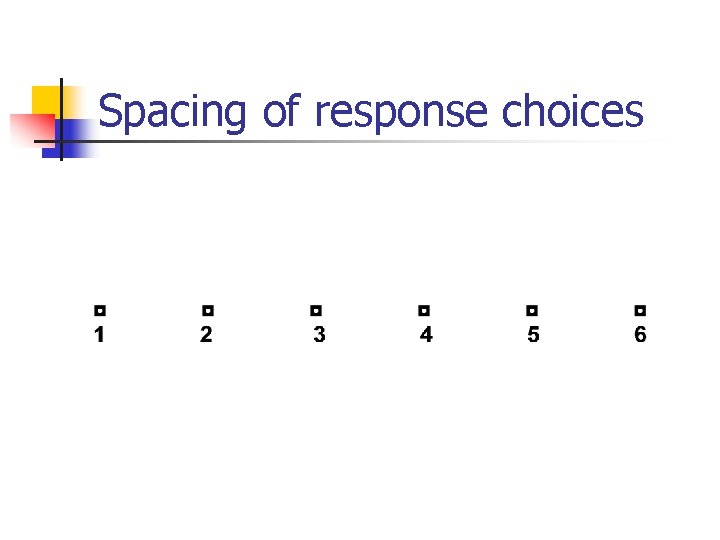
Why use a measurement analysis? n We can’t assume that the response choices (very strongly disagree, strongly agree, very strongly agree) indicated by equidistant circles or numbers on a page are really equidistant.
Spacing of response choices
Spacing of response choices

The logic of distributions
Example: Distribution of height
Distribution of Measures of Reading Achievement - 1
Distribution of Measures of Reading Achievement - 2
West Virginia results 2006
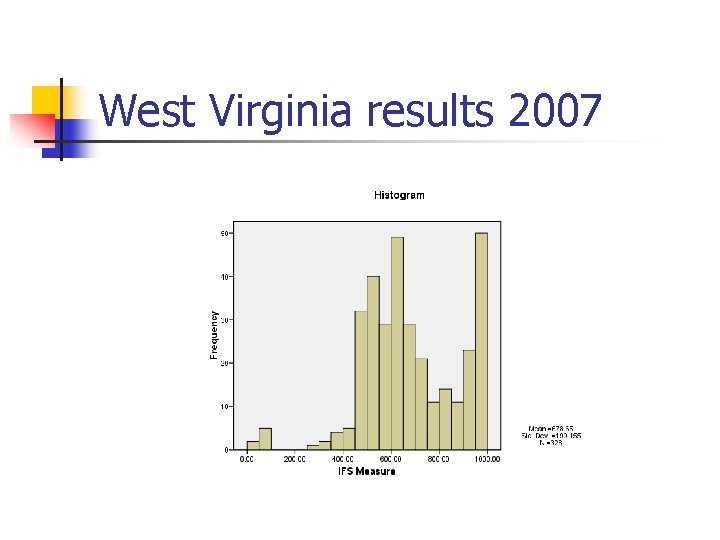
West Virginia results 2007
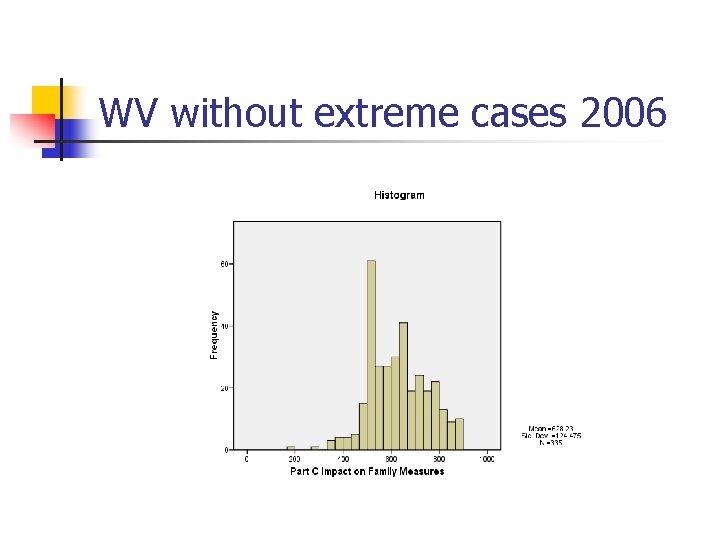
WV without extreme cases 2006
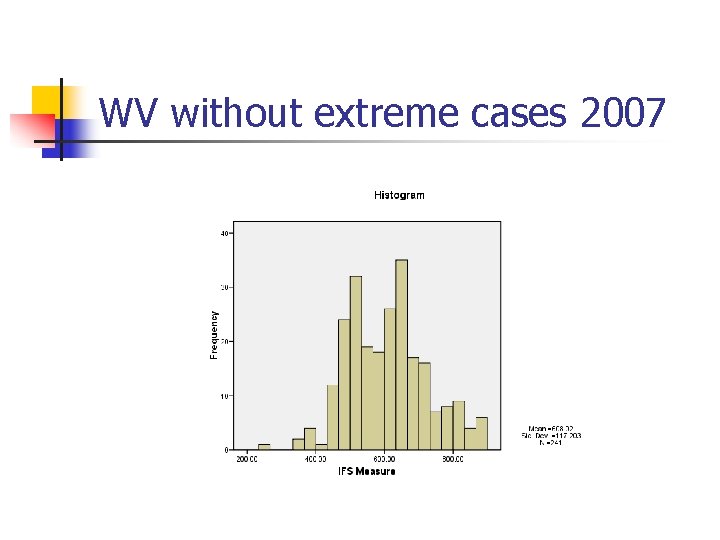
WV without extreme cases 2007
Instrumentation and approach to data analysis make a difference
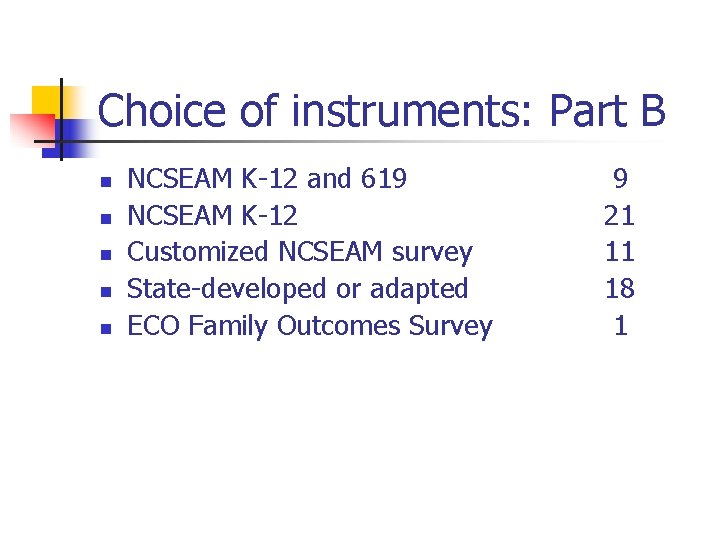
Choice of instruments: Part B n n n NCSEAM K-12 and 619 NCSEAM K-12 Customized NCSEAM survey State-developed or adapted ECO Family Outcomes Survey 9 21 11 18 1

States’ reported baseline data on Indicator 8 B
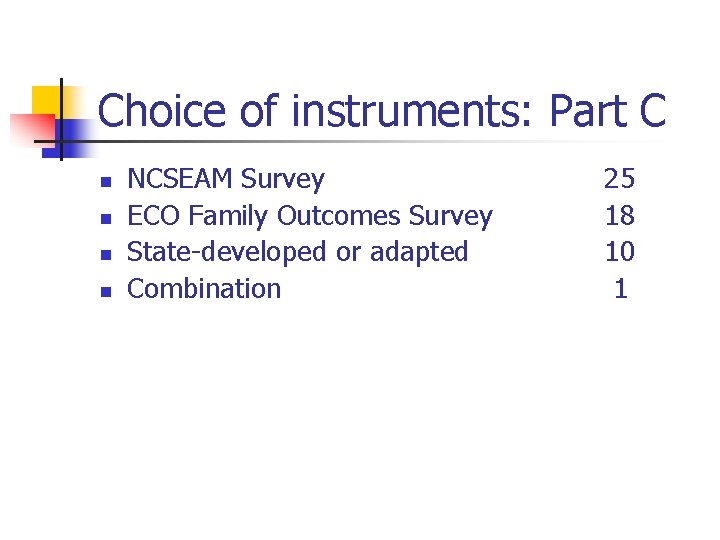
Choice of instruments: Part C n n NCSEAM Survey ECO Family Outcomes Survey State-developed or adapted Combination 25 18 10 1

Analysis of states’ baseline data: Indicator C 4

Analysis of states’ baseline data: Indicator C 4
APR Family Outcome Results – Part C States Using NCSEAM Survey and RASCH analysis APRs submitted February 2007
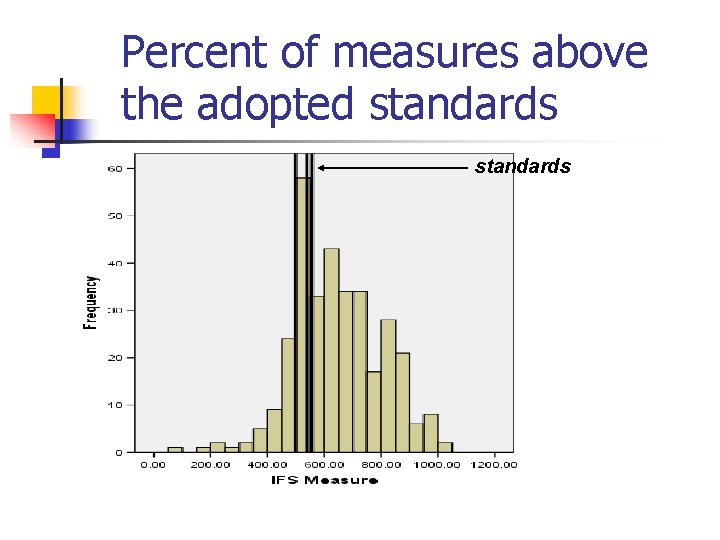
Reference to a standard
Percent of measures above the adopted standards
What is the relationship between % at or above the NCSEAM standard and % agreement on the “threshold item? ”

Sample descriptive interpretation related to Indicator 4 A n n Approximately 90 -95% of families agreed, with approximately two-thirds of families expressing strong or very strong agreement, that early intervention helped them: Understand their child’s special needs. Do things with and for their child that are good for their child’s development. Feel that they can handle the challenges of parenting a child with special needs.
Part C Example: WV data

Q 44 - know about my child's and family's rights
Q 42 - communicate more effectively
Q 46 - understand my child's special needs
Part B Example
The NCSEAM standard is a stringent standard n n Cut score for B at 600 Cut scores for C at 539, 516, 556 The standard is set so as to ensure that approximately 95% or more of the responses will be in one of the agree categories on the item designated as the “threshold item” Simple agreement with the “threshold item” is not enough
How precise are the percentages that states are reporting?
Error in estimation n n Whenever data are based on a sample (whether owing to sampling or to a less than 100% return rate), there is some amount of error in generalizing to the population. “Error, ” or imprecision, can be represented by a confidence interval. As sample size decreases, error of estimate - and its representation as a confidence interval - increases. The decrease is not linear!
- Slides: 45