
How to evaluate listening skills Observing the Performance
How to evaluate listening skills

Observing the Performance of the Four Skills Things that we can observe during listening as the receptive skills are process and product (invisible, audible)

The Importance of Listening is often implied as a component of speaking

Types of Listening Intensive: phonemes, words, intonation Responsive: a greeting, command, question Selective: TV , radio news items, stories Extensive: listening for the gist, the main idea, making inference
Micro and Macro Skills of Listening Micro Skills Attending to the smaller bits and chunks of language, in more of bottom-up process Macro Skills Focusing on the larger elements involved in a top-down approach

What Makes Listening Difficult 1. Clustering Chunking-phrases, clauses, constituents 2. Redundancy Repetitions, Rephrasing, Elaborations and Insertions
3. Reduced Forms Understanding the reduced forms that may not have been a part of English learner’s past experiences in classes where only formal ” textbook” language has been presented 4. Performance variables Hesitations, False starts, Corrections, Diversion
5. Colloquial Language Idioms, slang, reduced forms, shared cultural knowledge 6. Rate of Delivery Keeping up with the speed of delivery, processing automatically as the speaker continues
7. Stress, Rhythm, and Intonation Correctly understanding prosodic elements of spoken language, which is almost always much more difficult than understanding the smaller phonological bits and pieces.
8. Interaction Negotiation, clarification, attending signals, turn taking, maintenance, termination
Designing Assessment Tasks Negotiation, clarification, attending signals, turn taking, maintenance, termination
Designing Assessment Tasks: Intensive Listening Recognizing Phonological & Morphological Elements Phonemics pair, consonants Test takers read : a. He’s from California b. b. She’s from California
Designing Assessment Tasks: Responsive Listening Appropriate response to a question Test-takers read : a. In about an hour. b. b. About an hour c. c. About $10 d. d. Yes, I did
Designing Assessment Tasks: Selective Listening Selective listening, in which the test-taker listen to a limited quantity of aural input and must discern within it some specific information
Listening Cloze (cloze dictations or partial dictations) It requires the test-taker to listen a story monologue, or conversation and simultaneously read the written text in which selected words or phrases have been selected In a listening cloze task, test-takers see a transcript of the passage that they are listening to and fill in the blanks with the words or phrases that they hear
Test-takers write the missing words or phrases in the blanks
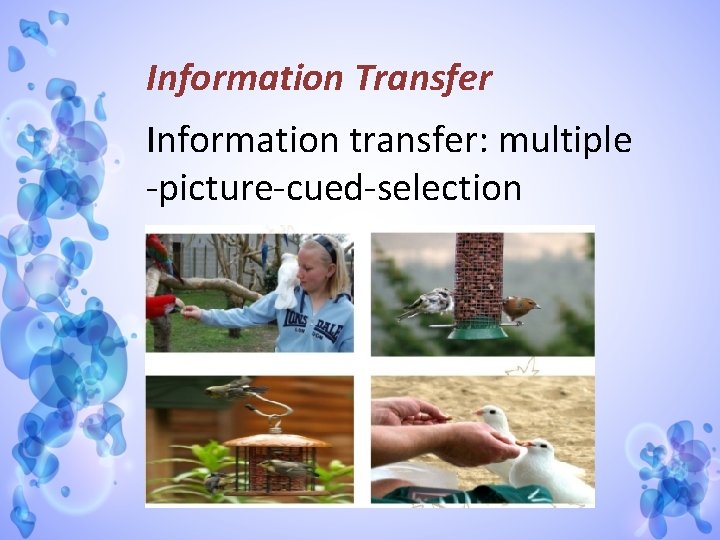
Information Transfer Information transfer: multiple -picture-cued-selection
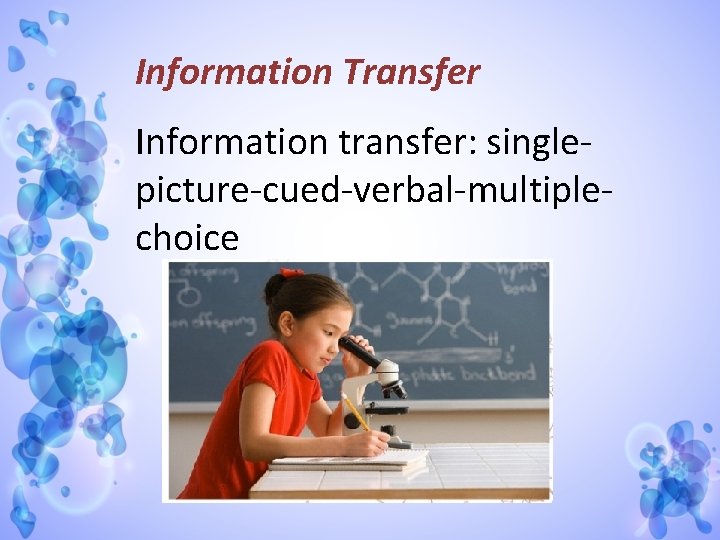
Information Transfer Information transfer: singlepicture-cued-verbal-multiplechoice
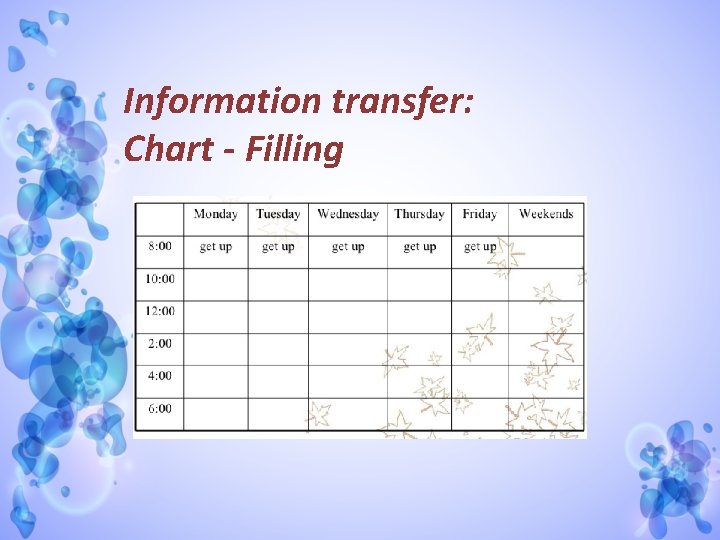
Information transfer: Chart - Filling
Sentence Repetition The task of simply repeating a sentence or a partial sentence, or sentence repetition, is also used as an assessment of listening comprehension
Designing assessment Test: Extensive Listening to develop a top down, global understanding of spoken language
Some extensive / quasi-extensive listening comprehension tasks Dictation: widely researched genre of assessing listening comprehension Ø 50 – 100 words Ørecited 3 times: normal speed, long pauses between phrases, normal speed
Communicative stimulusresponse tasks Listen to a monologue or conversation and respond to a set of comprehension questions. Disadvantages: some of the multiplechoice questions don’t mirror communicative real-life situations.
Authentic listening tasks Ideally, listening tests are cognitively demanding, communicative, authentic, and interaction. Test as a sample of performance/tasks implies an equally limited capacity to mirror all the real-world context of listening performance
Alternatives to assess comprehension in a truly communicative context Note taking Listening to a lecturer and write down the important ideas. Disadvantage: scoring is time consuming Advantages: mirror real classroom situation it fulfills the criteria of cognitive demand, communicative language & authenticity
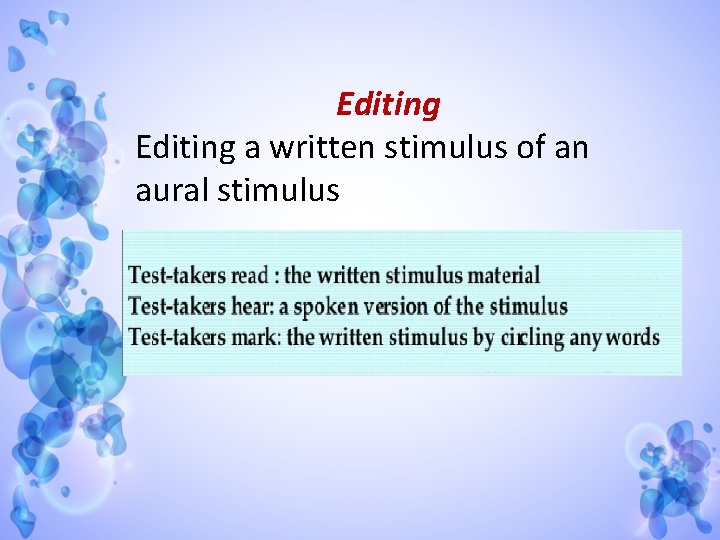
Editing a written stimulus of an aural stimulus
Interpretive tasks paraphrasing a story or conversation Potential stimuli include: song lyrics, poetry, radio, TV, news reports, etc.
The stimuli can be directed through questions like: “why was the singer feeling sad? ”, “what do you think the political activists might do next? ” Difficulties: The task conforms to certain time limitation, and the questions might be quite specific, there may be more than one correct interpretation
Retelling Listen to a story or news event and simply retell it either orally or written show full comprehension Difficulties: scoring and reliability validity, cognitive, communicative ability, authenticity are well incorporated into the task. Interactive listening (face to face conversations)
- Slides: 29