
How to Enhance Service Delivery to Constituents through

- Slides: 35
How to Enhance Service Delivery to Constituents through e. Government — CRM Solutions June 13, 2002 Pw. C Consulting. TM is a business of Pricewaterhouse. Coopers.
Agenda · What is CRM in the Public Sector · Challenges and Opportunities in the Public Sector · Delivering C-Centric, Multi-channel Solutions · Pw. C Case Studies - NC FAST - California Commission on Teacher Credentialing 2
What is CRM in the Public Sector? Pw. C Consulting. TM is a business of Pricewaterhouse. Coopers.
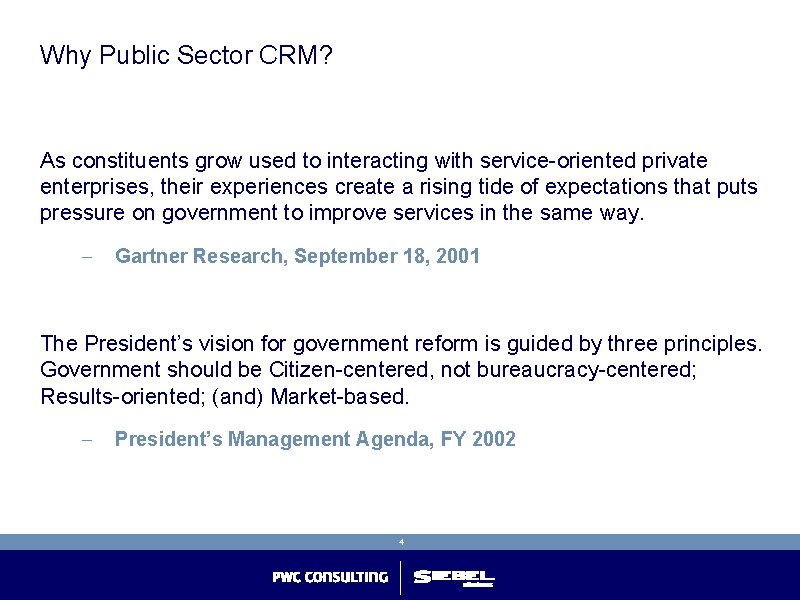
Why Public Sector CRM? As constituents grow used to interacting with service-oriented private enterprises, their experiences create a rising tide of expectations that puts pressure on government to improve services in the same way. - Gartner Research, September 18, 2001 The President’s vision for government reform is guided by three principles. Government should be Citizen-centered, not bureaucracy-centered; Results-oriented; (and) Market-based. - President’s Management Agenda, FY 2002 4
Public Sector CRM Call it what you want – Customer RM, Citizen RM, Constituent RM, Convict RM, Customer Care…. the principles are the same. “C” Relationship Management is… 1. It is a “customer centric” strategic vision 2. CRM supports the consistent and efficient delivery of services and products across all interactions and channels 3. It means learning, developing, and deploying knowledge about public sector customers, within privacy requirements, to better serve those customers 4. It allows information to be leveraged for better policy and service development 5. CRM must address privacy as a critical design consideration, but privacy requirements need not be a barrier to effective CRM 5
Public Sector CRM Functionality CRM includes process and technology “C facing” solutions that involve: - Case Management - Service/Product Licensing - Service Delivery & Support - Eligibility Determination - Benefits Administration - Information Dissemination Every time an individual or business interacts with government, CRM issues are at play. CRM is central to the role of government. CRM solutions support multiple contact channels: - Call Centers - Fax - Internet Self-service - Mail - Web Chat - Kiosks - Email - Service offices 6
What Value is CRM Bringing to Government? Governments and agencies are focusing on constituents, clients, partners, citizens and businesses to: - Improve consistency of service - Improve compliance through consistent and readily available information - Promote equity and parity in information and service delivery across geographic boundaries - Reduce expensive contact methods when self-service is appropriate - Increase data security while integrating information for more effective use - Decrease current costs of maintaining inaccurate information across multiple legacy systems - Increase levels of constituent and employee satisfaction 7
…But There Are Challenges to be Addressed CRM isn’t easy - the public sector can benefit from lessons learned in the private sector - The public sector is developing electronic channels in an effort to improve service, but an integrated approach to channel management requires greater effort. - Organizations must balance what constituents want and need against the cost to deliver and maintain systems and processes. - Information management and integrity of existing data remain a fundamental obstacle to improving service. - Content management across channels can become a major issue with the growth of channels or an opportunity for more effective and efficient service. - CRM is not a technology project. It is a program that affects strategies, processes, and culture, too. 8
Challenges and Opportunities in the Public Sector Pw. C Consulting. TM is a business of Pricewaterhouse. Coopers.
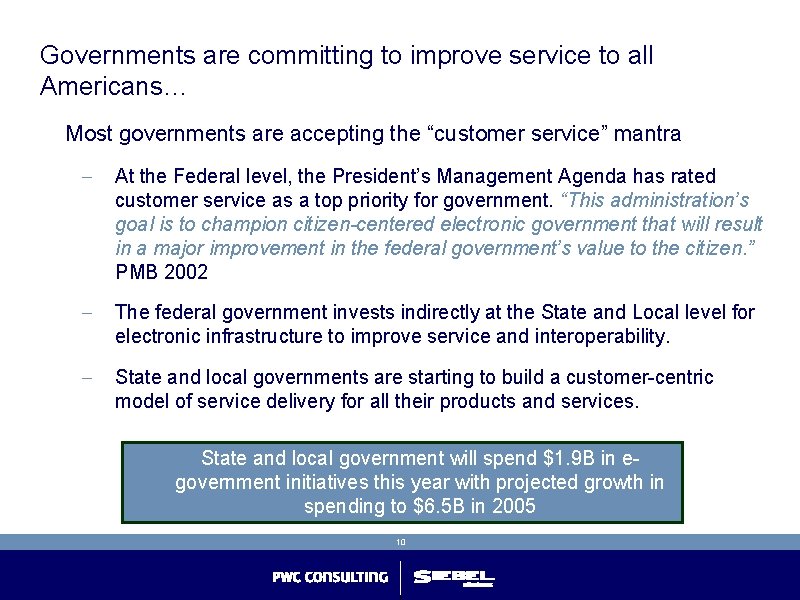
Governments are committing to improve service to all Americans… Most governments are accepting the “customer service” mantra - At the Federal level, the President’s Management Agenda has rated customer service as a top priority for government. “This administration’s goal is to champion citizen-centered electronic government that will result in a major improvement in the federal government’s value to the citizen. ” PMB 2002 - The federal government invests indirectly at the State and Local level for electronic infrastructure to improve service and interoperability. - State and local governments are starting to build a customer-centric model of service delivery for all their products and services. State and local government will spend $1. 9 B in egovernment initiatives this year with projected growth in spending to $6. 5 B in 2005 10
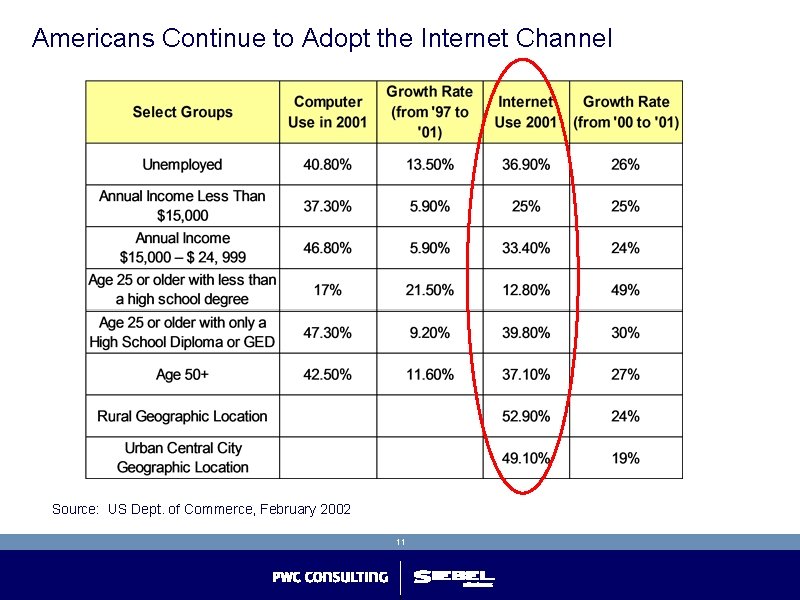
Americans Continue to Adopt the Internet Channel Source: US Dept. of Commerce, February 2002 11
Government Adoption of Channel Management Despite cost advantages, governments are not yet influencing which service channels constituents use - While financial incentives are used widely by the private sector to encourage customers to use lower cost channels, public sector agencies either cannot or have not employed this tactic. - Government electronic services are not yet being aggressively marketed to constituents – a change may be required to increase take-up rates. - Government organizations are not comfortable or experienced in segmenting constituents – an important tactic in private sector channel management. 12
Balancing Personalization and Privacy Personalization – the use of customer specific data to determine what and how information is presented to the customer – is one of the important tools within CRM – but what about privacy? - Privacy and security must be design objectives for electronic systems regardless of public or private sector use. - For public sector organizations, consent or permission is the key to: - save profiles to customize services; - share “tombstone” information, such as address change, between agencies as a convenience to the constituent and business; and - access more sensitive information, such as health records. - Personalization can be made a choice that constituents select. Government needs to offer the option as a convenience and capitalize on the benefits when a constituent gives permission. 13
Delivering C-Centric, Multi-channel solutions Pw. C Consulting. TM is a business of Pricewaterhouse. Coopers.
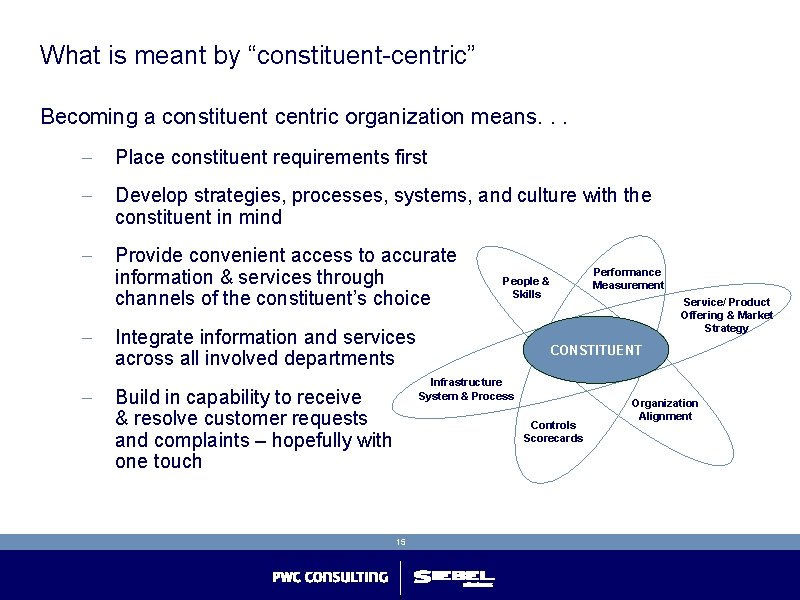
What is meant by “constituent-centric” Becoming a constituent centric organization means. . . - Place constituent requirements first - Develop strategies, processes, systems, and culture with the constituent in mind - Provide convenient access to accurate information & services through channels of the constituent’s choice - People & Skills Integrate information and services across all involved departments Controls Scorecards 15 Service/ Product Offering & Market Strategy CONSTITUENT Infrastructure System & Process Build in capability to receive & resolve customer requests and complaints – hopefully with one touch Performance Measurement Organization Alignment
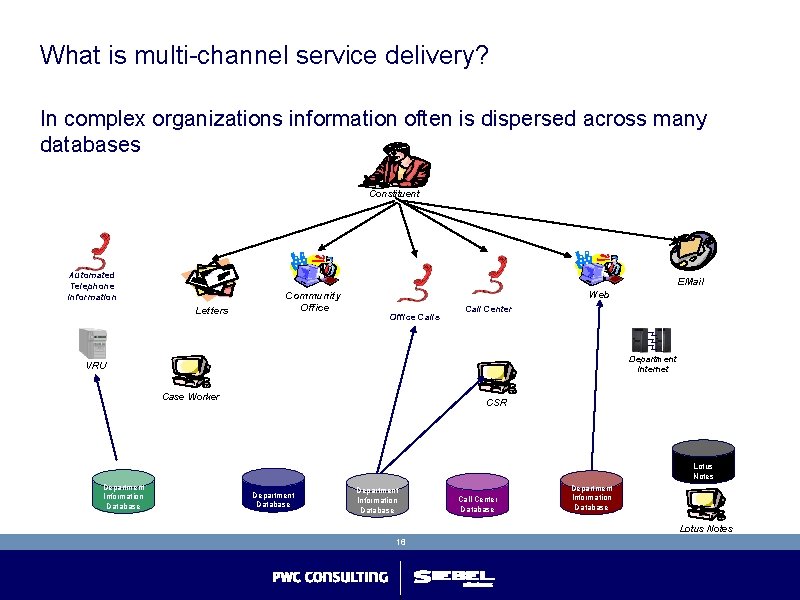
What is multi-channel service delivery? In complex organizations information often is dispersed across many databases Constituent Automated Telephone Information EMail Letters Community Office Web Office Calls Call Center Department Internet VRU Case Worker CSR Lotus Notes Department Information Database Call Center Database Department Information Database Lotus Notes 16
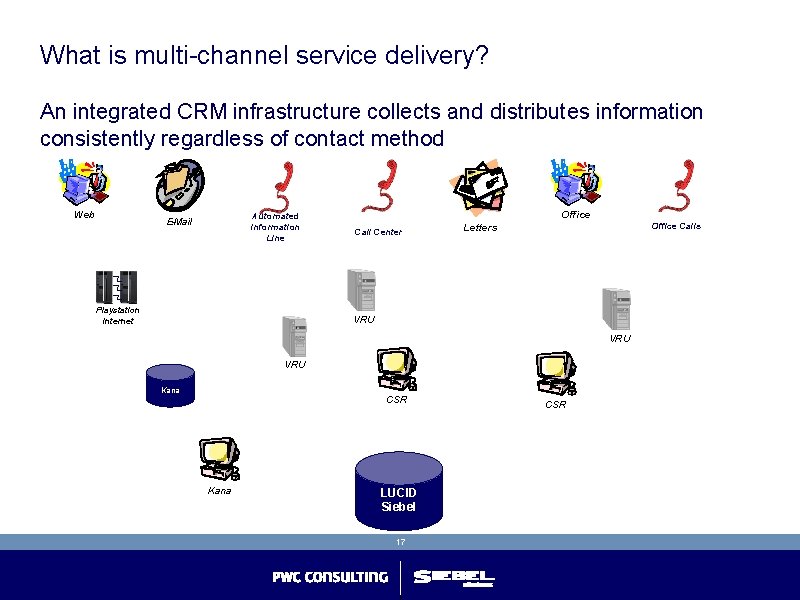
What is multi-channel service delivery? An integrated CRM infrastructure collects and distributes information consistently regardless of contact method Web Automated Information Line E-Mail Playstation Internet Office Call Center Office Calls Letters VRU VRU Kana CSR Kana LUCID Siebel 17 CSR
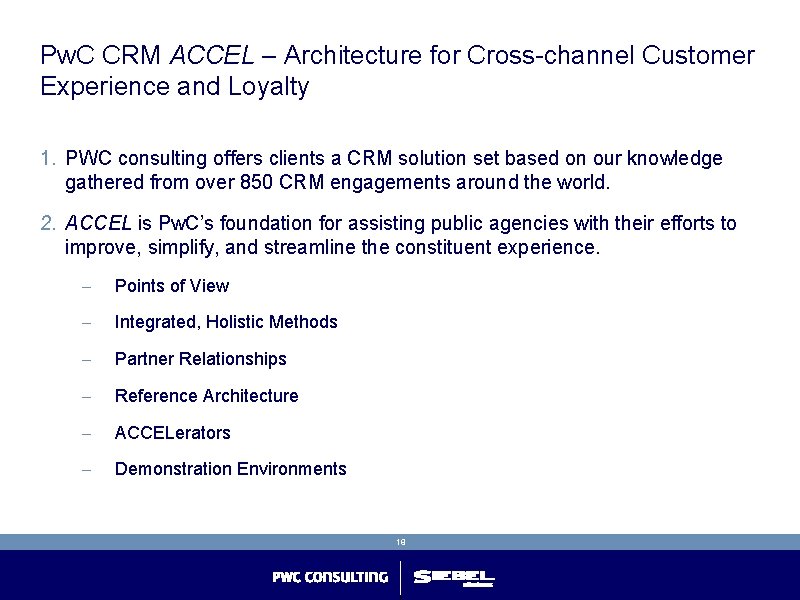
Pw. C CRM ACCEL – Architecture for Cross-channel Customer Experience and Loyalty 1. PWC consulting offers clients a CRM solution set based on our knowledge gathered from over 850 CRM engagements around the world. 2. ACCEL is Pw. C’s foundation for assisting public agencies with their efforts to improve, simplify, and streamline the constituent experience. - Points of View - Integrated, Holistic Methods - Partner Relationships - Reference Architecture - ACCELerators - Demonstration Environments 18
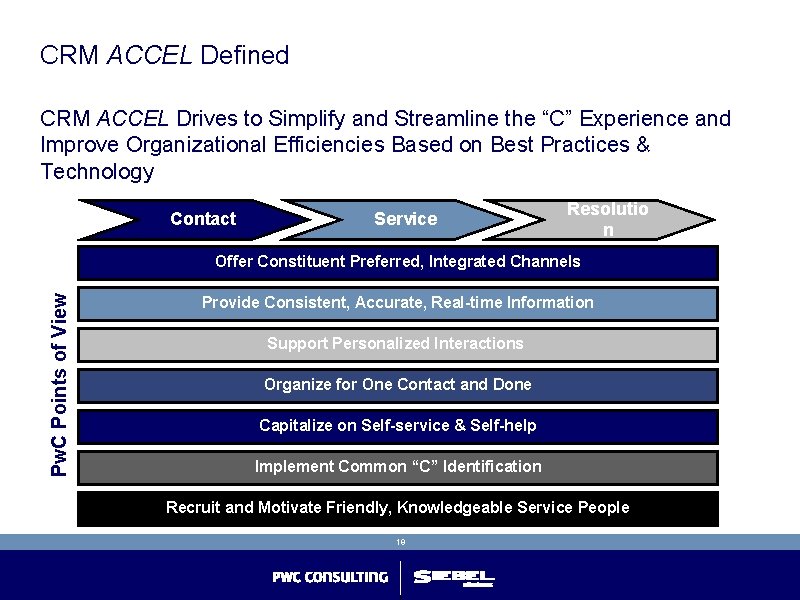
CRM ACCEL Defined CRM ACCEL Drives to Simplify and Streamline the “C” Experience and Improve Organizational Efficiencies Based on Best Practices & Technology Contact Service Resolutio n Pw. C Points of View Offer Constituent Preferred, Integrated Channels Provide Consistent, Accurate, Real-time Information Support Personalized Interactions Organize for One Contact and Done Capitalize on Self-service & Self-help Implement Common “C” Identification Recruit and Motivate Friendly, Knowledgeable Service People 19
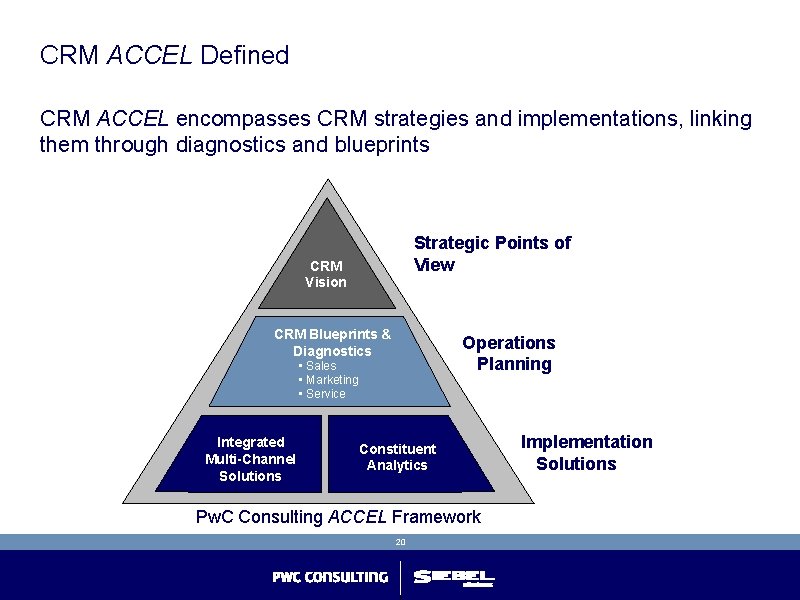
CRM ACCEL Defined CRM ACCEL encompasses CRM strategies and implementations, linking them through diagnostics and blueprints Strategic Points of View CRM Vision CRM Blueprints & Diagnostics Operations Planning • Sales • Marketing • Service Integrated Multi-Channel Solutions Constituent Analytics Pw. C Consulting ACCEL Framework 20 Implementation Solutions
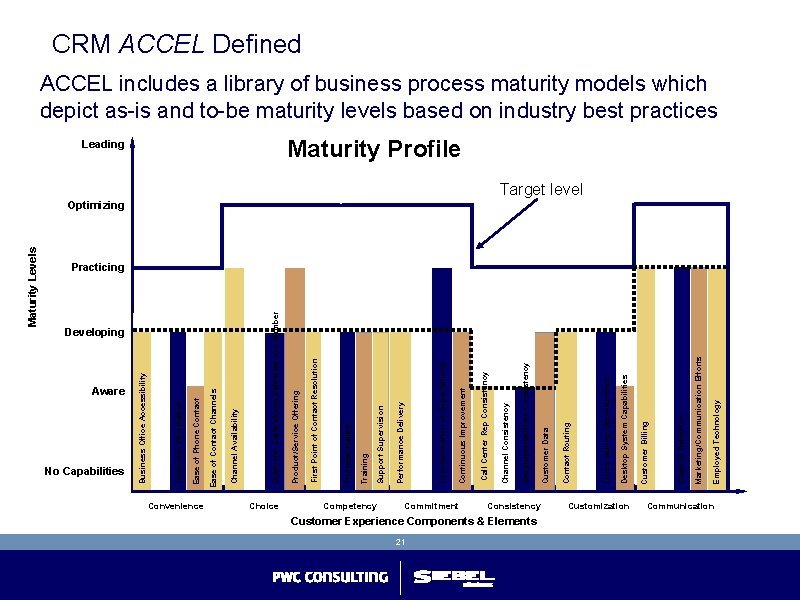
Aware No Capabilities Convenience Developing Choice Competency 21 Commitment Customer Experience Components & Elements Consistency Customization Employed Technology Marketing/Communication Efforts Channel Definition Call Center Reps Customer Billing Desktop System Capabilities Cross-Selling Opportunities Call Handling Contact Routing Customer Data Geographical/Time Consistency Channel Consistency Call Center Rep Consistency Continuous Improvement Communication of Expectations Establishment of Expectations Performance Delivery Support Supervision Training Professionalism Employee Empowerment First Point of Contact Resolution Leading Product/Service Offering Customer Calls Wrong Sales/Service Number Resolution Preference Channel Availability Ease of Contact Channels Ease of Phone Contact Customer Information Ability to Speak To Human Business Office Accessibility Maturity Levels CRM ACCEL Defined ACCEL includes a library of business process maturity models which depict as-is and to-be maturity levels based on industry best practices Maturity Profile Target level Optimizing Practicing Communication
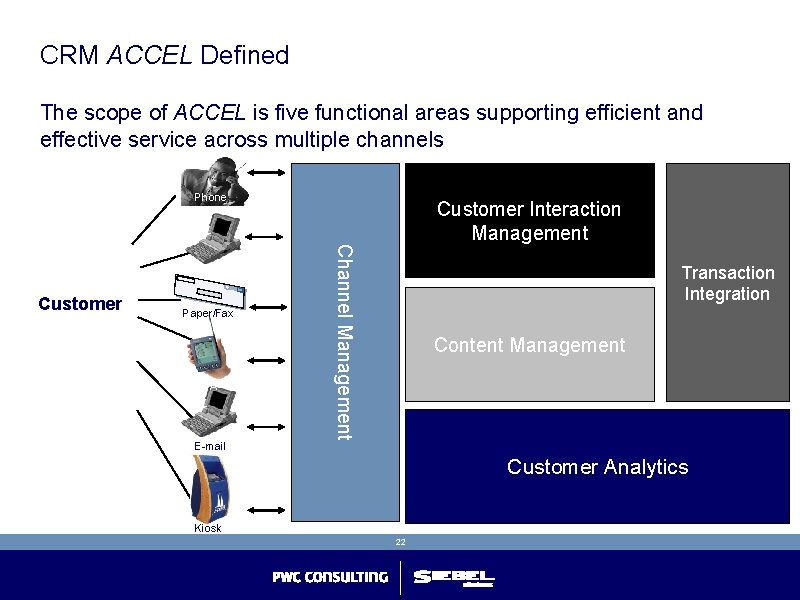
CRM ACCEL Defined The scope of ACCEL is five functional areas supporting efficient and effective service across multiple channels Phone Customer Paper/Fax PDA E-mail Channel Management Web Customer Interaction Management Transaction Integration Content Management Customer Analytics Kiosk 22
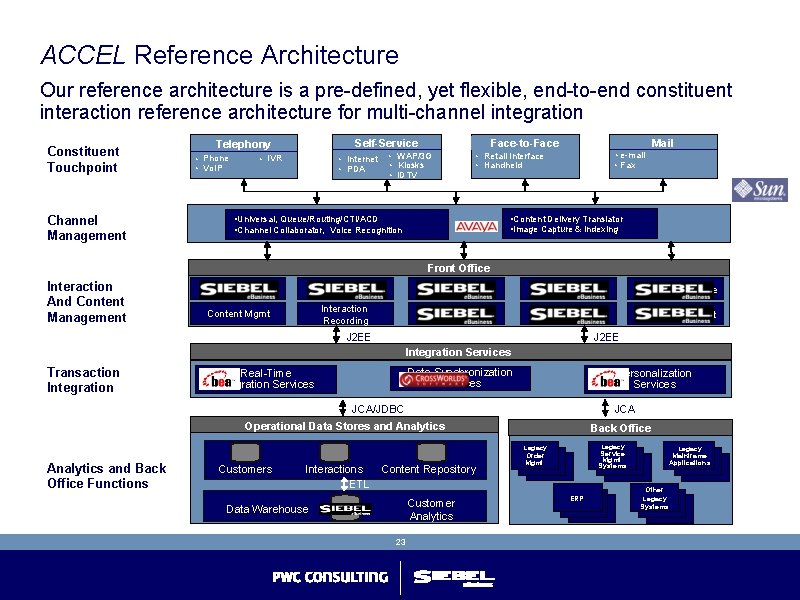
ACCEL Reference Architecture Our reference architecture is a pre-defined, yet flexible, end-to-end constituent interaction reference architecture for multi-channel integration Constituent Touchpoint Channel Management • Phone • Vo. IP • IVR • Internet • PDA Mail Face-to-Face Self-Service Telephony • WAP/3 G • Kiosks • i. DTV • e-mail • Fax • Retail Interface • Handheld • Content Delivery Translator • Image Capture & Indexing • Universal, Queue/Routing/CTI/ACD • Channel Collaborator, Voice Recognition Front Office Interaction And Content Management Sales/Service Contact Centers Field Sales Field Service Marketing Self-Sales/Service Content Mgmt Interaction Recording Email Response Workflow Knowledge Mgmt J 2 EE Integration Services Transaction Integration Data Synchronization Services Real-Time Integration Services Personalization Services JCA/JDBC Operational Data Stores and Analytics and Back Office Functions Customers Interactions ETL Content Repository Customer Analytics Data Warehouse 23 JCA Back Office Legacy Service Mgmt. Systems Legacy Order Mgmt. ERP Legacy Mainframe Applications Other Legacy Systems
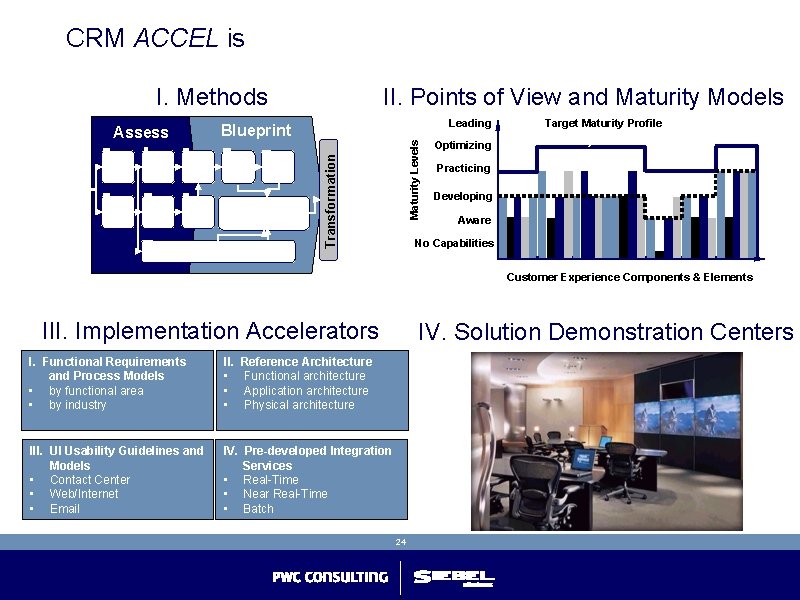
CRM ACCEL is I. Methods 4 6 5 7 10 9 8 Maturity Levels 2 Leading Blueprint Transformation Current Assess 3 1 ment II. Points of View and Maturity Models Target Maturity Profile Optimizing Practicing Developing Aware No Capabilities Customer Experience Components & Elements III. Implementation Accelerators I. Functional Requirements and Process Models • by functional area • by industry II. • • • III. UI Usability Guidelines and Models • Contact Center • Web/Internet • Email IV. Pre-developed Integration Services • Real-Time • Near Real-Time • Batch IV. Solution Demonstration Centers Reference Architecture Functional architecture Application architecture Physical architecture 24
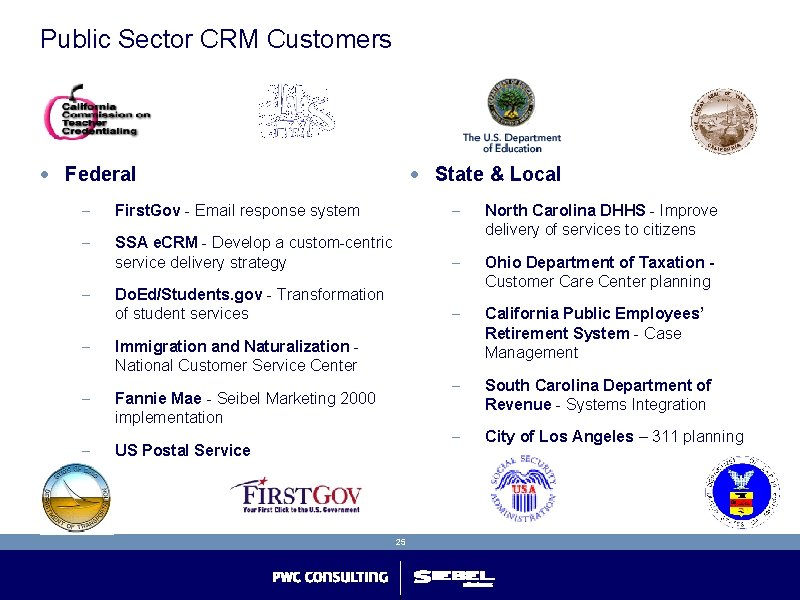
Public Sector CRM Customers · Federal · State & Local - First. Gov - Email response system - - SSA e. CRM - Develop a custom-centric service delivery strategy North Carolina DHHS - Improve delivery of services to citizens - Do. Ed/Students. gov - Transformation of student services Ohio Department of Taxation Customer Care Center planning - California Public Employees’ Retirement System - Case Management - South Carolina Department of Revenue - Systems Integration - City of Los Angeles – 311 planning - Immigration and Naturalization National Customer Service Center - Fannie Mae - Seibel Marketing 2000 implementation - US Postal Service 25
Case Study – NC FAST Families Accessing Services through Technology Pw. C Consulting. TM is a business of Pricewaterhouse. Coopers.
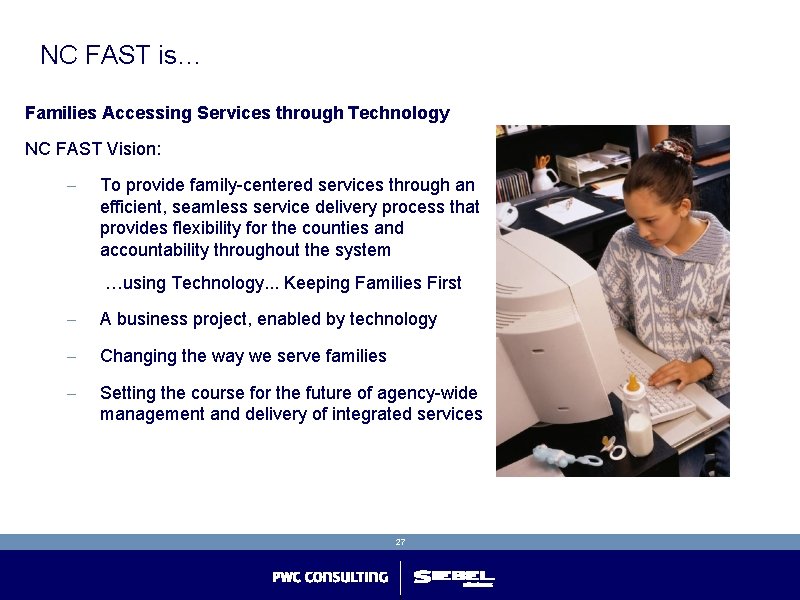
NC FAST is… Families Accessing Services through Technology NC FAST Vision: - To provide family-centered services through an efficient, seamless service delivery process that provides flexibility for the counties and accountability throughout the system …using Technology. . . Keeping Families First - A business project, enabled by technology - Changing the way we serve families - Setting the course for the future of agency-wide management and delivery of integrated services 27
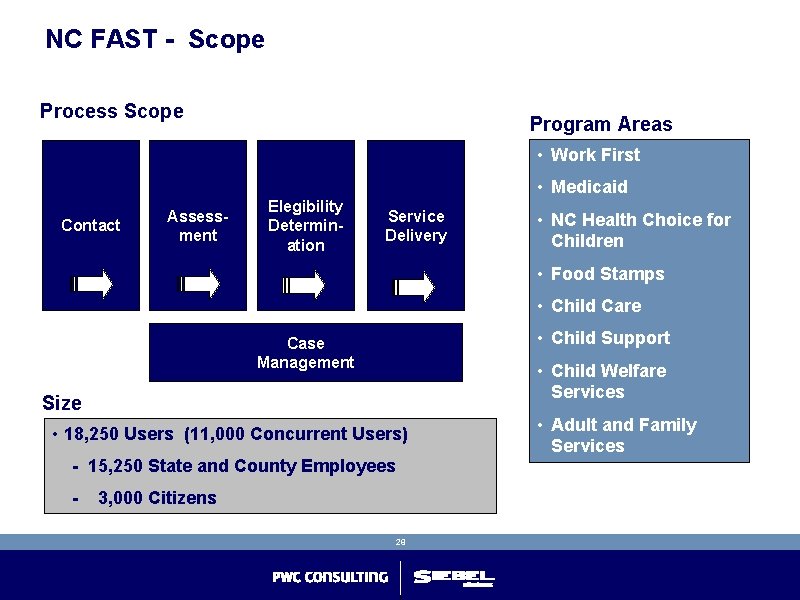
NC FAST - Scope Process Scope Program Areas • Work First • Medicaid Contact Assessment Elegibility Determination Service Delivery • NC Health Choice for Children • Food Stamps • Child Care • Child Support Case Management • Child Welfare Services Size • 18, 250 Users (11, 000 Concurrent Users) - 15, 250 State and County Employees - 3, 000 Citizens 28 • Adult and Family Services
Existing NC FAST Systems in DHHS 20+ legacy mainframe systems developed in 1980 s to report rather than support user needs 29
Case Study – CTCC California Commission on Teacher Credentialing Pw. C Consulting. TM is a business of Pricewaterhouse. Coopers.
California Commission on Teacher Credentialing CCTC is a State agency responsible for many important functions in California public education (Kindergarten-12), including: - Establishing requirements for credentials that authorize public school teaching and service - Setting standards for programs that prepare public school personnel - Setting standards for subject matter programs - Assessing skills and knowledge; and enforcing professional practices standards. 31
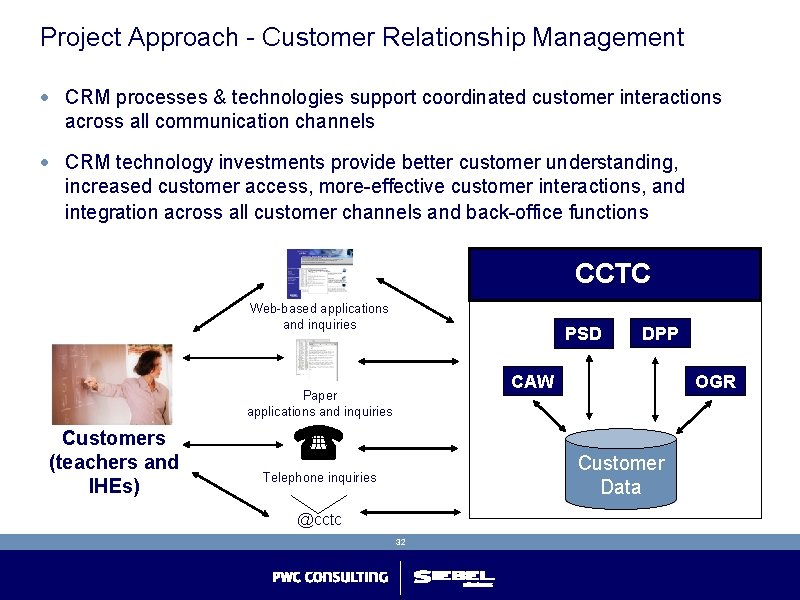
Project Approach - Customer Relationship Management · CRM processes & technologies support coordinated customer interactions across all communication channels · CRM technology investments provide better customer understanding, increased customer access, more-effective customer interactions, and integration across all customer channels and back-office functions CCTC Web-based applications and inquiries PSD CAW Paper applications and inquiries Customers (teachers and IHEs) OGR Customer Data Telephone inquiries @cctc 32 E-mail inquiries DPP
Project Timeline - Phases 1 and 2 Phase 1 - Web-based Status Tracking · Implementation in October 2001. · Provides the capability for credential applicants, credential holders, and stakeholders to perform application status look-ups over the web. Phase 2 - Web-based Submission on Renewal Applications · Implementation in April 2002. · Provides the capability for credential holders to complete certain credential renewal applications on-line. Phase 3 - Credential Processing and Reporting · Implementation in January 2003. · Automated processing and reporting of credential, disciplinary, and examination program information. · Will replace the existing Credentialing Automation System (CAS). · Provides a common repository for all credential-related information. · Will support the end-to-end credentialing process managed by CCTC. · Will provide consistent information and service across all communication channels (web, Interactive Voice Response [IVR], e-mail, telephone). 33
Closing Thoughts… Customer Relationship Management is not about technology. Applying CRM principles to the public sector is about enabling vision, strategy, and process change – it is using “C”-centric principles to redefine and transform the delivery of government services to constituents. CRM can assist government in realizing ”C”-centric efficiencies, increasing satisfaction, and building a more effective multi-channel service delivery model. 34
Pw. C Consulting. TM refers to the management consulting and technology services businesses of the 35 member firms of the Pricewaterhouse. Coopers network of firms. © 2002 Pricewaterhouse. Coopers refers to the individual member firms of the Pricewaterhouse. Coopers network of firms. All rights reserved.